The trial update includes safety and efficacy data from all 14 patients treated to date in the study comprised of 12 adults and two pediatric patients. EDIT-101 was tolerated with no serious ocular adverse events or dose-limiting toxicities observed. Most adverse events were mild and expected for subretinal delivery.
Along with showing improvement in BCVA, three of the 14 people demonstrated consistent improvements in two of the following three additional endpoints: Full-field sensitivity test (FST), visual function navigation, which means navigating a mobility course to assess mobility and functional vision in people with an inherited retinal disease such as LCA10, and visual function quality of life, information derived from the patient or caregiver while participating in the study.
Of those three people, two of them each had two identical versions of the genetic marker for the CEP290 IVS26 mutation, meaning they were homozygous for that mutation.
Because LCA10 patients homozygous for CEP290 IVS26 represent an estimated 300 people in the United States, and no other baseline characteristics were identified in the study’s dataset, the Editas statement said, “[T]he company will not progress this program independently and will seek to identify a collaboration partner to continue the development of EDIT-101.
“As a result, Editas Medicine is pausing further enrollment in the BRILLIANCE trial and will continue long-term follow-up of all patients who have been treated to date.”
Stay informed, stay connected
Hope in Focus keeps the LCA community informed of various trials focused on finding cures for any one of the more than 27 forms of LCA, including people living with LCA10 and associated research into developing therapies to correct mutations in the CEP290 gene. LCA10 is the most common form of the rare disease, affecting 20 to 30 percent of all LCA patients. LCA affects about 1 in 33,000 people worldwide.
Hope in Focus Co-Founder and Board Chair Laura Manfre asks anyone interested in learning more about the Editas trial to please send us an email at info@hopeinfocus.org, and we would be happy to facilitate a conversation.
“Science, business, and people are all key to getting a treatment from the lab to the people who need it. The announcement from Editas Medicine is a win for science, most certainly. Being able to go into the back of the eye and safely edit a genetic mutation is nothing short of a historic milestone,” Manfre said.
“The announcement isn’t entirely what we hoped for, however, as Editas has paused its LCA10 trial. More needs to be learned on the science side of things, there are business and regulatory issues to address, and as always, access to the patient community is critical.
“This journey was never going to be a straight line, and setbacks, although disappointing, are just proof we’re still moving. Stay informed, stay connected, and please make sure you’re registered and up-to-date in My Retina Tracker®.”
It will be three years this July when Editas began its CRISPER/Cas9-based trial of EDIT-101, administered through a subretinal injection to reach and deliver the gene-editing machinery directly to photoreceptor cells.
Researchers designed the BRILLANCE Phase 1/2 clinical trial of EDIT-101 to assess the safety, tolerability, and efficacy of the potential treatment. Patients received a single dose of EDIT-101 under the retina in one eye. They are monitored every three months for a year after dosing and less frequently for two more years. More details about the trial can be found at here under the reference NCT#03872479.
Atsena Therapeutics, a clinical-stage gene therapy company focused on reversing and preventing blindness, has an ongoing Phase 1/2 clinical trial evaluating a potential therapy for Leber congenital amaurosis 1 (LCA1) caused by mutations in the GUCY2D gene.
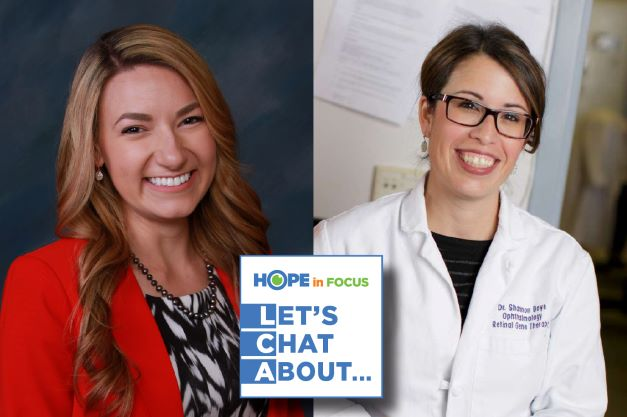
Kara Fick (L) and Shannon Boye (R) on Hope in Focus Let’s Chat About … series
We learned about this research from Kara Fick, head of Patient Advocacy and Medical Affairs at Atsena Therapeutics, and Atsena Founder and Director Shannon E. Boye, PhD, during our Oct. 27, 2022, webinar episode titled “Let’s Chat About…Atsena Therapeutics’ work in LCA.” Courtney Coates, Hope in Focus Director of Outreach and Development, moderated the session, which can be viewed here.
“Let’s Chat About…” is our free webinar series bringing together researchers, advocates, industry leaders, and people living with Leber congenital amaurosis (LCA) or other rare inherited retinal diseases (IRDs) for conversations important to the rare retinal disease community.
How did Atsena Therapeutics come to be?
Shannon and her husband, Sanford, met in grad school.
“It was a nerd romance,” she said.
Boye’s thesis involved developing viral vectors for retinal disease treatment, specifically for LCA1 (GUCY2D), and she became known for generating gene technology. She has authored more than 60 peer-reviewed manuscripts and multiple textbook chapters. She also has been actively involved in grant and manuscript review, and she has received several major awards.
Over several years, the couple worked with large, medium, and small pharmaceutical companies, but they grew frustrated at how long it took to bring developing therapies to patients.
“It was going very slowly and that was frustrating,” Boye said. “We saw business decisions overriding sound scientific decisions.”
Eventually, she sent a big long vent to Foundation for Fighting Blindness CEO Ben Yerxa, and he helped push her and her husband into starting their own company, Atsena Therapeutics. The couple co-founded the business, with Sanford Boye serving as Chief Technology Officer.
Kara Fick, who has been working as a patient advocate for rare diseases in the biotech world for nearly a decade, is passionate about bringing the patient voice, perspective, and expertise to the table.
“It’s pretty apparent, and you know from Atsena’s founding, that really keeping patients at the center and trying to move research forward so that it can get to patients is super important,” Fick said.
At Atsena, she strives to bridge the gap between the science of innovative therapies and the daily needs of individuals living with rare diseases. She also works to understand more clearly the barriers to diagnosis, treatment, and management of rare diseases and how to better address those hurdles with patients and clinicians.
What is gene therapy?
All of us have genes. They give us blue eyes or brown eyes, for instance. But our genes also make proteins. Proteins are the building blocks of life. They can act alone or in combination with other proteins to perform essential functions in our cells.
A good example of proteins important for vision are the proteins in our photoreceptors and retinas. Those proteins all work together to convert light into an electrochemical signal that is sent to the brain and processed as vision.
Genes make proteins, and proteins perform essential functions. But sometimes, we can have a misspelling in our genes — in other words, a mutation. Because of that misspelling or mutation, in some cases, the protein that gene was supposed to make did not form. In other cases, perhaps, the protein forms, but it’s misshapen and can’t interact properly with the other proteins. When that happens, the normal biological function of the protein is disrupted, for example, in your photoreceptors. As a result, your photoreceptors are unable to transmit light into a signal processed as vision.
The concept of gene therapy involves taking a healthy copy of a gene that lacks that misspelling and delivering that healthy version of the gene to the photoreceptor cells.
How is the LCA gene therapy trial going?
Drug development and gene therapy development take a long time, and there are a lot of processes that companies have to go through to ensure that anything given to patients is safe and effective.
Work to develop this gene therapy began in earnest in 2004 in Boye’s lab at the University of Florida. After pre-clinical studies in chickens and mice, they were ready for clinical trials in humans.
Atsena is working on a combination Phase 1/2 clinical trial for LCA1 (GUCY2D). In this phase of the trial, researchers test different gene therapy doses, find the best dose, and closely monitor the safety of the therapy.
“Because we’re doing a combo Phase 1/2, we’re looking primarily at safety, but we’re also incorporating some tests into the clinical trial that can help to tell us a little bit about the efficacy of the gene therapy,” Boye said.
‘Researchers began with adults aged 18 and up but recently opened it up to ages 6 and up. Fifteen people, all with GUCY2D mutations, are taking part in the trial, ranging in age from 12 to 76 years old.
So far, the trial is going well, with no participants reporting serious side effects related to the gene therapy. They did see two cases of inflammation, but both were mild and resolved after treatment.
Besides safety monitoring, Atsena has conducted several tests, including the Full-field Stimulus Test (FST). The test quantifies visual perception through flashes of varying luminance. Researchers saw significant improvements in the results of that test from individuals who received the highest dose of the gene therapy.
Participants receiving the gene therapy also showed clear improvement in a multi-luminance mobility test (MLMT), in which they navigated a course with obstacles of varying height and under different levels of illumination.
Participants also underwent a third test, called the BCVA or Best Corrected Visual Acuity, which measures everyday vision. (Think of the poster with different letters you’re asked to read at the eye doctor’s.) That test had more mixed results, with some patients seeing improvement and others not seeing much, if any, improvement.
What happens next?
This is still just the preliminary data. Atsena needs all 15 participants in its trial to get through their first full year after being treated with gene therapy. Then, they’ll collect all of the data, analyze it, and summarize it vigorously and thoroughly before moving on to the next phase.
At that point, they’ll need to meet with the Food and Drug Administration (FDA) and other regulatory agencies to get their agreement and permission to move forward with a Phase 3 trial. That trial will focus on efficacy and seeing how well the gene therapy works. It’ll still pay attention to safety, but the primary goal of Phase 3 is to focus on efficacy and use that as supportive data that could be submitted to the FDA and other agencies to get full approval of the gene therapy.
Why genetic testing is essential for clinical trials?
As more trials are starting and more gene-specific research is being done, it’s going to become more important to know precisely which genetic mutation may be causing your LCA.
“Getting genetic testing is essential for figuring out the specific genetic mutation that may be causing your LCA,” says Boye.
If you have not been genetically tested, talk to Hope in Focus. There’s no cost to patients and family members to receive genetic testing.