Desirae Potts breaks into tears when she recalls the first time a doctor said her infant son James had a disease she’d never heard of – Leber congenital amaurosis, known as LCA.
“I had no earthly idea what she was talking about. I left that appointment, I remember feeling so confused and so sad,” the 33-year-old mom said.
The doctor didn’t or couldn’t give Desirae and her husband, Robert, any information about LCA because the doc didn’t know a thing about the rare inherited retinal disease.
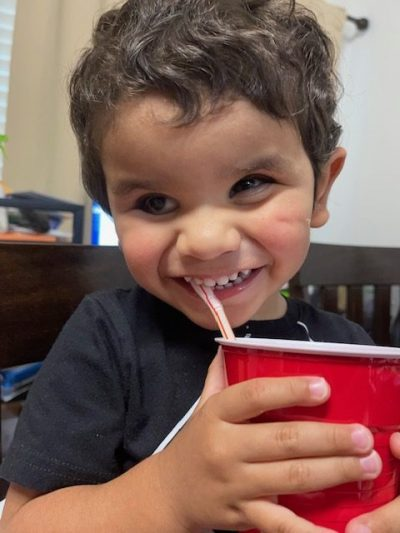
A smiling James Potts
“I had to grieve the life that my son would have had,” she said. “But I also wish that I knew then what I know now, that is: Whether he could see or not, I have a bright light!
“He’s so amazing, I couldn’t imagine him any other way and I wouldn’t change it if I could.”
She thought about the best way to bring up her son.
“I quickly learned the best way to raise him would be to raise him like my sighted children. He is the most resilient and bright young man. I know he is so smart. He amazes me every day.”
Mom becomes nurse to better help her son
James was 10 months old when his parents learned their younger son’s genetic diagnosis: LCA1* caused by a mutation in his GUCY2D gene.
About the same time, Desirae kept listening to doctors talking over her head and decided to become a nurse.
“I wanted to help him with my knowledge. It definitely helps because I have more medical knowledge than I did before. I understand what the doctor is saying. The doctors used all these words I didn’t know, and I was scared that I didn’t know.”
She began nursing school in James’ first year and earned her nursing degree about a year and a half ago. James is now 4.
“I’m not as worried now, and I know what to do in certain situations.”
James goes to school for the full day in an integrated classroom at the same school as his older brother, 9-year-old Robert. His older sister, Ariona, is in high school.
Their mom is the school nurse at the four middle schools in the district of their South Texas coastal city.
Keeps informed of LCA1 GUCY2D research
Desirae knew something wasn’t right with her baby’s vision at 2 months when he didn’t track objects or light. At 4 months, an ophthalmologist prescribed glasses, but they didn’t help.
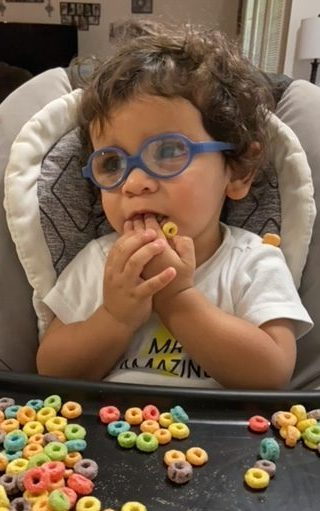
James wearing his “Mr. Amazing” shirt
After the initial retinal disease diagnosis, James received his confirmed genetic diagnosis 6 months later at Baylor College of Medicine by Richard A. Lewis, MD, MS, Professor of Molecular and Human Genetics at the Houston medical school.
Annually, James visits John T. Stout, MD, PhD, who keeps the family informed of research in the LCA1 GUCY2D space. Dr. Stout specializes in retina/macular and retinal vascular diseases at Texas Children’s Hospital. His current research projects include human gene and stem cell therapy for proliferative and inherited ocular disease, retinal disease genotype-phenotype correlation, and intraocular angiogenesis, the formation of new blood vessels from the existing vascular tree.
LCA accounts for 5 percent of all retinal dystrophies and 20 percent of blindness in school-age children.
James received early-intervention therapy, and orientation and mobility therapy during his first years. He also sees a speech therapist at school and a developmental specialist in town.
Right now, his favorite food is bagels and butter. And he absolutely loves music and Daniel the Tiger, a spinoff from Mr. Rogers Neighborhood, where he sings songs about learning, and growing, and what to do with feelings.
James does not yet have words to describe his sight, which makes it hard to explain what he can see, although his mom believes he has light perception.
James’ vision is a family affair
“It not only affected him, but it also affected all of us,” Desirae said. “We all had to adjust and learn how to make things in a way that he could do things on his own and foster his independence.”
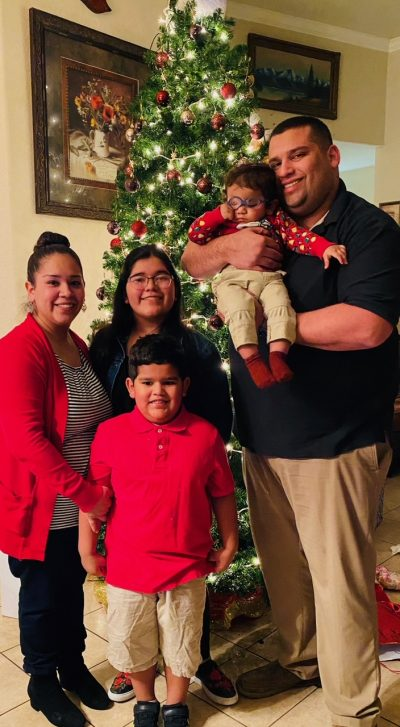
The Potts Family
Ariona, James’ 17-year-old sister, nurtures her little brother, with mom adding, “She’s the closest thing to me he can get. She’s very, very helpful.”
Robert was 5 when James was born.
“He didn’t quite understand what’s going on and how to be accommodating to his brother. We definitely had to inform him.”
Desirae is concerned about James pressing or rubbing his eyes, a symptom of LCA called oculodigital reflex. While the doctor said the reflex is normal, she is worried the action may cause harm. She tries to keep him occupied.
“I try very hard, but James is maybe the most headstrong person I have ever met in my entire life. If you tell him to do something, he will do the complete opposite. So, I tell him, ‘Don’t let me see your eyes,’ even though I don’t want him to defy me.”
James loves to explore and see with his hands.
“We don’t use the word ‘blind.’ We prefer to say that he sees with his hands. We don’t say ‘blind’ or ‘visually impaired.’ We do not want him to think that that would define him.
“That was something I had to teach both of our children, my husband, and all of our family. Some relatives are still in denial. We don’t put him in a box. We let him explore and have the same toys as his brother and sister,” she said.
“We try to have everyone stay on the same page to help build his confidence. Like it’s normal for him that he sees with his hands.”
One woman called doctor after doctor, only to hear they would not treat her and her two rare pediatric conditions because she turned 18 and no longer qualified for help.
Another fights for life-saving medicine to treat her rare disease that causes dangerous swelling.
While another faces $60,000 in annual medical expenses for her two teenagers living with a rare metabolic disorder requiring a special diet to stave off life-threatening symptoms.
“The medicine is there but you can’t get to it,” Candice Flewharty told the group gathered in Hartford, Connecticut, for Rare Disease Day. “Each phone call I make is a battle for my childs’ lives.”
State Sen. Cathy Osten, who has proposed legislation requiring insurance coverage for medical foods, accompanied Candice and her daughter to the gathering.
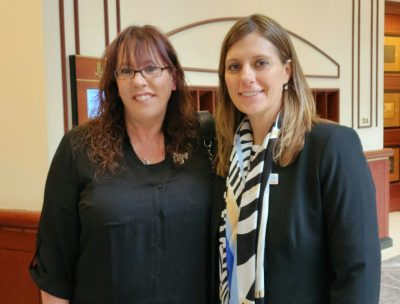
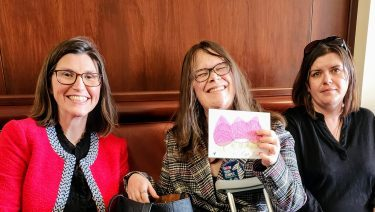
Candice Flewharty (L) with State Senator Cathy Osten
People living with rare diseases told their stories to Connecticut legislators on Rare Disease Day on March 23, about a month after a New England snowstorm canceled the event usually celebrated the last day of February.
Through the state’s newly minted Rare Disease Advisory Council, known as the RDAC, legislators of Connecticut’s General Assembly now have a collaborative and organized way to improve the lives of residents living with rare diseases.
The council’s first report of its findings and recommendations is due in November. Click here for a summary of the RDAC legislation, effective last July.
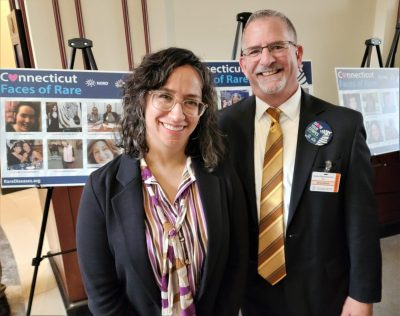
Lesley Bennett, CT-RAN State Volunteer and new RDAC member
The council will give patients, families, caregivers, health care providers, advocates, researchers, and other stakeholders the opportunity to make formal recommendations to state agencies and the legislature on ways to develop policy and health care legislation to improve the lives of those people living with rare disease and their caregivers, according to Lesley Bennett, Volunteer Ambassador for the Connecticut Rare Action Network (CT-RAN) of the National Organization for Rare Disorders (NORD).
Connecticut Gov. Ned Lamont signed legislation establishing the council after rare disease advocates worked for years to get it going.
“We did it,” Lesley said. “It took eight years, but we did it.”
Introducing six new council appointees
Rare Disease Advisory Council members will include Insurance, Public Health, and Social Services commissioners, or their designees, and 10 members appointed by the Governor and the Public Health Committee leadership. Six new members were introduced at the Rare Disease Day event; four have yet to be announced.
James Rawlings, President/CEO Sickle Cell Disease Association of America Connecticut Chapter, and new RDAC member
The six members and their council roles are:
Patient Advocate Representative: Lesley Bennett, RDAC Coalition Leader and CT-RAN Volunteer State Ambassador.
Pediatric Patient Representative: Saurabh Vaidya, Connecticut Hemophilia Society President, and father of a son with hemophilia.
Caregiver Representative: Mary Caruso, Friedreich’s Ataxia Research Alliance Founding Member, and caregiver for two adult children living with the disease.
Researcher: Joanna Gell, MD, Pediatric Oncologist and Hematologist, Connecticut Children’s, and Research Scientist, Jackson Laboratories.
Physician Treating Rare Disease Patients: Emily Germain-Lee, MD, Division Head, Pediatric Endocrinology & Diabetes; Director, Center for Rare Bone Disorders, Albright Center, and Osteogenesis Imperfecta Center.
Patient Representative: James Rawlings, R.PH, MPH, President/CEO Sickle Cell Disease Association of America, Connecticut, Michelle’s House.
“Everybody is here to help each other out.”
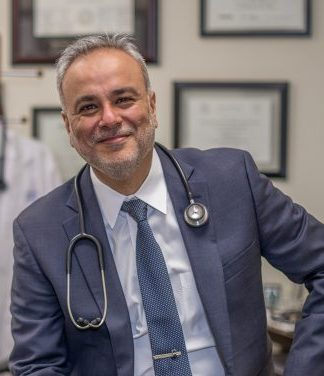
State Senator Saud Anwar
Connecticut Public Health Committee Co-Chair Sen. Saud Anwar told the gathering the time is here to find solutions to take care of and invest in the health of the rare disease population, saying the council must go forward with this mindset:
“Every illness is treatable. Every disease has an answer and a solution.”
The senator spoke about the realities of national and international collaborations resulting in developing regenerative medicine.
“We will put our hearts together a make sure we come out of the room with solutions. Everybody is here to help each other out.”
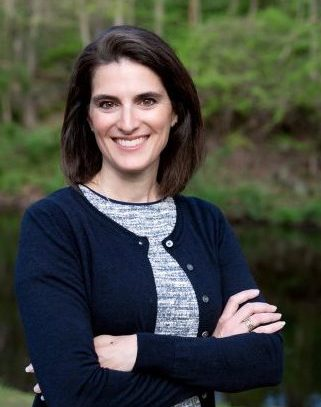
Connecticut Public Health Committee Co-Chair Rep. Cristin McCarthy Vahey told the group, “I look forward to working with you and being supportive in making things happen for all of you.”
State Representative Cristin McCarthy Vahey
Fewer than 40 treatments existed for rare disease 40 years ago; the number is now 600, according to Annissa Reed, NORD’s Associate Director of State Policy. She said she hopes the collaborative effort makes the dream of finding more rare disease solutions and access to medicine a reality.
Connecticut-based Hope in Focus advocated throughout the years with the Rare Action Network to help create the council, with Co-Founder and President Laura Manfre attending the Rare Disease Day event.
Hope in Focus’ Laura Manfre with Brian Rosen of Axion Pharmaceuticals
Connecticut joins 24 states in establishing a council specifically to address the complexities of living with a rare disease, caring for someone with a rare disease, gaining access to treatment, and getting better insurance coverage. To find out whether your state has an RDAC or is developing one, please go to: https://rarediseases.org/rare-disease-advisory-councils/map/.
The council is critical, as it is exponentially more difficult for the rare disease population – inherently fewer in number than the rest of Connecticut – to have a voice on the state level.
A rare disease in the United States is characterized as any disease, disorder, illness, or condition affecting fewer than 200,000 people. With more than 7,000 known rare diseases, upwards of 90 percent have no FDA-approved treatment. About 1 in 10 people – more than 30 million Americans – live with a rare disease.
Most rare diseases are genetic or have a genetic component, more than half of those affected by rare diseases are children, and all pediatric cancers are rare.
Dominic Cotton, a rare disease parent and co-leader of the RDAC Coalition, thanked the Department of Public Health and its nearly 60 years of support for newborn screening.
“Without newborn screening, my son wouldn’t be alive today.”
Kristen Angell and Jennifer Huron of the National Organization for Rare Disorders (NORD)
Every newborn in Connecticut is assessed for a range of diseases, and each year more than a hundred babies tested for any one of the diseases are on a critical, early-intervention path leading to keeping a disease in check and people living fulfilled lives.
Kristen Angell, NORD’s Associate Director of Patient Advocacy, said the gathering is important for our population living with rare diseases.
“It gives them an opportunity to speak face to face with our General Assembly and let them know the daily struggles and challenges they face, and it provides the legislators an opportunity to assist in making a possible impact.”
Access to medication a matter of life or death
Rare Disease Day is all about awareness. Here is a sampling of what legislators learned from people living with rare diseases:
Pamela Johnson and her 10-year-old son have a rare, life-threatening disease called Hereditary Angioedema (HAE), a genetic condition that can cause severe swelling in various parts of the body and affects about 1 in 50,000 people globally. She has a well-paying job and feels she should be able to afford to pay for her medications, but they cost $90,000 a month.
With no access to life-saving drugs in 2017, she underwent two surgeries for severe swelling in her throat. Without medication, two or three times monthly, she would experience attacks making it extremely difficult to breathe.
Pamela Johnson
David Leeds, who helped with the day’s introductions and has HAE, highlighted one aspect of life more difficult with a rare disease – getting treatment at a hospital. It is a place of stress, anxiety, and fear of not receiving the treatment he needs because doctors and nurses never encountered his disease.
He described two published investigations of major insurance companies denying coverage for medication to help people live. Insurance companies, rather than treating doctors, are deciding who gets to have medication and who doesn’t.
“This is every day for rare disease patients.” he said. “Insurance companies cannot be relied upon to determine what is medically necessary.”
***
Megan Freeman said no one should ever have to go through what a person living with a rare disease has to experience.
As if it were yesterday, she remembers the day she got her diagnosis, and her response:
Alissa DeJonge (L), Megan Freeman, and her friend Elizabeth Nagle
“Am I going to die? Am I going to live? Am I going to be able to live to get married and live to have kids.”
Megan lives with 2q37 deletion syndrome. She is one of about a hundred people worldwide with the ultra-rare chromosome disease that can affect many parts of the body. She is an advocate and founder of her own rare disease organization. She praised the legislators for creating the RDAC, saying, “I give you guys an A for effort!”
***
Rachel O’Grady was diagnosed as an adult with two pediatric conditions: Tethered Cord Syndrome, a neurologic disorder caused by tissue attachments limiting spinal cord movement, and Spina Bifida Occulta that causes a small gap in the spine. Any resources for Rachel in Connecticut dried up when she turned 18, no longer qualifying for help as a minor.
“They would not see me, nor would they treat me,” she said. Maxed out in medical debt, she found help in Massachusetts.
***
Alissa DeJonge’s sixth-grade son lives with a bleeding disorder called Hemophilia A. She knows people living with rare diseases make tough choices, given the huge cost of necessary medicines, and looks forward to having the new council work to protect patient care, help caregivers, and allow parents to take time off from work.
***
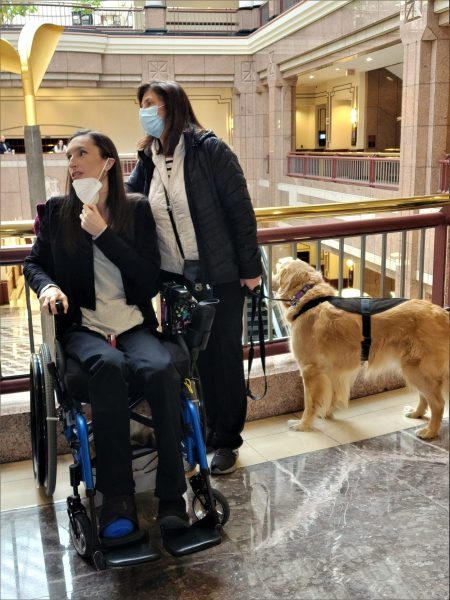
Kelly Considine, with her mother, Susan, and service dog, Gunner, in the atrium of the Legislative Office Building
Kelly Considine, accompanied by her mother, Susan, came to raise awareness about and promote research for a rare chronic pain disorder she lives with called Complex Regulatory Pain Syndrome.
Kelly characterized the disease as the most painful condition known to modern medicine. She receives some relief from an implanted therapeutic device and receives help and love, from her mother and her service dog, a golden retriever named Gunner.
***
Amy LaChance, the mother and caregiver of a child with Syngap1, a genetic mutation affecting 1,200 people worldwide, said people need access to genetic testing to support research and trials for a treatment to fix this genetic typo.
It makes a difference when people with rare disease tell lawmakers their stories about needing access to tests and medicine, saying, “The squeaky wheel really does get the grease.”
Biotechnology growth important to state economy
Paul Pescatello, JD, PhD, is Senior Counsel and Executive Director of the Connecticut Bioscience Growth Council, a committee of the Connecticut Business and Industry Association’s biotech and biopharma members.
Amy LaChance
The bioscience council fosters collaboration with the life-science institutions of biotech and biopharma, and with the state to help grow this sector of Connecticut’s economy. Developing a new medicine costs about $2.7 billion and takes 12 to 15 years, he said.
“Essentially, it costs what it costs, no matter the size of the patient population,” he said. “That’s why it’s important to underscore how rare disease new medicine research typically leads to many insights and advances in drug development for larger patient populations.”
Keep telling your rare disease stories
Representative Vincent Candelora, house minority leader and rare disease champion, urged people to tell their stories to make people aware so lawmakers can help fashion policy to help them.
“If we don’t hear from you, it’s harder for us to do our job. It’s the true stories that tell us everything that’s going on.”
His advice echoed the encouragement we at Hope in Focus give to our LCA and IRD community – tell your stories to feel less isolated in your journey of living with a rare inherited retinal disease and to help advance research into treatments to improve vision or to halt vision loss.