In December 2023, ProQR sold its sepofarsen (LCA10) and ultevursen (USH2A) programs to Théa, a large European biotechnology company focused on ophthalmology. Théa, through its new dedicated business unit, Sepul Bio, will continue developing sepofarsen and ultevursen. I asked representatives at Sepul Bio a few questions about their emerging therapies, plans, and efforts. Here are their answers.
What are sepofarsen and ultevursen? Who developed these therapies, and how did they perform in clinical trials?
Sepofarsen is an experimental mRNA therapy designed to improve visual function for patients with Leber congenital amaurosis 10 (LCA10). Sepofarsen targets a specific genetic mutation (c.2991+1655A>G) in the CEP290 gene. This mutation stops the cell from producing an essential protein needed for the cells in the retina to function. By addressing this mutation with a piece of genetic material called an antisense oligonucleotide (AON), sepofarsen aims to restore cell function in the retina. The AON is delivered by an intravitreal injection. Sepofarsen is entering Phase 3 clinical development.
Ultevursen is an experimental mRNA therapy designed to stabilize visual function for patients with Usher syndrome type 2A or non-syndromic retinitis pigmentosa caused by mutations in exon 13 of the USH2A gene. These mutations stop the cell from producing usherin, an essential protein needed for the cells in the retina to function. By addressing this mutation with an AON, ultevursen aims to restore cell function in the retina. The AON is delivered by an intravitreal injection. Ultevursen is entering Phase 2 clinical development.
Both sepofarsen and ultevursen were first clinically developed at the biotechnology company ProQR Therapeutics, based in the Netherlands. Both emerging therapies improved vision in some patients participating in ProQR’s previous clinical trials.
What is Sepul Bio? What is its mission?
Sepul Bio is a dedicated business unit of Théa. The team is at the forefront of advancing transformative RNA therapies for inherited retinal diseases, particularly emphasizing the further development of sepofarsen and ultevursen.
Sepul Bio’s projects are driven by the vision of a future where patients with inherited eye diseases have treatment options for their eye condition. Through ongoing research and rigorous development, Sepul Bio hopes to bring new therapies to patients. Learn more at www.sepulbio.com.
As part of the divestment from ProQR, the dedicated team at Sepul Bio includes former members of the previous clinical development teams. This structure maintains consistency and brings previous experience with the programs to the new clinical development steps. The new business unit underlines Théa’s firm commitment to advancing therapeutic products for eye disorders, particularly where medical needs are unmet.
What are the lessons learned from the ProQR trials? What will Sepul Bio do differently to improve the two therapies’ chances of success?
The Sepul Bio team previously worked on the sepofarsen and ultevursen programs at ProQR. This experience has enabled the team to learn from previous regulatory and clinical interactions in formulating new plans for the programs.
All the previous learnings from the years of clinical development have been incorporated into the new designs, with further validation from key physicians and inherited retinal disease specialists. A key area of focus has been new tests and novel study designs that are more suited for developing therapies for rare retinal diseases.
It can be easy to feel alone living with an inherited retinal disease (IRD). As a kid, only one other person in my school had a visual impairment. Recently, I went on a first date with someone who said, “Forgive me if I ask any dumb questions—I’ve never dated someone who is visually impaired before.” She is not the first person to express such a sentiment on a date with me. In fact, I’m pretty sure I’m the first visually impaired person for every woman I’ve dated. I’m also the first visually impaired colleague, friend, etc., for most people in my life.
Throughout my life, community has played a significant role in helping me feel less alone in these moments. I’ve been fortunate to be connected to groups of other visually impaired people, where I’ve been able to learn from their successes, feel less alone by connecting with others who have similar experiences, and support people who are experiencing challenges I have overcome.
It is common for young people with visual impairments not to feel fully seen or understood by their sighted peers. For many, finding a community of visually impaired peers is the first time they feel they can truly be themselves in social situations. These environments can help them develop more confidence interacting in other social situations.
Having access to such communities has helped me get to where I am today. When I think that accessibility barriers are too significant to overcome, I can look in my community for proof that it can be done. When I feel like I am the only person going through a particular challenge, I can ask my community to find someone who has already overcome it. When I encounter an accessibility = barrier that feels unfair, my community and I can work together to fix it.
Many things can contribute to a visually impaired person’s success, and having a community is one of those foundational things that I encourage everyone with a visual impairment to seek. Of course, a community can only do so much. But I’ve learned that people are resilient, and having a community can help us find and develop resiliency.
Connecting with organizations like Hope in Focus can be an excellent opportunity for you and your family. Learn more about the Hope in Focus Family Connections program, our LCA conference 2025, and other organizations supporting those living with visual impairment on our website at hopeinfocus.org.
Toprak Kulekci is a vivacious, seven-year-old budding ballerina who lives with her parents in Ankara, Turkey. When she was born in 2017, her father, Haydar, a software engineer, and mother, Gizem, an agricultural engineer, had no forewarning that their daughter could inherit a blinding retinal disease. However, with early concerns about her eyesight, they later discovered that Toprak had only five percent vision as a result ofGUCY2D-associated Leber congenital amaurosis (LCA1). Thanks to her parents’ teamwork and tenacity, Toprak is thriving in school, taking ballet lessons and performing on stage with her class.
THE BEGINNING Haydar credits Gizem with having unique insights about their daughter. One morning, close to the end of her pregnancy, Gizem woke up feeling ill. “She said that something was wrong. The baby usually moved after she ate sweet things, but that morning, nothing happened after breakfast,” Haydar explained. A trip to the hospital resulted in an emergency cesarean section. “The umbilical cord was wrapped around Toprak’s neck eight times. If my wife hadn’t been paying attention to all of their little habits, we would have lost our daughter.”
Then, about a month after her birth, Gizem noticed that Toprak wasn’t making eye contact or closing her eyes when breastfeeding. “We waited about 40 days,” Haydar said, “and then we took her to the doctor. He said not to worry. Her eyes will get better.” A follow-up exam five months later showed no improvement.
SEEKING A DIAGNOSIS The doctor’s evaluation ignited the couple’s problem-solving instincts. Determined to find an answer, they took Toprak to five or six doctors over the next year and a half. “Finally, one doctor said it could be LCA, and this was our first real answer,” Haydar said. “That day, we went to a research center for genetic testing, and several months later, it was confirmed that she had LCA1.”
With little to no information about LCA available in Turkey, the Kulekcis turned to the internet for answers. Haydar was elated when he discovered Shannon Boye, PhD, professor and chief – Division of Cellular and Molecular Therapy, Department of Pediatrics at the University of Florida. Dr. Boye and her team were researching an adeno-associated viral vector (AAV) delivered gene therapy treatment for LCA1. Not only was there someone who had deep knowledge about LCA1, but her lab was also working on a possible treatment. “That night, I emailed Dr. Boye,” Haydar said. “A couple of hours later, I received a response. In that moment, I cried, filled with hope again. It was so important to hear from a doctor on the other side of the world who knew about this disease and might be able to help fix it.” Haydar, who is fluent in English, asked Dr. Boye for her research papers so he could learn more about Toprak’s condition. He also contacted Penn Medicine, regularly sending them Toprak’s exam reports. Meanwhile, Toprak was receiving help at a local rehabilitation center. At the rehabilitation center and home, the focus was on helping her use and “love the light and contrasts” she could detect.
THE INCLUSIVE AND ACCESSIBLE LIFE ASSOCIATION Through his research, Haydar realized that some organizations in other countries are focused on helping the blind and visually impaired. Others, including Hope in Focus (HIF), were dedicated to providing information and support for specific conditions such as LCA. Excited by the content on the HIF website, Haydar translated some of its articles into Turkish, putting them out to the media and on his blog while asking friends to share them.
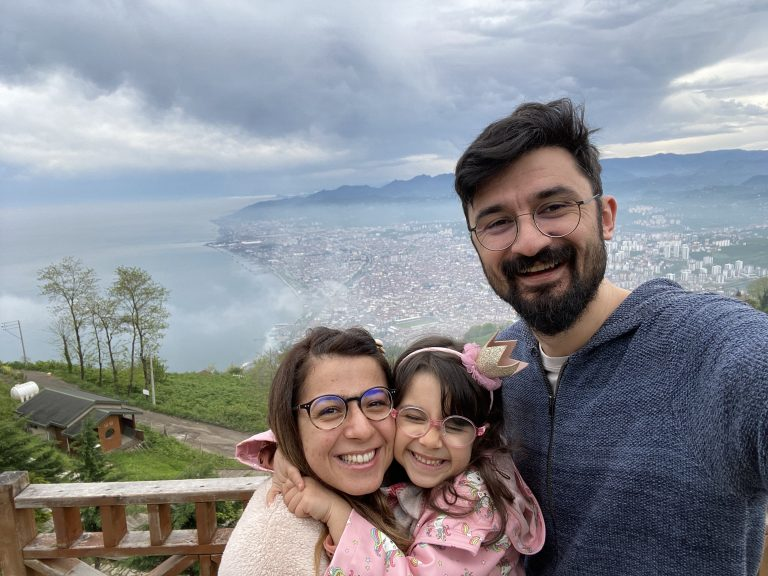
Family photo with Gizem, Toprak, and Haydar
“I realized what other organizations are doing to help the visually impaired, and I thought we needed to do this in Turkey,” he said. “Hope in Focus and Dr. Boye were role models for me, and in 2021, I created the Inclusive and Accessible Life Association. People with limited vision, blindness, or LCA all face similar issues, so our goal is to provide information and resources to anyone who is visually impaired in Turkey.”
KINDERGARTEN COMPANION Determined to continually improve Toprak’s quality of life, the Kulekcis’ information needs accelerated as she got older. “About two years before she went to school, I started researching what was available for education and how we could help her,” Haydar explained. “Many blind or visually impaired children in Turkey don’t go to kindergarten because families are not educated about it.”
Toprak’s kindergarten experience provided Haydar with firsthand information he could share with other parents. “When she started school, they told us that they didn’t know what they could do to help her. I took a two-month vacation from my job and sat with her every day in class, helping the teacher understand how to help my daughter,” Haydar said as he described perching on a tiny chair next to Toprak.
“I told the teacher that Toprak could handle everything and that she could help the teacher help her. I didn’t solve my daughter’s problems for her. I taught her how to solve them on her own,” he said. At the end of two months, Toprak told her father that she was fine and he should go home.
Haydar encourages other parents of visually impaired children to send their children to school and not be fearful about what might happen. He emphasizes the importance of parents allowing their children to solve some of their problems. “Many children who are visually impaired are less fearful than their parents. And most of them can manage and do much more than their parents expect.”
LET’S DANCE! Living across the street from a ballet school gave Toprak an unexpected opportunity. Her parents’ discussions about the school’s problematic traffic jams sparked her curiosity. “What is ballet?” she asked.
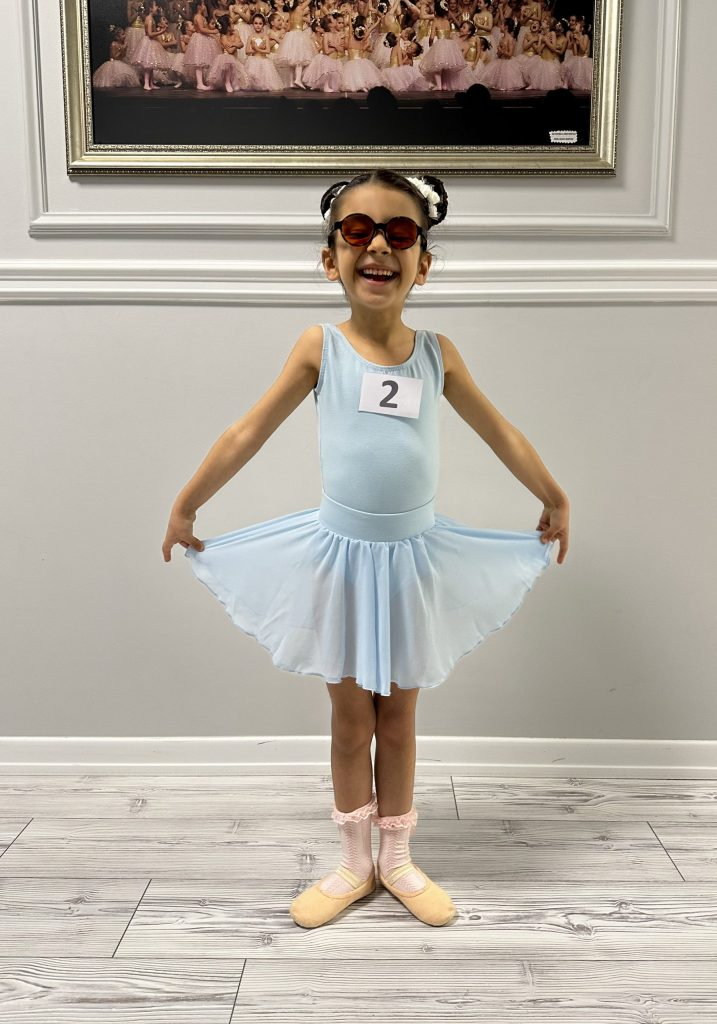
Toprak in her blue ballet leotard.
After doing their best to describe ballet, Haydar found a high-contrast video of a performance to show Toprak. The video resulted in a torrent of questions about how to do ballet, whether there were special clothes for ballerinas, and whether she could take ballet lessons.
“We realized this could be an opportunity for her,” said Haydar. “But we didn’t have any experience with ballet. The school said we could do it but that they didn’t know how to teach her. So, I said, I am here for this problem!” Haydar began attending the classes, helping Toprak stretch and move her body correctly. “We’d get additional help from the teacher to explain how and where to put her foot or leg using words and moving her body into the correct position.” Haydar noted that ballet has additional benefits because visually impaired children often have difficulty understanding where their body is in space. “Ballet is not just visual but also a feeling and understanding of how the body works,” he said.
Toprak’s ballet experience has thus far culminated in two performances with her classmates, each before a thousand people at a performing arts center. “We tested her in the classes, and she hit the mirror a couple of times, but the teacher said not to worry. She can handle it,” Haydar said. Anxious about her first performance, the Kuleckis sat close to the stage in case she fell off. However, Toprak’s classmates successfully guided her when needed.
“When she was on the stage, she was like an angel walking and running around with her friends helping her,” Haydar said, his voice vibrant with joy. “Toprak solved some of her problems, and when she couldn’t see where to sit or stand, she gave a friend her arm. She didn’t give up! Isn’t this the solution for all of us—learning to ask for help and helping each other?”
HIF FAMILY CONFERENCE In 2023, the Kuleckis attended the HIF Family Conference in Indianapolis. Haydar said it was a significant event for them to attend. “We met many people there with LCA and some with the same gene as Toprak. We also met Dr. Boye there, and it was like a dream for us,” he said. “To think that we sent an email in 2019 to someone in the US who gave us answers and information about our daughter’s LCA, and now we see that person is real.”
LIFE CONTINUES In Turkey, schools often lack the knowledge or resources to meet the needs of visually impaired students, and Haydar often relies on his engineering background to find solutions. For example, Toprak finished first grade in June of this year. But she at first struggled to see the blackboard. Her father put a camera in front of the board, sending pictures to Toprak’s tablet so she could zoom in on the content. She also reads books using a digital magnifier, and the rehabilitation center teaches her Braille. The Kuleckis are grateful that Toprak’s last eye exam indicated stable vision, at least for now.
Gizem and Haydar work together to forge the best quality of life for Toprak that they can while sharing information and offering support to others through the Inclusive and Accessible Life Association. “We are a great family team! Gizem identifies a problem, I am the problem solver, and Toprak is a hardworking teammate who keeps us learning new things,” Haydar said.
With supercharged energy and positivity, Anthony, born with Leber congenital amaurosis (LCA), shares what it’s like to be blind through motivational speaking and his various social media platforms. His wife, Kelly Anne, helps him plan out what he wants to portray, and then she shoots and edits the videos about their life that later appear on TikTok, Instagram, Facebook, and YouTube. Anthony’s social platforms have become popular as he shares what managing the world without vision is like. As an advocate for increased accessibility, whether he’s changing diapers, making smoothies, or skateboarding, he shares how he tackles a variety of activities without sight.
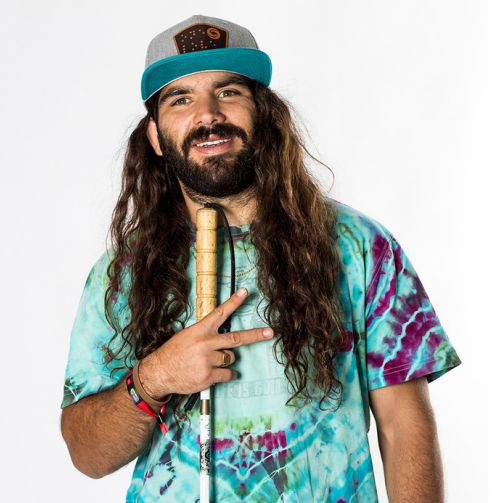
Anthony wearing a tie-dye tee-shirt holding up a peace sign and his guide cane.
Growing up in Spring Lake, New Jersey, the youngest of five children, Anthony was born with only 20/400 visual acuity (profound vision loss). He lost a chunk of vision in seventh grade and then again in his junior year of high school. Now in his late twenties, Anthony’s vision is decreasing daily, and he says, “The light is starting to go black.”
Against the odds, Anthony became a champion wrestler in high school and was the subject of an award-winning film, A Shot in the Dark, documenting his attempt to win a state wrestling championship in his senior year. In a previous interview with Hope in Focus, he said, “Wrestling has taught me a lot of things. It taught me hard work, that things don’t happen overnight, discipline, and how to deal with loss. It helped me prepare for life.”
Anthony aims to participate in the Los Angeles Paralympic Games in 2028 in Judo. The pivot from wrestling to Judo resulted from a concussion that ended his wrestling career in college. However, this event opened the door to pursuing Judo when the U.S. Paralympic team asked him to train for the team.
Open about his life, Anthony talks about struggling with depression. “When I was 19, I got so depressed that I checked myself into a mental health hospital. I learned a lot about mental health and not bottling things up. I got to work on myself and learn about what I was feeling and going through,” he said. “When I was 21 or 22, I started accepting the fact that I was blind and started using my cane and the resources that were around. That’s when my whole life changed. Soon after, I met Kelly Anne!”
An accomplished musician and skateboarder, Anthony is game to try almost anything. He and Kelly Anne have a baby girl, and some of his videos demonstrate how he cares for her. One example is his TikTok video “How I Find My Baby as a Blind Dad.” With unending zeal and courage, which Kelly Anne fully matches, Anthony propels himself into life.
Come meet Anthony and his family at Dinner in the Dark 2024 and hear him speak about his personal experiences and hopes for a possible treatment for LCA, tickets are available at hopeinfocus.org/dinner. Learn more about Anthony and connect with him on social media at asfvision.com.