In March 2024, the company announced vision improvements for the first three adult patients in its Phase 1/2 LCA5 gene therapy clinical trial. Some patients, who had been almost totally blind since birth, can now see and identify objects for the first time. The company has also reported positive safety data for the trial thus far.
Though LCA5 patients have severe vision loss at birth, they have some surviving retinal structure that researchers believe can be harnessed for improved vision using gene therapy.
Known as OPGx-001, the gene therapy uses a human-engineered adeno-associated virus (AAV) to deliver healthy copies of the LCA5 gene to patients’ retinas, augmenting the mutated copies that cause vision loss. The therapy is administered through a one-time injection underneath the retina. Researchers believe gene therapies will be effective for many years, perhaps for the patient’s lifetime.
Opus plans to administer the next highest dose of its LCA5 gene therapy to the next cohort of adult patients in mid-2024. The company also has plans to dose patients as young as 13 years old sometime in the future.
Courtney Coates, Hope in Focus’s Director of Outreach and Development, stated, “We are thrilled that patients in this trial are having early success with the low-dose treatment. We look forward to hearing more as the next cohort is enrolled for the mid-dose.”
The LCA5 gene therapy clinical trial is the first launched by Opus, a company founded in 2021 by the RD Fund, the venture arm of the Foundation Fighting Blindness, which is investing in companies near or in early-stage clinical trials for their retinal degenerative disease treatments.
As someone with a visual impairment, I’ve learned the importance of choosing accessible environments. I recently purchased my first home and wanted to share some lessons I learned about accessibility and the home-buying process.
One of the most important decisions anyone makes when selecting a home is picking a real estate agent who understands your needs and desires. Of course, you want someone who knows your local market and won’t pressure you to make a decision you aren’t ready for. But as someone living with a visual impairment, I also wanted an agent who had experience helping people with disabilities find a home. I started by speaking with a few agents who mentioned having this expertise on their websites, but I did not find anyone I felt comfortable working with.
The Right Agent Thankfully, I asked a friend who is also visually impaired and who had recently moved. He had an excellent referral for an agent whom I contacted and chose to work with. Because of my real estate agent’s knowledge and experience, he was able to help me narrow my search by eliminating areas with poor public transit or limited businesses within a walkable distance. He also helped me identify features that would make my life easier as a visually impaired person, such as green space for my guide dog, nearby access to trails making it easier for me to run with a guide, easy-to-use appliances, and lots of lighting.
I looked at a lot of properties, and it was overwhelming! As I searched, I also discovered several things that would make my life better. I eliminated properties that required renovations. I’m not handy and have no interest in supervising a construction project. I also excluded properties on busy roads because it’s much easier for me to navigate quieter spaces, and I like to avoid noise as much as possible.
Adding Accessibility I ended up purchasing a first-floor condo, which provides for trouble-free maintenance. It has a large patio, making it easy to take my guide dog outdoors, and it allows me to be outside as much as possible.
Once I moved in, there were a few things I needed to do to make my new home more accessible for me. Some rooms were not as bright as I wanted, so I purchased the brightest LED lightbulbs I could find. I was also tired of having thermostats that I could not control independently. Thankfully, there is a wide selection of thermostats that you can control with an app on your phone. I got an EcoBee thermostat and found the app fully accessible. Finally, I put Braille labels on all my appliances so I can use them independently. The Braille Superstore is a great place to get a Braille label maker and other stickers/labels to make your home more accessible.
I’m thrilled to have my own home and to live in an accessible and comfortable place. I hope my experience gives you some ideas regarding purchasing a home and how to make it more accessible for you or a loved one.
This year’s Dinner in the Dark at Foxwoods was a tremendous success, raising over $225,000 and welcoming 330 attendees. Because of the immense support of everyone who joined us for this important evening and those who supported from a distance it was our most successful year yet.
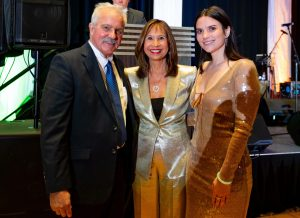
This year, we recognized Susette Tibus and Chuck Sneddon and the entire Simply Majestic team for their 10 years of incredible commitment to Hope in Focus and our LCA community. To honor their support, a special table was set up displaying the jewelry they generously donated over the years, along with photographs of the grand prizes from past events.
Susette Tibus stated in her remarks before dinner, “There is a saying in Africa if you want to go fast, go alone. But if you want to go far, go together.” Thanks to their abundant generosity of resources, time, talent, and community connections Hope in Focus has gone far in the last 10 years, becoming the leading global advocacy organization for those living with LCA.
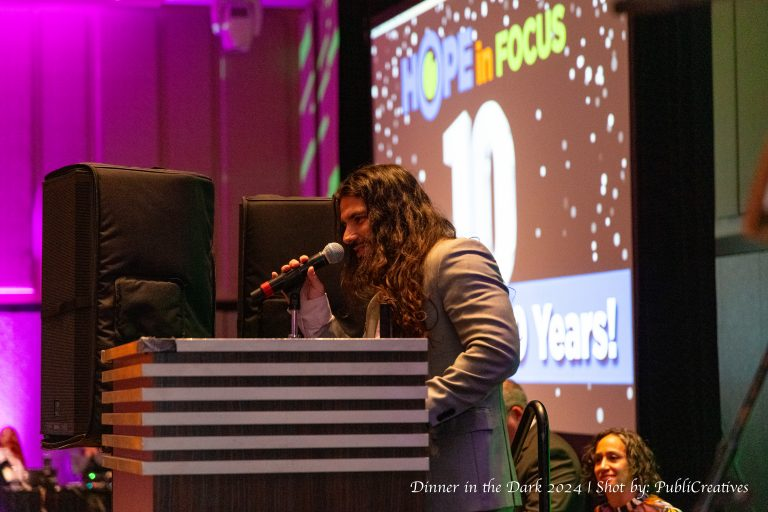
Keynote speaker, Anthony Ferraro
Thank you to our speakers, emcee Mike O’Farrell, Laura Manfre, Courtney Coates, Sofia Priebe, and keynote speaker Anthony Ferraro. Anthony is a remarkable athlete, motivational speaker, social media sensation, and proud new father whose message is relatable and uplifting. With warmth and humor, Anthony heightened our understanding of LCA and its impact on daily life.
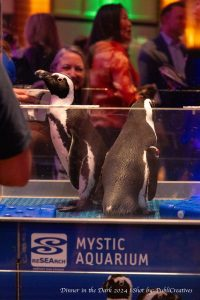
This year, we were delighted to host some extraordinary guests— one with hooves and others with wings! Courtesy of Mystic Aquarium, penguins waddled into the celebration. We’re incredibly grateful to Mystic Aquarium and want to thank their team, the penguins, and our zebra, a symbol of rare diseases, Luca Priebe.
The penguins from Mystic Aquarium.
We want to thank each of our sponsors, whose generous support helped us reach this exciting milestone. We also want to acknowledge the donors of the auction items, The Cartells for entertaining us with their music, and our 20/20 Vision Patrons for their contributions.
When it comes to the food and drinks, we can’t forget the contributions of our in kind donors, Angelini Wines,Beer’d, and Foxwoods. Not to mention the Foxwoods Resort and Casino team who designed, cooked and served a beautiful seasonal menu – check out what we ate on our “What’s for Dinner?” blog.
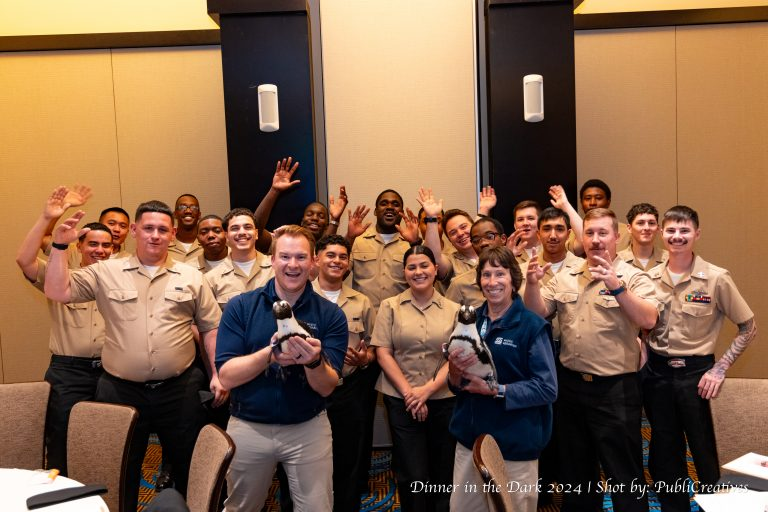
Lastly, a heartfelt thank you to our support team, including the Naval Submarine School in Groton, which served and assisted guests throughout the evening as sighted guides. We also thank our event committee for their hard work in planning, designing, and organizing the event.
As we head into Thanksgiving, we are feeling very grateful to the community of friends, family, volunteers, sponsors, attendees, donors, and penguins! You really showed your stripes and we sincerely thank everyone who made this year’s Dinner in the Dark a success. We look forward to welcoming you again next year.
Caitlin and Greg Smith eagerly looked forward to the birth of their fourth child, who would complete their busy family of two girls and a boy. Caitlin’s pregnancy was unremarkable, and the family excitedly welcomed baby James in June 2023. But when he was about two months old, the couple noticed that James wasn’t visually tracking as they had expected. “His eyes were closed much more than our other children, and I remember thinking that was odd,” Caitlin said. “He also wouldn’t lock eyes with us or look directly at objects or our faces.” Worried, the Smiths took James to their pediatrician, who wasn’t overly concerned given his age but suggested seeing a pediatric ophthalmologist.
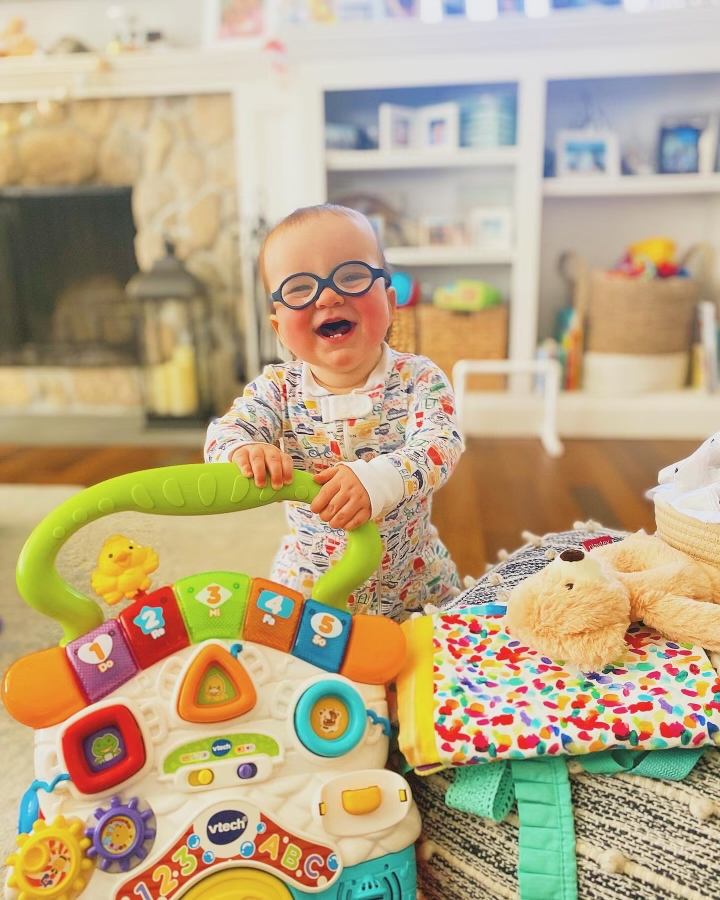
James with his toys
ADiagnosis
Unfortunately, the ophthalmology exam revealed that something was wrong. “The doctor noticed pigmentation in his macula and mentioned it could be a number of things but recommended that James be seen by a retinal specialist at Boston Children’s Hospital,” said Caitlin. “The doctor did a clinical exam and, based on seeing degeneration in the retina, diagnosed James with Leber congenital amaurosis (LCA). It was a terrible shock. We knew nothing about inherited retinal diseases or LCA.”
The next step was genetic testing, which revealed James had LCA9, caused by a mutation in the NMNAT1 gene. Greg and Caitlin were also tested, and their results verified that James’ LCA was inherited and not the result of a random mutation. “Just knowing what we were dealing with was a big milestone,” Greg said. “But we needed to know where to go from here.”
After learning that many children with LCA9 are born with no light perception or severe vision impairment, they were encouraged that James appears to be on the better end of the spectrum. “We know he has light perception, can see colors, and has some functional vision. Sometimes, he appears to track people or large objects, but it’s hard to know if it’s because he’s hearing or seeing something,” Caitlin said.
Finding Support, Getting Educated
Immediately after the diagnosis, the Smiths dedicated themselves to researching and understanding all they could about LCA and visual impairments. “As a parent, you always want what is best for your child, and to think about and create what would be best for him, we needed to educate ourselves,” said Caitlin. As they searched LCA online, Hope in Focus popped up. “The day we got the clinical diagnosis, or maybe a day later, we found Hope in Focus,” Greg said.
Several days later, Greg spoke with Courtney Coates, Hope in Focus Director of Outreach and Development, who provided him with family and research connections and a high-level review of the current treatments and technologies relevant to LCA9. “It’s hard to put into words how impactful it was to get this diagnosis and to be able to go online and get connected to a community of people that could hear our story and help,” he said. “Having Hope in Focus was incredible for us as we began this journey. It makes such a difference knowing you’re not alone. We are forever grateful to Laura, Courtney, and the rest of the Hope in Focus team.”
Courtney also connected the Smiths with another Hope in Focus family whose son had LCA9, which Caitlin said provided an “awesome jumping-off point for connecting to other families with the same mutation.” They’ve also found other LCA9 families in the US and abroad through social media.
Through recommendations from Hope in Focus and via their research, the Smiths began reaching out and networking with people researching and developing potential treatments. “Getting more involved with the research community has been very helpful, and as a family, we are very focused on helping to advance a treatment for James and others with LCA9,” Greg explained.
In James’ case, early-stage preclinical work has been conducted on a potential gene therapy treatment for the NMNAT1 mutation, with promising results in mouse models. “With these rare diseases, taking a traditional path to treatment development is very challenging given the economics involved,” said Greg.
Living Life
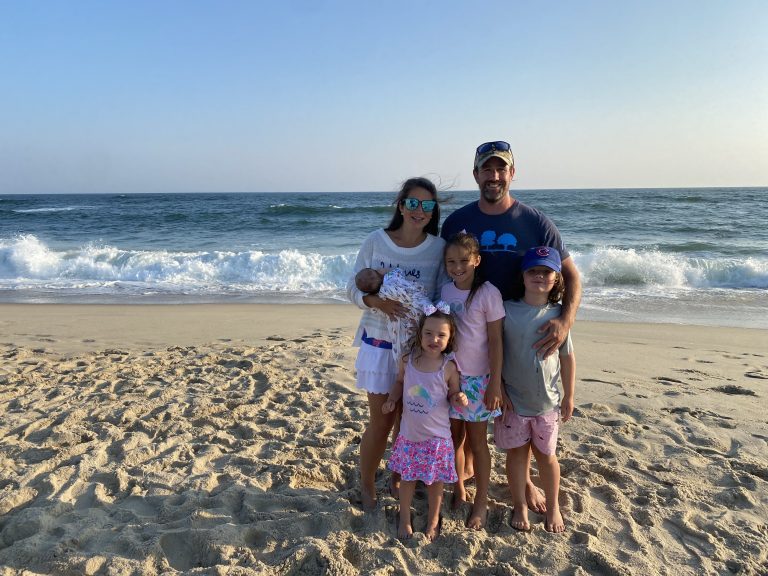
His parents describe James as outgoing, adventurous, fearless, and a ball of fun who is always smiling and laughing. “His siblings are totally in love with him,” said Caitlin. Now, James is just another sibling rather than a sibling with a vision impairment.”
The Smith Family at the beach
Greg said that he and Caitlin dealt with James’ diagnosis in different ways. It was more challenging for him to accept the vision impairment, and his mind went to all of the things that his son might not be able to do that his siblings could do. “I think Caitlin did a much better job internalizing all of that,” he said.
Caitlin said that she turned her grief into action by focusing on the next steps, such as identifying and arranging for therapies. “It felt like a blessing that our life is so busy. There wasn’t time to sit around and be depressed or in shock—instead, I focused on James’ immediate needs and how we could best support him and give him an amazing life, just like our other children. I didn’t want him to be treated any differently from other kids. We will not allow his vision to define him, but we will make sure he has every opportunity every other child has,” she said.
Daily life at the Smiths is essentially divide and conquer. Greg works at an investment firm and has taken the lead in researching the disease and potential therapies in his spare time. Caitlin is a stay-at-home mom who is incredibly busy with the three older children’s sports schedules and James’ physical, occupational, vision, and speech therapies. They have gotten involved with the NAPA Center in Boston, which offers specialized coaching and therapies for children with disabilities, and they attend a weekly baby group at the Perkins School for the Blind. They feel lucky and thankful for access to excellent resources and support nearby. “It’s been incredible to see how much James has grown and all the milestones he has accomplished. In certain areas, he is more advanced at this age than our other three were,” Caitlin said.
James currently sees three different doctors, including a local eye specialist who used to work at Boston Children’s Hospital. He also goes to Boston Children’s Hospital once a quarter, and there is a yearly trip to the Children’s Hospital of Philadelphia.
Regarding advice for other LCA families, Greg and Caitlin said it may seem overwhelming initially, but everything will be okay. “I struggled with the diagnosis for a while. But now we’re at a place where we feel like James is not our child with LCA. He is just James!”