Gene therapy is unequivocally the most advanced approach for treating retinal diseases like Leber congenital amaurosis (LCA). Of course, there’s LUXTURNA® which is FDA-approved and has restored significant vision for people with LCA caused by RPE65 mutations. But several other emerging gene therapies are, or will soon be, in clinical trials. Excitingly, some are restoring vision early in human studies.
I had the honor and privilege of moderating an expert research panel at the 2025 Hope in Focus Conference last June in Minneapolis to discuss some of the exciting developments in LCA gene therapies. The three panelists were Kenji Fujita, MD, chief medical officer, at Atsena Therapeutics; Sarah Tuller, JD, chief regulatory officer at Opus Genetics; and Bikash Pattnaik, PhD, a professor at University of Wisconsin-Madison.
Atsena’s LCA1 Gene Therapy Moving into Phase 3
Dr. Fujita delivered the exciting news that Atsena’s LCA1 (GUCY2D) performed very impressively in a Phase 1/2 clinical trial. “We were super-thrilled with the results,” he said. “The gene therapy worked better than we expected.” Thanks to the excellent results, the gene therapy is moving into Phase 3 in a co-development partnership with Nippon Shinyaku which brought a few of their representatives to Minneapolis.
The Phase 1/2 trial enrolled nine adults in Part A (the dose escalation group) to evaluate initial safety and determine the optimal dose. An additional three adults and three pediatric patients were subsequently dosed. Patients receiving the highest dose (all were treated in one eye) had 100-fold improvement in retinal sensitivity, as measured by full-field sensitivity (FST). Some had10,000-fold improvement. Patients were also able to navigate a multi-luminance mobility test (MLMT) in dimmer light (two lux levels lower) after treatment. “This was a transformative difference, on par what we have seen with LUXTURNA,” said Dr. Fujita.
The Phase 3 clinical trial will enroll a larger group of patients and treat both eyes. Some patients will be in a deferred treatment group, serving initially as controls.
The Foundation Fighting Blindness, through its RD Fund, is an original investor in Atsena.
Opus Reports Vision Improvements in LCA5 Gene Therapy Clinical Trial
Opus Genetics, a company established by the Foundation Fighting Blindness in 2021, launched its first clinical trial in 2023 for an LCA5 gene therapy. LCA5 is a severe retinal degeneration diagnosed in a child’s first year. It is also very rare, affecting only about 200 patients in the US.
Opus reported excellent results for the first three patients (adults) in the trial with improvements in FST and virtual maze navigation. The company is now dosing pediatric patients and expects to report on them in the third quarter of 2025. “We are trying to move forward as aggressively as the FDA will allow,” said Ms. Tuller.
She acknowledged the great work of Dr. Tomas Aleman, the principal investigator on the trial, who was also at the meeting and had an engaging discussion with Sarah McCabe, one of the first patients to receive an RPE65 gene therapy.
A CRISPR Therapy is Emerging for LCA 16
Dr. Pattnaik reviewed his team’s emerging CRISPR gene editing approach for correcting the W53X mutation in the gene KCNJ13 which causes LCA16. He explained that the treatment works like molecular scissors to cut out the mutation.
Dr. Pattnaik is using lipid nanoparticles ⎯ which are like microbubbles ⎯ to deliver the treatment into retinal pigment epithelial (RPE) cells. Unlike most other genetic therapies which use engineered viruses to get genetic cargo into cells, nanoparticles have the advantage of being able to deliver therapeutic cargo of any size. Also, they are less likely to cause an immune reaction than viral systems.
Dr. Pattnaik tested the approach in cells and small animal models, and is now evaluating it in a large animal. He said the FDA is very positive about their current development plan.
The CRISPR therapy is currently funded through a grant from the National Institutes of Health (NIH) and was previously supported by the Foundation Fighting Blindness.
Dr. Pattnaik is also a co-founder of Hubble Therapeutics which is advancing a KCNJ13 gene augmentation therapy developed in his lab.
The development of diverse treatment approaches for Leber congenital amaurosis (LCA) is necessary because no single modality will work for everyone affected. While development of gene augmentation therapies (i.e., replacing mutated genes with healthy genes) has much momentum, other approaches also show promise as they move into and through clinical trials. Three of those emerging alternatives were discussed by a panel of experts at the Minneapolis meeting in June. The panel was moderated by Amy Laster, PhD, chief scientific officer, Foundation Fighting Blindness.
Optogenetics is a gene-independent approach for restoring some vision for people with advanced inherited retinal diseases (IRDs) who have lost most or all their photoreceptors (rods and cones), the retinal cells that make vision possible. Ray’s therapies deliver genes that express a light-sensing protein called channelrhodopsin to either bipolar or ganglion cells ⎯ cells that are normally not light sensitive but survive after photoreceptors are lost. In essence, the therapies enable bipolar or ganglion cells to work like a back-up system for photoreceptors. The therapies are delivered by a one-time injection into the vitreous, the soft gel in the middle of the eye. These non-invasive injections are performed thousands of times every day in retinal doctors’ offices for treatment of AMD and diabetic retinopathy.
While Ray’s clinical trials are at an early stage, Dr. Agrawal said early reports for safety and efficacy have been encouraging. Stay tuned.
Sepul Bio’s RNA Therapies for LCA10 and USH2A
In early 2022, the biotech company ProQR reported that sepofarsen, its RNA therapy for LCA10 (IVS26 mutation in CEP290), did not meet its primary endpoint in a Phase 2/3 clinical. That news came despite vision improvements, some significant, for many patients in the trial. The endpoint miss led ProQR to stop development of its ophthalmology assets ⎯ sepofarsen and ultevusen (exon 13 mutations in USH2A) ⎯ and find a company to acquire them.
Mike Schwartz, who was then vice president, global project leader, at ProQR, said, “That was devastating for me, the doctors, and the patients.” He noted that one patient with LCA10 in the trial with only light perception gained enough vision after receiving sepoafarsen to see letters on an eye chart. Another LCA10 patient in the study was able to return to his work as a carpenter after treatment.
Fortunately, a year and a half later, the large European eye care company Théa acquired sepofarsen and ultevursen and formed the Sepul Bio business unit to move the therapies back into clinical trials. Many former ProQR staff went to Sepul Bio including Dr. Schwartz who is now their chief operating officer.
A Phase 2 clinical trial for ultevursen is underway and a global Phase 3 trial for sepofarsen is imminent. Using what was learned from the ProQR trials, the Sepul Bio team made significant changes to designs for the forthcoming trials ⎯ changes they believe will greatly improve chances for success. Mr. Schwartz thanked the Hope in Focus team for providing input from patients for the sepofarsen clinical development program.
Sepul Bio’s RNA therapies, known as antisense oligonucleotides (ASOs), are tiny pieces of genetic material that fix mutations in RNA, the genetic messages that cells read to make protein that’s critical to the cells’ health and function. Both sepofarsen and ultevursen are delivered by intravitreal injections every six months.
The development of cell therapies for IRDs has been challenging for numerous reasons. Therapeutic cells haven’t been easy to source and enabling them to survive and integrate when transplanted into patients’ retinas has been difficult.
As a panelist for the session, I had the privilege of discussing a promising photoreceptor replacement therapy from BlueRock Therapeutics which came out of the lab of stem cell pioneer David Gamm, MD, PhD, University of Wisconsin-Madison. Excitingly, BlueRock’s therapy just moved into a clinical trial for people with RP and cone-rod dystrophy. Dr. Gamm said the cells might at some point be relevant to LCA patients.
The photoreceptor precursors used in the trial came from induced pluripotent stem cells (iPSC). The iPSC were derived from a small sample of mature blood or skin cells from a healthy donor. The cells were genetically tweaked to revert back to a stem cell state. The iPSC were then coaxed forward to develop into the photoreceptor precursors. As precursors, they aren’t fully mature. Dr. Gamm research showed that precursors have the best chance at survival and integration after transplantation.
BlueRock has the backing of two prominent companies: Bayer and Fuji Film. The Foundation Fighting Blindness funded Dr. Gamm’s previous iPSC-related lab research.
The BlueRock trial is moving forward methodically so that investigators can ensure safety for patients and best understand which patients and conditions can benefit most from the approach.
The 2025 LCA Family Conference in Minneapolis, MN, offered four informational panel sessions, where the 135 attendees learned about living with Leber congenital amaurosis (LCA) and other inherited retinal diseases (IRDs), participating in clinical trials, and the latest research and therapy updates.
The first session, “Living with an IRD,” was moderated by Laura Manfre, co-founder and Board Chair of Hope in Focus. This session is often a highlight for families wanting to learn how to support their children diagnosed with an IRD.
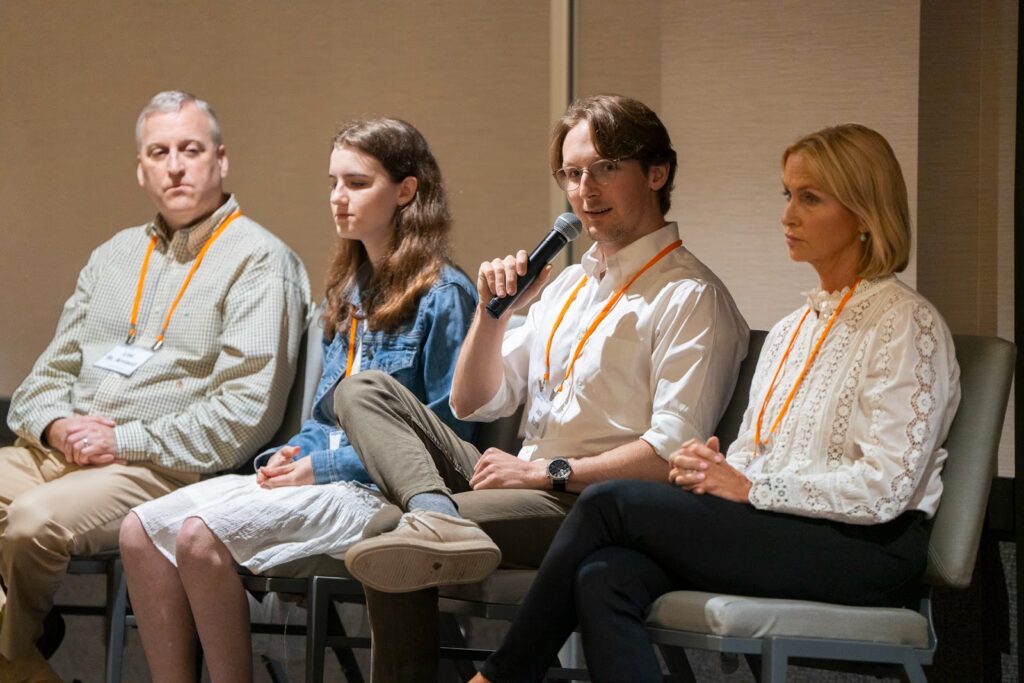
Laura Manfre, Lee St. Arnaud, Elle St. Arnaud, Jack Morris, Leslie Morris
Laura posed questions to the four panel participants, which included 18-year-old Elle St. Arnaud, who has LCA IQCB1/NPHP5and is attending Boston University this fall, and her father Lee St. Arnaud, and 22-year-old Jack Morris, who has RP CRB1and is a recent graduate of Brown University, and his mother Leslie Morris.
Below are some of the panelists’ edited responses to Laura’s questions.
What has your school journey been like? What challenges have you faced, and how did you advocate for yourself?
Elle St. Arnaud
Elle was educated in the public schools with a paraprofessional supporting her in class from preschool through fourth grade. She said that a key to her success was learning to advocate for herself early on by participating in her individualized education plan (IEP) meetings, explaining her accommodations to teachers, and taking responsibility for communicating her needs, especially regarding her vision. Elle reflected on the importance of self-advocacy and how it has shaped her life.
“It’s vital for kids to be able to explain their accommodations, as others often don’t fully understand visual impairments,” she said. “While I’ve had positive experiences, I’ve also faced challenges, such as being discouraged from joining the debate team or taking advanced classes. I pursued both anyway, proving that being blind doesn’t limit one’s ability to succeed. Self-advocacy and standing up for your needs are essential life skills.”
Jack Morris
Jack started in public schools and later switched to a private school. His vision was relatively good throughout most of his schooling. Jack thought he might have done even more to advocate for himself. Still, regular meetings with teachers and advisors proved very helpful. He said, “When people understand what you need, they generally want to help.” Although at the university level, he said some professors were resistant to making accommodations.
He stressed that “Accommodations are not favors—they are necessary for success. Blind individuals are not less intelligent; they simply need equal access to materials to perform just as well as others. Having confidence in advocating for these needs is crucial, and legal protections like the ADA support this.”
As parents, can you share a little about your journey? How was it seeking a diagnosis, and what are some things you wish you’d known earlier?
Lee St. Arnaud
Lee explained that Elle and her older brother, Patrick, both have LCA. When trying to diagnose Patrick’s vision issues, he shared how difficult it was when the doctor offered only a brief response, instructing them to return in five months to confirm their son’s blindness. Overwhelmed, the family immediately reached out to resources like the Chicago Lighthouse for the Blind, which connected them with supportive networks and foundations.
Lee stressed the importance of parents being proactive and finding tools like a detailed year-by-year visual goals guide, which they used effectively in IEP meetings to advocate for their children’s needs. He emphasized the importance of being prepared, pushing for necessary services, and actively advocating for the child and family.
The St. Arnauds encouraged their children to participate in outside activities like adaptive climbing and the live hockey association. “So many times we were nervous and sweating bullets. But by the time we got done, the kids were like, you know what? We can do this!” Lee said.
Leslie Morris
Leslie said that Jack’s diagnosis with a recessive form of RP at age five came as a shock because there was no family history. She described feeling heartbroken and overwhelmed by a sense of loss and isolation. Despite these emotions, Leslie and her husband, Jason, chose not to accept discouraging responses from doctors. Instead, they took action—connecting with others affected by IRDs and becoming involved with the Foundation Fighting Blindness, where both serve as trustees.
Advocacy became like a second job for the Morris family, as they worked to ensure Jack had every opportunity for a full and meaningful life. Leslie said they didn’t want the disease to define their son, and they encouraged him to try various activities like baseball, football, swimming, wrestling, and guitar. “We focused on letting Jack decide when to step away from activities while gently steering him toward pursuits that offered long-term fulfillment,” Leslie said.
How do you give your child enough independence to grow and to learn, while also wanting to protect and keep them safe?
Lee St. Arnaud
Lee felt that they didn’t experience significant disagreements with Elle or Patrick regarding their ability to self-manage. He stressed the importance of balancing caution with encouragement and supporting early opportunities for independent experiences in the community without rushing the process. He also reflected on the importance of understanding your child’s interests as they mature.
Elle St. Arnaud
Elle immediately spoke up after her father, expressing her childhood frustration and conflict with her parents over having to take Orientation and Mobility (O&M) training particularly the inconvenience and social discomfort of being taken out of school. Despite hating it at the time, she admitted the lessons had long-term value, especially in promoting independence. She noted the importance of starting children early with independent tasks at home, like cooking and laundry, while pacing community-based skills more carefully. “I think parents should keep their children engaged in O&M even if the child resists,” Elle said. “Because it equips them with critical life skills—such as safely crossing the street—that pay off later.”
Leslie Morris
Leslie emphasized the importance of parental teamwork and unity, particularly when supporting a child’s journey toward independence. She admitted to being a bit of a helicopter mom. “My husband, Jason, and I agreed on things before letting Jack go out and try them,” she said. “Having somebody by your side through this journey is very important.” She added that when parents are aligned in decisions and approaches, it helps minimize conflict and makes the process smoother.
Jack Morris speaking at the 2025 LCA Family Conference
Jack Morris
Jack didn’t recall having major conflicts and expressed gratitude for the trust his parents placed in him. One slight regret he had was not wearing sunglasses earlier, due to self-consciousness. Jack said he appreciated the opportunity to try things—even fail—while still feeling supported and safe.
Much to the amusement of the conference attendees, Jack recounted a brief period when he was legally allowed to drive, a decision made with medical guidance that, in hindsight, seemed very questionable.
“I appreciated that my parents trusted me to be able to take care of myself. This journey makes you resilient, tough, and resourceful,” Jack said. “Kids can be very clever in planning solutions to their unique circumstances, and my parents trusted me in that.”
Community members have expressed that mental wellness and accepting vision loss can be difficult. Elle and Jack, what are your thoughts?
Elle St. Arnaud
“Not wanting someone to see your pain and not wanting to wear sunglasses or use a cane will likely peak around middle school,” Elle said. “No one wants to be different, and you want to be ‘on trend’ with everybody else.”
She added that having a para in the classroom with her all of the time was an inhibitor and made it harder for her to talk with other kids. “Parents should try not to hover when their child is with other children because it can make them feel less confident or social,” she said.
Elle said she made it a priority to share her experiences as a blind person with her sighted friends. “We’d make jokes about it, and I talk about it constantly. I’d share what I’ve experienced and every blind story I’ve had,” she explained. “I think that’s important because when you need to ask your friends for help, they are a lot more understanding because you’ve explained it and talked about it so many times with them.”
For example, she told her friends about walking into a door, which helped them be more aware that she might not see it, allowing them to take the initiative to guide her when needed. “I think the easiest way to be accepted is to talk more about your blindness so it feels more normal,” Elle said.
Jack Morris
“I think there’s a line to be found between letting a disease define you and rejecting that it’s a part of you, because retinitis pigmentosa (RP) has been a huge part of my story—a beautiful but also a tough part. It’s something that feels different and lonely, but also unifying and community-building,” Jack said. “If we can find ways to live in and with our disease rather than despite it, that’s where truth and freedom lie for me.”
He offered advice to parents, saying that they needed to be strong in ways that aren’t obvious. “One of the hardest things for parents is watching their child struggle. But sometimes the biggest strength is allowing them to struggle. Kids need to feel the full spectrum of emotions—challenge, loneliness, empowerment, and togetherness,” Jack said. “If parents can be there as a foundation, even when things are hard, and let them be hard before stepping in with action, that’s one of the most powerful and meaningful things they can do for their children.”