“If someone told me that having access to perfect vision tomorrow meant not having impaired vision for my entire life, I would not change the past. While my visual impairment has created many challenges, it has shaped who I am and influenced me in many positive ways. I’ve become more resourceful, compassionate, creative, and resilient.” —Jack McCormick
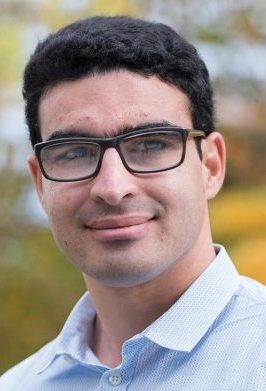
Jack McCormick lives a story of hope, tenacity, and measured success while embracing an unknown visual future. When Jack was two, a diagnosis of cone-rod dystrophy confirmed that he had impaired vision. As a teenager, genetic testing revealed that he had Leber congenital amaurosis type 2 (LCA2), due to a mutation in the RPE65 gene and that he was losing his vision. This form of LCA interferes with the production of the RPE65 protein affecting the eyes’ ability to process Vitamin A, leading to progressive vision loss. “It was tough to accept. I was only 15 and thought my life would be a certain way. Now, it was going to be different,” Jack recalled.
Fast-forward to 2022, when Jack, now 25, was treated with LUXTURNA®, a gene therapy for RPE65, becoming the first Canadian to receive a gene therapy. But his journey to treatment involved overcoming substantial hurdles with the Canadian healthcare system, even as his sight declined.
To have a chance for treatment, Jack realized he had to advocate for LUXTURNA® to be available in Canada. “I wrote letters to Parliament and was interviewed on national television to create awareness and to help expedite the process,” he explained. “My vision was getting worse every time I visited the eye doctor, and my window as a viable patient for this treatment was quickly narrowing.”
Even after clearing the bureaucratic obstacles and identifying a hospital and qualified surgeons, there was still no clear path for funding the expensive treatment. “There was a year lag between Health Canada approving LUXTURNA® and my lining up private funding,” he said.
While Jack wanted the treatment, the immediate or long-term outcomes were not guaranteed. His doctors set his expectations sufficiently low, saying he might see a little better in dim lighting. “My goal was to have stable vision for longer,” he said.
Jack finally received the treatment in March 2022. But the surgery was not easy. It took a long time to recover, and the effects were not immediate. His eye with the poorest vision was treated first, and the second eye was treated two weeks later.
“It is important to be realistic about the surgery. They’re injecting an air bubble and a drug into your eye. There are incisions with microscopic stitches that rub against the eye, causing an intense headache,” Jack said. “I was on my back for the first 24 hours. Later, I had to prevent putting pressure on the eye and couldn’t bend over.”
Another huge challenge was having to quickly decide after the first surgery whether to pursue the treatment for the right eye. “With my left eye, it took a week to see what I saw before the surgery,” he explained. “A few days later, my doctors began talking about the next surgery, and I still wasn’t seeing better. It was very stressful and resulted in multiple conversations with my ophthalmologists about whether to proceed.”
After weighing the risks, Jack chose to have his right eye treated. “At that point, my goal was to see as well as I did before the surgery and, ideally, a little better,” he said. “I’m very happy I did it because the treatment made a much bigger difference for my right eye.” His doctors were also pleased when testing showed vision improvement in dim lighting and an increase in color detection.
“Before the surgery, I didn’t see much walking around the city at night. Now, I might notice someone passing me. I can also see the lines of a crosswalk,” he said. “For me, these improvements are huge!” It’s unknown how long these changes will last, but it’s a future Jack is willing to live with.
His advice for people seeking treatment is to be persistent. “My obstacles were fighting the government and finding a way to pay for the treatment privately,” Jack said. “It’s also vital to find a community. It’s one thing to be a visually impaired person saying that I need this treatment. But it is much more impactful when a group says the same thing and gets others to care about it. Allying with organizations like Hope in Focus helps unite our voices while providing much-needed support and education.”
Jack McCormick graduated in 2018 from Canada’s Wilfrid Laurier University in Waterloo, Ontario. He was diagnosed in high school with LCA2 RPE65. Jack is a Hope in Focus ambassador, helping people living with LCA and IRDs. You can read his blog at jackdamccormick.wordpress.com
Allison Wolf, whose 9-year-old son Elliot lives with the encroaching blindness of Leber congenital amaurosis (LCA), spoke directly to staff from the country’s regulatory agency to help them understand the dire need for treatments for the rare inherited retinal disease.
Elliot Wolf sitting on red chair
“Elliot’s eyes are dying, Allison said. “They are dying, and we have nothing to help slow down the progressive loss of his eyesight,” she told the Food and Drug Administration (FDA).
“What would a timely and effective treatment mean? The whole world,” the mother of four said.
Allison and five others affected by LCA shared their stories with the FDA during a recent Patient Listening Session hosted by Hope in Focus.
We brought together the voices of people living with LCA, caregivers, and a clinician treating people with LCA to FDA staff members in a 90-minute online meeting Oct. 30, 2023. Simply put, we wanted the FDA to truly hear our community’s voices.
Our year-long planning resulted in a successful session to help regulators understand patient/caregiver experiences related to LCA. We requested the meeting to raise awareness with FDA staff about clinical differences of LCA genotypes, share patient experiences of LCA’s impact on the quality of their lives, given the scarcity of treatments, and communicate the extraordinary significance of vision stabilization for patients.
Raising awareness is key to advancing research
People in our community struggle daily to find ways to cope and try to live normal lives in a sighted world. Still, they never give up hope for new treatments and the possibility of a cure. As an advocacy organization, one of our biggest challenges is creating awareness of LCA.
Courtney Coates, our Director of Outreach and Development, introduced the Hope in Focus mission and said LCA affects about one in 33,000 people and presents early in life, resulting in total blindness. Twenty-seven genes have been identified to cause LCA, with treatment available for one form, while a handful of others are in clinical trials.
Co-founder and Board Chair Laura Manfre said as the parent and caregiver of their daughter Sofia living with LCA, raising awareness, searching out new treatments, and providing support to the growing LCA community became the mission of Hope in Focus.
Laura said she wanted to underscore the goals of treatment, in particular around the stabilization of vision for Sofia and others with LCA.
“While vision restoration would be fantastic, having access to a treatment that stabilizes her vision would be huge for her. Not having to constantly change her accommodations for her changing vision is a huge win, and not having to fall asleep every night worried that the next morning might be the one she wakes up without any vision at all. That would be life changing.”
Sharing a chart showing seven current clinical trials, she explained two are not recruiting at this time, two have been discontinued, and all seven represented only four LCA genetic variations.
“So, there is still a lot of work to be done to advance potential treatments.”
Caregivers and people living with LCA tell their stories
Six people from our community shared their experiences.
Elliot Wolf
Allison Wolf, who is 45 and from North Dakota, said doctors diagnosed her son Elliot with LCA13 (RDH12) when he was 6, and as he gets older, her challenges also grow.
“Nobody knows how to raise a visually impaired child. I must be taught. I must teach him the sighted world, while also dealing with the challenge of teaching him the non-sighted world,” she told agency staff. “My heart hurts when I hear Elliot say, ‘I just want to be done with all this work and I just want to play.’”
***
Mohamed Farid
Mohamed Farid of Illinois is a 36-year-old entrepreneur, diagnosed with LCA5 at 40 days old. His mother quit her job to take care of him, and they moved back to Egypt. Preserving his sight concerns him the most, and his greatest fear is the risk of injury.
“For new treatments,” Mohamed told the FDA, “the first thing I would look for is something to stop any degradation – I sense that my functional vision has degraded slightly over time and would imagine there is something going on with my retina, but do not know.
I have been told by doctors that I will lose my sight in the next two to three years ever since I was 5, and that lack of a prognosis is a killer. Following conservation, I care most about night blindness, then field of vision. …
“I was lucky to have a huge support network of people, who went out of their way and had a lot of energy and stress tolerance. This does not mean that life was easy or that I would not want a cure, even a partial cure would be life changing. It does mean that the cost of LCA is high, but barely bearable.”
***
Joy Goodwine, 40, of New York is the mother of 7-year-old Jordynn, diagnosed at age 1 with LCA2 (RPE65), and received a new diagnosis last year of LCA1 (GUCY2D). She always wanted Jordynn to have some sense of normalcy.
Jordynn Erwin
“I’ve always asked family and friends to treat her like any other child,” Joy said. “I do not want people to feel sorry for her and I do not want her to have any special treatment because of her
visual impairment. Jordynn is being raised to know that she is capable of doing anything she wants with limitations…
“What I fear most as a parent with a child living with LCA is I worry that her kindness and vulnerability will lead to unwanted interactions when she gets old enough to go off on her own, or her eyes get worse if treatment is not available.”
***
Linda Wirth is 76 and lives in Colorado. Her vision loss remained a mystery until her diagnosis of LCA10 (CEP290) at age 68. As a child, she learned about the world around her by touching things and holding them.
Linda Wirth
“My family often told me, ‘Don’t touch that! You will break it. Don’t act strange. People will stare at you.’ So, I began to fake it, pretending I understood things which I did not in order to get along and not appear any different.”
One doctor early on told her: “You are blind! What do you want me to tell you? If you are looking for a miracle, there is none.”
A retired clinical social worker, Linda’s been angrily dismissed from jury duty and job interviews, ignored by waitstaff, and questioned whether she deserved to be a parent.
“Just as many differently abled folks, I have encountered individuals with various stereotypes and prejudices.”
***
DJ Broadbin of Connecticut is a 34-year-old mother and caregiver to 5-year-old Jace, who was diagnosed with LCA4 (AIPL1) at 10 months old. Through a Hope in Focus connection, she succeeded in getting compassionate use treatment in the UK for Jace. The treatment, which applied only to his specific gene mutation, has restored some of his sight in one eye.
Jace Broadbin
“No matter what happens with his vision or developing new treatments,” DJ told the FDA, “I remain steadfast in having the same goal I had for Jace since the very second I found out I was going to be a mom – I just want him to be happy. And I will continue to fight for his inclusion in this world to make sure that he always is.”
She often finds herself exhausted by the constant stress of being a caregiver.
“I also wish sometimes,” DJ said as her voice broke, “I just got to be a mom. Not a medical coordinator, an occupational therapist, and a Teacher of the Visually Impaired all rolled up into one. Just mom.
“But then I think about all the things that Jace’s diagnosis has given me personally: Clarity. Patience. Compassion and empathy in a way that I myself was too blind to see in those earlier days.”
***
Mirielle St. Arnaud is 16 and lives in Illinois. She was diagnosed with LCA (IQCB1/NPHP5) at 6 months old. Her early diagnosis was possible because her older brother had been diagnosed with LCA.
Mirielle St. Arnaud
Mirielle worries about her safety and struggles to fit in with her classmates because she misses social cues. She hopes her fairly stable vision will not get worse.
She shared a wish list with the FDA that included personal independence, the opportunity to participate in sports, and more certainty about achieving the career of her choice (she dreams of being a lawyer).
“Some of the more significant challenges I face because of visual impairment relate to jobs and getting hired. It takes longer for me to learn certain skills at a job. I have to rely on others when out in public, especially when traveling. I also struggle to find accommodations for my impairment. It seems that other people know my needs better than I do.”
***
Rachel M. Huckfeldt
Our representative clinician, Rachel M. Huckfeldt, MD, PhD, of Massachusetts Eye & Ear, spoke about the difficulties of diagnosing and managing LCA and the small number of clinical trials. Identifying the responsible genes can be difficult, and the small number of patients severely limits opportunities for clinical trials.
Questions asked by FDA staff members focused on a few common themes: Have you participated in clinical trials? What are the key impediments to clinical trial participation? What are your deal-breakers to participation? What would a successful treatment look like to you?
One result certainly not on the agenda was the deep emotional impact of the stories shared by those living with LCA and caregivers. The session manifested itself as a profoundly moving event.
A full summary of the FDA Patient Listening Session will be available on our website.
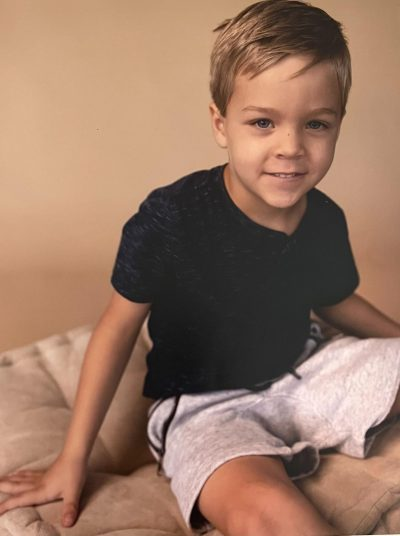
Five-year-old Noah Johnson lives in a special place where he can see rockets shoot into the air at night.
“I can see,” he yells to his mom, Stephanie. “I can see the rocket!”
One of the big joys of living in Melbourne on Florida’s Space Coast is witnessing dramatic liftoffs from nearby Cape Canaveral, especially when it’s dark.
“It’s so heartwarming because he can see what everyone else can see,” his mom said.
Noah also can see colors, faces, and at night, he can see the moon.
During the day, he can hear the booming roar of the magnificent engines, but unlike in darkness, he can’t see the spacecraft soar into the great beyond.
Noah
Stephanie and her husband, Brian, noticed in 2018 the rapid, side-to-side movements in the eyes of their 4-month-old. Stephanie now knows that the eye-movement condition, known as nystagmus, presents as a symptom of the rare inherited retinal disease Leber congenital amaurosis, known as LCA.
After following up with a pediatric ophthalmologist, the doctor asked Stephanie’s other children if they could leave the room, while she wondered, “What is going on?”
The family left the office with many questions and only one vague answer: Something was extremely concerning about Noah’s retina.
Getting a confirmed genetic diagnosis
Noah soon underwent what his mom described as a “horrible and kind of brutal” eye exam. She wants doctors and parents to understand the difficulty of getting an infant to sit still and open his eyes.
The extensive exam used eye hooks to expose his eyeball.
“They put the ultrasound gel directly on the eyeball. I am so thankful as a parent that we’re beyond that, as it was extremely difficult to watch and for him to experience.
“Everyone has their own journey. If I had known there were better imaging options when he got older, I would have asked more questions and inquired if we could wait. The imaging is different and a 2-year-old has the ability to sit and look straight.”
The couple declined an electroretinography (ERG) test that detects abnormalities in retinal function. Even if the earlier testing had gone more smoothly, they didn’t want the doctors to perform the test.
“We were not comfortable putting him under anesthesia,” Stephanie said. “It would give a disease diagnosis but would not confirm the type of LCA. For us we decided against it, for now.”
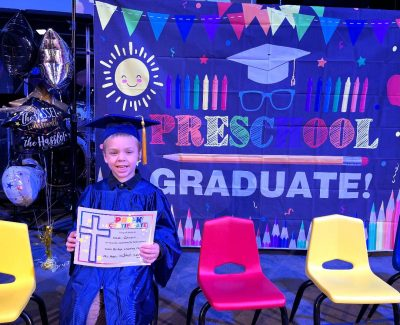
Noah graduating from Pre-K
Noah’s parents instead moved forward with genetic testing, receiving their son’s diagnosis of LCA and a confirmed genetic diagnosis of LCA9NMNAT1.
“I can tell you this, when we first got Noah’s diagnosis, it was extremely emotionally hard, and it took a whole season of trying to come to grips with it,” she said. “What does it look like? We don’t wear glasses, no one in our family wears glasses or has anything wrong with their vision. It came completely out of nowhere; it was a bit of a shock.
“We just dove deep into our faith, and we had so much of a peace about it. We just cried to God about it. That sustained us through that time of all these things going through your head about what he’ll ever be able to do and whether vision is the only issue.
“There’s a still a unique peace about it that we carry to this day.”
Looking forward to the 2023 LCA Family Conference
The mother of five, working at home full-time as a health insurance account manager, and her husband, who is an occupational therapist with the Veterans Administration, sought out as many people and organizations as possible to find services, to understand LCA, and to learn about retinal disease research.
“I was thinking of people to walk this journey with because it’s an extremely rare diagnosis,” Stephanie said. “I was trying to find other people who have walked through this and are now adults.”
She also attended the 2019 Hope in Focus LCA Family Conference in Philadelphia, where she connected with other families living with LCA and researchers working on treatments for the disease.
And she’s planning to attend Hope in Focus’ third LCA Family Conference this week from June 23-24, 2023.
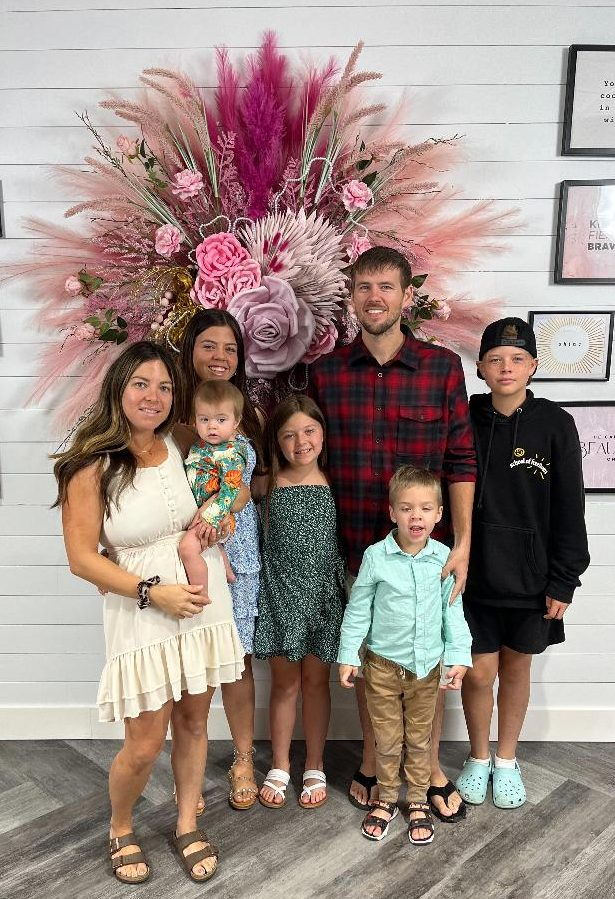
The Johnson Family
“I think the LCA conference is so vital. It was a great experience, and I’m looking forward to it even more this year.
“We’ve been at this much longer. We know more, we know what to ask. With Noah going into kindergarten, it’s important to connect with families and talk about how their children went through kindergarten.”
While she’s excited about advances in LCA research that could help Noah, she worries about the effectiveness and risks of trying new therapies.
“The progress made in just the past five years is amazing, and we are optimistic for further advancements, especially for NMNAT1.”
Biotech to advance NMNAT1 gene therapy research
Stephanie finds comfort knowing Noah’s form of LCA is among three in the scope of research advancement by Opus Genetics, a biotech created through the Foundation Fighting Blindness’Retinal Degeneration Fund (RD Fund) to invest in projects in, or advancing toward, early-stage clinical trials.
Ben Yerxa, PhD, Chief Executive Officer of Opus, characterized the company as a first-of-its-kind model for patient-focused development.
“As the first company launched by the Foundation’s venture arm, RD Fund, Opus is uniquely positioned to bring experts, resources, and patients together to efficiently advance ocular gene therapies for small groups of patients that to-date have been neglected.”
Opus’ lead program addresses mutations in the LCA5 gene encoding the lebercilin protein. The next one focuses on LCA13 RDH12, caused by mutations in the retinal dehydrogenase gene.
The company’s third program targets LCA9 NMNAT1, the gene mutation affecting Noah’s vision.
Stephanie met the Foundation’s Ben Shaberman and Ben Yerxa at the 2019 conference when he served as Foundation’s CEO.
“It just feels so exciting that he is leading Opus. He is a wealth of knowledge for the blind community and has been essential in raising money for research, as money is such a major part of moving this research forward.”
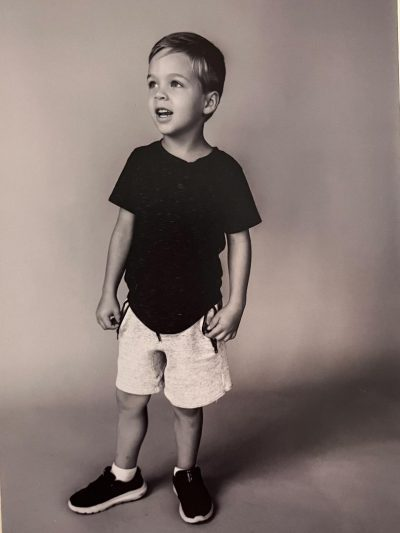
Noah
Onward to kindergarten
Doctors think Noah’s vision is 20/200, with little central vision and more peripheral vision. Considered legally blind, Noah navigates well, with most people not even knowing he has vision loss.
“I’m just excited, but nervous, about him going into the school this fall, just because I’ve never walked this journey with a school-aged child.”
Stephanie and Brian look forward to meeting and talking with other families living with LCA to gain insight into their son’s progress.
For now, though, Noah continues enjoying his favorite food – pepperoni pizza – and his favorite things: Toy Story movie’s Buzz Lightyear, monster trucks, and, at night: the rockets and the moon.
Desirae Potts breaks into tears when she recalls the first time a doctor said her infant son James had a disease she’d never heard of – Leber congenital amaurosis, known as LCA.
“I had no earthly idea what she was talking about. I left that appointment, I remember feeling so confused and so sad,” the 33-year-old mom said.
The doctor didn’t or couldn’t give Desirae and her husband, Robert, any information about LCA because the doc didn’t know a thing about the rare inherited retinal disease.
A smiling James Potts
“I had to grieve the life that my son would have had,” she said. “But I also wish that I knew then what I know now, that is: Whether he could see or not, I have a bright light!
“He’s so amazing, I couldn’t imagine him any other way and I wouldn’t change it if I could.”
She thought about the best way to bring up her son.
“I quickly learned the best way to raise him would be to raise him like my sighted children. He is the most resilient and bright young man. I know he is so smart. He amazes me every day.”
Mom becomes nurse to better help her son
James was 10 months old when his parents learned their younger son’s genetic diagnosis: LCA1* caused by a mutation in his GUCY2D gene.
About the same time, Desirae kept listening to doctors talking over her head and decided to become a nurse.
“I wanted to help him with my knowledge. It definitely helps because I have more medical knowledge than I did before. I understand what the doctor is saying. The doctors used all these words I didn’t know, and I was scared that I didn’t know.”
She began nursing school in James’ first year and earned her nursing degree about a year and a half ago. James is now 4.
“I’m not as worried now, and I know what to do in certain situations.”
James goes to school for the full day in an integrated classroom at the same school as his older brother, 9-year-old Robert. His older sister, Ariona, is in high school.
Their mom is the school nurse at the four middle schools in the district of their South Texas coastal city.
Keeps informed of LCA1 GUCY2D research
Desirae knew something wasn’t right with her baby’s vision at 2 months when he didn’t track objects or light. At 4 months, an ophthalmologist prescribed glasses, but they didn’t help.
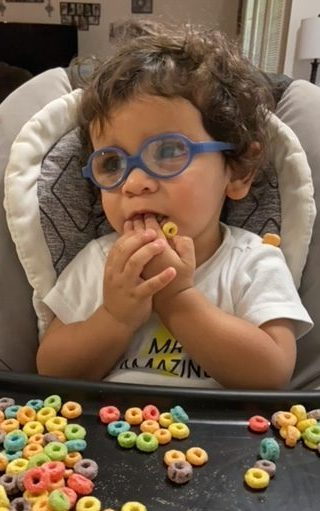
James wearing his “Mr. Amazing” shirt
After the initial retinal disease diagnosis, James received his confirmed genetic diagnosis 6 months later at Baylor College of Medicine by Richard A. Lewis, MD, MS, Professor of Molecular and Human Genetics at the Houston medical school.
Annually, James visits John T. Stout, MD, PhD, who keeps the family informed of research in the LCA1 GUCY2D space. Dr. Stout specializes in retina/macular and retinal vascular diseases at Texas Children’s Hospital. His current research projects include human gene and stem cell therapy for proliferative and inherited ocular disease, retinal disease genotype-phenotype correlation, and intraocular angiogenesis, the formation of new blood vessels from the existing vascular tree.
LCA accounts for 5 percent of all retinal dystrophies and 20 percent of blindness in school-age children.
James received early-intervention therapy, and orientation and mobility therapy during his first years. He also sees a speech therapist at school and a developmental specialist in town.
Right now, his favorite food is bagels and butter. And he absolutely loves music and Daniel the Tiger, a spinoff from Mr. Rogers Neighborhood, where he sings songs about learning, and growing, and what to do with feelings.
James does not yet have words to describe his sight, which makes it hard to explain what he can see, although his mom believes he has light perception.
James’ vision is a family affair
“It not only affected him, but it also affected all of us,” Desirae said. “We all had to adjust and learn how to make things in a way that he could do things on his own and foster his independence.”
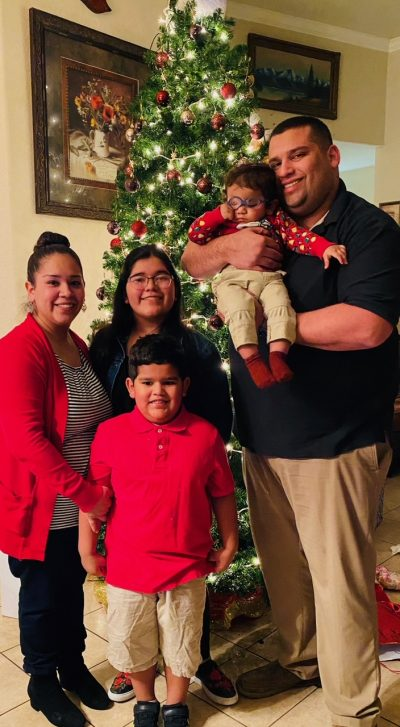
The Potts Family
Ariona, James’ 17-year-old sister, nurtures her little brother, with mom adding, “She’s the closest thing to me he can get. She’s very, very helpful.”
Robert was 5 when James was born.
“He didn’t quite understand what’s going on and how to be accommodating to his brother. We definitely had to inform him.”
Desirae is concerned about James pressing or rubbing his eyes, a symptom of LCA called oculodigital reflex. While the doctor said the reflex is normal, she is worried the action may cause harm. She tries to keep him occupied.
“I try very hard, but James is maybe the most headstrong person I have ever met in my entire life. If you tell him to do something, he will do the complete opposite. So, I tell him, ‘Don’t let me see your eyes,’ even though I don’t want him to defy me.”
James loves to explore and see with his hands.
“We don’t use the word ‘blind.’ We prefer to say that he sees with his hands. We don’t say ‘blind’ or ‘visually impaired.’ We do not want him to think that that would define him.
“That was something I had to teach both of our children, my husband, and all of our family. Some relatives are still in denial. We don’t put him in a box. We let him explore and have the same toys as his brother and sister,” she said.
“We try to have everyone stay on the same page to help build his confidence. Like it’s normal for him that he sees with his hands.”
Jessi Crawford fancied the clarinet when she played in her middle school band, while classmate Ted Beaman favored the trombone and guitar. Never did they dream their love of music would manifest a half lifetime later with the birth of their youngest son.
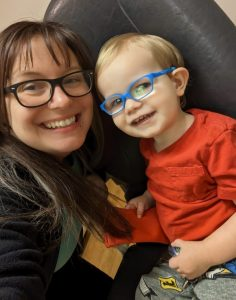
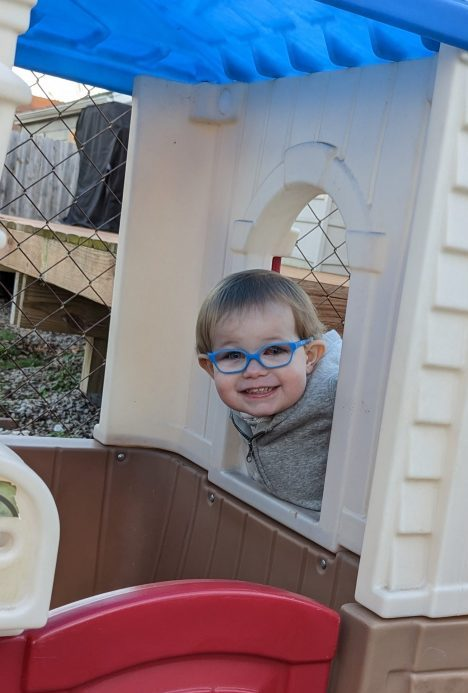
Atlas mixing it up!
Music is everything to almost 2-year-old Atlas – he loves to sing, he loves to dance, and he loves all kinds of music.
Before the toddler developed his interest in music, his parents noticed something about his eye movements.
“Out of nowhere,” at one-and-a-half-months old, his mom said, he developed horizontal and vertical nystagmus, characterized by side-to-side and up-and-down rapid, repetitive, uncontrolled eye movements.
Atlas received his first pair of glasses at 3 months from Kellogg Eye Center in Ann Arbor, Michigan, about an hour drive from the family’s home in Toledo, Ohio.
A month later, doctors suspected Atlas had Leber congenital amaurosis (LCA), a rare genetic eye disorder in which the rods and the cones of the retina – the light-gathering cells – do not function properly.
Geneticists confirmed his genetic diagnosis as LCA6 caused by a mutation in his RPGRIP1 gene. LCA6 can be particularly devastating because of its rapid onset and progression.
“This took us completely by surprise,” Jessi said. “What do you mean, we both have this dysfunctional gene? What are you talking about?”
She was more than floored, especially because her oldest son, 11-year-old Brayden-Lee, has a rare, life-threatening form of autism and epilepsy. Brayden-Lee and Atlas also have a 7-year-old brother named Ronan.
Jessi found comfort and encouragement from the geneticist and the genetic counselor, but it took time to process the idea that her son’s vision would deteriorate.
Atlas and mom, Jessi
“You have all these stigmas around losing your vision being the worst thing on the planet, but I realized he could still have a happy life. He’s not dying, he’s just going to lose his vision – that perspective helped a lot.”
She’d already enlisted state and local resources to help Brayden-Lee, so she began searching for any available support and assistance for Atlas.
“I found him an O&M (Orientation and Mobility) specialist, a developmental specialist, and a vision specialist, so he wouldn’t fall behind in anything – movement, sensory output, anything.
“I was still really kind of sad and overwhelmed, and, of course, worried, because I never experienced anything like this before. My oldest son had occupational therapy, speech therapy, hospital visits galore, but I never dealt with anyone who couldn’t see.”
LCA6 RPGRIP1 preclinical research underway
Atlas turns 2 in May and he’s quite advanced, talking in 4-, 5-, 6-word sentences.
“He knows his shapes and he’s working on colors, which is hard because he sometimes blends colors.”
Atlas has no vision from the midline of his eye, down. He has vision above, for now, and cannot see close up.
Jessi and Ted’s little boy underwent eye muscle surgery in February to release his eyes from crossing, which has helped his vision.
Atlas
Jessi connected with Odylia Therapeutics, a biotech working on late-stage preclinical studies for a potential treatment for the RPGRIP1 mutation, and, hoping to help advance research, she authorized the company’s use of images taken of her son’s eyes during the surgery.
The Atlanta-based business is developing an investigational gene therapy to treat vision loss caused by LCA6 and is working with vector technology developed by Odylia Co-Founder Luk Vandenberghe, PhD. The research builds on data generated at Massachusetts Eye and Ear in the labs of Vandenberghe and Eric Pierce, MD, PhD, a physician and surgeon at Mass Eye.
Odylia hopes to begin trials in 2025 and is seeking partnership or philanthropic funding for the estimated $3.5 million development costs.
Jessi said she’d like to enroll Atlas in a clinical trial, just not the first one because she fears possible, yet undiscovered, side effects from experimental treatment.
Watching Mickey Mouse and Listening to Rock ‘n’ roll, Country, Celtic, and Native American
Atlas loves music, singing, and watching TV.
“He loves watching Mickey Mouse-anything. He stood at the mirror, pointed at his shirt in the mirror and said, “Mickey Mouse, blue shirt, mamma.”
A happy child who loves raisins and pizza, he reaches for things and gets his spoon or fork to his mouth, while getting food into it is another thing.
Jessi said Atlas has a tough time with the letter ‘f’ and says shork when he means fork.
Atlas enjoying the beach
“He tells me every day, fork and bowl, fork and bowl, or ‘shork a bow, mamma, shork a bow.’” Jessi said just thinking about it makes her laugh.
The 31-year-old characterized herself and her fiancée, 32-year-old Ted, as “both huge, huge, musical people,” beginning back in the school band, when they started dating in their teens and later went their separate ways, only to start dating again four years ago.
“The fact that Atlas likes music so much is better for us. He loves Disney music, also rock, country music and Celtic, and Native American.
“So, when I say we’re well rounded, we’re well rounded.”
As general manager and vice president of Cardinal Honda in Groton, Conn., Kim Cardinal Piscatelli donates time and money to charities. But when she heard about Hope in Focus and the organization’s advocacy for people living with visual impairment, it struck a personal chord.
Piscatelli was a teenager when she watched her late grandmother slowly lose her vision to glaucoma.
“It was scary to watch her go through that,” Piscatelli recently recalled. “I loved her very much, and I saw her world get smaller and smaller.”
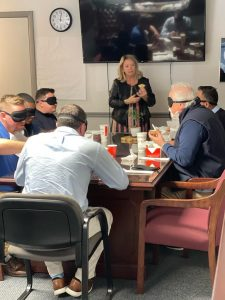
Employees blindfolded
Piscatelli and her family, including her sister, learned how to help her. They closed their eyes and folded laundry. They learned to present meals as if they were on a clock.
“The chicken is at 12 o’clock, and the coleslaw is at 3 o’clock.”
Hope in Focus’ Dinner in the Dark gala fundraiser, an annual culinary adventure that involves wearing a blindfold while eating food from a secret menu, immediately appealed to Piscatelli. She asked her sister to come with her.
“I was so excited,” she said. “As a child, I remember that the empathy I had for my grandmother would lead us to do things to learn to empathize with her.”
Though the concept brought back memories, it wasn’t exactly muscle memory. The two were eager to go, but a bit apprehensive.
“I remember holding hands under the table and being like, ‘I don’t know what is going to happen, but you are right here, right?’” Piscatelli said.
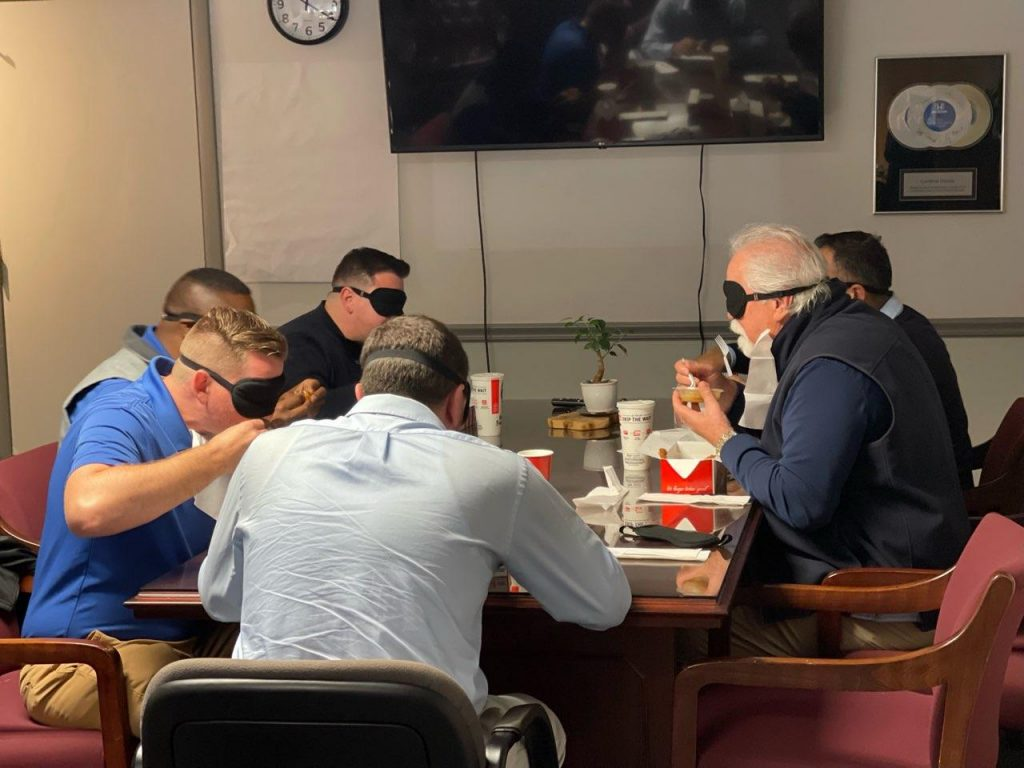
She loved it. Over the years, she’s brought her children, too. But she also has taken the concept back to Cardinal Honda. It started with a morning meeting four years ago. Employees wore blindfolds
“There’s a lot of conversation about diversity and inclusivity,” Piscatelli said. “It seemed like a good way to participate in that conversation.”
That conversation has grown significantly since then, as companies and individuals look to be more inclusive and empathetic to everyone. So, in 2022, the year Dinner in the Dark returned from a two-year pause due to COVID, Piscatelli resurfaced the exercise.
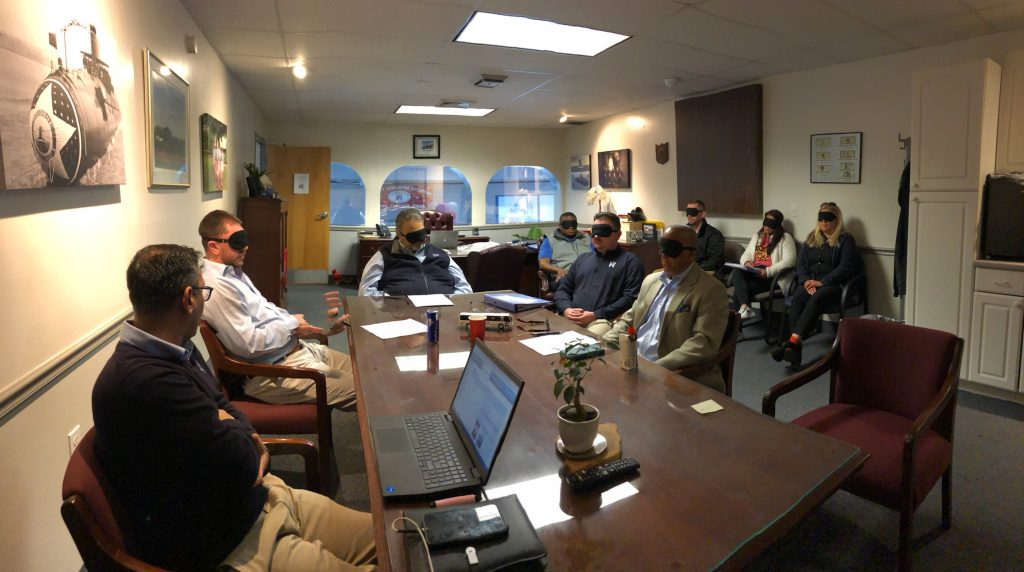
The group blindfolded.
It was a surprise twist on the typical Monday morning meeting — Piscatelli hadn’t announced her plan. Still, nine of the 10 employees put on blindfolds, while one took photos. When the blindfolds came off, people expressed similar sentiments to those Piscatelli felt during her first Dinner in the Dark.
“They reported they were paying more attention and not worried about what everyone else in the room was doing,” Piscatelli said. “Someone said they felt lonely…because you are not looking around the room making connections or eye contact.”
But even with the uneasiness, people showed interest in trying it again. When Piscatelli asked for six volunteers to put on blindfolds for lunch, the hands shot up.
They tried using tips Piscatelli learned at Dinner in the Dark from Sofia, daughter of Hope in Focus Co-Founder Laura Manfre, and a young woman living with LCA: Bring your food to your face, not your face to your food. Piscatelli announced the clock placement of the meal for the employees, just as she used to do for her grandmother.They huddled up after to discuss.
“Someone said it gave them a whole new perspective,” Piscatelli said. “They didn’t know if they had food on their shirts. They were more aware of what they were eating and how it tasted better, but said it was hard to eat. They lost track of what food was where on the plate.”
Employees sitting in a meeting with blindfolds on
Piscatelli hopes the exercise allows her employees to feel more empathy for people with vision loss and think of strategies to make the world more inclusive for them.
“It forced them to think about different sorts of things,” Piscatelli said. “Instead of changing what was on TV, we had to announce what was going to happen next. It helped people be prepared without visual tools.”
In a home with a person with vision loss, people can announce who they are and why they are coming into the room. For example, “It’s me, Kim, and I am here to do laundry.”
In the end, the staff learned something new and embraced leaving their comfort zones.
“It turned their day…it wasn’t a typical Monday,” Piscatelli said. “Everyone was more aware: What else do I not know?”
Piscatelli hopes other businesspeople feel inspired to learn what they don’t know about vision loss.
“It’s one thing to talk about equity, diversity, and inclusivity.” Piscatelli said. “It’s another thing to immerse everyone in an exercise where they feel empathy for people who have low vision and compassion for other people as they are temporarily trying that on.