
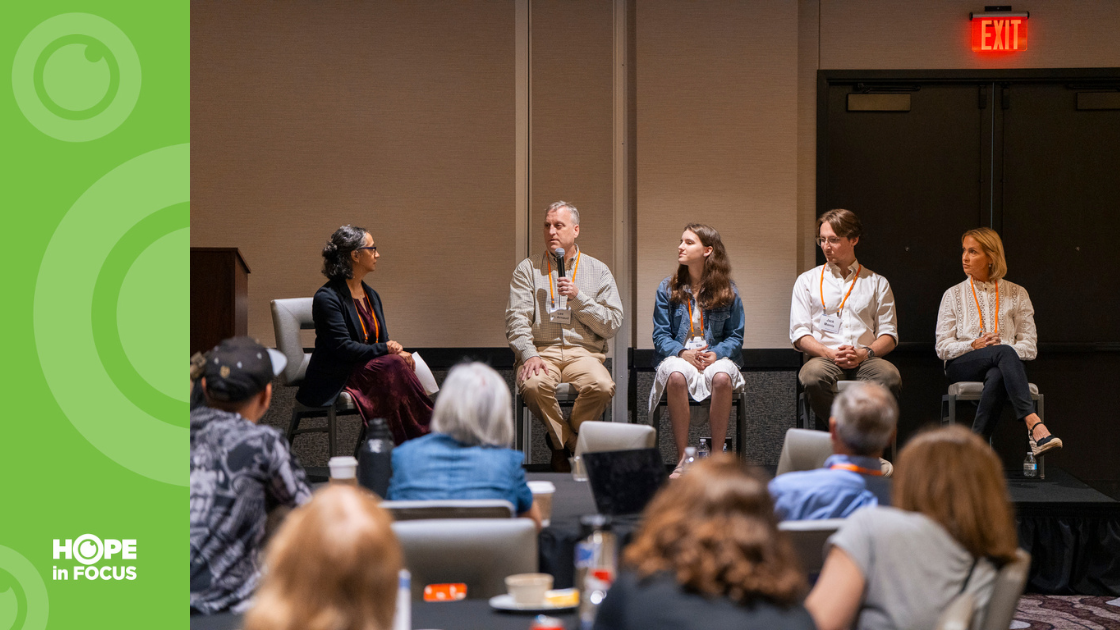
The 2025 LCA Family Conference in Minneapolis, MN, offered four informational panel sessions, where the 135 attendees learned about living with Leber congenital amaurosis (LCA) and other inherited retinal diseases (IRDs), participating in clinical trials, and the latest research and therapy updates.
The first session, “Living with an IRD,” was moderated by Laura Manfre, co-founder and Board Chair of Hope in Focus. This session is often a highlight for families wanting to learn how to support their children diagnosed with an IRD.
Laura Manfre, Lee St. Arnaud, Elle St. Arnaud, Jack Morris, Leslie Morris
Laura posed questions to the four panel participants, which included 18-year-old Elle St. Arnaud, who has LCA IQCB1/NPHP5 and is attending Boston University this fall, and her father Lee St. Arnaud, and 22-year-old Jack Morris, who has RP CRB1 and is a recent graduate of Brown University, and his mother Leslie Morris.
Below are some of the panelists’ edited responses to Laura’s questions.
What has your school journey been like? What challenges have you faced, and how did you advocate for yourself?
Elle St. Arnaud
Elle was educated in the public schools with a paraprofessional supporting her in class from preschool through fourth grade. She said that a key to her success was learning to advocate for herself early on by participating in her individualized education plan (IEP) meetings, explaining her accommodations to teachers, and taking responsibility for communicating her needs, especially regarding her vision. Elle reflected on the importance of self-advocacy and how it has shaped her life.
“It’s vital for kids to be able to explain their accommodations, as others often don’t fully understand visual impairments,” she said. “While I’ve had positive experiences, I’ve also faced challenges, such as being discouraged from joining the debate team or taking advanced classes. I pursued both anyway, proving that being blind doesn’t limit one’s ability to succeed. Self-advocacy and standing up for your needs are essential life skills.”
Jack Morris
Jack started in public schools and later switched to a private school. His vision was relatively good throughout most of his schooling. Jack thought he might have done even more to advocate for himself. Still, regular meetings with teachers and advisors proved very helpful. He said, “When people understand what you need, they generally want to help.” Although at the university level, he said some professors were resistant to making accommodations.
He stressed that “Accommodations are not favors—they are necessary for success. Blind individuals are not less intelligent; they simply need equal access to materials to perform just as well as others. Having confidence in advocating for these needs is crucial, and legal protections like the ADA support this.”
As parents, can you share a little about your journey? How was it seeking a diagnosis, and what are some things you wish you’d known earlier?
Lee St. Arnaud
Lee explained that Elle and her older brother, Patrick, both have LCA. When trying to diagnose Patrick’s vision issues, he shared how difficult it was when the doctor offered only a brief response, instructing them to return in five months to confirm their son’s blindness. Overwhelmed, the family immediately reached out to resources like the Chicago Lighthouse for the Blind, which connected them with supportive networks and foundations.
Lee stressed the importance of parents being proactive and finding tools like a detailed year-by-year visual goals guide, which they used effectively in IEP meetings to advocate for their children’s needs. He emphasized the importance of being prepared, pushing for necessary services, and actively advocating for the child and family.
The St. Arnauds encouraged their children to participate in outside activities like adaptive climbing and the live hockey association. “So many times we were nervous and sweating bullets. But by the time we got done, the kids were like, you know what? We can do this!” Lee said.
Leslie Morris
Leslie said that Jack’s diagnosis with a recessive form of RP at age five came as a shock because there was no family history. She described feeling heartbroken and overwhelmed by a sense of loss and isolation. Despite these emotions, Leslie and her husband, Jason, chose not to accept discouraging responses from doctors. Instead, they took action—connecting with others affected by IRDs and becoming involved with the Foundation Fighting Blindness, where both serve as trustees.
Advocacy became like a second job for the Morris family, as they worked to ensure Jack had every opportunity for a full and meaningful life. Leslie said they didn’t want the disease to define their son, and they encouraged him to try various activities like baseball, football, swimming, wrestling, and guitar. “We focused on letting Jack decide when to step away from activities while gently steering him toward pursuits that offered long-term fulfillment,” Leslie said.
How do you give your child enough independence to grow and to learn, while also wanting to protect and keep them safe?
Lee St. Arnaud
Lee felt that they didn’t experience significant disagreements with Elle or Patrick regarding their ability to self-manage. He stressed the importance of balancing caution with encouragement and supporting early opportunities for independent experiences in the community without rushing the process. He also reflected on the importance of understanding your child’s interests as they mature.
Elle St. Arnaud
Elle immediately spoke up after her father, expressing her childhood frustration and conflict with her parents over having to take Orientation and Mobility (O&M) training particularly the inconvenience and social discomfort of being taken out of school. Despite hating it at the time, she admitted the lessons had long-term value, especially in promoting independence. She noted the importance of starting children early with independent tasks at home, like cooking and laundry, while pacing community-based skills more carefully. “I think parents should keep their children engaged in O&M even if the child resists,” Elle said. “Because it equips them with critical life skills—such as safely crossing the street—that pay off later.”
Leslie Morris
Leslie emphasized the importance of parental teamwork and unity, particularly when supporting a child’s journey toward independence. She admitted to being a bit of a helicopter mom. “My husband, Jason, and I agreed on things before letting Jack go out and try them,” she said. “Having somebody by your side through this journey is very important.” She added that when parents are aligned in decisions and approaches, it helps minimize conflict and makes the process smoother.
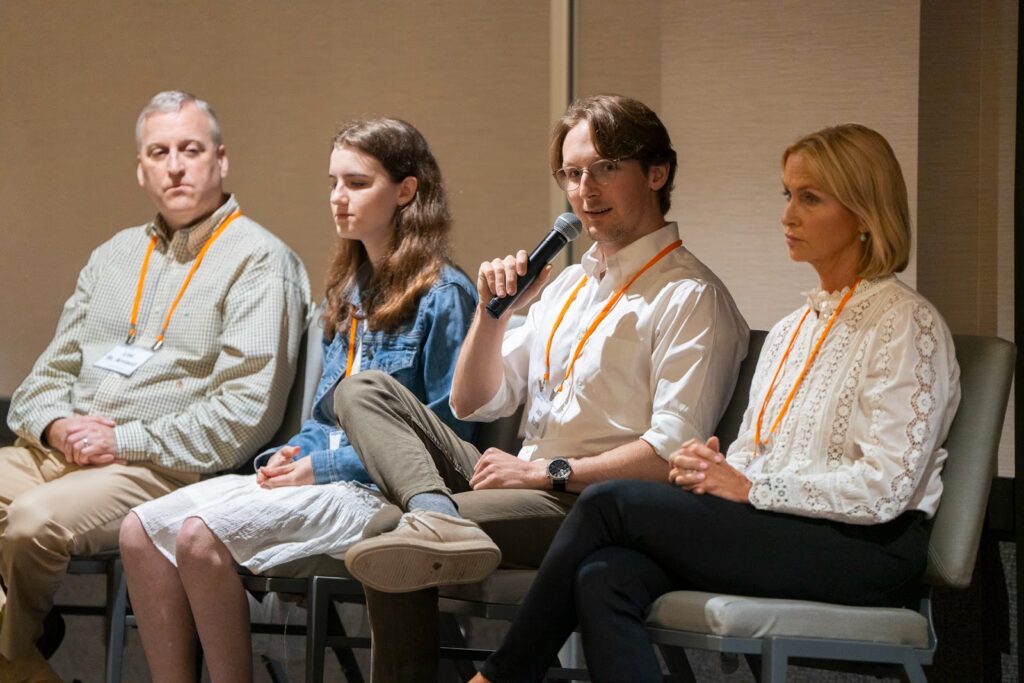
Jack Morris speaking at the 2025 LCA Family Conference
Jack Morris
Jack didn’t recall having major conflicts and expressed gratitude for the trust his parents placed in him. One slight regret he had was not wearing sunglasses earlier, due to self-consciousness. Jack said he appreciated the opportunity to try things—even fail—while still feeling supported and safe.
Much to the amusement of the conference attendees, Jack recounted a brief period when he was legally allowed to drive, a decision made with medical guidance that, in hindsight, seemed very questionable.
“I appreciated that my parents trusted me to be able to take care of myself. This journey makes you resilient, tough, and resourceful,” Jack said. “Kids can be very clever in planning solutions to their unique circumstances, and my parents trusted me in that.”
Community members have expressed that mental wellness and accepting vision loss can be difficult. Elle and Jack, what are your thoughts?
Elle St. Arnaud
“Not wanting someone to see your pain and not wanting to wear sunglasses or use a cane will likely peak around middle school,” Elle said. “No one wants to be different, and you want to be ‘on trend’ with everybody else.”
She added that having a para in the classroom with her all of the time was an inhibitor and made it harder for her to talk with other kids. “Parents should try not to hover when their child is with other children because it can make them feel less confident or social,” she said.
Elle said she made it a priority to share her experiences as a blind person with her sighted friends. “We’d make jokes about it, and I talk about it constantly. I’d share what I’ve experienced and every blind story I’ve had,” she explained. “I think that’s important because when you need to ask your friends for help, they are a lot more understanding because you’ve explained it and talked about it so many times with them.”
For example, she told her friends about walking into a door, which helped them be more aware that she might not see it, allowing them to take the initiative to guide her when needed. “I think the easiest way to be accepted is to talk more about your blindness so it feels more normal,” Elle said.
Jack Morris
“I think there’s a line to be found between letting a disease define you and rejecting that it’s a part of you, because retinitis pigmentosa (RP) has been a huge part of my story—a beautiful but also a tough part. It’s something that feels different and lonely, but also unifying and community-building,” Jack said. “If we can find ways to live in and with our disease rather than despite it, that’s where truth and freedom lie for me.”
He offered advice to parents, saying that they needed to be strong in ways that aren’t obvious. “One of the hardest things for parents is watching their child struggle. But sometimes the biggest strength is allowing them to struggle. Kids need to feel the full spectrum of emotions—challenge, loneliness, empowerment, and togetherness,” Jack said. “If parents can be there as a foundation, even when things are hard, and let them be hard before stepping in with action, that’s one of the most powerful and meaningful things they can do for their children.”