VISION BEYOND SIGHT: The Power of Community

It can be easy to feel alone living with an inherited retinal disease (IRD). As a kid, only one other person in my school had a visual impairment. Recently, I went on a first date with someone who said, “Forgive me if I ask any dumb questions—I’ve never dated someone who is visually impaired before.” She is not the first person to express such a sentiment on a date with me. In fact, I’m pretty sure I’m the first visually impaired person for every woman I’ve dated. I’m also the first visually impaired colleague, friend, etc., for most people in my life.

Throughout my life, community has played a significant role in helping me feel less alone in these moments. I’ve been fortunate to be connected to groups of other visually impaired people, where I’ve been able to learn from their successes, feel less alone by connecting with others who have similar experiences, and support people who are experiencing challenges I have overcome.

It is common for young people with visual impairments not to feel fully seen or understood by their sighted peers. For many, finding a community of visually impaired peers is the first time they feel they can truly be themselves in social situations. These environments can help them develop more confidence interacting in other social situations.

Having access to such communities has helped me get to where I am today. When I think that accessibility barriers are too significant to overcome, I can look in my community for proof that it can be done. When I feel like I am the only person going through a particular challenge, I can ask my community to find someone who has already overcome it. When I encounter an accessibility = barrier that feels unfair, my community and I can work together to fix it.

Many things can contribute to a visually impaired person’s success, and having a community is one of those foundational things that I encourage everyone with a visual impairment to seek. Of course, a community can only do so much. But I’ve learned that people are resilient, and having a community can help us find and develop resiliency.

Connecting with organizations like Hope in Focus can be an excellent opportunity for you and your family. Learn more about the Hope in Focus Family Connections program, our LCA conference 2025, and other organizations supporting those living with visual impairment on our website at hopeinfocus.org.

Let’s Chat About … Patient Registries and My Retina Tracker

Join the My Retina Tracker® registry and you’ll be contributing to science by driving research to help improve your quality of life and to find treatments and cures for Leber congenital amaurosis (LCA) and other rare inherited retinal diseases (IRDs). 

The free and secure online registry launched six years ago by the Foundation Fighting Blindness is being updated and your feedback is needed. The organization currently is conducting a “user-experience” survey of its membership to glean new ideas to make the registry more effective for patients and for researchers, according to the Foundation’s Todd Durham

Now, through at least the end of June, you can contribute by taking the survey on the registry’s website and updating your profile. If you’re not already part of the registry, click here to join. The global registry has more than 18,000 members and is open to anyone with an inherited retinal condition and/or adult caregivers of children.

As the Foundation’s Vice President of Clinical & Outcomes Research, Durham is responsible for directing the organization’s Clinical Consortium of retinal experts, developing strategies to enhance product development, partnering with industry, and providing technical input on partnered programs and investment decisions.

The Foundation is the world’s leading private funder of retinal disease research and collaborates with patients, caregivers, researchers, and biopharmaceutical companies. That funding has been a driving force behind the progress toward cures, including the identification of more than 270 genes linked to retinal disease, and the launch of 42 clinical trials for potential treatments.

Durham discussed the patient registry and survey in our May webinar episode: “Let’s Chat About … Patient Registries and My Retina Tracker®.” Sofia Sees Hope Director of Marketing and Communications Elissa Bass moderates the free monthly webinar series. You can watch the webinar here

Durham earned a Bachelor of Science in Public Health, a master’s in biostatistics, and a PhD in health policy and management (Decision Science and Outcomes Research) from the University of North Carolina School of Global Public Health. He has more than 25 years of drug-development experience.

Understanding Patients and Retinal Disease Through Data

A patient registry is a planned collection of data around a disease. My Retina Tracker distinguishes itself from others by focusing on inherited retinal degenerations or diseases with the purpose to understand genetics, prevalence of conditions, and impacts of IRDs on individuals’ lives. 

The registry also enables researchers to find people for clinical trials, especially challenging work in the rare disease world of LCA and other IRDs.

Registry subsections include assistive devices, driving, visual symptoms, and the recently added “My Health Today,” a series of questions developed by the National Institutes of Health (NIH) to assess physical and mental health.

To become a member, click on ‘Register Now’ and follow the prompts to establish a username and password and to answer questions to build your personalized retinal health profile. You are then guided through a series of questionnaires developed by retinal clinicians, geneticists, genetic counselors, and rare inherited retinal disease researchers.

The registry becomes your personal retinal health record, updated by you and your doctors. Your history and testing results create a critical resource in tracking the progress of your disease and becoming part of a comprehensive database. It employs state-of-the-art technology to protect privacy and adheres to the highest standards of confidentiality and ethics.

Your disease information is accessible only to you, Foundation registry staff, and researchers who meet a rigorous scientific review application process to use the data for studies and to reach individuals to participate in clinical trials, Natural History studies, or focus groups. Your personal information is never shared with researchers.

It’s important to update your profile because the data unique to those living with LCA and other IRDs gives researchers a trove of opportunities for studies. The more complete the profile, the more likely you are to be contacted about a research opportunity. 

“Many of our research collaborators may approach us with a research idea and a certain criterion they want to apply to their study, and we use as much data in the profile as we can to help find the right target for that study,” Durham said. “As your vision changes, as your life situation changes, we’d like to know the milestones along the way. That’s informative information.”

An important improvement to the registry would be the ability to highlight to its members the research emanating from the information given by registrants. Completing the survey and giving specific feedback will help accomplish this.

“The key focus right now is delivering back to the members some information that they find useful, that shows that they are contributing to science.”

The Foundation also wants to engage its registry membership more regularly with information tailored to profiles.

“Speaking with a number of individuals involved with the Foundation, they say ‘it sure would be nice if when I tell you that my gene is, let’s say, EYS that you could tell me more about people like me.’ We’re looking into some ways that we can collect that data, put it in a way that’s understandable, digestible, presentable, and make that available to our membership, the registry.”

Results from the user-experience survey will be central in making the registry more valuable.

“As much as possible we really want folks’ feedback and, in this survey, we ask about their experience not just with the registry itself, but also with our genetic testing program, which many people have been able to take advantage of.

“We’re in a rapidly evolving research field; we’ve got new therapies coming all the time. To me, it’s important to put in mechanisms where we can learn along the way, and we’ll want to get as many indicators as possible.” 

Patient Registries: Making a Difference Through Research

Every month, six or seven researchers contact the Foundation for access to the registry, Durham said. One proposed study would look at patient experience with genetic testing and counseling

“How did that counseling session change the way they view their life, what impact did it have on them? This is very promising and interesting research. When we saw this, we thought this is very relevant for our members and for our community in general because we believe genetic testing is hugely important. 

“From my conversations with individuals, that moment when you have the clarity of a genetic diagnosis is kind of a day that you remember. It is now the time where I can at least ask the question, ‘what is the typical progression for folks like me? Are there research opportunities for me? What are the research prospects for people like me?’

“All this research can make a big impact.”

One project using registry data produced an analysis estimating the cost of illness for an IRD – an economic burden of up to $31.7 billion in the United States.

“When you see the paper as to the estimated cost to the U.S. of the IRDs, that study result came because people participated in the My Retina Tracker registry.” 

The Foundation plans to prepare reports or peer-reviewed publications out of the registry over the coming years to show the research community how much can be learned about what life is like with an IRD.

Patient Registries Put People at the Center of Research 

The registry also is an integral part of patient-focused drug development, a national concept organized by the U.S. Food and Drug Administration to put patients at the center of research. 

“This is a unique thing that the Foundation is doing to make sure we don’t lose sight that there are humans, there are people and lives that are impacted by research.” 

In a partnership as part of this patient-focused research, Sofia Sees Hope and the Foundation conducted intensive workshops on the CRB1 and IQCB1 genes that included the voices and perspectives of patients and their families, along with dozens of leading experts.

Another example of patient-centered research is the collaboration between the Foundation and the biopharmaceutical industry to study males with X-linked retinitis pigmentosa (XLRP), an incurable genetic disease that causes blindness in men and affects about one in 15,000 people.

“We’ll be surveying people through our registry and then convening a panel of experts and inviting the FDA to attend a workshop about results of the work and also inviting affected individuals and their caregivers to tell us what life is like with XLRP,” Durham said.

Living in a Time of Hope

Retinal research has come far, with more than 40 clinical trials underway.

“This is an exciting time, and I don’t think it’s an exaggeration to say, which should be a great time of hope, because 10 years ago there were not a whole lot of treatments to talk about,” he said, “and now even as the Foundation stands, we struggle to keep up with all the latest news amongst therapy developers.”

Not all therapies work out, but researchers learn a lot in the process of product development.

Also, conditions once thought to have been impossible to treat now have multiple therapeutic approaches, with even more in the pipeline.

Durham said, for example, neuroprotection, which is the relative preservation of neuronal structure and/or function, and neuroprosthetics,* implantable medical devices that provide some degree of vision to people with blindness.

“If we can just slow down the further degeneration of the photo receptors that could be really helpful, that could add hopefully years to vision. Gene therapy has the potential in many cases to restore vision that was lost. And you have even new technologies for later-stage disease, like (visual) neuroprosthetics.

“It’s pretty amazing technology that’s coming out.”

Natural History Study of Usher Syndrome Type 1F Launches

A new Foundation Fighting Blindness initiative just getting underway is a Natural History study of Usher Syndrome Type 1F (USH1F) caused by a mutation in the PCDH15 gene. The objective of the study is to understand the progression of the inherited condition.

The rare disease causes hearing loss, balance problems, difficulty with gaze stabilization, and progressive vision loss. In childhood or by early adolescence, individuals with USH1F will develop retinitis pigmentosa (RP), an eye disease that causes night blindness and a gradual loss of peripheral vision.

“The main purpose of a study like this is to help design clinical trials in the hopes of accelerating the research process, making sure the design is well-targeted, not too onerous and not too burdensome,” said Todd Durham, Foundation Vice President of Clinical & Outcomes Research. He described the study during a recent Sofia Sees Hope webinar about the Foundation’s My Retina Tracker® patient registry.

“If we can develop a way to measure the progress of the disease in the absence of a treatment, we can decide whether the follow-up period after administration of that treatment should be two years, would one year suffice, and what tools do we ultimately judge the efficacy of that new treatment.”

Which States Have Rare Disease Advisory Councils?

15 states with an established Rare Disease Advisory Council:

Alabama, Kentucky, Illinois, Massachusetts, Minnesota, Missouri, Nevada, New Hampshire, New York, North Carolina, Ohio, Pennsylvania, Utah, Tennessee, and West Virginia.

Arkansas, California, Florida, Georgia, Kansas, Michigan, New Jersey, South Carolina, Texas, Virginia, Washington, and Wisconsin.

23 states with no Rare Disease Advisory Council:

Alaska, Arizona, Colorado, Connecticut, Delaware, Hawaii, Idaho, Indiana, Iowa, Louisiana, Maryland, Maine, Mississippi, Montana, Nebraska, New Mexico, North Dakota, Oklahoma, Oregon, Rhode Island, South Dakota, Vermont, and Wyoming.

‘We know how important it is to know your gene. We’ve lived it.’

It took more than seven years to get a genetic diagnosis for our daughter. During that time, doctors were pretty sure she had LCA, although we also heard that maybe she had cone-rod dystrophy or perhaps Stargardt’s Syndrome. We argued with insurance over genetic testing, paid out-of-pocket, took time off work and school for trips out of state and sent blood work all over. Still, no one could give us a genetic diagnosis. Some labs never even bothered to return phone calls to tell us if they had any results.  

And then things changed. More genes had been identified and there were new and better ways of genetically diagnosing IRDs. Finally, in 2013, I we received a confirmed diagnosis for Sofia.

Flash forward another five years to today and there are even more changes. While many aspects of obtaining a genetic diagnosis are still challenging, thanks to continued research, increased awareness, and accessible testing programs, it’s no longer a seven-year ordeal. Patients can get tested today without incurring travel expense and are much more likely to receive a confirmed genetic diagnosis.  

Thanks to donations to our organization, we have been able to support accessible genetic testing for families. Thanks to our donors and supporters, we are also able to provide outreach and education to families, driving awareness and access for genetic testing and encouraging participation in natural history studies and patient registries.  

Our awareness campaign this year is Know Your Gene: Get Tested, Get Connected.  Knowledge is power and we are helping more families get tested so they can receive their genetic diagnosis and then connect in ways that will accelerate research for treatments and cures for IRDs. We want to stress the importance of connecting to a patient registry or a genetic counselor. We want to help families and individuals find each other for support and sharing of information. And we are driving those programs and communications that will continue to advance cures for blindness.

We know how important it is to know your gene. We’ve lived it.

First, Diagnosis. Then, Genetic Testing. It’s Important.

My Retina Tracker® is a free and secure online registry launched by the Foundation Fighting Blindness that helps connect families dealing with rare inherited retinal diseases to feel less alone, and to find help.

Parents feel shock and isolation when they are told their babies have no vision or limited vision caused by a rare inherited retinal disease. They do adapt and pursue resources, but that feeling of isolation often persists because of the disease’s rarity. It’s unlikely you will bump into someone in the grocery store whose child also has retinitis pigmentosa.

My Retina Tracker® is a free and secure online registry launched by the Foundation Fighting Blindness (FFB) that helps alleviate those feelings of isolation. An individual goes from being one with an inherited retinal disease to becoming part of a growing community of people (currently 6,500) sharing similar concerns and hopes.

The goal of My Retina Tracker® is to drive the research toward prevention, treatments and cures for people living with retinitis pigmentosa (RP), Stargardt disease, Usher syndrome and the whole spectrum of inherited retinal degenerative diseases, including Leber congenital amaurosis (LCA).

The global registry includes rare inherited retinal disease patient disease information from Europe, North, South and Central America, Asia and the Pacific.

Dr. Brian Mansfield, FFB’s deputy research officer who managed the registry’s launch three years ago, said people registering take an active role in advancing research to find treatments and cures for specific rare inherited retinal diseases, affording the opportunity to join others and “stand up and be counted.”

“Whether you’re in the middle of New York City or in a small town in West Virginia,” Dr. Mansfield said, “you’re equal to everyone else in that registry. It removes isolation. You’re literally standing up.”

My Retina Tracker® notifies registrants of clinical trials and gives researchers access to their disease data – but not their personal information – to advance research and therapy development associated with IRDs.

To optimize the power of My Retina Tracker®, registrants should seek a genetic diagnosis. The registry facilitates that by making registrants eligible for free genetic testing. In today’s world, it is helpful to be genetically diagnosed if you want to participate in research.

Details of My Retina Tracker® can come none too soon for some. Dr. Mansfield said after LUXTURNA® recently came to market as the first genetic therapy for LCA patients with an RPE65 gene mutation, he came across information about a person who set up a crowd-funding site asking for $5,000 to travel to Texas because he needed a genetic test.

“You don’t have to raise $5,000 to get a genetic test,” Dr. Mansfield said. “You don’t have to travel to Texas to get a genetic test.”

Helping families get tested

Hope in Focus (formally Sofia Sees Hope) well understands the importance of genetic testing for those with rare inherited retinal disease. Part of its mission is to educate individuals and families about the importance of becoming part of patient registries and getting genetically tested. SSH also makes genetic testing accessible to those who cannot afford it.

“Last year, we supported FFB’s (genetic testing) program as a small test grant,” said SSH founder Laura Manfre. “This year, with the success of the test and thanks to the tremendous support of our donors, we are happy that we were able to more than quadruple our contribution, enabling many more individuals to receive free testing and genetic counseling.”

Dr. Mansfield thanked Sofia Sees Hope for for its $65,000 donation to FFB, earmarked for genetic testing.

“The help was truly appreciated,” he said. “I’m very proud of the relationship we have with Sofia Sees Hope.”

How My Retina Tracker® works

Go to myretinatracker.org, click on Register Now and follow the prompts to establish a username and password and to answer questions to build your personalized retinal health profile. You are then guided through a series of questionnaires developed by retinal clinicians, geneticists, genetic counselors and rare inherited retinal disease researchers.

If you have any questions, call the My Retina Tracker® coordinator at 800-683-5555 or email to Coordinator@MyRetinaTracker.org.

Once you’ve registered, send a request to Coordinator@MyRetinaTracker.org asking to be genetically tested and you’ll receive information and guidance on how to order the test.

The registry becomes your personal retinal health record, updated by you and your doctors. Your history and testing results create a critical resource in tracking the progress of your disease and becoming part of a comprehensive database.

The registry employs state-of-the-art database technology to protect privacy and adheres to the highest standards of confidentiality and ethics, following policy and protocol set by the National Institutes of Health’s Institutional Review Board.

Your disease information is accessible only to you,  FFB registry staff, and researchers who meet a rigorous scientific review application process to use the data for studies and to reach individuals to participate in clinical trials, natural history studies or focus groups. Your personal information is never shared with researchers.

Large commercial biotech companies use this pool of data to find people for clinical trials, a common research challenge. Rather than calling clinicians one by one, the data is accessible in one place and often updated.

Clinical trials are out there

The data helps inform researchers about the therapies patients want, the risks they are willing to take for different levels of vision improvement and when and how their vision loss progresses.

Personal updates, such as when someone had to stop driving because of increased vision loss, help track the progress of the patient’s disease.

“Then you have a clinical longitudinal timeline as to how vision is changing for the patient,” Dr. Mansfield said.

Before My Retina Tracker®, the foundation used a paper list of about 12,000 names accumulated over FFB’s 40 years. The names transferred to the new registry to total about 17,500, but many are outdated.

There are about 6,500 people actively engaging in the online portal profile, with about 150 new registrations a month.

Dr. Mansfield wants to reach a minimum goal of 20,000 registrants in the next four years, although 50,000 would be preferable, as it would make for an extremely effective base of data for phase 2 and phase 3 studies that create demand for more trial enrollees.

He also made the distinction that private labs hold onto their data tightly, whereas FFB’s goal is the opposite.

“We want to share it, we want to move the whole field forward,” Dr. Mansfield said. “After all, our goal is to ensure the treatment and cures of all retinal diseases.”

Making Connections: Nightstar Therapeutics

I was so happy to recently speak with Samantha Vieira, Senior Director of Program Management of Nightstar Therapeutics. Nightstar is a leading clinical-stage gene therapy company focused on developing and commercializing novel, one-time treatments for patients suffering from rare inherited retinal diseases that would otherwise progress to blindness.

Based in London, they also have a small office in Lexington, Mass., and have several projects focused on retinal disease in their pipeline.   

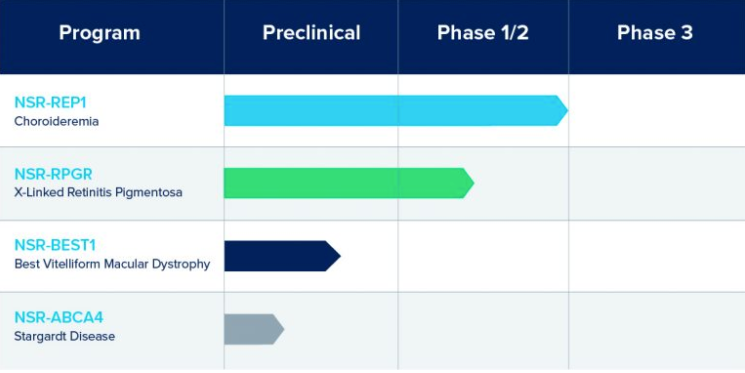
Their mission is to maintain and restore sight in patients with inherited retinal diseases and they shared information about four projects currently in their pipeline to treat these inherited retinal diseases: Choroideremia, X-linked Retinitis Pigmentosa (XLRP), Best Vitelliform Macular Dystrophy (MD) and Stargardt disease.  

Choroideremia a degenerative, X-linked genetic retinal disorder primarily affecting males is expected to enter stage 3 clinical trials in early 2018.  Very exciting news!  

Table showing preclinical to phase 3 for Choroideremia, X-linked Retinitis Pigmentosa (XLRP), Best Vitelliform Macular Dystrophy (MD) and Stargardt disease

Their website includes helpful overviews of the four diseases for which they have projects, and some great videos as well.  If you are interested in learning more about their research or upcoming clinical trials, there is also a sign up form for patients and families here.  

As always, I’m encouraged to meet a company that is dedicated to finding treatments for rare inherited retinal diseases, and I look forward to hearing more about their work in 2018!