
The second panel session of the 2025 LCA Family Conference, “Participating in a Clinical Trial,” examined clinical trial development and participation from the researcher and patient perspectives. This session supports a goal of Hope in Focus to educate the Leber congenital amaurosis (LCA) community so members are ready to participate in clinical trials when opportunities occur. For researchers, informed and prepared LCA patient groups are critical to moving a new drug or therapy through the testing pipeline.
Ben Shaberman, vice president of Science Communications at the Foundation Fighting Blindness, was the moderator. The panelists were Tomas Aleman, MD, a researcher with over 30 years of experience in researching genetic therapies related to inherited retinal diseases (IRDs), and Sarah McCabe, a mother and teacher from Iowa, and an LCA individual with the RPE65 gene mutation. Sarah participated in a gene therapy study in 2007, and 14 years later was treated with LUXTURNA®.
Overview of the Research Process
Ben began with an overview of the drug development process, highlighting that it is complex, demanding, and lengthy—often taking 10–15 years, and costing tens of millions of dollars. For retinal diseases like LCA, the development of a drug or therapy begins with identifying and understanding the mutated gene causing the degeneration. Researchers study these genes and their effects on the retina, then create disease models—traditionally in mice, but now also using “mini-retinas” grown in dishes.
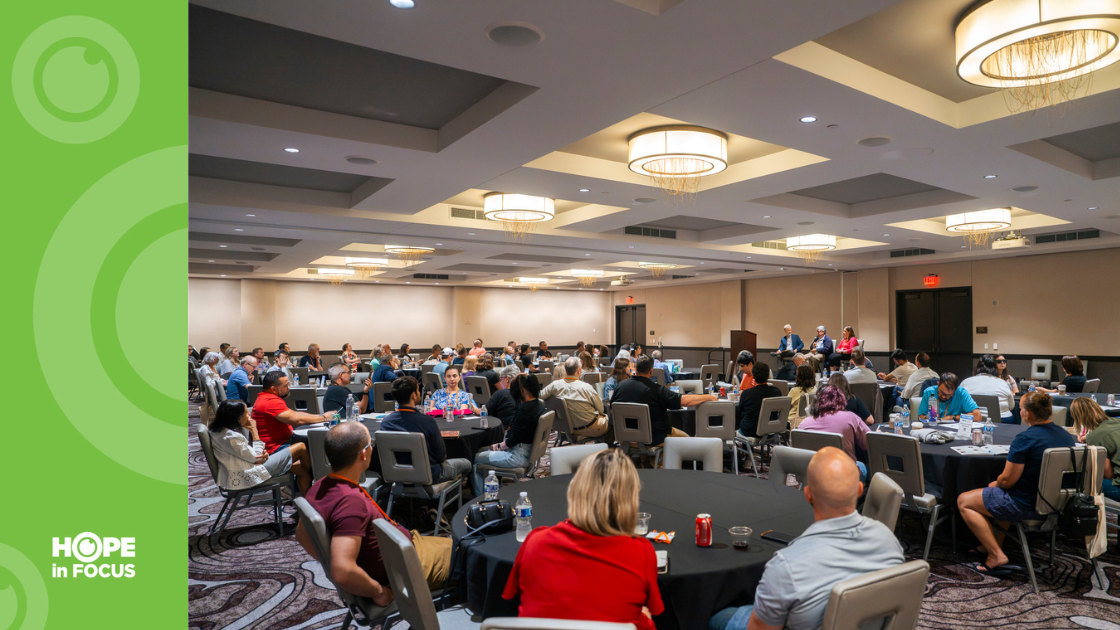
Conference attendees listening to the “Participating in a Clinical Trial” panel session.
Transitioning from animal or lab models to human trials is a significant hurdle, requiring higher-quality manufacturing standards, regulatory compliance (e.g., FDA), considerable funding, and specialized expertise. “This phase, called translational research, is often referred to as the ‘valley of death,’ Ben said. “Because many therapies fail to progress to clinical trials.”
For LCA, gene therapies can take 5–8 years to develop. Researchers must determine the right therapy, dosage, and method of administration before progressing to clinical trials, which can last 6–8 years, are extremely expensive, and often pose challenges for researchers and patients. While the process is rigorous and time-consuming, it is critical for developing effective therapies.
LCA Gene Research
Tomas Aleman, MD, co-directs the Center for Hereditary Retinal Degenerations (CHRD) at the Scheie Eye Institute at the Perelman School of Medicine, University of Pennsylvania. Dr. Aleman’s groundbreaking work has transformed the treatment of LCA, becoming the first disease where gene editing techniques were applied and gene therapy successfully restored vision. “Unlike what many people believe, most LCA patients are not completely blind, and their retinas often remain structurally intact,” Dr. Aleman said. “This makes the condition an ideal candidate for experimental therapies.”
Early research focused on RPE65-related LCA and started with animal models, including a dog, that helped pave the way for clinical applications, eventually leading to the first successful human treatments. After a decade of preclinical research, Dr. Aleman’s team moved into human trials, with LCA patients like Sarah McCabe playing a vital role. Dr. Aleman stressed the essential role of patients in clinical trials, saying that “Patient feedback is often critical to recognizing early signs of success.”
Clinical trials present both opportunities and challenges. They require long-term patient commitment and rely heavily on funding from smaller biotech companies. Patient selection for trials is also strategic—those chosen typically have structurally preserved retinas with poor function, maximizing the likelihood of measurable improvement. Dr. Aleman emphasized that exclusion from a trial does not mean the therapy won’t eventually be available for an individual; rather, it reflects the strict criteria needed to answer key safety and efficacy questions.
Looking ahead, Dr. Aleman said the goal is to expand the proportion of treatable LCA forms from roughly 25 percent to 50 percent. The progress made so far demonstrates the transformative potential of gene therapy in restoring vision for patients with inherited retinal diseases.
Doing Gene Therapy
Dr. Aleman gave an in-depth explanation of the gene therapy process for treating inherited retinal diseases, particularly focusing on subretinal delivery techniques. Gene therapy in this context is a meticulous process where the therapy is delivered directly beneath the retina via a subretinal injection.
Performed under general anesthesia, the injection only takes 5–10 minutes. It is done by entering the eye through three small incisions, removing the gel-like vitreous, and using a hair-thin needle to deliver the gene therapy. According to Dr. Aleman, the surgery resembles retinal detachment repair—a well-established procedure.
While there is an alternative delivery method known as intravitreal injection that is less invasive, it has not proven to be as effective or safe for all retinal indications. In particular, immune detection can reduce the efficacy of intravitreal injections, whereas subretinal injections can bypass these mechanisms.
Following surgery, a rigorous monitoring process begins to assess the treatment’s safety and effectiveness. This process includes frequent follow-up visits in the early stages—often at one, three, and six months and a year—during which visual function is tested and retinal imaging is conducted.
Participation in gene therapy trials is entirely voluntary, and patients can choose to withdraw at any time. However, once the gene therapy is delivered, it cannot be undone. The therapeutic genes remain in the eye’s cells indefinitely, making informed consent and long-term commitment critical components of the clinical trial process.
Patients are typically monitored for at least two years, and in many cases, much longer. For example, in the case of one early trial (the RPE65 trial), patients have been followed for over 16 or 17 years. Dr. Aleman emphasized that there is a lifelong partnership between patient and physician, stating that monitoring continues for as long as possible, regardless of whether the formal trial period has ended.
Dr. Aleman hopes to move toward treating very young children, ideally before age two, since the brain’s ability to learn to see develops rapidly in infancy and early childhood. Early treatment is believed to yield better visual and developmental outcomes, supported by early rehabilitation and educational interventions. A grant received two years ago is helping to support research and clinical work toward this goal.
“While gene therapy offers transformative potential, it also requires thoughtful implementation, long-term follow-up, and a commitment to tailoring support beyond the surgical intervention,” said Dr. Aleman. “The mission is not only to restore vision but to improve the quality of life and long-term outcomes for patients, especially children, by intervening as early as possible.”
Sarah’s Story & Clinical Trial Experience
When Sarah was about 10 days old, her mother, an ICU nurse, noticed that she wasn’t following the developmental patterns she’d observed with her son. Concerned, they visited a pediatrician who suspected something was wrong with Sarah’s vision. Further evaluation by a neurologist ruled out any neurological issues, and her parents were assured that Sarah would hit developmental goals right on time.
Regular eye exams ensued, with her parents keeping detailed records of each visit. Eventually, Sarah was referred to the University of Iowa, where tests suggested LCA, but at that time, genetic testing wasn’t available. A definitive LCA genetic diagnosis (RPE65) was finally made when she was in eighth grade.
At age 19, she was recruited for a clinical trial after struggling with vision during college. After going through the initial interviews and assessments, she was approved as a clinical trial participant. Sarah said the doctors clearly explained all the details and risks of the trial and that it was an experimental procedure primarily aimed at testing safety. The decision whether to move forward was left to Sarah and her family. “There wasn’t a whole lot of talking with my parents about it,” she said. “We knew things weren’t going to get any better if I didn’t participate, and I could be a part of helping [research advance].
To facilitate Sarah’s participation in the clinical trial, logistics were carefully arranged around her college schedule. It was toward the end of her senior year that her family drove her from Iowa to the University of Florida, where she underwent her first gene therapy surgery at age 23, describing it as terrifying but perfect.
The pre-operative steps included bloodwork and other standard preparations. During the surgery, Sarah was awake—a protocol that has since changed, with patients now put under general anesthesia. Post-surgery, she had a significant moment when she was able to read a giant letter “A” on a card, confirming that the surgery hadn’t worsened her vision. Over time, she noticed a new visible area in her field of vision, referred to as a “headlight,” which was a significant improvement.
Sarah’s recovery involved staying in Florida for a month with her family, with frequent follow-up visits stretching out from monthly to annually. Her clinical trial team remained in contact with her years after the trial formally ended. Fourteen years later, after LUXTURNA® was FDA-approved, she received the gene therapy at the University of Iowa, which improved her vision. Now in her 40s, Sarah’s primary goal is to maintain the stability of her vision. She summarized her clinical trial and gene therapy experiences, saying, “It was a long time ago now, but it was a very cool experience. All of it!”