Making Connections: Nightstar Therapeutics

I was so happy to recently speak with Samantha Vieira, Senior Director of Program Management of Nightstar Therapeutics. Nightstar is a leading clinical-stage gene therapy company focused on developing and commercializing novel, one-time treatments for patients suffering from rare inherited retinal diseases that would otherwise progress to blindness.

Based in London, they also have a small office in Lexington, Mass., and have several projects focused on retinal disease in their pipeline.   

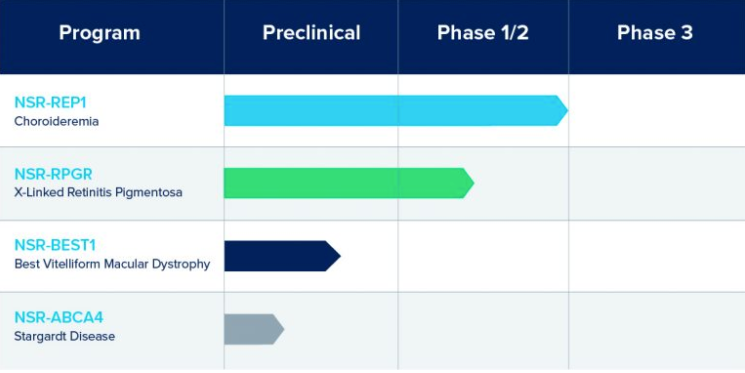
Their mission is to maintain and restore sight in patients with inherited retinal diseases and they shared information about four projects currently in their pipeline to treat these inherited retinal diseases: Choroideremia, X-linked Retinitis Pigmentosa (XLRP), Best Vitelliform Macular Dystrophy (MD) and Stargardt disease.  

Choroideremia a degenerative, X-linked genetic retinal disorder primarily affecting males is expected to enter stage 3 clinical trials in early 2018.  Very exciting news!  

Table showing preclinical to phase 3 for Choroideremia, X-linked Retinitis Pigmentosa (XLRP), Best Vitelliform Macular Dystrophy (MD) and Stargardt disease

Their website includes helpful overviews of the four diseases for which they have projects, and some great videos as well.  If you are interested in learning more about their research or upcoming clinical trials, there is also a sign up form for patients and families here.  

As always, I’m encouraged to meet a company that is dedicated to finding treatments for rare inherited retinal diseases, and I look forward to hearing more about their work in 2018!

Living with LCA: Life Through Vicky’s Eyes

Preschooler Vittoria shrieks with delight as she bounds down the cobblestone way, toward the big statue of the angel riding a chariot. Later we see the almost-4-year-old, nicknamed Vicky, tossing a coin in the azure waters of an elaborate fountain. Yet another image shows the little girl with glasses going bump, bump, bump, down the ancient marble steps on her bum.

This is all part of her parents’, Silvia and Enrico, effort to help their daughter see as much as she can while she still has vision.

The couple learned in April 2016 that their daughter had Leber congenital amaurosis (LCA). Vicky was 2½ and her mom was six months pregnant with little brother Filippo. That October, doctors genetically diagnosed Vicky with LCA-RDH12. Filippo carries the gene, but he is not affected by Leber congenital amaurosis.

On a recent trip to their native Italy from their home in the U.K., the family took in many sights, including Winged Victory, a majestic statue of the goddess Victoria riding a chariot pulled by four horses, atop the Altar of the Fatherland, and the stunningly ornate Trevi Fountain.

The images are from their Facebook video, “Come see with me . . . Rome!” or “Vieni con me a . . . Roma!” Vicky smiles and at times looks straight into the camera with her big brown eyes.

The video is among several “come-see-with-me” stories created by Silvia, and it represents one of the three goals the couple has for Vicky – to show her all they can while she still can see, before the effects of the Leber congenital amaurosis fully take hold.

Preschooler Vittoria “Vicky” Cerolini swimming with pink floaties and pink sunglasses.

The second goal is to support Vicky’s development despite her sight impairment. They look for the right kinds of social, educational and technological environments in which their daughter can thrive.  

“As parents, this is what you do,” Silvia said. “You invest all your effort in fighting for a better life for your kids.”

Their third goal is to do all they can to help find a cure. They have attended rare retinal disease symposiums, which led to an invitation to a family conference where they connected with researchers.

Silvia worked to find people around the globe – the U.K., Italy, Germany, South Africa, China, Australia, Canada and the U.S. – to partner with families and to raise money to fund research to correct the RDH12 gene.

They’ve connected with a group of U.S. families who are part of the RDH12 Fund for Sight. One of those families is Allison Galloway and her husband, Michael, who live in Colorado with their children, 6-year-old Logan and 4-year-old Zoe, both of whom have the RDH12 mutation. They also joined with people in Europe through Candle in the Dark.

Silvia and Enrico learned quickly that much needs to be done – and fast – to find treatments and cures. They’ve launched campaigns to support their near-future goal of funding the work of two researchers concentrating on RDH12.

Amid these efforts, Silvia said she has good days and bad days.

The family had a terrible scare recently when Vicky could see nothing for a few seconds as she rode on an escalator. “The thought of going suddenly black was really, really frightening,” Silvia said.

Then there was the time when their school of choice for Vicky made them feel as if they “shut their door in front of us,” saying they had no experience with sight loss and showing no willingness to learn or support the child.

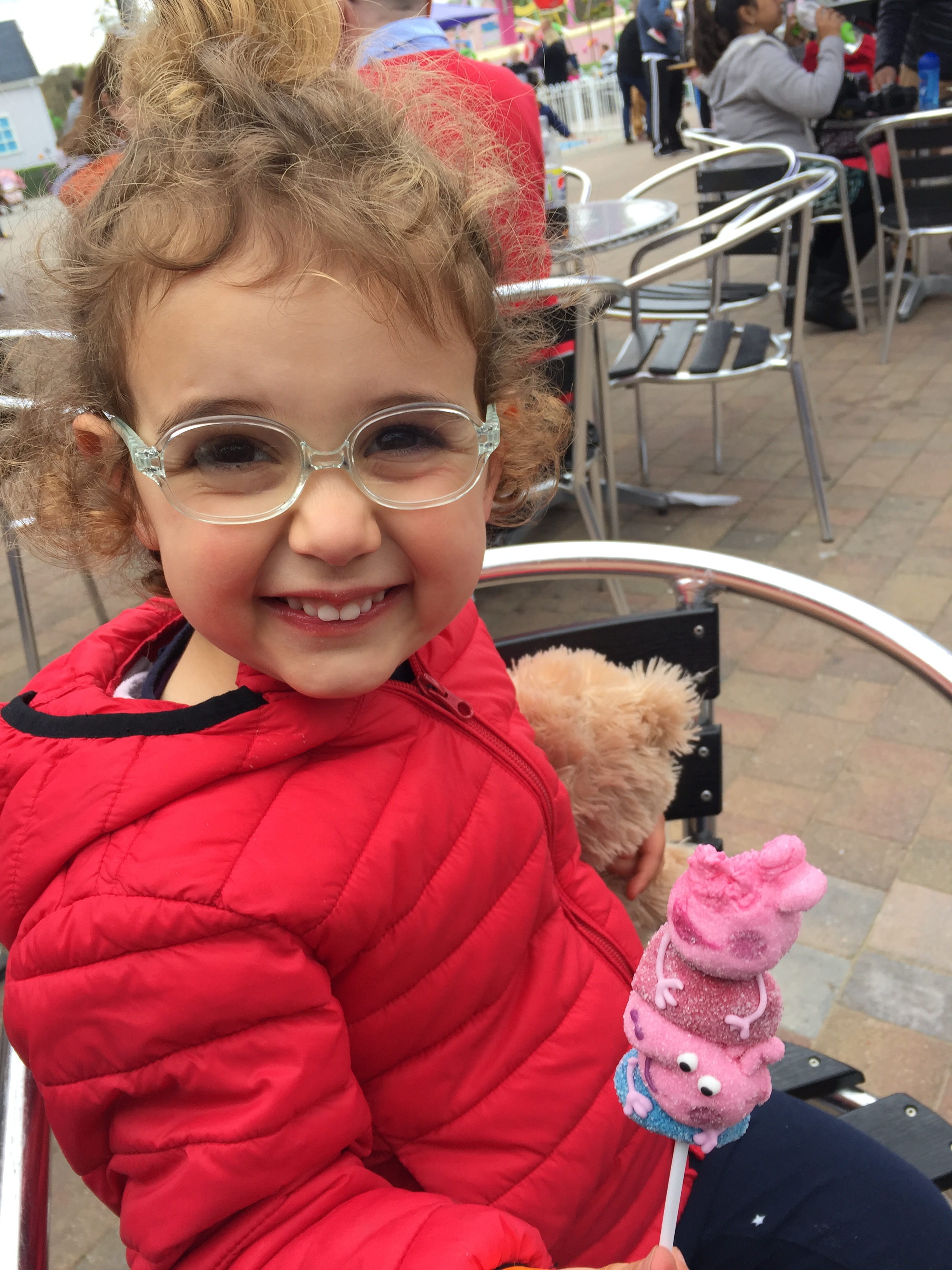
Preschooler Vittoria “Vicky” Cerolini in a bright red jacket and eyeglasses, enjoying an outdoor cafe.

“It was really, really heartbreaking. This complete, cold, concrete reality,” Silvia recalled.  

They found another school, where Vicky is flourishing. To help educators understand Vicky’s level of sight, a visual-impairment teacher brought glasses simulating Vicky’s vision for the regular teacher to try. Silvia said the teacher’s jaw dropped when she learned she was experiencing how Vicky sees now.

Silvia said it is incredible what her daughter can accomplish. Vicky does everything all the other kids do. She climbs and plays, she’s vibrant and full of energy, and she loves pizza and hearing stories.

“Now she’s into the fairies and princesses. Every night we have to read three books and she always asks for more.”

Vicky, who will turn 4 on Christmas Eve, does not quite understand her sight loss. “We haven’t fully told her yet; she knows she wears glasses and they help her see better … I know the worst is yet to come.

“On the other side, we have committed now to do everything we can to help, including fundraising for an RDH12 cure. It’s actually liberating because it’s given us purpose and initiative in life.”

Silvia’s thoughts on the future:

“Maybe the message is cliché, but it’s really about hope and doing everything we can. I don’t want to give up. I feel a sense of urgency because I feel it might come a little too late.

“I want to say 50 years from now, I’ve done everything I can. In the worst-case scenario, it’s going to help future kids, and still it is going to show Vicky the importance of fighting for your hopes and beliefs.

“In the best-case scenario, imagine a cure is coming in time and we can help kids like Vicky see for longer! If I had even a little role in making this happen, imagine how fulfilling that would feel.”

Follow Vicky’s journey here.

RPE65 Trial Patient Tami Morehouse: “There’s So Much To See”

Tami Morehouse made research history in the Leber congenital amaurosis world, and in the nation, when at age 44 she became the oldest person in a successful LCA-RPE65 genetic therapy trial, and the first patient to receive the retinal therapy in both eyes.

It’s been a long road for Tami, now 53 and living in the Cleveland area with her husband, Mike.

With no LCA diagnosis until her 30s, Tami made her way through life doing whatever she had to do. Sink or swim, she developed good coping and resource skills.

“I did what I had to do,” she said. “I had enough vision to make it work.”

No one noticed her vision problems until she was about a year old, when nighttime came, and she couldn’t see well at all. Attention focused on the idea she had night blindness.

It is difficult to detect vision clarity in small children, but her mom and dad knew something wasn’t quite right. Doctors picked up on it when she was 5, during an exam in which she recalled she was scared to death, screaming and crying, because they were poking around her eyes.

They determined she had issues with the clarity and clearness of vision, known as visual acuity.

She just adapted

From kindergarten into her 20s, she adapted to her surroundings and to her level of vision. She had difficulty seeing the chalkboard, reading a paper or deciphering bulletin-board postings.

“All of my teachers knew I had a hard time. I needed more light than the average kid. I remember the hallways of my elementary school were very, very dim and I had a hard time making my way around.”

Something her father said a long time ago helped her along the way. Her dad, who always called her Timmer, said, “‘Timmer, we all have our troubles, and if you want me to take you anywhere or do anything, just ask me.’ They just treated me like the typical kid I was not.”

Studying social work at Edinboro University in Pennsylvania, Tami scheduled classes in familiar and comfortable places. She avoided night classes, and when she couldn’t, she’d figure out how to get there, walking in better lit areas.

She realized that all her life she was a tweener – someone poised in-between.

“I was a tweener for forever because I did most things like everyone else did and there was that part that everyone else didn’t know.”

Since she was young, some sort of eye doctor tracked her through the years, but it wasn’t until she got her first social-work job and her then-boyfriend, now-husband, Mike, said they needed to explore potential options.

Specialists diagnosed her under the retinitis-pigmentosa umbrella and told her she would lose her vision. They said it was good she already had her education and she should consider having her children now. “It was a heartbreaker day,” Tami recalled.

As she aged, so did her retina and its ability to function well. She went from reading storybooks to her three children to reading Dr. Seuss alphabet books. Some days she saw only hazy grays and browns and needed the brightest lights to see.

“It was really very scary. At that point, before the trial, I had more poor-vision days, than OK-vision days. Sometimes I was scared to death to set my alarm. What if tomorrow is the day I wake up and my vision doesn’t get better? What if I wake up and I can’t see?”

But one Sunday morning, Tami was in the house, and her husband was out in the garage. He suddenly barreled in. He had heard on the radio that a study was being done on children with LCA in Philadelphia by Dr. Jean Bennett and Dr. Albert McGuire. Mike called Bennett the next day, and the wheels turned fast. Bennett opened the study at Children’s Hospital of Philadelphia to older patients and invited Tami to take part in the Spark Therapeutics trial that would change her life.

In March 2009, doctors injected her left eye with healthy cells to help her retina perform more efficiently and regenerate healthy cells.

Several days later, she and her husband were having dinner in Philadelphia and Tami reached over and picked up her drink.

‘Do you know that you just reached over and picked that up, you didn’t feel for it?,’ Mike asked. ‘You just looked out and saw it and picked it up!’

The injection in her right eye in November 2010 brought more brightness and clarity, to the point where she could see some eye-chart letters.

In spring at a baseball practice for one of her sons, she noticed colors more than ever before.

“It was color and light and movement and the kind of stuff people take for granted every day, which may seem small if you have it. Once you lose those little things and then get them back, you realize how important they were. For me it was huge.”

Tami also got to see her daughter taunting the opposing pitcher on her softball team, as she frequently danced up and down the third-base line to almost always steal home.

‘Don’t give up’

Her only wish was that the therapy had been an option sooner, because as the years passed, her retinas kept deteriorating.

“If this was a life-threatening illness,” she quipped, “I would have died a long time ago.”

She advises anyone with LCA-RPE65 to investigate whether the therapy is an option, saying, “Time is of the essence. Don’t give up. There were a lot of us in that trial and we all seem to have different levels of benefits from procedures, whether you have a little vision or a lot of vision. I just value my vision so much, I just think everybody needs to act and respect whatever level you have and just be glad to have it. There’s so much to see. It’s an incredible gift.”