
First, Diagnosis. Then, Genetic Testing. It’s Important.

My Retina Tracker® is a free and secure online registry launched by the Foundation Fighting Blindness that helps connect families dealing with rare inherited retinal diseases to feel less alone, and to find help.

Parents feel shock and isolation when they are told their babies have no vision or limited vision caused by a rare inherited retinal disease. They do adapt and pursue resources, but that feeling of isolation often persists because of the disease’s rarity. It’s unlikely you will bump into someone in the grocery store whose child also has retinitis pigmentosa.

My Retina Tracker® is a free and secure online registry launched by the Foundation Fighting Blindness (FFB) that helps alleviate those feelings of isolation. An individual goes from being one with an inherited retinal disease to becoming part of a growing community of people (currently 6,500) sharing similar concerns and hopes.

The goal of My Retina Tracker® is to drive the research toward prevention, treatments and cures for people living with retinitis pigmentosa (RP), Stargardt disease, Usher syndrome and the whole spectrum of inherited retinal degenerative diseases, including Leber congenital amaurosis (LCA).

The global registry includes rare inherited retinal disease patient disease information from Europe, North, South and Central America, Asia and the Pacific.

Dr. Brian Mansfield, FFB’s deputy research officer who managed the registry’s launch three years ago, said people registering take an active role in advancing research to find treatments and cures for specific rare inherited retinal diseases, affording the opportunity to join others and “stand up and be counted.”

“Whether you’re in the middle of New York City or in a small town in West Virginia,” Dr. Mansfield said, “you’re equal to everyone else in that registry. It removes isolation. You’re literally standing up.”

My Retina Tracker® notifies registrants of clinical trials and gives researchers access to their disease data – but not their personal information – to advance research and therapy development associated with IRDs.

To optimize the power of My Retina Tracker®, registrants should seek a genetic diagnosis. The registry facilitates that by making registrants eligible for free genetic testing. In today’s world, it is helpful to be genetically diagnosed if you want to participate in research.

Details of My Retina Tracker® can come none too soon for some. Dr. Mansfield said after LUXTURNA® recently came to market as the first genetic therapy for LCA patients with an RPE65 gene mutation, he came across information about a person who set up a crowd-funding site asking for $5,000 to travel to Texas because he needed a genetic test.

“You don’t have to raise $5,000 to get a genetic test,” Dr. Mansfield said. “You don’t have to travel to Texas to get a genetic test.”

Helping families get tested

Hope in Focus (formally Sofia Sees Hope) well understands the importance of genetic testing for those with rare inherited retinal disease. Part of its mission is to educate individuals and families about the importance of becoming part of patient registries and getting genetically tested. SSH also makes genetic testing accessible to those who cannot afford it.

“Last year, we supported FFB’s (genetic testing) program as a small test grant,” said SSH founder Laura Manfre. “This year, with the success of the test and thanks to the tremendous support of our donors, we are happy that we were able to more than quadruple our contribution, enabling many more individuals to receive free testing and genetic counseling.”

Dr. Mansfield thanked Sofia Sees Hope for for its $65,000 donation to FFB, earmarked for genetic testing.

“The help was truly appreciated,” he said. “I’m very proud of the relationship we have with Sofia Sees Hope.”

How My Retina Tracker® works

Go to myretinatracker.org, click on Register Now and follow the prompts to establish a username and password and to answer questions to build your personalized retinal health profile. You are then guided through a series of questionnaires developed by retinal clinicians, geneticists, genetic counselors and rare inherited retinal disease researchers.

If you have any questions, call the My Retina Tracker® coordinator at 800-683-5555 or email to Coordinator@MyRetinaTracker.org.

Once you’ve registered, send a request to Coordinator@MyRetinaTracker.org asking to be genetically tested and you’ll receive information and guidance on how to order the test.

The registry becomes your personal retinal health record, updated by you and your doctors. Your history and testing results create a critical resource in tracking the progress of your disease and becoming part of a comprehensive database.

The registry employs state-of-the-art database technology to protect privacy and adheres to the highest standards of confidentiality and ethics, following policy and protocol set by the National Institutes of Health’s Institutional Review Board.

Your disease information is accessible only to you,  FFB registry staff, and researchers who meet a rigorous scientific review application process to use the data for studies and to reach individuals to participate in clinical trials, natural history studies or focus groups. Your personal information is never shared with researchers.

Large commercial biotech companies use this pool of data to find people for clinical trials, a common research challenge. Rather than calling clinicians one by one, the data is accessible in one place and often updated.

Clinical trials are out there

The data helps inform researchers about the therapies patients want, the risks they are willing to take for different levels of vision improvement and when and how their vision loss progresses.

Personal updates, such as when someone had to stop driving because of increased vision loss, help track the progress of the patient’s disease.

“Then you have a clinical longitudinal timeline as to how vision is changing for the patient,” Dr. Mansfield said.

Before My Retina Tracker®, the foundation used a paper list of about 12,000 names accumulated over FFB’s 40 years. The names transferred to the new registry to total about 17,500, but many are outdated.

There are about 6,500 people actively engaging in the online portal profile, with about 150 new registrations a month.

Dr. Mansfield wants to reach a minimum goal of 20,000 registrants in the next four years, although 50,000 would be preferable, as it would make for an extremely effective base of data for phase 2 and phase 3 studies that create demand for more trial enrollees.

He also made the distinction that private labs hold onto their data tightly, whereas FFB’s goal is the opposite.

“We want to share it, we want to move the whole field forward,” Dr. Mansfield said. “After all, our goal is to ensure the treatment and cures of all retinal diseases.”
Being Married to Brandon: “A Precious Exercise of Mindfulness”

When I met Brandon in September 2014, I thought that I was talking to the most interesting person I had ever met.

Not only was he the first American I had ever talked to, Brandon was also the opposite of the typical 20-something Italian: Not Catholic, vegetarian, mostly homeschooled, who preferred peanut butter over Nutella.

Besides the cultural diversities, I immediately liked his positive way of thinking, his unusual curiosity and his witty sense of humor.

Another particularity of Brandon was his blindness, which is actually the reason why we met.

I was giving a tour of my university, the University of Milano, Italy, for international students and I was asked to guide Brandon, who was there to study Italian for opera. Among a group of a hundred students, it would have been unlikely that I would have gotten to know any of them. Since Brandon was by my side, however, we had the chance to talk during the tour. And then we scheduled a date.

We were married two years later.

The last three years with Brandon have been quite a journey; we have been apart for several months, but we also managed to live in five countries and visit nine in total.

I have special memories for each of them, for example swimming in the crystal sea in Croatia for our honeymoon, walking through the Christmas markets in Vienna, visiting the Nobel Museum in Stockholm, making cheese on a Maltese farm, seeing “Matilda the Musical” in London. These are just a few of the unforgettable moments we have shared so far.

Currently, we are happily living on a houseboat on a little canal in the city of Groningen, Netherlands, where I am studying for my master’s in computational linguistics.

I consider living with a blind partner a precious exercise of mindfulness.

If I am alone, I walk in the street careful enough to be safe, but I am immersed in my thoughts, listening to music with my isolating headphones. When I am with Brandon, I acknowledge everything around me: people, buildings, colors, behaviors, my own emotions, and I feel that I am present in the moment.

At the same time, I acknowledge accessibility issues, which are a wide problem in south European countries. Sidewalks are too narrow, uneven or used for  parking by cars. Also, street lights without sound effects or unsafe driving behaviors are a cause of frustration for me. 

Previously I said that Brandon and I met because he was blind, which is not exactly the truth.

Brandon’s education, O&M (Orientation & Mobility) training, and his (now, also my,) incredible family have made him an independent, healthy and positive person, confident enough to decide to take a plane solo, cross the ocean and live abroad for one year to learn a new language.

Therefore, I am forever grateful to everyone who contributed to Brandon’s education. I am now happy to see Brandon helping his mum, Sonja, to build educational services that can have a significant impact on other young blind determined students.

Learn more about Brandon

Read Brandon’s mother’s story

Read Brandon’s father’s story

Atom Biggs: ‘The Greatest Adventure of My Life”

Raising a blind son has been one of the most exciting and inspiring experiences a dad can ever have. I’d like to tell you a little about our son, Brandon.

As a baby he had some vision, so his visual impairment wasn’t initially noticeable to us. About the time he started walking, it became clear something was unusual.

At first my wife and I thought he was clumsy or maybe a little absent-minded when he would collide with things. When we’d put food on the table in front of him, he’d feel around for it with his hands while his eyes looked off into space. When I’d try to look him in the eye, he’d look to the right or left of my face but couldn’t seem to make eye contact with me.

We were shocked when the ophthalmologist diagnosed Brandon with retinitis pigmentosa (RP). Now we were faced with new challenges.

Before we had children, my wife and I sat down and put together a plan on how we would raise them. Now we had to rethink everything. Our first step was to gather every resource available to us. We were quite surprised at how much lay within our reach. We read books, got him a free computer, visited the School for the Blind, and learned how to read Braille. We also organized his room with little baskets and cubbies, so he’d know where to find everything.

One of the most important stories I read was written by a blind man whose parents coddled him his whole life and were afraid to let him venture outside the safety of his home. I determined that was not going to be the story of our son. Instead, we looked for every opportunity for Brandon to experience the world around him.

We took our son to the zoo, on hikes, on field trips, exhibits, fairs and everything we thought might be experiential and educational. A blind person’s eyes are his fingers, so we always made it known that our son was blind and requested special permission for him to touch, even if the signs said, “no touching.”

We enrolled him in Junior 4H. I bought him a bicycle and tried to teach him how to ride; he persisted without my help and taught himself how to ride in our basement.

We met with his teachers and explained how blind children learn differently from sighted children and what accommodations Brandon would need in his classroom. We emphasized that he should be allowed to experience everything the other students experienced and not be left out of anything. They almost always listened to us and were grateful for our input.

We found that none of Brandon’s teachers had any experience with blind students, so we met with them frequently to make sure he didn’t get brushed aside. I think the most common excuse from teachers not to let Brandon participate was “we’re just concerned about his safety.” We’d explain that if they’d just let him tour the stage platform with his cane or have him buddy-up with a friend until he learned to walk the trail, he would be perfectly safe.

When our son was younger, we advocated for him, but as he got older we encouraged him to advocate for himself.

I think Brandon’s first major experience for self-advocacy was 7th-grade basketball. I told him I really didn’t think basketball was for him but that if he really wanted to play then he should arrange a meeting with the coach and the principal and voice his feelings. And so he did. He told them how much he wanted to play basketball, we were at the meeting and backed him up, and the coach was so impressed that he let Brandon on the team. He only played defense, but he played almost every game and the coach said Brandon was the most tenacious guard he’d ever had.

Brandon went on to advocate for audible traffic signals near our home, so he could safely cross the street and catch the bus. He touched models of cells in biology class, so he could feel what everyone else saw. Currently Brandon is advocating for the entire blind community to get them equal access to many online applications and software programs.

When Brandon was first diagnosed and we shared it with our friends, we got a lot of pity responses. I wasn’t sure what to say, but now I do.

Now when I tell people that my son is blind, and they say, “Oh, I’m so sorry!” I tell them there’s really nothing to be sorry about. It’s been the greatest adventure of my life and I’d have it no other way.

Learn more about Brandon

Read Brandon’s mother’s story

Read Brandon’s wife’s story

Sonja Biggs: “My Normal and His Normal Are Just Different”

Brandon Biggs is the chief financial officer with his mother Sonja in their company, he conducts accessibility research and he helps businesses make their software content more accessible to the visually impaired.

He is a 26-year-old self-taught programmer who is earning a master’s degree in Inclusive Design from OCAD University in Toronto while living on a houseboat in Groningen, Netherlands, with his Italian wife. Oh, and he’s an opera singer?

But he’s still Sonja Biggs’ little boy.

“Even with all the successes in his life and his own positive spirit toward blindness,” Sonja says, “I am still having a mom moment in my heart.”

Brandon has Leber congenital amaurosis with a mutation in the CRB1 gene. He was diagnosed as a toddler, and subsequently, Sonja became a Teacher of the Blind and Visually Impaired, and an Orientation and Mobility Specialist. She, Brandon, and her husband (and Brandon’s dad), Atom, run Sonja Biggs Educational Services, Inc. Sonja and Atom live in Gilroy, Calif., and they also have a 22-year-old son, Joshua, a talented programmer, gifted in science and graphic art.

Brandon’s interests include theater and opera. He performed in many musical theater productions and in a professional production of “La Bohème.”

“I was introduced to opera by a voice teacher when I was 18,” Brandon says. “And I fell in love with the mysteriousness and power of singing something so emotional and powerful in another language.”

His mother said she and Atom always encouraged both their sons to explore. When they were interested in marine life, they went to the San Juan Islands; when they were interested in volcanoes, they went to Mt. St. Helens. Bats? They checked out zoos and bat houses.

“We never told them no,” she recalls. “We just immersed them in whatever they were interested in and made it real for them.”

Sonja likens the inaccessibility of common tools for the visually impaired to the process of making chocolate chip cookies by adding the chips to the cookies after they’ve baked and cooled.

She said her “mom-heart” sometimes gets in the way of what she knows in her head. She still sometimes grieves that Brandon is blind.

“All of a sudden, something triggers it along the way – ‘Your son has no sight,’ or his frustration over inaccessibility in an application.”

Any parent of a child with disabilities goes through different stages of grief, she says. “The grief never seems to go away; it crops up at inopportune moments.”

A vision appointment triggered the grief this time. Brandon has no measurable vision, seeing light and shadows. He said he does not even notice his sight disappearing.

“I look at the things that I see every day that are beautiful,” Sonja says, “and he’s never seen them.”
Brandon is married and he’s never seen his wife. “He’s felt her, but he’s never seen her,” she adds. To which Brandon replies, ‘Yeah, mom, I can tell how beautiful someone is by touching their elbow.’

She knows her son’s blindness does not make him any less an accomplished human being. “He’s a beautiful young man. He’s wonderful, and to him it’s just normal and I just have to remember that,” she notes.

“My normal and his normal are just different.”

Learn more about Brandon

Read Brandon’s father’s story

Read Brandon’s wife’s story

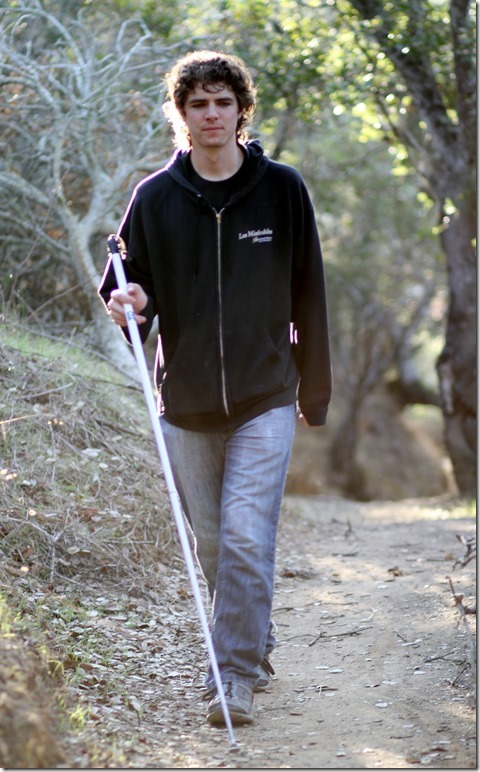
Living with LCA: Brandon Biggs

Brandon Biggs was diagnosed with vision loss — and ultimately with Leber congenital amaurosis (LCA) — as a toddler. His genetic mutation is LCA-CRB1, which can cause LCA, retinitis pigmentosa (RP) and cone-rod dystrophy. CRB1 is the second highest incidence (10%-13%) of the nearly 30 different LCA genes that cause the disease.

His mother, Sonja Biggs, described in a telephone interview from her California home that despite all her now-26-year-old son’s accomplishments, she still has her “Mom moments,” triggering grief for her son’s vision loss.

What we discovered in exploring Brandon’s story for our series “Living with LCA” is that different members of his family have differing views of their journey with this rare inherited retinal disease. And so we invited the Biggs family to each share their story revolving around Brandon — mom Sonja, dad Atom, and wife Claudia.

But first, a little about Brandon himself: In pursuing his master’s degree in Inclusive Design, Brandon is writing his thesis exploring multimodal representations of data. He is focusing on creating auditory maps for blind people showing, for instance, where the hurricane is in Texas, or where the wildfires are in California. He is also working on making auditory graphs, so blind students won’t be required to always read tactile graphs.

“As technology is developing faster and faster,” Brandon says, “it is becoming more and more difficult to make sure technology is accessible to blind users, especially in the work environment.”
As a business owner, Brandon sees how difficult it is for a blind person to work in a small business. “I evaluate systems, such as for accounting, payroll, HR, timekeeping, document storage . . . and it is scary that for many crucial systems, there are few accessible solutions and no user-friendly solutions (for the blind).

“I just evaluated around 20 accounting systems and there were only two systems that were partly accessible; all the others were completely inaccessible. This means that blind people who work at all with accounting can only successfully work at companies that use those two systems, and only about half as efficiently as their sighted counterparts. This half-efficiency is because the experience of the blind user was not taken into consideration when the system was developed.”

Despite these issues, Brandon is actively working with companies to make their systems more accessible. He performs user-experience reviews for companies and writes evaluations of their products from a blind user’s perspective. He recently evaluated Intuit’s QuickBooks Online, and Intuit invited him in to see what they are working on.

“They are very slowly making changes that I recommended, but it is very slow. There are two guys on accessibility out of the 8,000 employees at Intuit, and that is considered to be a big accessibility team.”
All the more reason that Brandon is devoting his life to making sure blind people have quality access to technology.

Read Sonja’s story

Read Atom’s story

Read Claudia’s story