Life After LUXTURNA: ‘Now He Can See’

This is the sixth in a series following the progress of Creed Pettit, a 9-year-old Florida third-grader, who completed treatment in March with the breakthrough gene-therapy drug called LUXTURNA™, approved as the first gene therapy for RPE65 genetic mutations and as the first-ever genetic therapy in the United States for an inherited disease.

Sarah St. Pierre Pettit’s life has been filled with lots of firsts these days as she watches her little boy literally see his world in a brighter light.

Before retinal surgery with LUXTURNA™, a ground-breaking, gene-therapy treatment, 9-year-old Creed needed very bright lights to see; post-surgery, he can see into a dark box, read books and discern crisper details in standard lighting.

One of the most unexpected differences to Sarah after her son’s surgery is his state of mind.

“I’m surprised at how much more relaxed he is,” the mom from Mount Dora., Fla., said. “That’s the biggest difference to me.”

Creed never was hyperactive, but his sense of relief and calm manifested as an unforeseen result of his revolutionary eye surgery.

“I think he’s relieved because the surgery is over and because now he can see,” she said. “He’s not so nervous about everything.”

Doctors diagnosed Creed with Leber congenital amaurosis (LCA) caused by a mutation in his RPE65 gene when he was nearing 3 years old in 2011 – the same time scientists at Spark Therapeutics worked to research and develop the innovative gene therapy that came to market as LUXTURNA™ in December.

The new drug is an injectable, human-engineered virus with copies of RPE65 to prompt the creation of more RPE65.

Creed’s surgery last month went well, though he had his issues with sticky things, even though he and his mother practiced at home with special tape from the doctor to get him used to the bandage he’d need over his eye afterward. He did well with the first patch because he mostly slept before it came off, 24 hours after surgery. The second wasn’t so easy. Creed didn’t sleep and obsessed about the patch, so taking it off was hard.

“As soon as it was off, he was happy. Everything was good again. He was ready to go.”
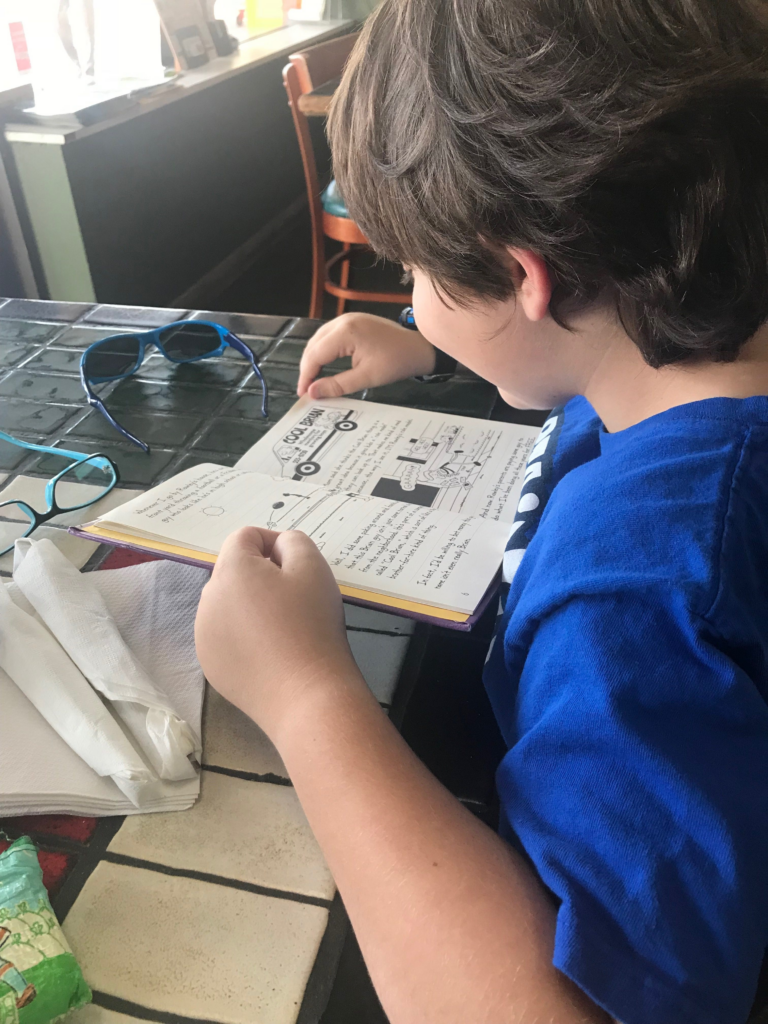
Creed in a blue shirt reading a book
Creed reading the menu at his favorite restaurant, Mount Dora Pizza, without a flashlight or extra lamps.

Wednesday marked a milestone after Creed’s surgery, reaching what doctors call the 30-day peak, meaning 30 days after surgery on Creed’s right eye, his vision will have improved as much as it is going to from the treatment.

Creed met with Dr. Christine Kay of Vitreo Retinal Associates in Gainesville, Fla., Thursday to check his vision at this 30-day point. On Monday, which will be about a month from surgery on his left eye, he is scheduled to meet with Dr. Audina Berracol, his surgeon at Miami’s Bascom Palmer Eye Institute.

As Sarah awaits medical word on Creed’s level of vision improvement, she sees signs of great progress every day.

He no longer needs help keeping the handlebars straight when he rides his three-wheeled bicycle.

“He was so excited. He did awesome, looking right at me, smiling, and I’m thinking, oh my god, he’s gotta slow down.”

Creed also climbed onto to the wheel well of a boat trailer to get into a powerboat before settling in on a cushion to read and draw. Would he have ever done that before? “Heck, no,” Sarah said. “No way.”

Since he’s gotten back from Miami, Creed’s also gone to his favorite restaurant, Mount Dora Pizza, where he ate six, count ’em, six, meatballs.

He went back to school at Mount Dora Christian Academy on April 10th.

“He’s doing so good,” his mom said. “He’s right back into chorus. He didn’t want to miss chorus.”

Creed brought his usual lunch – peanut butter and jelly, a bag of cereal, a granola bar and three cookies. He was particularly impressed at lunchtime, though, when he clearly saw for the first time all the food choices in the cafeteria. While he still prefers to bring lunch, he realized students could get two side orders, rather than just one, with their main meal.

That first day back, as she does every school day, Sarah left a note in Creed’s lunch bag, telling him to have an awesome day, not to forget to do eyedrops after lunch and to wash his hands a lot to keep germs out of his eyes.

When she asked him how his first day back was, she said, “Typical Creed. ‘It was good.’”

Then he remembered something any third-grader would want their mom to know: “I saw a kid throw up.”

“A kid who’s sick,” Sarah mused. “This is what I get; I was expecting all these great things.”

The next day when she accompanied her son to school, Creed’s teacher, Mrs. Shyers, handed over a big box filled with all the lamps and bright bulbs that Sarah brought to school for her son to see better in the classroom, long before his surgery.

“He doesn’t need these,” Mrs. Shyers told Creed’s mom.
Read Creed’s story

Future so Bright, Need to Wear Shades!

Beginning to See the Light

Annnnnd We’re Off!

Ready, Set, Scheduled

The Road To Treatment

New Patient Services Program Helps People Navigate Their Road To A Cure

Now that LUXTURNA™ has come to market as a revolutionary vision-restoring genetic treatment, how does it get to patients?

The answer to that question and many others can be found within a new patient services program developed by LUXTURNA™ creator Spark Therapeutics. The newly approved injectable drug treats people with the RPE65 gene mutation that causes Leber congenital amaurosis (LCA)  and retinitis pigmentosa (RP), both of which are inherited retinal diseases (IRDs).

The program is called Spark Therapeutics Generation Patient Services and it is being used by RPE65 patients who underwent surgery with LUXTURNA™ and those who are preparing for treatment. Spark launched the breakthrough drug commercially in March, three months after it received approval from the U.S. Food and Drug Administration.

Spark Therapeutics Generation Patient Services provides each patient with a two-person team to help

navigate insurance coverage and connect them to financial assistance resources as they are needed, said Patient Services Lead Sarah Derewitz.

“We partner with them to help set their expectations along the way because it’s a long and potentially confusing journey,” she said.

Patient Services is dedicated to communicating with patients in the best way for everyone, which means via Language Line interpreters if their primary language is not English, via mail if they don’t use a computer, in person, by text, by email or by telephone.

“Whatever works,” she said.

Sarah St. Pierre Pettit, whose 9-year-old son Creed underwent surgery on both eyes with LUXTURNA™ last month, said she has talked with and emailed questions to the Patient Services people at Spark since January.

Sarah, from Mount Dora, Fla., said her Spark team answered a full range of questions, including those that stemmed from her simply being a nervous mom, worried about her son. No matter what the topic, Sarah noted, Spark always responded quickly.

Amy Reif, whose 7-year-old Hannah is on track for LUXTURNA™ treatment this summer, also started talking with Spark in January. Amy, from Maple Glen, Penn., said Spark hooked her up with a team to help with insurance coverage, available financial assistance and treatment centers.

Derewitz characterized the Patient Services team as “logistical, supportive, proactive and expectation-setting.”

Patient Services is committed to answering any non-medical questions that come their way. She said patients with medical questions are referred to their doctors for answers.

One member of the team is a Patient Access Specialist, the patient’s first point of contact who works in Spark Therapeutic offices and stays in touch by phone or by email.

Spark Therapeutics Patient Access Liaison Lee Liberator

The other team member is a Patient Access Liaison, and as liaison Lee Liberator said of the title’s acronym, PAL, “We try to be a resource.”

“Our driving interest and desire is to have patients reach out to us when they have questions,” she said. “And because of how rare this disease is, we just want to make sure they have access to the tools and information available.”

Liberator is inspired by patients’ life stories and works to alleviate any stress or confusion patients might encounter. She works as a source of in-person support when you need it.

You’ll find more information about her and other liaisons and specialists on the Spark Therapeutics Generation Patient Services website www.mysparkgeneration.com.

As the website says, the goal of Spark’s Patient Services is to be your partner and to help you through your experience. It is voluntary and participating or not taking part in the program does not affect your eligibility for treatment or the nature of your treatment or care.

Genetic diagnosis required

While enrolling in the program is not required to receive LUXTURNA™ treatment, Spark encourages patients to take advantage of the free service.

What is required for program enrollment is a confirmed genetic diagnosis of a mutation in both copies of the RPE65 gene. Humans have two copies of every gene, one from each parent, so each person has two copies of the RPE65 gene.

To learn more about getting genetically tested, go to https://luxturna.com/about-luxturna/#who-luxturna-is-for.

If you already have been genetically diagnosed, fill out an enrollment form available on the www.mysparkgeneration.com website. This allows Spark to enroll you in the program, investigate insurance and schedule a treatment center consultation.

If you already are connected with a treatment center, you will need to have a treatment center specialist fill out a Statement of Medical Necessity (SMN) for you. An SMN confirms eligibility to receive treatment and begins the investigation into insurance benefits.

If you are not connected with a treatment center, this is where your team comes into play to discuss options and insurance requirements to schedule a consultation at treatment center to confirm your eligibility. If eligible, the center specialist will fill out an SMN confirming eligibility and start looking into insurance benefits.

People interested in Spark’s patient services program also can call toll free 1-833-SPARK-PS (1-833-772-7577) between 8:30 a.m.-6:30 p.m. ET, Monday through Friday. Services are confidential and free.

You also can send an email to: mysparkgeneration@sparktx.com

College Connection: Making A Successful Transition To College

Starting high school or going off to college is not easy; new people, classes and sometimes even a new city makes for a stressful transition. Doing it all with a vision impairment adds some additional complexity. I am going to share with you my experience of moving to college with a vision impairment. Hopefully you can learn from my experiences and apply it to your own life.

Four years ago I knew that I wanted to attend Wilfrid Laurier University. When I received my acceptance letter I immediately started to plan, which proved to be incredibly important. I was able to connect with various people at the university: getting a larger dorm room at no additional cost to accommodate my guide dog, speaking with the Accessible Learning Center to arrange exam accommodations (I write my exams on a computer in a private room), and connecting with professors before classes started.

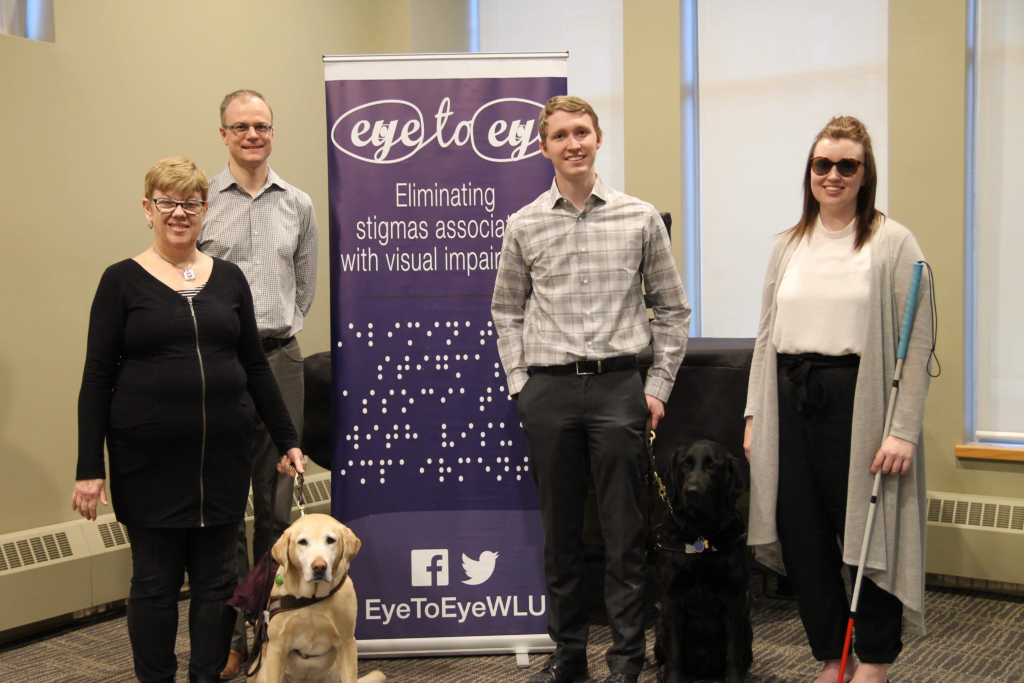
Jack McCormick and his guide dog Jake, center, at a recent “Eye To Eye” event Jack organized at his college. On the left is Dr. Penny Hartin, CEO of the World Blind Union, the guest speaker at the event.

For someone with vision loss it can be challenging to navigate a new place and college campuses are no different. It is so important to learn the layout of your college before move in day because I am telling you, you won’t have time during frosh week and you will want to know where your classes are before they start. There are a lot of benefits to knowing the layout of your campus beyond being able to find your classes and places to eat.

  1.     If you know where things are better than the people on your floor, then you can help them find their classes. It’s a good way to get to know people and show them that you don’t let your vision loss stand in your way.
  2.     Getting involved with campus organizations is a great way to have some fun and get to know like-minded people. These organizations aren’t going to meet in the same places as your classes. So you need to be able to find them or you are going to miss out on one of the best parts of college life!

“So, Jack, I’ve planned and learned the layout of campus. What about the first day? How do I make friends? I am worried that people will judge me because of my vision impairment.”

  • Remember that all people are nervous during their first days of college. You are not alone!
  • Own your vision impairment, tell people about it and be open to answering questions (you will get some dumb ones). This eliminates any awkwardness that people may have about your vision loss and soon you will find a great group of friends!

I hope this helps as you move away to college!

Jack McCormick is a 21-year-old honors business student at Canada’s Wilfrid Laurier University in Waterloo. Jack was diagnosed in high school with Leber congenital amaurosis due to mutations in the RPE65 gene. He is a Hope in Focus (formally Sofia Sees Hope) ambassador, helping people living with LCA and IRDs. Read his blog at jackdamccormick.wordpress.com

His Future’s So Bright, He’s Gotta Wear Shades

This is the fifth in a series following the progress of Creed Pettit, a 9-year-old Florida third-grader, who completed treatment in March with the breakthrough gene-therapy drug called LUXTURNA™, approved as the first gene therapy for RPE65 genetic mutations and as the first-ever genetic therapy in the United States for an inherited disease.

Life looks a lot brighter for Creed Pettit, the Florida boy who just became one of the first LCA-RPE65 patients to have eye surgery using the brand-new gene therapy treatment LUXTURNA™.

For the very first time, Creed built the entire track of his wooden train set, and he did it in the garage rather than in the house with all the lights on.

“He played with it for over two hours,” said his mom, Sarah St. Pierre Pettit. “He played with it like a kid should play with it.”

Before the surgery, Creed and his mom would have what she called “taught play,” with her little boy doing only what he was taught or told.

“All of a sudden, he was playing with these things, interactive play, putting doors on the train, making the bridges of the train set.”

Even digging into the box with the train-set pieces is a new experience. Before, Creed wouldn’t look in the box because it was dark, and he couldn’t see anything. Now, he’s looking into the box and pulling out curved pieces of track.

Creed is back home in Mount Dora, Fla., from having his second surgery, this time on his left eye, on March 28 at Bascom Palmer Eye Institute in Miami.

He and his family came home to a house decorated by friends with streamers, balloons and a big home-made sign that said, “Welcome Home Creed.”

Creed is one of a handful of the first LCA-RPE65 patients to receive the genetic therapy treatment LUXTURNA™ developed by Spark Therapeutics.

The U.S. Food and Drug Administration granted approval of the revolutionary drug in December. Soon after, preparations began for administering the treatment to the first patients the week of March 19. The surgery entails injecting under the retina a human-engineered virus containing copies of a normal gene, prompting the making of more RPE65.

As Creed came into the operating room last week, he heard “I’ll Be There For You,” coming from the speakers; it’s the theme song from the television show “Friends,” and the same song Creed and his mom – and the whole surgical team – sang while waiting out a short delay before his first eye surgery.

After performing surgery on his right eye on March 21, Dr. Audina M. Berracol found new growth in the eye’s photoreceptor. Creed will return to Miami on Monday for high-resolution scanning, called Optical Coherence Tomography, (OCT) on his left eye.

Back at home using just basic lighting, Creed reads “Diary of a Wimpy Kid.” And he looks down at his food now.

“It’s really, really neat,” Sarah said. “Every day has just shocked me.”

He watched “Peanuts,” one of his favorite shows, and then went on a long walk.

“It’s just so cool to watch him. He has his sunglasses on, he’ll just stare, looking at different trees, touching them.”

No more flashlights, either. Years ago, Creed’s mom outfitted their home with bright lights and lots of flashlights, so he could see things if they dropped under the table.

The third-grader also stopped by his school to see his friends and he kept looking at the designs on the floor and asking people what they were eating.

“It’s a hamburger,” his mom said. “It’s almost like teaching a toddler all these things.”

Speaking of school, after Creed returns from Miami for his follow-up appointment on Monday, he goes back to school Tuesday and plans to wear a new T-shirt, much to his mother’s chagrin.

Sarah wanted to buy Creed something special to celebrate the success of the surgeries and his new-found look on life. She wanted to buy him a watch or something cool at one of the popular stores.

“Look, here’s a neon one,” she said, pointing to a big watch. “Anything you want.”

Instead, he picked out a shirt with words on it, “totally not something I’d ever buy,” Sarah said. The shirt says, “I was going to do my homework, but my hands are full,” and shows an image of two hands holding a game console.

She thinks he picked it out because he could read the letters.

“He’s never gotten in trouble (at school). He thought it was hilarious that it said that.”

Sarah said she was thankful that her mom and her fiancée accompanied her and Creed to Miami and helped keep her calm after waiting nine years for Creed’s treatment come to fruition.

“I think I cried harder on the second one,” Sarah said after this latest surgery.

“Oh my gosh! It’s done! We’re done! We beat this! We never stopped fighting and look where we are now.”

Read Creed’s story

Beginning to See the Light

Annnnnd We’re Off!

Ready, Set, Scheduled

The Road To Treatment