The Road to Treatment: Understanding How Therapies Are Developed

Successful clinical drug trials are a cornerstone of U.S. Food and Drug Administration approval, such as with LUXTURNA™, a ground-breaking genetic therapy that helps restore vision in Leber congenital amaurosis (LCA) patients with a mutation in their RPE65 gene (LCA2).

But the FDA’s Dr. Wiley A. Chambers II cautioned LCA families and patients at a recent LCA Family Conference hosted by Hope in Focus (formally Sofia Sees Hope) to make sure their clinical trial of interest is real and not bogus.

Clinical trials drive research with the goal of finding treatments or cures that need FDA approval before commercial use. Twenty-three gene-based clinical trials targeting 13 genes are underway, including an LCA4 (AIPL1) trial, according to Foundation Fighting Blindness. More than 20 retinal cell therapy trials are in progress, and another 100 genes are under investigation in the preclinical pipeline, the Foundation reported.
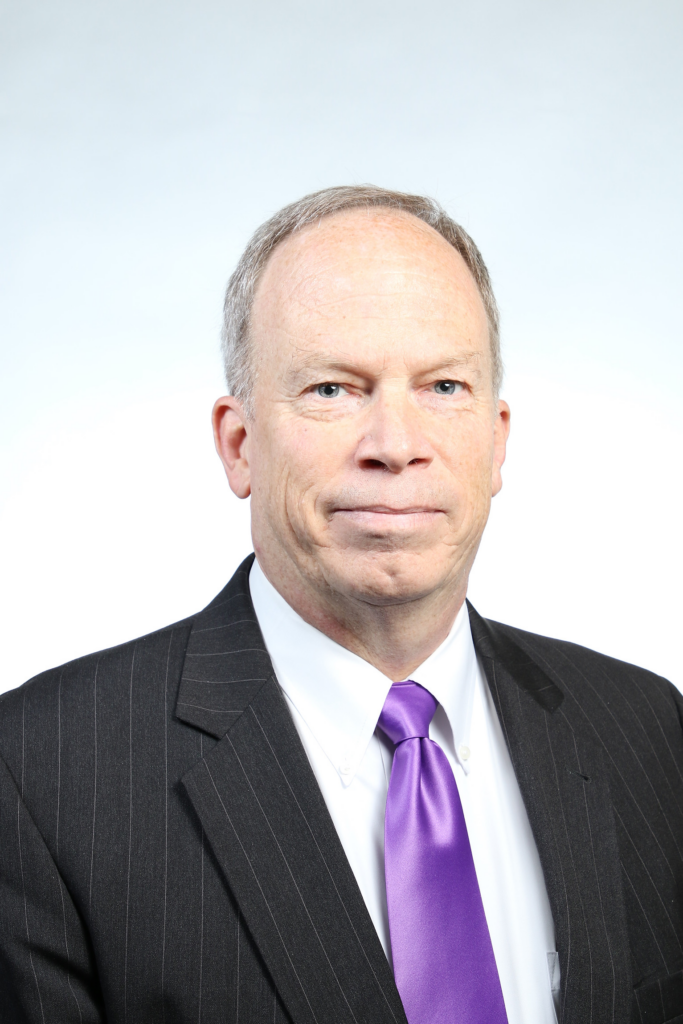
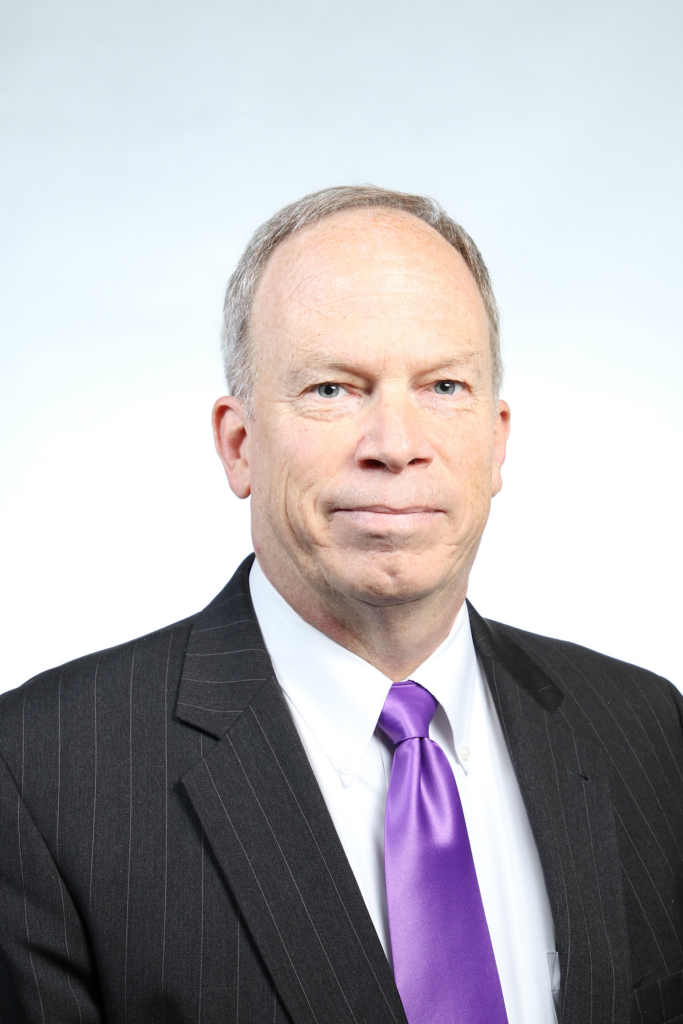
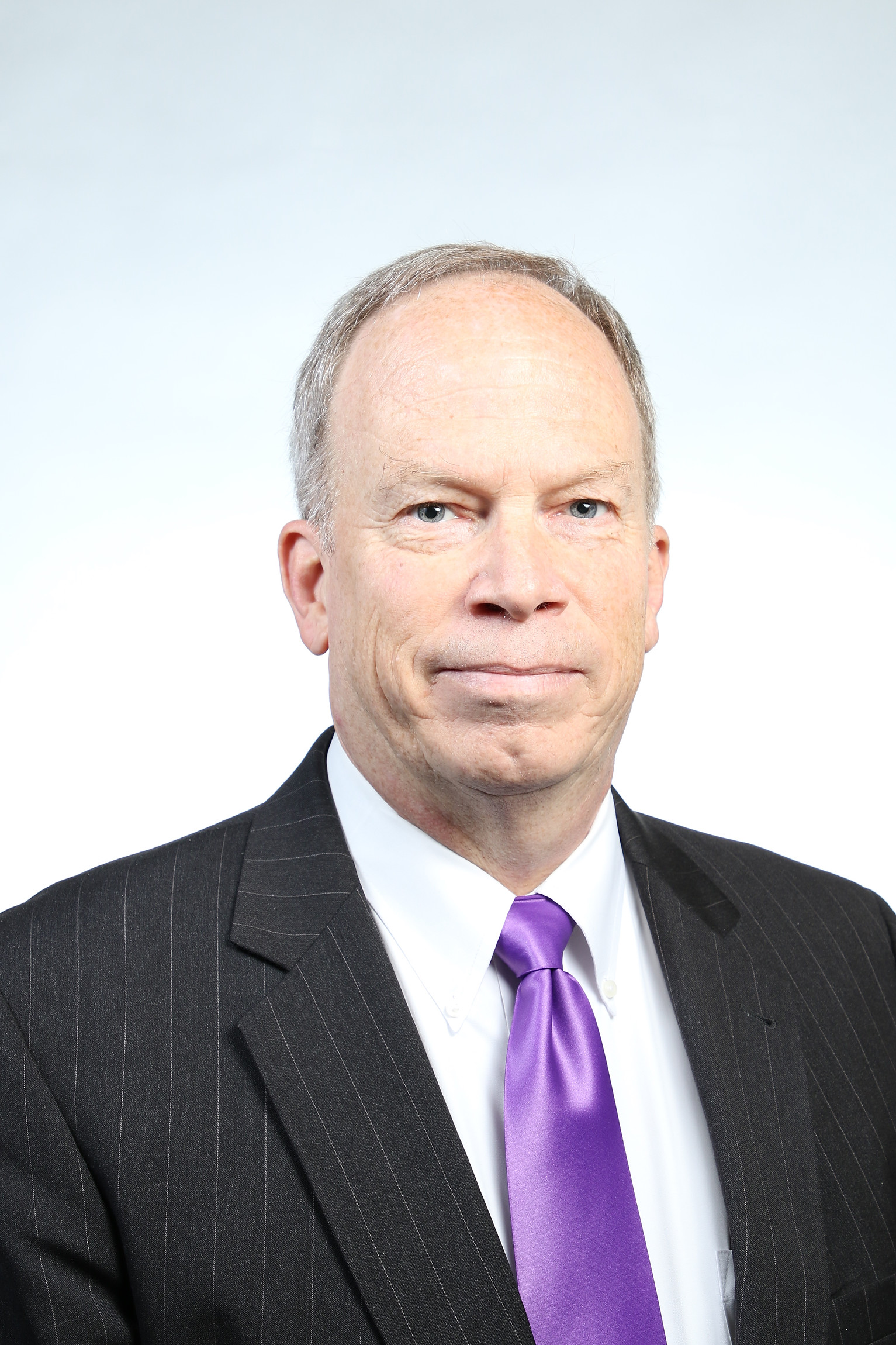
Dr. Wiley Chambers II, MD headshot
Dr. Wiley Chambers II, MD

Chambers is supervisory medical officer in the Office of New Drugs in the FDA’s Center for Drug Evaluation and Research. The center’s mission is to assure that safe and effective drugs are available to the American people.

He was among three panelists who joined moderator Jeffrey Finman, PhD., of Jupiter Point Pharma Consulting, in exploring the development and approval of new treatments for rare diseases, including LCA. The panel was part of Sofia Sees Hope’s first-ever LCA Family Conference in Groton, CT, on Oct. 6.

Jennifer Hunt with Editas Medicine, a discovery-phase biotechnology company, and Tami Morehouse, a participant in the breakthrough LCA2 (RPE65) genetic therapy trial joined Chambers on the panel.

Not all trials are ‘real’

“Be aware of any trial where you’re charged for the drug or biologic product,” Chambers said. “If they’re charging you, watch out.”

He said every clinical trial is assigned an Investigational New Drug (IND) number. No number, no real trial.

Chambers sited the disastrous case of a 77-year-old woman who traveled to Georgia to have stem cells injected in her eyes in the hopes of a cure or at least help for her macular degeneration. The procedure entailed taking fat from the woman’s belly, separating stem cells that naturally occur in fat, and injecting them into her eyes to regenerate damaged tissue.

The procedure, not covered by insurance and not approved by the FDA, cost the woman $8,900. Within three months, her retinas – the eye’s layer of light-sensitive cells – had peeled away from the rest of her eyes. Her vision deteriorated to where she only could see hand movement before her eyes. She no longer could find her way on her own.

To fulfill its mission, the FDA monitors the drug development process during investigational stages, approves new drug products that are safe and efficacious, and monitors post-approval adverse events.

The FDA does not conduct clinical studies, choose which products a company will study, force companies to market products, or regulate the practice of medicine.

Approval depends on whether the benefits of a drug outweigh the risks.

“There is always a risk,” Chambers said. “If it does anything positive, it does something negative…It’s a balancing act.”

The factors weighed in this balancing act of forces and interests, clinically referred to as equipoise, consist of:

  • the potential benefit from the drug product;
  • the potential adverse event from drug;
  • the potential safety from not taking a new drug;
  • the potential loss from disease condition if not taking an effect therapy;
  • and missing out on an alternative therapy.

Panelist Jennifer Hunt, vice president of clinical operations for Editas Medicine, described the process of developing a medicine that corrects mutated genes through editing. Using her company’s investigational medicine, EDIT-101, as an example, she detailed the course for finding an ocular medicine to treat patients with LCA10 (CEP290). LCA10  is one of the leading causes of blindness beginning in the first years of life.

Editas is working on developing CRISPR-based medicines (pronounced crisper, and meaning Clustered Regularly Interspaced Short Palindromic Repeats). CRISPRs are specialized stretches of DNA; the protein Cas9, meaning CRISPR-associated, is an enzyme that acts like a pair of molecular scissors, capable of cutting strands of DNA, according to LiveScience

EDIT-101 is poised to be the first in vivo CRISPR medicine used in human trials. Before those clinical trials begin, researchers have been looking to answer key questions, such as, does editing restore protein expression in cells and what are the best clinical trials for patients?

Editas researchers also are conducting an ongoing natural history study with 40 patients, ages 3 and older. They are followed up with six times over the course of a year at seven sites – four in the United States and three in Europe – to characterize them, assess their vision changes and validate study endpoints.

Editas has stated it plans to file an Investigational New Drug (IND) application with the FDA in October. Once allowed by the FDA, Editas can begin clinical trials.

The FDA evaluates three study phases of a proposed new drug:

  • Phase 1 investigation of new drugs in humans is a phase of research to describe clinical trials that focus on the safety of a drug. They are usually conducted with healthy volunteers, and the goal is to determine the drug’s most frequent and serious adverse events and, often, how the drug is broken down and excreted by the body. These trials usually involve a small number of participants.
  • Phase 2 consists of research to describe clinical trials that gather preliminary data on whether the drug is effective in people who have a certain condition/disease. Participants receiving the drug may be compared to similar participants receiving a different treatment, usually an inactive substance, called a placebo, or a different drug. Safety continues to be evaluated, and short-term adverse events are studied.
  • Phase 3 research is to describe trials that gather more information about a drug’s safety and effectiveness by studying different populations and different dosages and by using the drug in combination with other drugs. These studies typically involve more participants.

The third panelist, Tami Morehouse, spoke to the safety and effectiveness of LUXTURNA, a medication developed by Spark Therapeutics that the FDA approved last December for commercial use. Tami made medical history at age 44 when she became the oldest person to participate in the successful Phase 1 LCA-RPE65 genetic therapy clinical trial in 2009.

Dr. Jean Bennett and her husband, Dr. Albert Maguire successfully used the treatment on Lancelot, a dog born blind with a mutation in his RPE65 gene, before testing the medication on humans.

Prior to the trial, Tami could see faces, but much of the time she saw dark, gray haze. She woke up every morning when her alarm clock went off, wondering, would this be the day she would wake up with no vision.

“I had no hope whatsoever,” she said.

Her husband, Michael, added, “That’s where she’d be today were it not for that trial.”

Michael learned of Dr. Bennett and her ongoing clinical trials at Children’s Hospital of Philadelphia (CHOP) from a radio broadcast.

The trials resulted in FDA approval of LUXTURNA, a gene therapy that enabled Tami to regain some of her vision.

“It was an incredible experience that was a long time coming,” she said.

Tami said she is “walking, living proof” of the treatment’s safety and effectiveness. She told her audience to keep in mind that older people, along with children and young adults, can benefit from the treatment.

“Don’t give up hope and keep looking.”
IRD Milestones: Reasons to Be Excited

1971 – Just those numbers in white on a black page appeared on the big screen.

That’s how Brian Mansfield, PhD., began his presentation to families and patients living with Leber congenital amaurosis at Hope in Focus (formally Sofia Sees Hope) LCA Family Conference on Saturday, Oct. 6, in Groton, CT.

The year on that otherwise empty page marked the founding of Foundation Fighting Blindness – a time when patients losing vision often heard, “Go home. Learn Braille. You are going to go blind.”

Mansfield’s audience at the conference was made up of people diagnosed with a variety of rare inherited retinal diseases, including LCA, their caregivers and relatives, and representatives of various bio-tech and pharmaceutical companies working in the IRD arena. It was Sofia Sees Hope’s first such conference.

Dr. Brian Mansfield headshot
Dr. Brian Mansfield

Mansfield is the foundation’s senior vice president of research. He brought his audience up to date with information about clinical trials for inherited retinal diseases (IRDs), the rich preclinical therapeutic pipeline, how the Foundation uses money to move treatments forward and what people can do to drive change for IRD treatments and therapies.

His presentation culminated in a projected slide filled with logos of bio-technology and pharmaceutical firms, many of which are in contact with the Foundation, and represent the ever-expanding research and development field to help people with visual impairment.

$725 million in funding

In its 47 years, Foundation Fighting Blindness has raised more than $725 million toward research, development and public health education. It partners with several dozen U.S. non-profit organizations, including Sofia Sees Hope.

Mansfield traced the rapid trajectory of identifying genes causing retinal disease, from the founding of the National Eye Institute in 1968 through the Foundation’s funding of the Berman-Gund Laboratory for the Study of Retina Degenerations in 1971. It included the 1989-90 work identifying the rhodopsin gene as the genetic cause of Retina Pigmentosa (RP), and conducting the first retinal disease gene therapy trials in 2007. And of course culminated in last December’s federal approval LUXTURNA™, a gene therapy that helps restore vision in people with LCA2 (RPE65).

For people affected by LCA, more than 80 percent can now get a clear genetic diagnosis. For IRDs, more than 260 retinal disease genes have been identified, and the overall success in providing a clear genetic diagnosis is 65 percent.

Mansfield said that 23 gene-based clinical trials targeting 13 different genes are currently underway, including the LCA4 (AIPL1) gene trial by MeiraGTx.

He said the gene therapy preclinical pipeline is promising, with 100 genes under investigation. Researchers also are conducting preclinical studies of optogenetic gene therapies, in which light is used to control genetically modified retinal cells.

ProQR is planning a pivotal Phase 2/3 gene patch clinical trial for the LCA10 (CEP290) gene that involves injecting a short DNA molecule to cover up the faulty instruction the gene otherwise gives to act incorrectly. Also, Mansfield said, Editas Medicine is close to gene editing clinical trials, called “cut and paste” because an enzyme seeks out and repairs the defective gene. Another editing therapy in the pipeline, called base editing, essentially backspaces over the mutation and types the correction over it.

Also underway are more than 20 retinal cell therapy trials in which lost cells are put back to replace missing cells or used as biofactories to produce factors that help stabilize the retinal cells.

To help propel research and trials, the Foundation funds Career Development Awards to attract and retain clinician researchers dedicated to retinal disease research. The Foundation also provides awards to the brightest minds in the field, individually or as a team, to drive research.

It also gave 16 years of preclinical research support amounting to $10 million toward Spark Therapeutics’ commercial gene therapy, LUXTURNA, the first directly administered gene therapy approved in the United States that targets a disease caused by mutations in a specific gene – LCA RPE65.

Mansfield talked about how Applied Genetics Technology Corp. (AGTC) leveraged an early Foundation investment to garner $265 million to develop genetic therapies, some of which are in clinical trials.

The Foundation also supports 20 centers – the International Clinical Consortium – that have standardized assessment protocols for clinical trials.

To continue to attract industry interest, Mansfield detailed the Foundation’s My Retina Tracker registry, with its tagline “Track your vision. Drive the research.” It’s a free, secure, online patient registry that notifies registrants of clinical trials and gives researchers access to their disease data – but not their personal information – to advance studies on any number of research and therapy development efforts associated with IRDs.

The power of My Retina Tracker is optimized by registrants getting a genetic diagnosis. Sofia Sees Hope donated $65,000 to help people receive genetic testing and counseling.

Mansfield emphasized to his audience the vital importance of their knowledge, what they carry with them, and that patient input is critical to drug development.

2018 LCA Family Conference Presentations

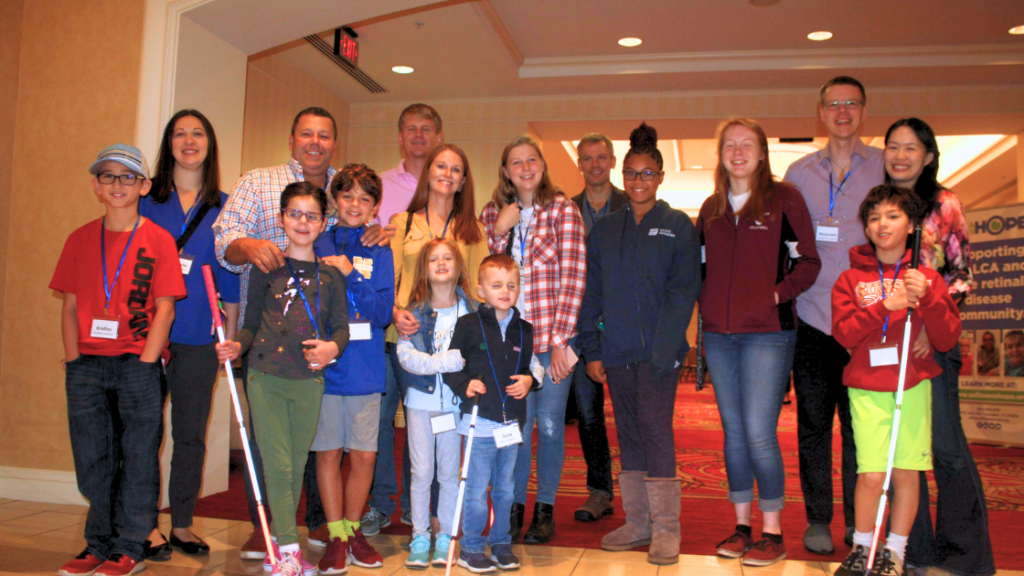
Children with canes and their parents smiling
2018 LCA Family Conference Attendees

On October 5-6, 2018, Hope in Focus (formally Sofia Sees Hope) held its first Family Conference for LCA and IRD families and caregivers. Thank you to all who attended and thank you to our sponsors, who made it all possible!

This event was the culmination of our first five years of work and fulfills our mission to connect LCA and IRD patients and families to researchers, industry experts and others who are keenly interested in LCA and and rare inherited retinal diseases. The goal of this conference was to get you excited about advances in research, deepen your understanding of the roles various organizations play in developing treatments, and provide insight into how an active patient community can support and accelerate treatment.

Below is the description of the panels and included are the presentations given by some of the speakers.

IRD Milestones: Reasons to Be Excited

Dr. Brian Mansfield, Senior Vice President of Research, Foundation Fighting Blindness

At no time in history has there been more promising research applied to genetically inherited eye disease.
Hear from our partners at the Foundation Fighting Blindness about how much easier it is today to access
genetic testing and genetic counseling and the exciting research and trials that are underway.

Download the presentation.


Moderator: JEFFREY FINMAN, Jupiter Point Pharma Consulting, LLC, Board Member, Sofia Sees Hope
Panelists: • DR. WILEY CHAMBERS, Supervisory Medical Officer in the Office of New Drugs at the FDA
• JENNIFER HUNT, Vice President of Clinical Operations, Editas Medicine
• TAMI MOREHOUSE, Phase 1 RPE65 Trial Subject RPE65 genetic therapy trial

From research to federal approval, what does it take to develop and approve a new treatment for rare disease? We’ll explore the regulatory, clinical, and industry aspects so you have a deeper understanding of what is involved in developing treatments, including how rare disease is different.

Download Dr. Chambers’ presentation.

Download Editas presentation.


Thank You to these speakers and organizations for their participation!

  • Kristen Angell, Associate Director, Advocacy, National Organization for Rare Disorders (NORD)
  • Beth Borysewicz, TVI for State of Connecticut and Sofia Sees Hope Board Director
  • Dr. Wiley Chambers, Supervisory Medical Officer in the Office of New Drugs at the U.S. Food and Drug Administration
  • Michael & Sela Cornell, Father and daughter from Chicago
  • Jill Dolgin, Head of Patient Advocacy, AGTC
  • Jeffrey Finman, Jupiter Point Pharma Consulting, LLC and Sofia Sees Hope Board Member
  • Jennifer Hunt, Vice President of Clinical Operations, Editas Medicine
  • Dr. Brian Mansfield, Senior Vice President of Research, Foundation Fighting Blindness
  • Tami Morehouse, Phase 1 RPE65 Trial Subject RPE65 genetic therapy trial
  • Jamie Ring, Head of Patient Advocacy, Spark Therapeutics

LCA Family Conference: The Role of the Patient Voice

Hope in Focus (formally Sofia Sees Hope) is holding its first LCA Family Conference on Saturday in Groton, CT. This event is the culmination of our first five years of work and fulfills our mission to connect LCA patients and families
to researchers, industry experts and others who are keenly interested in LCA and and rare inherited retinal diseases.

The goal of this conference is to provide updates about advances in research, deepen understanding of the roles various organizations play in developing treatments, and provide insight into how an active patient community can support and accelerate treatment.

We are pleased to welcome Jamie Ring, Head of Patient Advocacy, Spark Therapeutics; Jill Dolgin,
Head of Patient Advocacy, AGTC; Kristen Angell, Associate Director, Advocacy, National Organization for Rare Disorders (NORD) to our panel, “The Role of the Patient Voice in Developing Treatments for Rare Disease.”

Kristen Angell took a few minutes recently to chat with us about her work.

Kristen Angell headshot
Kristen Angell, NORD

Angell’s devotion and exuberance in her work with people with rare disease is literally in her DNA. A graphic designer by trade, life carried her in a different direction when she began volunteering for local non-profits. Shortly after, when her mother was diagnosed with breast cancer, Angell “dove in feet first.”
Then her father was diagnosed with stage 4 pancreatic cancer. Her cousin, who is her best friend, has cystic fibrosis, and later her sister was diagnosed with a rare blood cancer.

“Rare disease has always been common in my family,” she said. “Rare diseases in general don’t have a lot of research and funding, so I ran with that and began networking and started learning about rare diseases. I decided I wanted to do more in the community. I had a passion for patient advocacy.”

Before joining the National Organization for Rare Disorders (NORD), Angell got her first taste of volunteer advocacy when she worked on federal legislation resulting in the 2012 Recalcitrant Cancer Research Act requiring the National Cancer Institute to develop scientific framework for pancreatic and other deadly cancers.

Angell, NORD’s Associate Director of Advocacy since 2014, works with rare disease patients, families, industry leaders, medical professionals and legislators spanning the 50 states on public policy and advocacy initiatives to improve the lives of those affected by rare disease.

Angell runs NORD’s Rare Action Network that has 5,000 members nationally and ambassadors in 31 states. NORD, a voice for the 30 million Americans with rare diseases, is the official U.S. sponsor of Rare Disease Day, which takes place the last day of February each year.

She works to empower patient advocates, making sure they have the tools and resources to educate the community and to join the Rare Action Network. She helps advocates set up meetings with elected officials and overcome their fear of talking to policy makers.

She said it warms her heart that she can help her family and others who live with rare disease.
“I literally say I am one of the luckiest people,” she said. “I have the best job and I look forward to going into work each day.”

LCA Family Conference: The Road To Treatment

Hope in Focus (formally Sofia Sees Hope) is holding its first LCA Family Conference on Saturday in Groton, CT. This event is the culmination of our first five years of work and fulfills our mission to connect LCA patients and families
to researchers, industry experts and others who are keenly interested in LCA and and rare inherited retinal diseases.

The goal of this conference is to provide updates about advances in research, deepen understanding of the roles various organizations play in developing treatments, and provide insight into how an active patient community can support and accelerate treatment.

We are pleased to welcome Jeffrey Finman, Jupiter Point Pharma Consulting, LLC, Board Member and

Sofia Sees Hope; Dr. Wiley Chambers II, Supervisory Medical Officer in the Office of New Drugs at the FDA; Jennifer Hunt, Vice President of Clinical Operations, Editas Medicine; Tami Morehouse, Phase 1 RPE65 Trial Subject RPE65 genetic therapy trial, to talk about the The Road to Treatment: Understanding How Therapies Are Developed.

Dr. Chambers took a few minutes recently to chat with us.

Dr. Wiley Chambers II, MD headshot
Dr. Wiley Chambers II, MD

Wiley Chambers planned to join his ophthalmologist father in Connecticut after his residency at George Washington University Medical Center. But word got around the Washington, D.C., medical community that the Food and Drug Administration had no ophthalmologists; he thought he’d give the job a try for a year or two. He could always go to Connecticut.

Thirty-one years later, and having married a lobbyist along the way, Chambers remains in D.C. at the FDA where he has held multiple positions that have all included reviewing ophthalmology products. He has received numerous Public Health Service, FDA and Center for Drug Evaluation and Research awards for his work at the agency. Since 2011, he has been Deputy Director of the Division of Transplant and Ophthalmology Products, Office of New Drugs, in the FDA’s Center for Drug Evaluation and Research. As a Supervisory Medical Officer, he is usually the final person to review and sign off on new proposals before the beginning of clinical trials.

The FDA is involved anytime anyone wants to use an unapproved drug in humans or an approved drug for a different use in humans.

Chambers has clinically reviewed more than 100 ophthalmology drugs that have received FDA approval, including the first gene therapy “done inside a person,” as he said, in the form of LUXTURNA™, approved in December. The drug is a human-engineered virus, injected under the retina in the back of the eye, which contains a healthy version of the RPE65 gene that causes blindness in patients with Leber congenital amaurosis (LCA).

You won’t hear Chambers describe LUXTURNA as groundbreaking or extraordinary. He does not care for the superlatives, because every product that helps an individual is important to the person that it helps. Instead: “If it’s safe and effective, that’s what I care about most.”

In the study process, he said, reviewers and the company that makes LUXTURNA, Spark Therapeutics, ultimately came up with a maze for patients to navigate. “The issue was not how quickly you got through it. The issue was, could you navigate the maze in a lower level of light?”

He called the review and approval process of the medication “routine,” except for the endpoint.
“The endpoint was different than one we used for any other drug product – the ability to navigate in low light. We had never approved something for that before.”

Ultimately, Chambers says, his goal is to have cures, saying “Treatments are OK, but I’d much prefer cures.