An LCA Diagnosis Leads to Founding A Nonprofit for This Family

Even the Covid-19 cloud has a silver lining, and living proof is Andrew Picinich, a 4-year-old preschooler with LCA-CRX, an exceedingly rare form of Leber congenital amaurosis (LCA) caused by a mutation in his CRX gene.
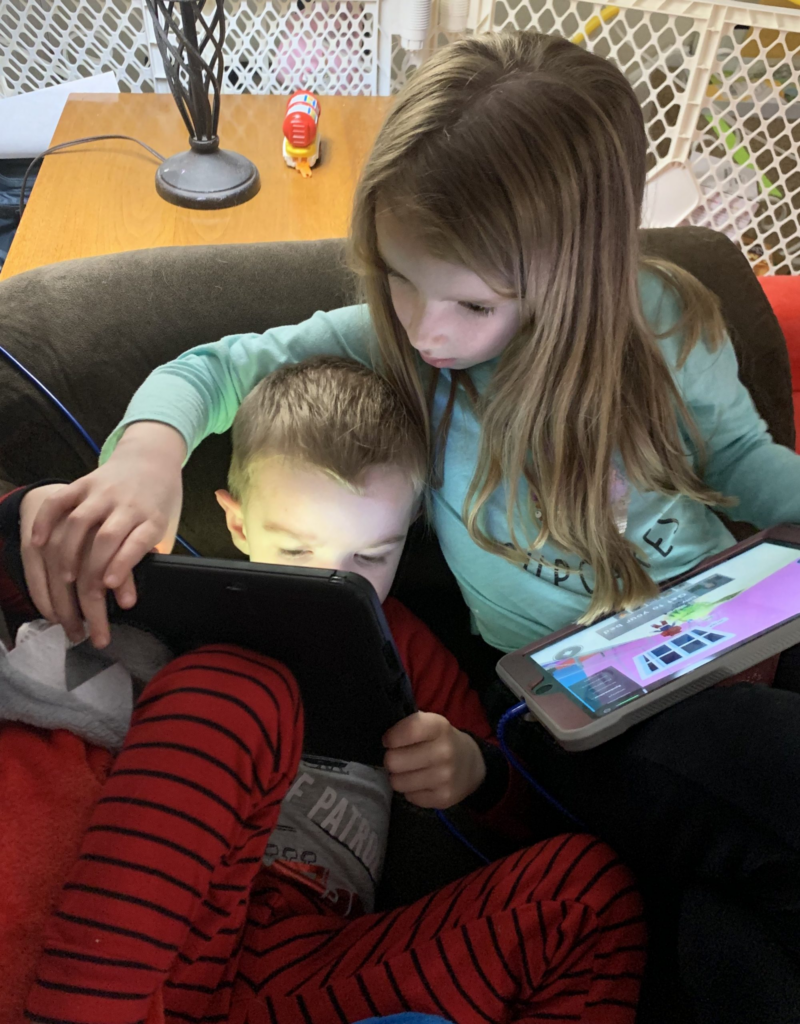
Anna helping Drew on his ipad
Drew’ s sister Anna helping him with his computer

Other than saying a few words, Andrew, who goes by Drew, usually does not speak. Coaxing him to be more open and social poses one of the biggest challenges for his parents.

Turns out being stuck at home in northeast Philadelphia to temper the spread of the coronavirus, opened up Drew’s personality, thanks to being with his family – all day, every day. He is interacting and engaging with them more than ever.

Drew also receives vision teletherapy and virtual preschool assignments through Philadelphia’s Overbrook School for the Blind. Virtual learning, a challenge for many, has its built-in difficulties for a 4-year-old who, as his mother said, has the attention span of, a 4-year-old.

As with many families staying home during the pandemic, the Picinich household is extraordinarily busy.  Drew’s mom, 39-year-old Monica, works full time now from home as a teacher of the visually impaired,  and Drew’s dad, 41-year-old Cian, works full time downtown for the Philadelphia Corporation for the Aging, which helps with elder care.

Monica, a former middle school science teacher, decided rather than focus on Drew’s pre-Braille and computer skills for now, she would concentrate on teaching him – literally and figuratively – how to navigate everyday life, including helping him learn to play with the same games and toys as his 7-year-old sister, Anna, and 2-year-old brother, Sean. Anna also plays sort of a teaching-assistant role with her outgoing personality. But being so social while not being in a classroom also means she terribly misses her school, and her first-grade friends and her teacher. 

CRX: Rare among the rare

At 4 months old, Drew moved his eyes from side to side as if reading a teleprompter, his mom said, and a pediatric 
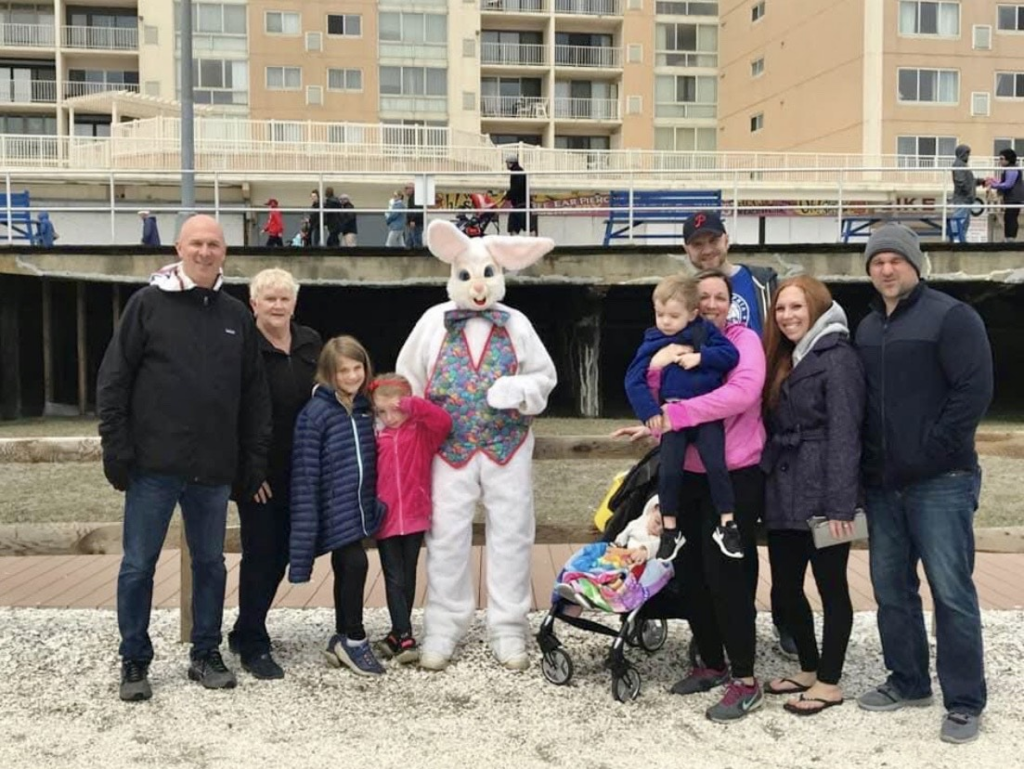
Drew's family with the Easter bunny
Drew’s Uncle Joe, Grandmom Barbara, cousin Sienna, sister Anna, brother Sean, Drew, Mom Monica, Dad Cian, Aunt Alysha and Uncle Greg, posing with the Easter bunny.

ophthalmologist diagnosed him with nystagmus. At Children’s Hospital of Philadelphia (CHOP), he underwent an electroretinogram (ERG), revealing his LCA diagnosis. 

Drew’s confirmed genetic diagnosis later found he had a mutation in his CRX gene, resulting in LCA-CRX, also known as LCA7, a rarer version of the already rare forms of LCA.

The more than 25 identified forms of LCA usually occur in 1 to 2 per 100,000 births. The extremely rare CRX affects 1 percent to 3 percent of all LCA patients.  

The CRX mutation also distinguishes itself as an autosomal-dominant gene rather than LCA’s usual autosomal-recessive, meaning a gene mutation caused Drew’s condition, rather than him inheriting it from his parents. This also means Drew has a 50/50 chance of passing it on to his children.

Developing therapies for treating CRX also presents bigger challenges. The CRX dominant gene first needs to be turned off before inserting a good gene. A federally approved therapy for LCA2 (LCA-RPE65) works by inserting a new gene to overtake the bad, while a developing technology of gene editing works like molecular scissors to cut out the mutation. 

As part of their search for more CRX information, the family attended the LCA Family Conference hosted by Hope in Focus (formally Sofia Sees Hope)last summer in Philadelphia. Patients, family members, advocates, doctors, researchers, and biotech industry leaders gathered at the two-day conference. 

“I came away with knowledge and connections,” Monica said. “Being able to listen to and converse with doctors, FFB (Foundation Fighting Blindness) representatives, people from Sofia Sees Hope, and other families, was both informative and empowering. Even more impressive was the amount of dedication and love displayed by everyone that attended the conference.” 

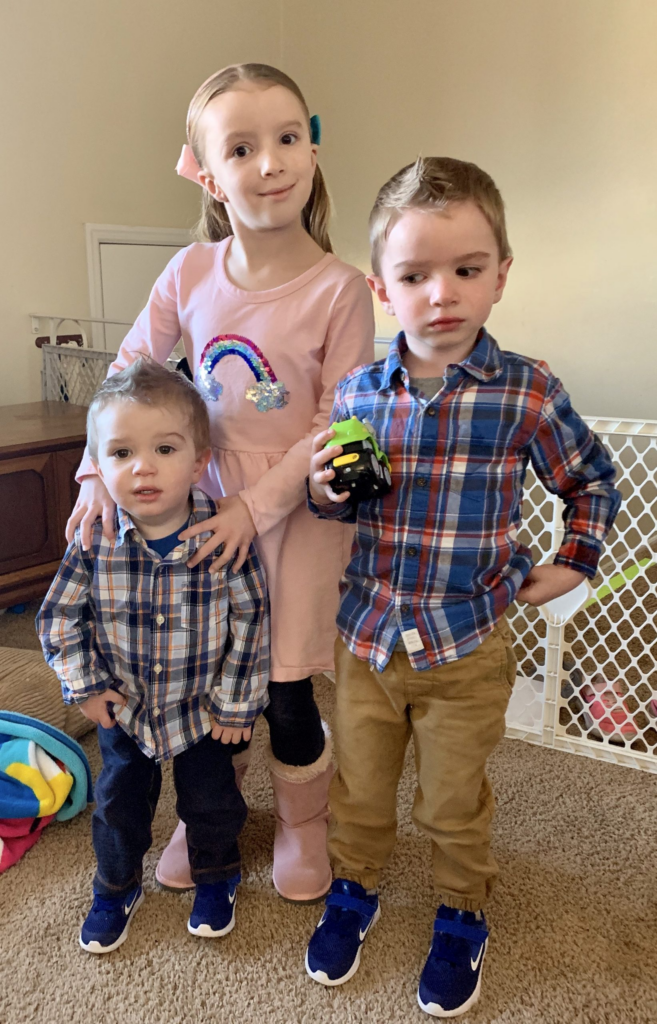
Sibling photo of Drew, Anna and Sean
Four year old Drew (right) with Anna, his 7-year-old-sister, and Sean, his 2-year-old-brother.

Soon after their son’s diagnosis, Monica and Cian (pronounced key-in) realized CRX families needed a patient organization to reach other families affected by LCA-CRX and to raise money for research. 

Four summers ago, their extended family gathered around the dining room table at Monica’s parents’ beach house. They brainstormed and created Drew’s Beacon for Blindness. Monica and her brother, Joseph Cardullo, run the group.

The nonprofit supports the blind in Pennsylvania, New Jersey, and Delaware, and has two objectives: Finding a treatment/cure for CRX blindness and supporting schools and other organizations that provide educational technology for students living with blindness.

The group secured grant funding to give schools a 3-D printer and a K-NFB Reader (Kurzweil-National Federation of the Blind Reader), a mobile app that converts text to speech or text to Braille. 

While researchers work toward developing a treatment for CRX blindness, Monica said, “Our main goal right now is to find other families with the same gene that want to unite to support CRX research.

“Aside from the research, it’s great getting to know people who have similar experiences as you. It helps make your rare experience feel more normal.”

Still in the early planning stages, Drew’s supporters in partnership with the Foundation Fighting Blindness are working on an educational webinar for CRX families. Sofia Sees Hope will help spread the word when the webinar plan comes to fruition.

With more input from researchers and families, Drew’s Beacon for Blindness hopes to discern promising avenues of CRX research and help fund studies to find a cure.

“Hopefully,” Monica said, “We can start to help move the research forward. It would be fantastic if everyone with LCA, no matter the gene, had an option for treatment.”
Living with LCA: ‘It’s ABCs and 123s’

Blink and you just might miss toddler Jordynn rocket past you. A force to be reckoned with when it comes to music and movement, Jordynn is 4 years old and lives with Leber congenital amaurosis (LCA) caused by a mutation in her RPE65 gene

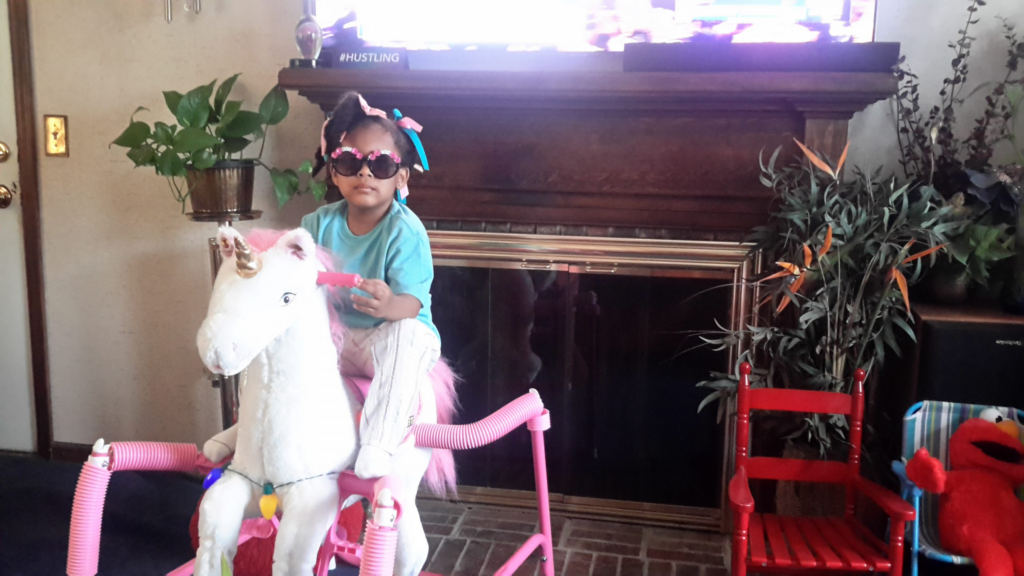
Jordynn on her rocking unicorn horse wearing sunglasses
Jordynn on her rocking unicorn.

“Jordynn is obsessed with movement,” said her mother, Joy. “So, before COVID happened, I would take her to Sky Zone (Trampoline Park),” now closed as part of a national shutdown to help contain the pandemic of coronavirus, known as COVID-19. 

“Anything that moves, Jordynn is willing to try. We have a hard time getting her off the swings. At school, they use it as a reward for what she accomplished.”

Jordynn and her mother, who live in upstate New York near Rochester, received their genetic diagnoses in 2017, just several months before the U.S. Food and Drug Administration approved LUXTURNA™, a genetic therapy for patients with the RPE65 gene mutation, known as LCA2.

Jordynn was on a waiting list to take part in an RPE65 gene therapy study by Dr. Mina Chung  of the University of Rochester Medical Center (URMC) Strong Flaum Eye Institute when Dr. Chung died in February after a fall while skiing in Italy. 

Jordynn’s family is still reeling from Chung’s sudden death. She was a 51-year-old renowned researcher and retinal surgeon. 

“She was the best,” Joy said. “We had just seen her a week before she went on her vacation and we’d see her when she came back.”

Joy is waiting to hear when Jordynn can join the study and was told by Dr. Benjamin Hammond, a colleague of Dr. Chung’s and an ophthalmologist working with Jordynn, that everything is on hold until another surgeon comes on board. 

Turning 4 in the middle of a pandemic

Jordynn just celebrated her 4th birthday Wednesday, May 6, when her very arts-and-crafty mom gave her daughter a

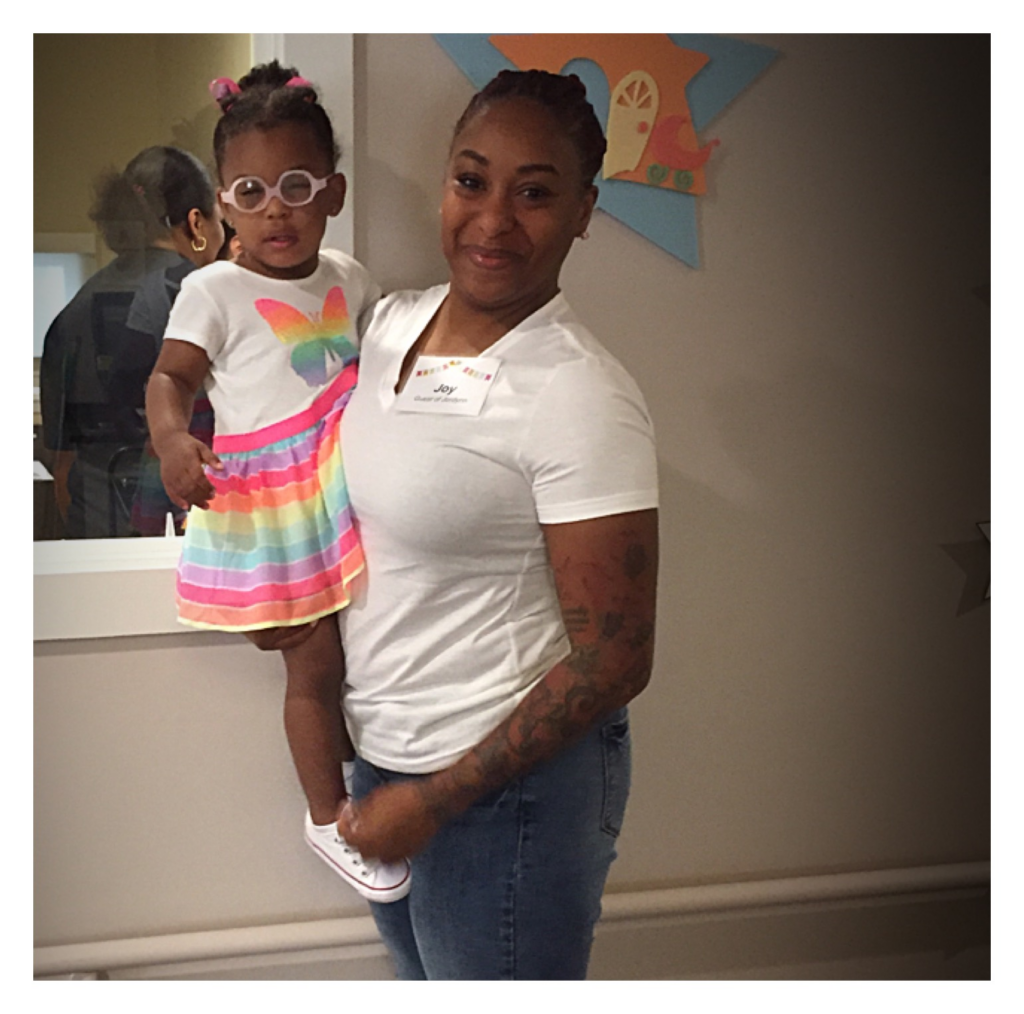
Jordynn being held by her mom, Joy
Joy and her daughter Jordynn

quarantine birthday party, planned far in advance with a rainbows-and-cupcakes theme. Family members sang “Happy Birthday,” took photographs, and five minutes later left for their respective homes to help curb the spread of the virus.

With her prekindergarten class closed because of the pandemic, Jordynn gets her schoolwork sent home and through a YouTube channel. She has music therapy incorporated with orientation and mobility training because she is so drawn to playing the piano and the drums and loves to follow the beat and sing.

She also is learning Braille on a Brailler, and everything throughout her mom’s apartment and her grandmother’s nearby home is labeled in Braille for her to identify. 

“Before it was all about Sesame Street,” Joy said of her daughter’s learning. “Right now, it’s ABCs and 123s and colors and all the things on YouTube that she can dance to and learn her numbers while she’s singing.”

Jordynn’s vision allows her to follow light and see three-dimensional shapes, but she cannot see them on paper.

Her mother first noticed something might be awry with her vision when she wouldn’t pay attention to people looking at her and smiling. Doctors diagnosed Jordynn with nystagmus,  a vision condition wherein the eyes make repetitive, uncontrolled movements. 

With a later diagnosis of LCA, Joy was stunned: “I just sat there, and then I said, is this my fault? Is there something I could have done when I carried her? OK, it’s something genetic. 

“I cried,” she said. “The whole family cried.”

Already working with URMC Pediatrician Dr. Mary Porter for early mobility intervention, Jordynn’s family found more resources through Dr. Chung and Dr. Hammond, and through upstate New York’s Association for the Blind & Visually Impaired

Through it all, though, Joy is most grateful for an incredibly supportive family. Jordynn’s family support extends to her dad in North Carolina, aunts, uncles and four grandparents, including Grandma Gwen, Joy’s mom, who sees her almost every day.

“It’s just family support; that’s how we get through this,” Joy said. “Family support and lots of toys.”

Jordynn is among Gwen Goodwine’s dozen grandchildren and gets to see her grandma almost daily because they live near each other and because Gwen takes care of her while her mom, Joy, cares for the elderly and those with dementia. 

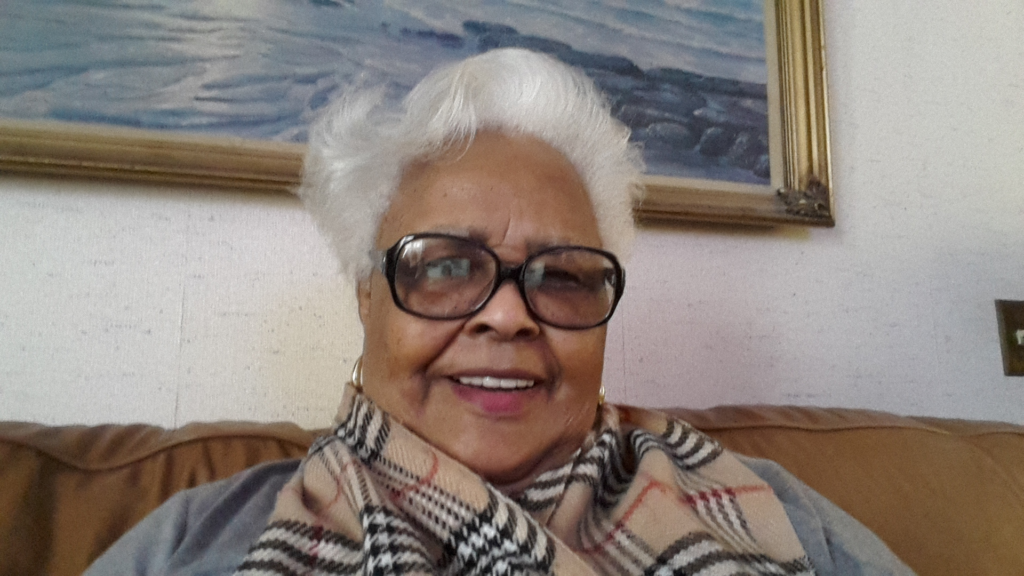
Gwen taking a selfie
Gwen Goodwine

There is no disguising the abundant love and hope that Gwen exudes for her youngest grandchild. For Jordynn, Gwen set up rugs like oversized dominoes throughout her house, blue and white rugs, from the family room, to the living room, to the kitchen, to the bedroom.

“That’s how she learned how to navigate,” Gwen said. “She runs through here like she’s got 20/20 vision. 

“She likes to climb up on things. Anything she can reach. She takes the stool everywhere she wants to get. She loves to take the stool to my dresser. She plays with my perfume and plays with the jewelry. She’s fascinated. She looks in the mirror. She can’t see herself, but she’s seen me do it so many times that she does it.”

Jordynn moves a lot at grandma’s. 

“She’d jump off this house if she could. I bought her a rocking horse. She’ll get on that horse and say, ‘I’m going to Tennessee, I’m going to Georgia, I’m going to California.’ She tore it up. Got another one. How she used it! They sent us another one free.

“She can be stubborn, too, oh my God. It’s her way or no way. She has a mind of her own. She knows what she wants, and she gets it.”

Gwen, now 80 with still a lot of energy, wants more than anything to see Jordynn see.

“I say, Lord, please. I don’t want to leave this earth ’til she look at me and see my white hair, take both of her hands on my jaws and kiss me.”

After Jordynn’s genetic diagnosis, Joy and Gwen found out about Spark Therapeutics, the research company that developed LUXTURNA™. The drug is an engineered virus that delivers the human RPE65 gene by subretinal injections.

They spoke with Spark’s Head of Patient Advocacy, Jamie Ring, who told them about Hope in Focus (formally Sofia Sees Hope) and its advocacy work with people living with LCA and other rare inherited retinal diseases (IRDs). They also heard about Sofia Sees Hope’s (then) upcoming LCA Conference in July 2019.

Joy, her sister Jackie, Gwen, and Jordynn traveled last summer to the Philadelphia conference, a two-day event attended by more than 80 people – patients, family members, advocates, doctors, researchers, and biotech industry leaders – from across the country and Mexico.

The many people they met included Dr. Jean Bennett, who with her colleagues at Children’s Hospital of Philadelphia and Spark Therapeutics, developed LUXTURNA. They also spoke extensively to Ben Shaberman, Senior Director of Scientific Outreach and Community Engagement for the Foundation Fighting Blindness

Joy said it was great to meet families with kids who have gone through the same experiences. 

“Learning about the treatment and getting the education about all of it really gave me something to think about as my daughter’s journey continues as she lives with this visual impairment,” she said. “Knowing that my daughter can thrive and live a happy life with some occasional bumps in the road was a wonderful feeling.”

She’s learned along the way the importance of perseverance and patience, offering this advice to parents beginning this journey:

“Don’t get discouraged. Take your time. Learn the process. Get to know your options. Find the resources available in your state. It’s a process but it takes time and sometimes it can be frustrating.”

Joy’s other message? “Please treat Jordynn like a normal toddler, because this is her normal and she is just like any other toddler.”