‘Let’s Chat About …’ Webinar Offers LCA Overview and Updates on Clinical Trials

In the debut of Hope in Focus (formally Sofia Sees Hope) ‘Let’s Chat About …’ monthly webinar series, Ben Shaberman of the Foundation Fighting Blindness, provided his Zoom audience with a plethora of information about Leber congenital amaurosis (LCA), highlighting some of the more than 40 clinical trials underway to find treatments and cures for LCA and other rare inherited retinal diseases (IRDs) and giving updates on promising preclinical research. 

The recorded webinar aired 1 p.m. Wednesday, Jan. 27, 2021, and can be seen here. Elissa Bass, our marketing and communications director, moderated the session.

Shaberman, Senior Director, Scientific Outreach & Community Engagement, stumbled across a science writing position at the Foundation Fighting Blindness 16 years ago without a clue about retinas or blindness. He called his move to the Foundation serendipitous. He knew he made the right choice after hearing retinal researcher Dean Bok, PhD, tell attendees at a 2005 Foundation conference how he was drawn to the field by the seduction of the retina’s myriad complexities and inner workings.

Shaberman, too, felt pulled by the intriguing science of the retina.

As such, so are the 27 forms of LCA that cause varying kinds of visual impairment within each gene mutation and within each affected person. An estimated 8,000 people in the United States have LCA.

The path of retinal research

Shaberman took his audience from the beginnings of identifying the RPE65 gene in 1993 and learning shortly thereafter it could lead to LCA, to using mice models and later studying Briard dogs that had the same gene mutation that caused LCA in humans. A clinical trial at Children’s Hospital of Philadelphia led to the 2017 FDA approval of the breakthrough gene therapy LUXTURNA®, developed by Spark Therapeutics. The drug successfully improved the vision of many of the LCA2-RPE65 patients who received the treatment through subretinal injections.

When children receive an LCA diagnosis, their families should find a good retinal specialist, get regular exams, and ultimately get a confirmed genetic diagnosis to be on the path to more specific information and research into that form of LCA, Shaberman said.

Families also should register with the Foundation’s My Retina Tracker®, a free and secure online registry that facilitates getting a confirmed genetic diagnosis by making registrants eligible for free genetic testing.

The registry becomes your personal retinal health record, updated by you. It employs state-of-the-art database technology to protect privacy and adheres to the highest standards of confidentiality and ethics. 

It also notifies registrants of clinical trials and gives researchers access to their disease data – not their personal information – to advance research and therapy development associated with LCA and IRDs. 

Reading research publications and attending events sponsored by the Foundation and by Sofia Sees Hope also provide opportunities for families to interact and learn the latest research. Shaberman and Bass encouraged people affected by LCA and their families to contact them, respectively, through the Foundation’s website and/or the Sofia Sees Hope website for specific information on clinical trials or other questions and concerns about living with LCA. 

“Yes, it’s work,” Shaberman said. “You have to be your own advocate and your own child’s advocate, but more and more information is becoming available, and that’s the good news.”

Shaberman also reviewed some of the more than 40 retinal clinical trials in the pipeline for LCA and other IRDs:

Join us Feb. 16

February’s “Lets Chat About …” webinar airs at 3 p.m. ET, Tuesday, Feb. 16. Our guest will be Wiley A. Chambers, MD, Supervisory Medical Officer for the Office of New Drugs, Center for Drug Evaluation and Research at the U.S. Food and Drug Administration. Register here.

Register Now for LCA-CRX Webinar Set for July 15

Drew’s Beacon for Blindness and Foundation Fighting Blindness are hosting a webinar Wednesday, July 15, at 4:30 p.m. EST on current research involving LCA-CRX, an extremely rare form of Leber congenital amaurosis (LCA) caused by a mutation in the CRX gene.

Drew’s Beacon for Blindness was founded by the parents of Drew Picinich, a now 4-year-old preschooler who was diagnosed in 2016 with LCA-CRX, also called LCA7.

The more than 25 identified forms of LCA usually occur in 1 to 2 per 100,000 births. The exceedingly rare CRX affects 1 to 2 percent of all LCA patients.

To attend the informational webinar, please send your email contact information to Drew’s mom, Monica Picinich, at mpicinich@drewsbeacon.org. A follow-up email with the Zoom access link will be sent to you.

Interested parties also can contact Monica by email with any questions or concerns.

An LCA Diagnosis Leads to Founding A Nonprofit for This Family

Even the Covid-19 cloud has a silver lining, and living proof is Andrew Picinich, a 4-year-old preschooler with LCA-CRX, an exceedingly rare form of Leber congenital amaurosis (LCA) caused by a mutation in his CRX gene.

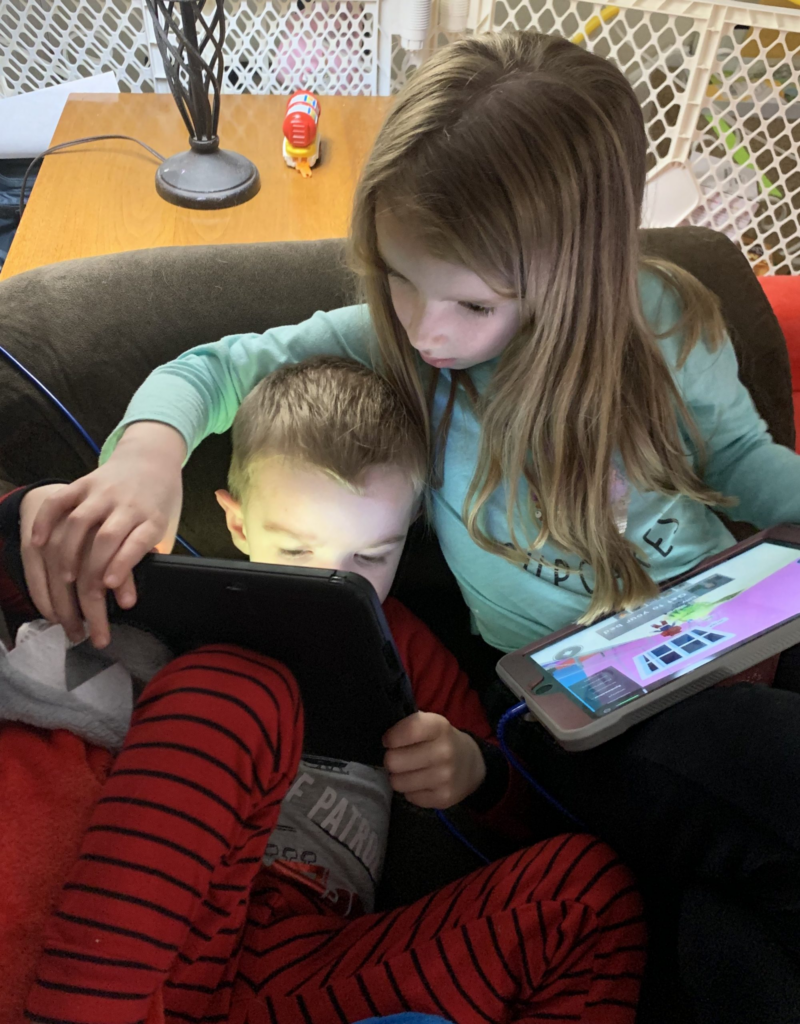
Anna helping Drew on his ipad
Drew’ s sister Anna helping him with his computer

Other than saying a few words, Andrew, who goes by Drew, usually does not speak. Coaxing him to be more open and social poses one of the biggest challenges for his parents.

Turns out being stuck at home in northeast Philadelphia to temper the spread of the coronavirus, opened up Drew’s personality, thanks to being with his family – all day, every day. He is interacting and engaging with them more than ever.

Drew also receives vision teletherapy and virtual preschool assignments through Philadelphia’s Overbrook School for the Blind. Virtual learning, a challenge for many, has its built-in difficulties for a 4-year-old who, as his mother said, has the attention span of, a 4-year-old.

As with many families staying home during the pandemic, the Picinich household is extraordinarily busy.  Drew’s mom, 39-year-old Monica, works full time now from home as a teacher of the visually impaired,  and Drew’s dad, 41-year-old Cian, works full time downtown for the Philadelphia Corporation for the Aging, which helps with elder care.

Monica, a former middle school science teacher, decided rather than focus on Drew’s pre-Braille and computer skills for now, she would concentrate on teaching him – literally and figuratively – how to navigate everyday life, including helping him learn to play with the same games and toys as his 7-year-old sister, Anna, and 2-year-old brother, Sean. Anna also plays sort of a teaching-assistant role with her outgoing personality. But being so social while not being in a classroom also means she terribly misses her school, and her first-grade friends and her teacher. 

CRX: Rare among the rare

At 4 months old, Drew moved his eyes from side to side as if reading a teleprompter, his mom said, and a pediatric 

Drew's family with the Easter bunny
Drew’s Uncle Joe, Grandmom Barbara, cousin Sienna, sister Anna, brother Sean, Drew, Mom Monica, Dad Cian, Aunt Alysha and Uncle Greg, posing with the Easter bunny.

ophthalmologist diagnosed him with nystagmus. At Children’s Hospital of Philadelphia (CHOP), he underwent an electroretinogram (ERG), revealing his LCA diagnosis. 

Drew’s confirmed genetic diagnosis later found he had a mutation in his CRX gene, resulting in LCA-CRX, also known as LCA7, a rarer version of the already rare forms of LCA.

The more than 25 identified forms of LCA usually occur in 1 to 2 per 100,000 births. The extremely rare CRX affects 1 percent to 3 percent of all LCA patients.  

The CRX mutation also distinguishes itself as an autosomal-dominant gene rather than LCA’s usual autosomal-recessive, meaning a gene mutation caused Drew’s condition, rather than him inheriting it from his parents. This also means Drew has a 50/50 chance of passing it on to his children.

Developing therapies for treating CRX also presents bigger challenges. The CRX dominant gene first needs to be turned off before inserting a good gene. A federally approved therapy for LCA2 (LCA-RPE65) works by inserting a new gene to overtake the bad, while a developing technology of gene editing works like molecular scissors to cut out the mutation. 

As part of their search for more CRX information, the family attended the LCA Family Conference hosted by Hope in Focus (formally Sofia Sees Hope)last summer in Philadelphia. Patients, family members, advocates, doctors, researchers, and biotech industry leaders gathered at the two-day conference. 

“I came away with knowledge and connections,” Monica said. “Being able to listen to and converse with doctors, FFB (Foundation Fighting Blindness) representatives, people from Sofia Sees Hope, and other families, was both informative and empowering. Even more impressive was the amount of dedication and love displayed by everyone that attended the conference.” 

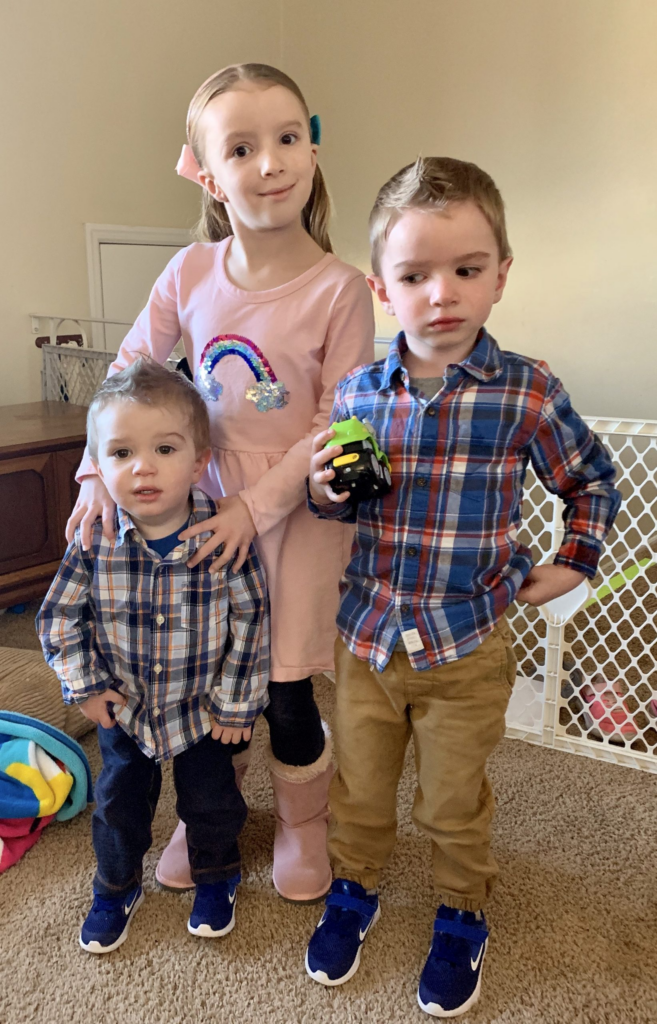
Sibling photo of Drew, Anna and Sean
Four year old Drew (right) with Anna, his 7-year-old-sister, and Sean, his 2-year-old-brother.

Soon after their son’s diagnosis, Monica and Cian (pronounced key-in) realized CRX families needed a patient organization to reach other families affected by LCA-CRX and to raise money for research. 

Four summers ago, their extended family gathered around the dining room table at Monica’s parents’ beach house. They brainstormed and created Drew’s Beacon for Blindness. Monica and her brother, Joseph Cardullo, run the group.

The nonprofit supports the blind in Pennsylvania, New Jersey, and Delaware, and has two objectives: Finding a treatment/cure for CRX blindness and supporting schools and other organizations that provide educational technology for students living with blindness.

The group secured grant funding to give schools a 3-D printer and a K-NFB Reader (Kurzweil-National Federation of the Blind Reader), a mobile app that converts text to speech or text to Braille. 

While researchers work toward developing a treatment for CRX blindness, Monica said, “Our main goal right now is to find other families with the same gene that want to unite to support CRX research.

“Aside from the research, it’s great getting to know people who have similar experiences as you. It helps make your rare experience feel more normal.”

Still in the early planning stages, Drew’s supporters in partnership with the Foundation Fighting Blindness are working on an educational webinar for CRX families. Sofia Sees Hope will help spread the word when the webinar plan comes to fruition.

With more input from researchers and families, Drew’s Beacon for Blindness hopes to discern promising avenues of CRX research and help fund studies to find a cure.

“Hopefully,” Monica said, “We can start to help move the research forward. It would be fantastic if everyone with LCA, no matter the gene, had an option for treatment.”

Living with LCA: Juliet’s Story

Scott and Heather Soady and big sister Gillian welcomed baby Juliet two years ago, and life progressed in an understandably hectic way for the San Diego parents who also are practicing lawyers. But life soon became more complicated as the couple’s new baby was diagnosed with Leber congenital amaurosis.

Juliet was born with strabismus, also known as crossed eyes, a condition that often disappears with time. At the age of 4 months, Juliet’s pediatrician noticed she had involuntary eye movement, a condition called nystagmus. The doctor said Juliet presented the worst case she’d ever seen in a child.

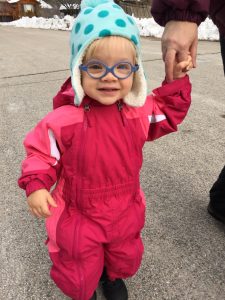
Juliet in a pink snow suit wearing a pooka dot hair and blue glasses
Juliet

Doctors placed Juliet under general anesthesia to scan her optic nerve and eliminate causes of her condition. It was a difficult time, Scott said, for Heather, especially, because she was breastfeeding and Juliet was only 4 months old.

When doctors told Scott, “It’s probably not brain cancer, ” he said, “I didn’t realize that was an option.”

Two months later, with Juliet again under anesthesia, a specialist measured her retina’s light perception by placing contact lenses with electrodes in her eyes. This procedure is called an Electroretinography (ERG) and is used to clinically diagnose LCA and other inherited retinal disorders such as Retinitis Pigmentosa (RP), cone-rod dystrophies, X-linked juvenile retinoschisis, achromatopsia and others. 

Twenty minutes later, the family received a confirmed clinical diagnosis of Leber congenital amaurosis.

“What you’re told is, there’s this condition you’ve never heard of, that’s extremely rare, that has no cure, that’s she’s going to be blind and there is nothing you can do about it,” Scott said.

“… You go through this grieving process of the life that you envisioned for your child. I would constantly think about these things, going to the beach, seeing a sunset, watching a movie, doing all of these things with her and sharing the world with her, and all of a sudden, that’s never going to happen with her.”

Gradually, his perspective changed: “You’re still going to do all these things, but you’re going to do it in a different way. … There is nothing in the world that tells you what that’s going to be like for her. … You have to adapt everything so that it will happen.”

At the age of 2, Juliet is legally blind. With glasses, her vision is 20/470. In other words, Scott said, the same object and details you can see at 470 feet away, she will only be able to see at 20 feet. Doctors say her vision may deteriorate over time.

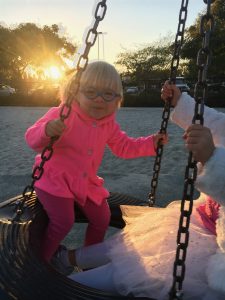
Juliet on a swing

Looking for more information and answers, Scott attended the national VISIONS conference hosted by the Foundation Fighting Blindness last summer in Baltimore.

“That’s where I met Laura Manfre (Hope in Focus, or formally known as Sofia Sees Hope’s co-founder) and a bunch of other families that have kids with the same condition. That was truly amazing,” Scott said. “You feel so alone, the condition is so rare, there’s not going to be someone you just run into.”

He said he was touched that for the first time, people asked how he was doing.

Meeting parents who are dealing with LCA and seeing young people with LCA functioning as normal teen-agers gave Scott comfort and hope that everything’s going to be OK.

Through Laura, Scott and Heather connected with Spark Therapeutics’ “ID your IRD” initiative for Juliet’s genetic testing. Scott said he still held hope that maybe Juliet really did not have LCA, but the genetic findings confirmed otherwise.

The testing also revealed that Juliet has what is called a de novo mutation of the CRX gene, which caused it to be autosomal dominant rather than autosomal recessive. This means Juliet’s condition is a result of a gene mutation, rather than from inheriting it from her parents. It also means that Juliet could pass it on to her children.

“It’s not quite the normal LCA,” Scott said. Of those who have LCA, 1 percent to 5 percent have this gene mutation.

Genetic therapy also is more complicated. Rather than inserting a good gene and having the bad one go away or bypassed, the CRX dominant gene first needs to be turned off before a good gene can be inserted

The Soadys connected with a doctor who was conducting this research but had to stop for lack of funding.

“The light at the end of the tunnel got much dimmer,” Scott said of the end of the research. “It would be nice to see if there’s a potential cure.”

For now, the family is in the intense process of preparing Juliet for a new time in her life, from a home environment to a school environment, as she begins preschool. Gillian, who turns 5 in September, will be in kindergarten.