Moving emerging therapies through clinical trials and across the finish line is often challenging—and in some cases, harrowing. Many treatments never make it.
In early 2022, the future looked bleak for ProQR Therapeutics’ two RNA therapies in clinical trials. The biotech company reported that sepofarsen, its RNA therapy for LCA10 (IVS26 mutation in CEP290), did not meet its primary endpoint of improvement of at least three lines in best-corrected visual acuity or BCVA. (Improvement in BCVA was only on average two lines in the Phase 2/3 trial.) That news came despite vision improvements, some significant, for many patients. The endpoint misled ProQR to stop development of its ophthalmology assets—sepofarsen and ultevursen (exon 13 mutations in USH2A)—and attempt to find a company to acquire them.
Mike Schwartz, who was then vice president, global project leader, at ProQR, said, “That was devastating for me, the doctors, and the patients.” He noted that one patient with LCA10 in the trial with only light perception gained enough vision after receiving sepofarsen to see letters on an eye chart. Another LCA10 patient in the study returned to his work as a carpenter after treatment.
Fortunately, a year and a half later, the large European eye care company Théa acquired sepofarsen and ultevursen and formed the Sepul Bio business unit to move the therapies back into clinical trials. Many former ProQR staff went to Sepul Bio, including Mr. Schwartz, who is now their chief operating officer.
The global HYPERION Phase 3 clinical trial for sepofarsen and the LUNA Phase 2 trial for ultevursen are now underway. Using what was learned from the ProQR trials, the Sepul Bio team made significant changes to the designs (protocols) for the clinical trials, changes they believe will greatly improve chances for success. Mr. Schwartz thanked the Hope in Focus team for providing input from patients for the sepofarsen clinical development program.
One major change in the new sepofarsen clinical trial protocol has to do with the placebo. In most clinical trials with regulatory authorization, the treatment group is compared to a placebo or control group to ensure that efficacy is indeed a result of the treatment. In the original sepofarsen trial, treated eyes of LCA10 patients were compared to the eyes of untreated LCA10 patients (i.e., the control group). Comparing treated patients to untreated patients was less than ideal because of significant variations in vision loss among LCA10 patients. So, in the new trial, each LCA10 patient will have one eye injected with sepofarsen and the other will get a saline placebo injection. The patient won’t know which eye is getting the treatment. Sepul Bio believes comparing untreated and treated eyes for the same patient will lead to less variation and a stronger efficacy signal.
Keep in mind that sepofarsen injections are made into the vitreous, the soft gel in the middle of the eye. These intravitreal injections are performed routinely (e.g., monthly) and safely in doctors’ offices for treating age-related macular degeneration. In the sepofarsen clinical trial, patients will receive injections every six months.
Sepul Bio’s RNA therapies, known as antisense oligonucleotides (ASOs), are tiny pieces of genetic material that fix mutations in RNA—the genetic messages that cells read to make proteins critical to the cells’ health and function.
Stay tuned. We will report on updates from the trials as soon as we receive them.
For more information on the sepofarsen or ultevursen trials, send an email to: contact@sepulbio.com.
Hope in Focus Director of Outreach and Development Courtney Coates attended the Retinal Therapeutics Innovation Summit on May 2, 2025, hosted by the Foundation Fighting Blindness. This annual summit showcases over 25 presentations on advancing therapies, lessons learned, and progress on natural history studies and clinical trial endpoints.
Eric Hartman, Choroideremia Research Foundation with Courtney Coates
Highlights for the LCA community included: Twelve-month clinical trial data for LCA5 showing a clear safety profile, clinically meaningful improvement in vision, and durability. Lessons learned from the Editas gene editing trial for CEP290 The Road Ahead for SepulBio’s Antisense Oligonucleotide Therapy for LCA10 CEP290
Additionally, several presentations provided updates on programs for IRDs in various treatment modalities. Clinical trial endpoints continue to be an important topic of discussion as the field works to develop outcomes that are easy to measure, reflect a clinically meaningful improvement in vision, and can be validated for regulators.
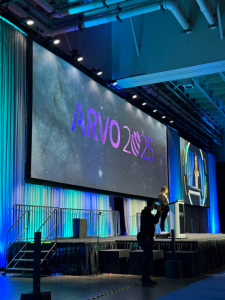
The summit was followed by the ARVO Annual Meeting, an essential resource for research updates, early pre-clinical research posters, and networking with the entire ecosystem of ophthalmic drug development. We continue to monitor early research for ultra-rare gene mutations, consistently engage with industry to incorporate the patient voice into clinical trials, and promote policy positions that will benefit the rare disease and LCA community.
For additional questions, please feel free to reach out to Courtney at courtney@hopeinfocus.org.
In December 2023, ProQR sold its sepofarsen (LCA10) and ultevursen (USH2A) programs to Théa, a large European biotechnology company focused on ophthalmology. Théa, through its new dedicated business unit, Sepul Bio, will continue developing sepofarsen and ultevursen. I asked representatives at Sepul Bio a few questions about their emerging therapies, plans, and efforts. Here are their answers.
What are sepofarsen and ultevursen? Who developed these therapies, and how did they perform in clinical trials?
Sepofarsen is an experimental mRNA therapy designed to improve visual function for patients with Leber congenital amaurosis 10 (LCA10). Sepofarsen targets a specific genetic mutation (c.2991+1655A>G) in the CEP290 gene. This mutation stops the cell from producing an essential protein needed for the cells in the retina to function. By addressing this mutation with a piece of genetic material called an antisense oligonucleotide (AON), sepofarsen aims to restore cell function in the retina. The AON is delivered by an intravitreal injection. Sepofarsen is entering Phase 3 clinical development.
Ultevursen is an experimental mRNA therapy designed to stabilize visual function for patients with Usher syndrome type 2A or non-syndromic retinitis pigmentosa caused by mutations in exon 13 of the USH2A gene. These mutations stop the cell from producing usherin, an essential protein needed for the cells in the retina to function. By addressing this mutation with an AON, ultevursen aims to restore cell function in the retina. The AON is delivered by an intravitreal injection. Ultevursen is entering Phase 2 clinical development.
Both sepofarsen and ultevursen were first clinically developed at the biotechnology company ProQR Therapeutics, based in the Netherlands. Both emerging therapies improved vision in some patients participating in ProQR’s previous clinical trials.
What is Sepul Bio? What is its mission?
Sepul Bio is a dedicated business unit of Théa. The team is at the forefront of advancing transformative RNA therapies for inherited retinal diseases, particularly emphasizing the further development of sepofarsen and ultevursen.
Sepul Bio’s projects are driven by the vision of a future where patients with inherited eye diseases have treatment options for their eye condition. Through ongoing research and rigorous development, Sepul Bio hopes to bring new therapies to patients. Learn more at www.sepulbio.com.
As part of the divestment from ProQR, the dedicated team at Sepul Bio includes former members of the previous clinical development teams. This structure maintains consistency and brings previous experience with the programs to the new clinical development steps. The new business unit underlines Théa’s firm commitment to advancing therapeutic products for eye disorders, particularly where medical needs are unmet.
What are the lessons learned from the ProQR trials? What will Sepul Bio do differently to improve the two therapies’ chances of success?
The Sepul Bio team previously worked on the sepofarsen and ultevursen programs at ProQR. This experience has enabled the team to learn from previous regulatory and clinical interactions in formulating new plans for the programs.
All the previous learnings from the years of clinical development have been incorporated into the new designs, with further validation from key physicians and inherited retinal disease specialists. A key area of focus has been new tests and novel study designs that are more suited for developing therapies for rare retinal diseases.
Luxturna®, the only approved treatment for one of 27 identified forms of Leber congenital amaurosis (LCA), cost $500 million to develop and took more than 12 years to come to market.
With such an enormous investment in time and money, it would make sense to use that same platform for developing new treatments to improve vision or halt progression of blindness.
Every individual clinical study must complete a set of rigorous requirements – which cost time and money – to receive regulatory approval from the Food and Drug Administration (FDA).
Chad R. Jackson
The Foundation’s translational research program steps up the pace of preclinical studies toward clinical studies involving humans through proactive management and industry-level advice to drive research leading to prevention, treatment, and vision restoration for degenerative retinal diseases.
A Hope in Focus partner, the Foundation has raised nearly $900 million since its founding in 1971 and funds more than 90 programs worldwide, including no-cost genetic testing and the My Retina Tracker® patient registry. The Foundation also launched a Retinal Degeneration Fund (RD Fund) to help accelerate life-changing outcomes for people with retinal degenerations through direct mission-related investments in therapeutic companies.
Chad and other presenters shared information about drug development, gene therapies, and non-gene therapies during two sessions of the Hope in Focus 2023 LCA Family Conference* in Indianapolis this summer.
More than 100 people attended the forum to hear the latest in LCA research and to network with families living with LCA and other rare inherited retinal diseases (IRDs).
Bringing a drug from inception to market takes 10 to 15 years, Chad said, and costs tens and tens of millions of dollars. He said bringing a developing drug from preclinical studies to the FDA requires three steps:
Identify your target to know what you’re seeking to do; conduct invitro studies by expressing patient cells in a lab or as it’s referred to, retinas in a dish; and perform animal-model studies, which save time and money to determine whether emerging therapies are safe and perhaps ready to move toward clinical trials using humans.
Gene-Agnostic Therapies
Chad moderated a panel discussion about research moving beyond single-gene correction to gene-independent therapies to help delay progression of blindness or restore levels of vision.
Eric Daniels
Kiora Pharmaceuticals’ Chief Development Officer Eric J. Daniels, MD, MBA, discussed the company’s first-in-human study for a non-gene therapy treatment for retinitis pigmentosa (RP), a group of inherited eye diseases that cause progressive vision loss. It is characterized by the gradual death of light-sensitive photoreceptor cells in the retina, known as rods and cones, responsible for converting light into neutral signals sent to the brain.
Dr. Daniels said his company’s technology shifts retinal ganglion cells from their off state, in which they respond to decreases in light. Kiora has discovered a way to shift these cells into their on state in the presence of light through channeled photoswitch molecules.
According to Kiora, the mutation-agnostic treatment has the potential for use in any of the various genetic forms of RP, as well as other retinal degenerative diseases; its intravitreal injection allows for more consistent and tolerable administration, and the small molecule can be manufactured and provided to patients at a much lower expense than the $450,000 per eye cost of Luxturna.
Huma Qamar, MD, MPH, CMI, the head of Clinical Development and Medical Affairs for Ocugen, discussed the biotech’s work on treatments for LCA10 (CEP290), RP, and other IRDs. One of their clinical trials involves a novel gene therapy, OCU400, consisting of a functional copy of a nuclear hormone receptor gene delivered to target retinal cells using an adeno-associated viral (AAV) vector. Expression of this receptor within the retina may potentially help stabilize cells and rescue photoreceptor degeneration, Dr. Qamar said.
Huma Qamar
Ocugen demonstrated the potential of a novel modifier gene therapy to elicit broad-spectrum benefits in early and intermediate stages of RP and LCA, based on animal studies, showing the potential for a mutation-agnostic treatment.
Since the conference, Ocugen reported an update on its Phase 1/2 clinical trial for OCU400 for 12 patients who had follow-ups from six to 12 months after a subretinal injection in one eye. The developing drug had a favorable safety profile in this trial phase. Also eight of the 12 patients showed stabilization or improvement in the visual function measures of best corrected visual acuity, low-luminance visual activity, and navigating a multi-luminance mobility test.
The trial is currently enrolling patients, including pediatric patients with LCA10.
Gene Therapies
In the conference’s final session, moderated by Foundation Vice President of Science Communications Ben Shaberman, four panelists discussed their work on LCA gene therapies.
Shannon E. Boye
Shannon Boye, PhD, Co-Founder, Director, and Acting Chief Science Officer of Atsena Therapeutics, said the road to drug development is long and bumpy. She helped design early studies on LCA1 (GUCY2D) in 2001.
With the process going so slowly, Shannon reached out to then-Foundation CEO Ben Yerxa, who helped push her and her husband into starting their own company.
In 2019 doctors dosed the first patient. Earlier this year, in a Phase 1/2 clinical trial, their LCA1 gene therapy, known as ATSN-101, showed clinically meaningful improvements in vision at the highest dose with no drug-related serious adverse events at six months after treatment.
Ash JayagopalBen Yerxa
At Opus Genetics, Chief Scientific Officer Ash Jayagopal, PhD, discussed the biotech’s progress for various programs in, or advancing toward, early-stage clinical trials.
Opus, headed by CEO Ben Yerxa, PhD, is the first spin-out company internally conceived and launched by the Foundation’s RD Fund. The Fund’s purpose is to accelerate advancing research into gene therapy for several forms of LCA and other retinal degenerative diseases.
Opus’ most advanced program for LCA5 (lebercilin), OPGx-LCA5, is dosing patients, while two other LCA programs involving LCA13 (RDH12) and LCA9 (NMNAT1) are in preclinical development.
Thomas Mendel, MD, PhD, talked about his research at The Ohio State University, where he is Assistant Professor of Ophthalmology and Vitreoretinal Surgery at the university’s Havener Eye Institute, Department of Ophthalmology & Visual Sciences. He is building a research program to develop and implement gene therapies for Professor of Ophthalmology and Vitreoretinal patients with inherited retinal disease.
Bikash R. Pattnaik
Thomas Mendel
The goal is to build a translational lab with a team and accelerate development and clinical trials with gene-based treatments.
Bikash R. Pattnaik, PhD, told the audience about his work at the University of Wisconsin-Madison (UWM), where he is a professor and Clinical Director for Electrophysiology in the departments of Pediatrics, Ophthalmology, and Visual Sciences.
This summer, the National Institutes of Health awarded UWM a $29 million grant to develop gene-editing therapies for two inherited retinal conditions: LCA16 (KCNJ13) and Best disease. Bikash said the LCA16 treatment in development could be in clinical trials next year.
*Please go to our Hope in Focus website to see our previous three stories detailing sessions from our 2023 LCA Family Conference. Click here to see a video about the conference.