Explosive Growth Seen in Field of Rare Inherited Retinal Disease Research

Advances in genetic sequencing boosted research into rare inherited retinal diseases (IRDs), making a tremendous impact on the number of clinical trials underway for genetic treatments.

“There are 37 trials in IRDs; 10 years ago, you could count them on your fingers,” said Foundation Fighting Blindness Chief Executive Officer Benjamin Yerxa, Ph.D

Also, genetic testing zoomed from zero-possibility to an individual being able to receive a full genetic sequence within a few weeks for a couple of thousand dollars.
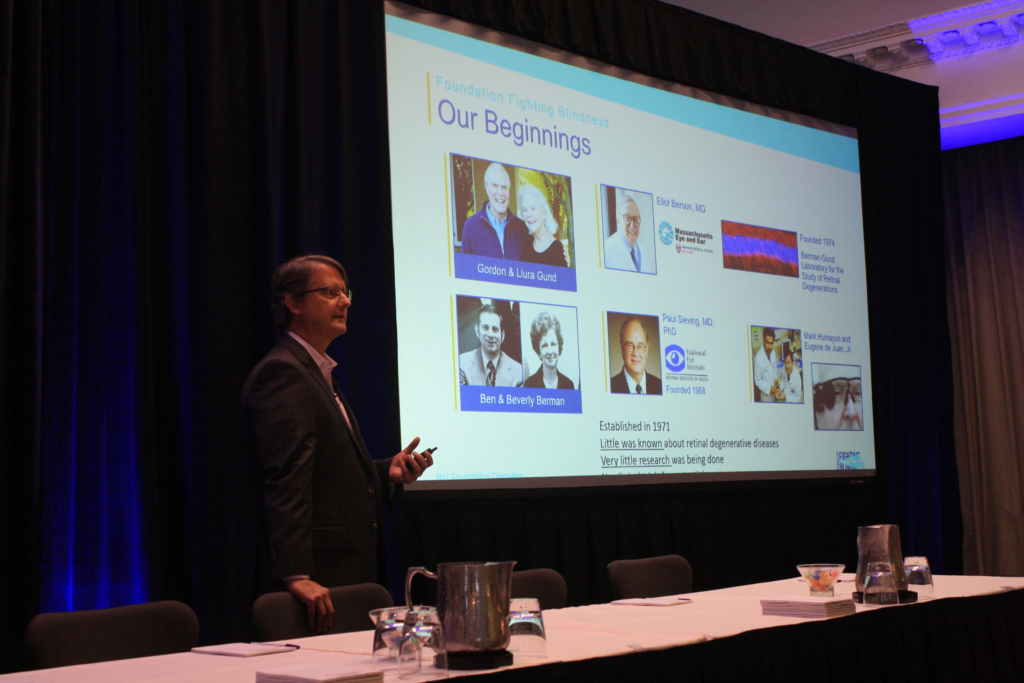
Dr. Ben Yerxa presenting
Dr. Ben Yerxa at the LCA Family Conference in July.

Dr. Yerxa opened the Hope in Focus (formally Sofia Sees Hope) second LCA Family Conference on July 27 in Philadelphia before an audience of more than 80 people from 15 states and Mexico. They represented patients and families living with Leber congenital amaurosis (LCA), other rare diseases (retinal and otherwise), and advocates, doctors, researchers and biotech leaders. 

He delivered updates on the Foundation’s work in his presentation, “Accelerating Translation of New Treatments for IRDs – A Foundation’s Perspective.” The Foundation, the world’s largest private funding source for research into treatments and cures for IRDs, has raised more than $750 million toward its mission since its founding in 1971. Sofia Sees Hope partners with the Foundation by helping provide families with free access to genetic testing, and funding research.

Advances in genetic sequencing

Dr. Yerxa credited the Human Genome Project (HGP) – costing an inflation-adjusted $5 billion – with netting continued advances in genetic sequencing and making great gains in the IRD field.

Researchers have identified the mutated genes in 65 percent of people with retinal disease who get genetically tested, and in 2017, the U.S. Food and Drug Administration approved LUXTURNA™, the first approved gene therapy for the eye or an inherited condition. LUXTURNA is for people with mutations in the RPE65 gene, one of the more than 25 genes that, when mutated, can lead to LCA.

Dr. Yerxa said that approximately 200,000 people in the United States have an IRD, with each condition meeting the definition of an orphan disease

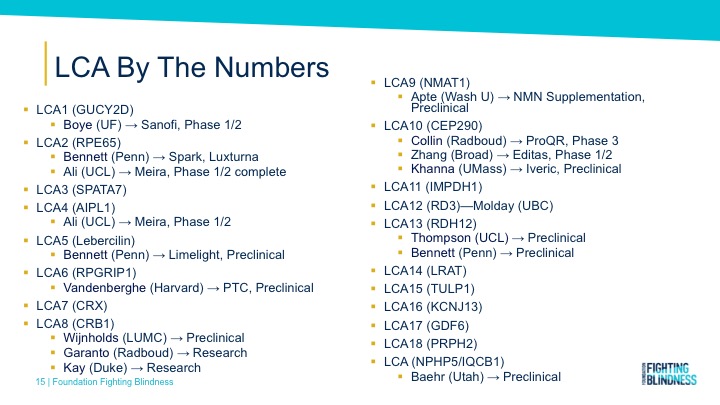
'LCA By The Numbers' slide from 2019 LCA Family Conference

He also delineated the LCA trials in progress in an “LCA by the Numbers” presentation. He discussed an emerging treatment for CEP290 (LCA10) by ProQR, which is in a Phase 2/3 clinical trial, and research also on CEP290 by Editas Medicine and Allergan, who are recruiting patients in a landmark clinical trial to test a gene-editing technique called CRISPR/Cas9.

“We all know it takes a village,” Dr. Yerxa said. “There are tons of people involved in these programs.”

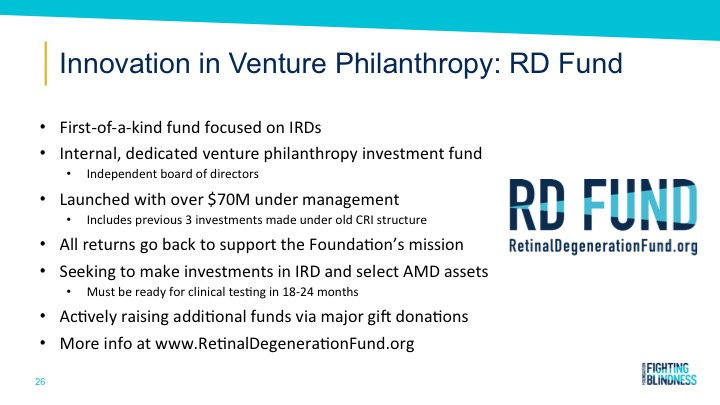
'Innovation in Venture Philanthropy: RD Fund' slide

He also detailed the Foundation’s new “Innovation in Venture Philanthropy: RD Fund,” a first-of-a-kind retinal degeneration fund focused on IRDs. It is an internal venture philanthropy investment account overseen by an independent board of directors. Donor dollars go to biotechnology companies as investments, with financial returns reinvested to support the Foundation’s mission. 

Among its contributions to research, the Foundation gave $10 million toward the development of LUXTURNA and $6 million to the Natural History of the Progression of Atrophy Secondary to Stargardt Disease or ProgStar studies that produced new knowledge and potential outcome measures. 

Dr. Yerxa also reported impressive gains in membership to My Retina Tracker® (MRT), the free and secure online international patient registry managed by the Foundation.

“I call it the LUXTURNA effect. Thanks to LUXTURNA, registration went up like a hockey stick.”

With membership at more than 23,000 and growing, the registry’s goal is to drive research toward prevention, treatments and cures for people living with Retinitis Pigmentosa (RP), Stargardt diseaseUsher syndrome and the whole spectrum of inherited retinal degenerative diseases, including LCA.
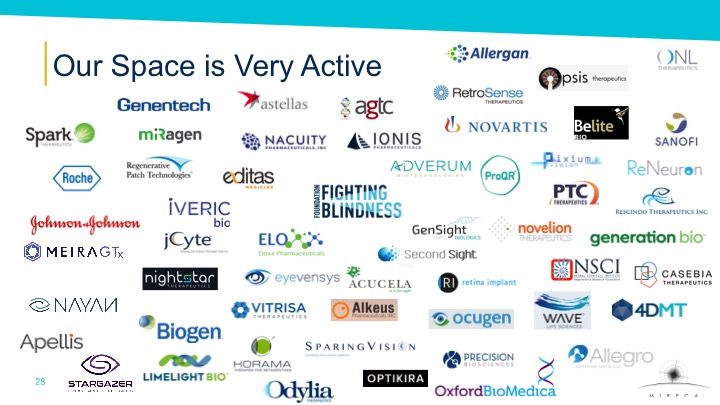
50 logos showing the involvement of biotechs in vision research

In a slide titled “Our Space is Very Active” showing a collage of more than 50 logos of biotech companies involved with vision research, Dr. Yerxa said, “More and more people are jumping into this space. 

“This is good news. Ocular is hot.”

First, Diagnosis. Then, Genetic Testing. It’s Important.

My Retina Tracker® is a free and secure online registry launched by the Foundation Fighting Blindness that helps connect families dealing with rare inherited retinal diseases to feel less alone, and to find help.

Parents feel shock and isolation when they are told their babies have no vision or limited vision caused by a rare inherited retinal disease. They do adapt and pursue resources, but that feeling of isolation often persists because of the disease’s rarity. It’s unlikely you will bump into someone in the grocery store whose child also has retinitis pigmentosa.

My Retina Tracker® is a free and secure online registry launched by the Foundation Fighting Blindness (FFB) that helps alleviate those feelings of isolation. An individual goes from being one with an inherited retinal disease to becoming part of a growing community of people (currently 6,500) sharing similar concerns and hopes.

The goal of My Retina Tracker® is to drive the research toward prevention, treatments and cures for people living with retinitis pigmentosa (RP), Stargardt disease, Usher syndrome and the whole spectrum of inherited retinal degenerative diseases, including Leber congenital amaurosis (LCA).

The global registry includes rare inherited retinal disease patient disease information from Europe, North, South and Central America, Asia and the Pacific.

Dr. Brian Mansfield, FFB’s deputy research officer who managed the registry’s launch three years ago, said people registering take an active role in advancing research to find treatments and cures for specific rare inherited retinal diseases, affording the opportunity to join others and “stand up and be counted.”

“Whether you’re in the middle of New York City or in a small town in West Virginia,” Dr. Mansfield said, “you’re equal to everyone else in that registry. It removes isolation. You’re literally standing up.”

My Retina Tracker® notifies registrants of clinical trials and gives researchers access to their disease data – but not their personal information – to advance research and therapy development associated with IRDs.

To optimize the power of My Retina Tracker®, registrants should seek a genetic diagnosis. The registry facilitates that by making registrants eligible for free genetic testing. In today’s world, it is helpful to be genetically diagnosed if you want to participate in research.

Details of My Retina Tracker® can come none too soon for some. Dr. Mansfield said after LUXTURNA® recently came to market as the first genetic therapy for LCA patients with an RPE65 gene mutation, he came across information about a person who set up a crowd-funding site asking for $5,000 to travel to Texas because he needed a genetic test.

“You don’t have to raise $5,000 to get a genetic test,” Dr. Mansfield said. “You don’t have to travel to Texas to get a genetic test.”

Helping families get tested

Hope in Focus (formally Sofia Sees Hope) well understands the importance of genetic testing for those with rare inherited retinal disease. Part of its mission is to educate individuals and families about the importance of becoming part of patient registries and getting genetically tested. SSH also makes genetic testing accessible to those who cannot afford it.

“Last year, we supported FFB’s (genetic testing) program as a small test grant,” said SSH founder Laura Manfre. “This year, with the success of the test and thanks to the tremendous support of our donors, we are happy that we were able to more than quadruple our contribution, enabling many more individuals to receive free testing and genetic counseling.”

Dr. Mansfield thanked Sofia Sees Hope for for its $65,000 donation to FFB, earmarked for genetic testing.

“The help was truly appreciated,” he said. “I’m very proud of the relationship we have with Sofia Sees Hope.”

How My Retina Tracker® works

Go to myretinatracker.org, click on Register Now and follow the prompts to establish a username and password and to answer questions to build your personalized retinal health profile. You are then guided through a series of questionnaires developed by retinal clinicians, geneticists, genetic counselors and rare inherited retinal disease researchers.

If you have any questions, call the My Retina Tracker® coordinator at 800-683-5555 or email to Coordinator@MyRetinaTracker.org.

Once you’ve registered, send a request to Coordinator@MyRetinaTracker.org asking to be genetically tested and you’ll receive information and guidance on how to order the test.

The registry becomes your personal retinal health record, updated by you and your doctors. Your history and testing results create a critical resource in tracking the progress of your disease and becoming part of a comprehensive database.

The registry employs state-of-the-art database technology to protect privacy and adheres to the highest standards of confidentiality and ethics, following policy and protocol set by the National Institutes of Health’s Institutional Review Board.

Your disease information is accessible only to you,  FFB registry staff, and researchers who meet a rigorous scientific review application process to use the data for studies and to reach individuals to participate in clinical trials, natural history studies or focus groups. Your personal information is never shared with researchers.

Large commercial biotech companies use this pool of data to find people for clinical trials, a common research challenge. Rather than calling clinicians one by one, the data is accessible in one place and often updated.

Clinical trials are out there

The data helps inform researchers about the therapies patients want, the risks they are willing to take for different levels of vision improvement and when and how their vision loss progresses.

Personal updates, such as when someone had to stop driving because of increased vision loss, help track the progress of the patient’s disease.

“Then you have a clinical longitudinal timeline as to how vision is changing for the patient,” Dr. Mansfield said.

Before My Retina Tracker®, the foundation used a paper list of about 12,000 names accumulated over FFB’s 40 years. The names transferred to the new registry to total about 17,500, but many are outdated.

There are about 6,500 people actively engaging in the online portal profile, with about 150 new registrations a month.

Dr. Mansfield wants to reach a minimum goal of 20,000 registrants in the next four years, although 50,000 would be preferable, as it would make for an extremely effective base of data for phase 2 and phase 3 studies that create demand for more trial enrollees.

He also made the distinction that private labs hold onto their data tightly, whereas FFB’s goal is the opposite.

“We want to share it, we want to move the whole field forward,” Dr. Mansfield said. “After all, our goal is to ensure the treatment and cures of all retinal diseases.”