BlueRock Photoreceptor Replacement Therapy Moving into a Clinical Trial

The development of gene therapies for inherited retinal diseases (IRDs) took off when young adults and children showed significant vision improvements in an early clinical trial for what would become LUXTURNAⓇ for LCA2 (RPE65 mutations). That was 2008. LUXTURNA became the first FDA-approved IRD gene therapy in 2017. Thanks to that success, dozens of gene therapy clinical trials are underway. Some target specific genes. Others are gene-agnostic, designed to preserve photoreceptors or harness non-light-sensing cells in the retina, an approach called optogenetics.

Cell-based therapies for IRDs have not advanced so quickly, with just a few clinical trials being launched. Gene therapies, which use human-engineered viruses to deliver the therapeutic gene, are not easy to develop or administer. But cell therapies, especially those for replacing lost photoreceptors, present additional challenges that have been difficult to overcome. These include determining the source and manufacturing of the cells, promoting their survival after transplantation, and enabling their integration into the host retina.

The launch of a Phase 1/2 clinical trial for OpCT-001, an emerging photoreceptor replacement therapy from BlueRock Therapeutics, is a big step forward for the IRD cell therapy field. The trial will initially enroll people with IRDs such as retinitis pigmentosa and cone-rod dystrophy. But the approach could also be relevant for forms of LCA that primarily affect photoreceptors.

OpCT-001 is comprised of photoreceptor progenitors—photoreceptors that haven’t fully matured. Researchers believe that progenitors have the best chance of integrating and surviving once they are transplanted and mature. The progenitors are developed from induced pluripotent stem cells (iPSC). To produce iPSCs, investigators take a small blood or skin sample from an adult human donor. The cells are then genetically tweaked to revert to a stem-cell-like state. As stem cells, they can be coaxed to develop into virtually any cell type in the body, including photoreceptors. Furthermore, billions of cells (many therapy doses) can be produced from the cell sample. The study will assess several dose levels of the therapy and is expected to enroll participants in sites across the U.S.

BlueRock Therapeutics is a wholly owned subsidiary of Bayer AG. The company licensed OpCT-001 from FUJIFILM and Opsis Therapeutics, a company co-founded by David Gamm, MD, PhD, a world-renowned retinal cell therapy pioneer at the University of Wisconsin-Madison. The Foundation Fighting Blindness provided significant funding over several years to Dr. Gamm and his team for the development of retinal and photoreceptor cell therapies derived from iPSC.

One should never get too excited about any emerging therapy in an early-stage clinical trial, especially for something as cutting-edge as a photoreceptor progenitor treatment. But if there is one scientist on the planet who can get photoreceptor replacement to work, it is Dr. Gamm.

Stay tuned.

Clinical Trials and Emerging Research Show Promise for LCA Treatments

Forty clinical trials and a lot of pre-clinical research into LCA treatments show promising pathways to discovering the next LUXTURNA®, according to Shannon Boye, PhD, the opening speaker for the Virtual VISIONS 2020 conference, presented earlier this summer by the Foundation Fighting Blindness

The breakthrough drug developed by Spark Therapeutics marked a milestone in the history of genetic research as the first gene therapy in the United States for any inherited disease and as the first to treat one of the more than 25 forms of Leber congenital amaurosis (LCA).

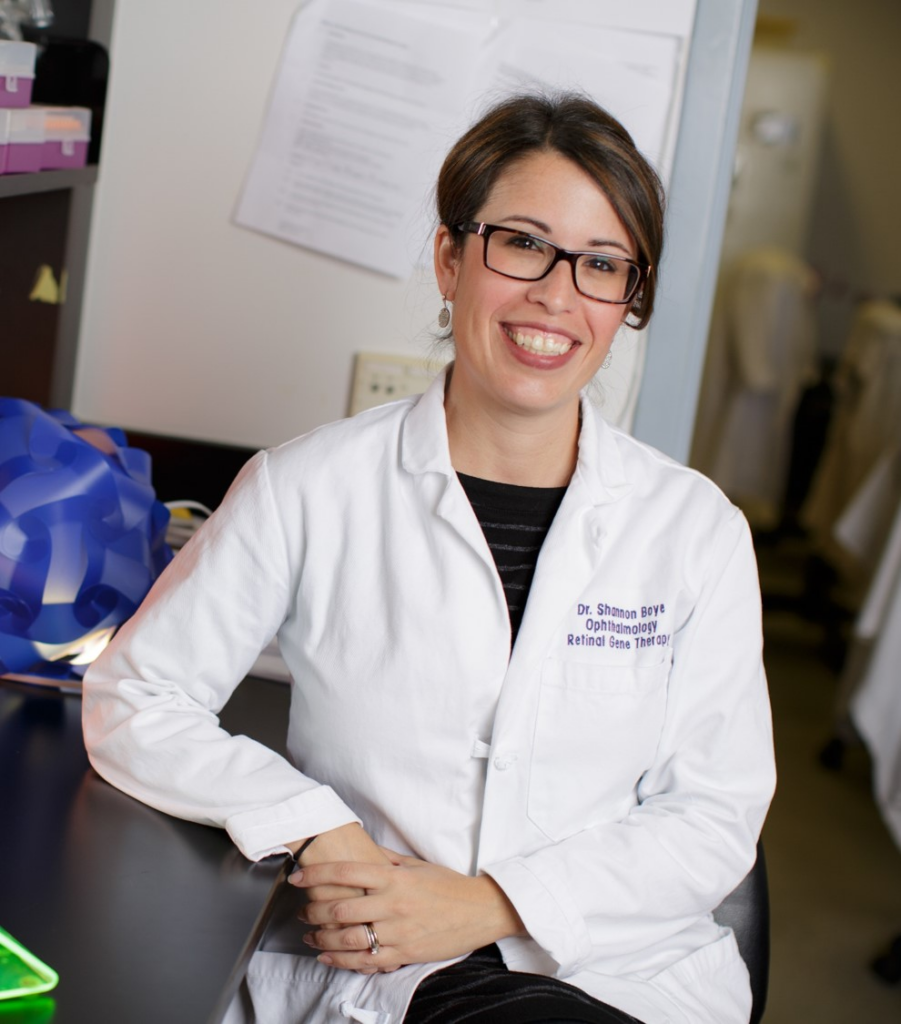
Shannon Boye, PhD in a lab coat
Shannon Boye, PhD

Boye, along with Foundation Chairman of the Board David Brint and Foundation Chief Executive Officer Benjamin Yerxa  PhD, kicked off the three-day, first-time virtual conference, the Foundation’s major annual gathering. Rather than convening in person, the event’s speakers, exhibitors and more than 1,600 attendees participated through an online app, due to concerns surrounding the coronavirus pandemic.

Brint said that the 40 clinical trials and more emerging treatments for various IRDs span the disease profile.

“No matter what your disease is, these hopefully will be able to restore vision,” Brint said. “In the next 10 years, we have an opportunity to bring many more vision-saving treatments into and through the pipeline and across the finish line.”

Yerxa said the topic of genetic therapies would be good to lead off with because of the sheer variety of innovative programs and approaches to each therapeutic challenge.

“There’s essentially a revolution happening right now in personalized medicine and genetic therapies in general,” Yerxa said.

Boye, an assistant professor in the Department of Ophthalmology at the University of Florida, addressed the audience in the beginning session called: “Mission Possible! What’s Next?”

She discussed three major strategies in treating LCA and other IRDs: Gene supplementation or gene replacement therapyRNA therapeutics and gene editing

Boye set up an analogy to better understand the complexities of these strategies, saying we all have little letters in our bodies called DNA. Subunits of those letters – that DNA – are genes. RNA carry the instructions from DNA for making proteins, the building blocks of life.

“They act alone or in concert with a bunch of other proteins to perform essential functions.”

Continuing her letters analogy, Boye said, imagine a friend texts you: ‘Please take out the dog.’ You get that message and perform that function because letters combined correctly to tell you to take the dog out. 

If only the word ‘Please’ appears on your phone screen, you don’t take the dog out.

Or, if the ‘d’ is pushed and an ‘l’ comes out, sending the message, ‘Please take the log out,’ “you then have a mess to clean up,” she quipped.  

In the first strategy of gene supplementation or gene replacement, the right protein needs to be expressed in the patient’s retina. 

The letters need to be correctly sequenced to generate a coherent message, in this case, telling a protein to perform an important function. Any break in that cascade of events can cause visual impairment. 

The gene replacement therapy LUXTURNA is a human-engineered virus containing copies of the corrective gene that doctors deliver through a subretinal injection so the cells can make the originally missing protein.

“You deliver the right letters that make the right message and the right protein,” she said. “That’s a pretty simple concept. That’s LUXTURNA.”

Developed to improve vision in people with LCA2* caused by a mutation in the RPE65 gene, LUXTURNA received Food and Drug Administration approval for  use in humans in December 2017. 

One area of Boye’s research as Associate Division Chief of Cellular and Molecular Therapeutics is entering into a Phase 1/2 clinical trial, applying the same premise for mutations in the GUCY2D gene that causes LCA1

“It’s early,” she said. “But this is an example of another perhaps next LUXTURNA being right around the corner.”

She cited similar research moving forward on other IRDs, including Retinitis Pigmentosa (RP)Choroideremia, and Bardet Biedl Syndrome (BBS)

The second strategy is a form of RNA therapeutics that uses antisense oligonucleotides (AONs) – short, single-stranded DNA  molecules that interact with messenger RNA to correct translation of a targeted gene. Think of an AON as an autocorrect feature that binds to the ‘l’ in log and changes to a ‘d’ for dog.

Promising pre-clinical work now in Phase 2/3 for CEP290 or LCA10 also is coming out of Rob Collin’s research group in The Netherlands, Boye said.

Another AON program underway addresses a form of Usher Syndrome

The third strategy – the newest and most exciting – is gene editing. A guide RNA is used to drag a special enzyme to a region in the DNA that contains the mutation, and the enzyme cuts the DNA, like molecular scissors. 

Researchers are exploring a host of gene editing variations, including cutting out a specific area of DNA and replacing it with the right letters to make a coherent message. The lab work has created paths to address a range of IRDs, including CEP290,  Usher Syndrome,  RP, Stargardt Disease and Choroidermia.

“There’s an absolute exponential increase in the therapies that are being developed,” she said.

These strategies are not limited to the disease conditions under discussion and can be more widely applied to a number of genes and conditions.

Addressing those who do not have RPE65 or LCA2 for which a treatment exists, Boye said, with all of this research in progress, “that one day, there’s going to be a LUXTURNA for your inherited retinal disease, too.” 

Retinal Disease Gene Therapy Breakthroughs Trace Their Roots to 19th Century Research

Theodor Karl Gustav von Leber would be proud. So would Adolphe Franceschetti and Carl-Henry Alström

Their research from the 19th and 20th centuries laid the foundation for groundbreaking gene therapy to treat Leber congenital amaurosis (LCA) and other rare inherited retinal diseases (IRDs). Translational research focused on LCA helped bring forth unprecedented numbers of genetic clinical trials now underway for IRD treatments and cures.

Dr. Tomas S. Aleman, associate professor of ophthalmology and director of the Hereditary Retinal Degeneration Clinics at the Perelman Center for Advanced Medicine and the Center for Advanced Retinal and Ocular Therapeutics at the University of Pennsylvania, discussed the beginnings of research into retinal degeneration as part of his presentation at the Hope in Focus (formally Sofia Sees Hope) second LCA Family Conference in Philadelphia last summer.

Dr. Aleman joined three panelists in a conference session called “One Disease, Many Approaches,” moderated by Brian Mansfield, PhD, executive vice president of research and interim chief scientific officer for the Foundation Fighting Blindness

In a research paper published in 1871, Dr. Theodor Karl Gustav von Leber recognized early-infancy severe retinal disease with pupils that are “amaurotic,” related to amaurosis, meaning dimming, darkening, dark or obscure. Amaurotic pupils do not relate to light normally, expanding and contracting more slowly than normal or not responding to light at all. A large group of early-onset inherited retinopathies causing blindness carry his name as Leber’s Congenital Amaurosis. 

“His descriptions still endure,” Dr. Aleman told his audience of more than 80 people from across the country and Mexico.

The evolution of research

Dr. Tomas S. Aleman, associate professor of ophthalmology and director of the Hereditary Retinal Degeneration Clinics at the Perelman Center for Advanced Medicine and the Center for Advanced Retinal and Ocular Therapeutics at the University of Pennsylvania

Dr. Adolphe Franceschetti authored more than 500 articles throughout his life (1896-1968), realizing the retinal origin of the blindness and working on ocular genetics, Dr. Aleman said. A specific behavior comprised of poking, pressing and rubbing the eyes with a knuckle or finger to mechanically evoke perception of light is called Franceschetti’s oculo-digital sign and is characteristic of LCA. Researchers suspect this behavior in affected children may contribute to deep-set eyes and keratoconus, a condition in which the normally round cornea thins and bulges into a cone-like shape, causing distorted vision.

Dr. Carl-Henry Alström confirmed that LCA is genetic in nature, and he is credited with recognizing in the 1950s syndromic forms of LCA and other early-onset retinopathies such as Bardet-Biedl Syndrome, a rare genetic disorder with highly variable symptoms that may include retinal degeneration, obesity, reduced kidney function and many other features.

LCA occurs in 1 in 30,000 to 1 in 80,000 people and makes up 5 percent of all retinal dystrophies. Twenty percent of children with visual impairment and attending special schools have LCA.  

LCA, thought of as one disease until 40 years ago, now consists of more than 27 forms.

“It’s a large pack of diseases,” Dr. Aleman said.

He characterized LCA as a molecularly heterogenous or diverse group of diseases with most primary disease location within the cells that perceive light or photoreceptors. Dr. Aleman detailed the complexities of clinical exams, vision testing and the spectrum of severity of vision loss observed in LCA. One such scenario, known as structural-functional dissociation, occurs when the loss of vision is disproportional to the loss of photoreceptors and is frequently seen in LCA, particularly very early in life. Such scenario represents the ideal for gene corrective treatment strategies. 

RPE65-LCA studies led by a group of researchers at the University of Pennsylvania dating back to the late 1990s solidly demonstrated LCA could be treated. Dr. Aleman  cited the importance of the translational research and clinical trials that led to federal approval of LUXTURNA™, a gene therapy treatment for LCA2 or RPE65-LCA, saying other, more frequent and neglected diseases have gotten attention through the RPE65 story.

He singled out two researchers, Jean Bennett, MD, PhD, who joined him on the conference panel, and her partner in research and marriage, Dr. Albert M. Maguire. He pointed out that their foresight and drive pushed research beyond the initial gratification granted by the spectacular results of early multi-institutional RPE65 gene therapy trials, to fulfill the practical need of an approved treatment for use in the clinic. The treatment, which produces dramatic gains in visual sensitivity, is the first and is, to date, the only gene therapy product approved for clinical use for an inherited retinal disease in the United States and Europe.

More patients have been treated with LUXTURNA since its approval in December 2017 by the U.S. Food and Drug Administration than those who received the medication during the clinical trials.

“I like to think that if it wasn’t for Jean and Albert, we wouldn’t be where we are today,” he told the gathering of patients, patient advocates, family members, researchers, doctors and biotechnology leaders.

Having one retinal gene therapy approved for use in the clinic, 900 patients enrolled in trials across 30 sites, and progress on therapies for the most severe forms of LCA, Dr. Aleman said, “That should stimulate ourselves to continue.”

He noted that much work remains to be done: LCA has not been cured, and researchers do not have a solution for every type of LCA. Gene therapy may not be enough for every patient or form of LCA, and the potential outcomes after treatments should not be expected to be the same across the heterogeneous group of diseases under the LCA umbrella.

In closing his presentation, Dr. Aleman posed three questions regarding LCA treatment and research: 

  • Can we treat hereditary retinal degenerations/LCA? “Yes, the answer is yes.
  • Can we defeat LCA? “And the answer is also yes.” 
  • Do we have the tools and people to do it? “The answer is also yes.”

In her presentation, Dr. Jean Bennett described how the RPE65 gene, when mutated, causes LCA2 or RPE65-LCA. In early research, Briard herding dogs that carried the mutated gene gained improved vision after receiving subretinal injections of an engineered virus of the human RPE65 gene. The treatment works by encoding an enzyme that converts light into electrical signals interpreted by the brain.

Dr. Bennett was one of the first investigators to use viral vectors, in which a virus is used as a vector or carrier that is genetically engineered to deliver the gene to specific cells in the retina. She is professor of ophthalmology at the Center for Advanced Retinal and Ocular Therapeutics and the F.M. Kirby Center for Molecular Ophthalmology at the Perelman School of Medicine. Please see a related story detailing her conference presentation

Pam Stetkiewicz, PhD, vice president of program management at Editas Medicine, described a different approach using gene editing technology developed by Editas. The treatment uses molecular biology to create genomic medicine that precisely edits – by locating and removing – the targeted mutation in LCA10 or CEP290-LCA. She said the technology builds on the foundation inspired by Dr. Bennett’s gene replacement therapy.

Pam Stetkiewicz, PhD, vice president of program management at Editas Medicine

Editas Medicine, based in Cambridge, Mass., in partnership with Allergan, based in Dublin, Ireland, use CRISPR/Cas9 gene-editing technology to accomplish DNA editing. The treatment, called EDIT-101, cuts out the mutation and is delivered to photoreceptors by subretinal injection. The editing permanently corrects the original, non-functioning protein essential for vision.

Dr. Stetkiewicz said Editas hopes to use the medicine to treat LCA10. Additionally, the company is developing experimental medicines to treat Usher Syndrome 2A and Retinitis Pigmentosa, among other IRDs. Editas is also working to develop engineered cell medicines to treat cancers and blood diseases, including Sickle Cell Disease

The FDA approved the company’s 10,000-page data package, securing the required Investigational New Drug (IND) application to begin clinical studies with EDIT-101 in humans.

Editas and Allergan currently are recruiting patients with CEP290-LCA for a natural history study that will create the basis to test safety and efficacy in the Phase 1/2 clinical trial of EDIT-101.

Dr. Stetkiewicz said preclinical data shows that EDIT-101 is well-tolerated, efficacious and safe. Measurement of editing intended DNA versus unintended DNA is called specificity. Human retinal explants, pieces of tissue cultured for growth, treated with EDIT-101 resulted in a high level of intended editing with zero unintended editing, meaning the treatment has an excellent genomic specificity profile.

“So, we’re thrilled with this result,” she said. 

Phase 1/2 clinical trials will begin in the second half of this year with 18 patients age 3 years and older at clinical sites in Massachusetts, Florida, Oregon and Michigan.

Michael Schwartz, M.S., MBA, is vice president of ophthalmology at ProQR Therapeutics and is the global project leader for Sepofarsen (QR-110), an RNA therapy under development.

Panelist Michael Schwartz, M.S., MBA, is vice president of ophthalmology at ProQR Therapeutics and is the global project leader for Sepofarsen (QR-110), an RNA therapy under development. 

ProQR, based in The Netherlands with offices in Cambridge, Mass., is developing an antisense oligonucleotide (AON) product, Sepofarsen (QR-110), designed as a disease-modifying therapy for LCA due to the c.2991 +1655A>G mutation (p.Cys998X) in the CEP290 gene. The company is developing AON products, which are RNA therapies primarily for ophthalmic inherited disease. AON are short, single-stranded RNA molecules that interact with messenger RNA to prevent translation of a targeted gene.

Sepofarsen works like genetic tape to block the mutation p.Cys998X in the CEP290 gene.

To help understand what this means, Schwartz presented background on DNA, RNA and LCA:

The body comprises many different cells, and we have DNA in each of these cells. DNA contains many instructions for making all the different proteins, which are important building blocks needed by a cell.

When the cell needs a building block, it first copies instructions to a shorter blueprint called RNA; the RNA is then used to guide how to make a new protein, like CEP290. Together, these different proteins make sure the cell works as it should, resulting in normal vision.

But things don’t always go right. Inherited diseases are caused by mistakes in the DNA, and then these mistakes are copied into the RNA, as in the p.Cys998X mutation in CEP290.

This means that the proteins also will have the mistakes in them. They can’t work properly, and the cell cannot function as it should. This is what causes LCA.

He also detailed the workings of RNA therapies, saying they consist of short RNA molecules, with the aim to repair the mutation in a patient’s RNA – without changing the DNA – and to restore the function of the protein and the cell to hopefully improve vision.

A normal CEP290 protein maintains cilium structure in the photoreceptors of the retina and enables normal protein transport to the photoreceptor outer segment.

The CEP290 p.Cys998X mutation creates an environment that results in an aberrant exon that disrupts the splicing code of genes by truncating the CEP290 protein, ultimately leading to the degeneration of the photoreceptor cells.

Sepofarsen, delivered by intravitreal injection, blocks the recognition of the aberrance, and that results in favoring production of normal protein. 

“We can actually reverse the phenotype of that mutation,” Schwartz said.

ProQR is finalizing interim results of its ongoing Phase 1/2 trial involving 11 people from ages 8 to 44. Schwartz said most of the patients had clinically meaningful improvement. The company’s Phase 2/3 trial began, with the first patient dosed in April. The 24-month trial expects to enroll 30 patients.

He cited an exceptional patient responder in the Phase 1/2 trial in which an adult with only light perception vision before the trial could now read letters on the eye chart.

“They said they could see things out of the treated eye that they had not seen for decades.”

Explosive Growth Seen in Field of Rare Inherited Retinal Disease Research

Advances in genetic sequencing boosted research into rare inherited retinal diseases (IRDs), making a tremendous impact on the number of clinical trials underway for genetic treatments.

“There are 37 trials in IRDs; 10 years ago, you could count them on your fingers,” said Foundation Fighting Blindness Chief Executive Officer Benjamin Yerxa, Ph.D

Also, genetic testing zoomed from zero-possibility to an individual being able to receive a full genetic sequence within a few weeks for a couple of thousand dollars.

Dr. Ben Yerxa presenting
Dr. Ben Yerxa at the LCA Family Conference in July.

Dr. Yerxa opened the Hope in Focus (formally Sofia Sees Hope) second LCA Family Conference on July 27 in Philadelphia before an audience of more than 80 people from 15 states and Mexico. They represented patients and families living with Leber congenital amaurosis (LCA), other rare diseases (retinal and otherwise), and advocates, doctors, researchers and biotech leaders. 

He delivered updates on the Foundation’s work in his presentation, “Accelerating Translation of New Treatments for IRDs – A Foundation’s Perspective.” The Foundation, the world’s largest private funding source for research into treatments and cures for IRDs, has raised more than $750 million toward its mission since its founding in 1971. Sofia Sees Hope partners with the Foundation by helping provide families with free access to genetic testing, and funding research.

Advances in genetic sequencing

Dr. Yerxa credited the Human Genome Project (HGP) – costing an inflation-adjusted $5 billion – with netting continued advances in genetic sequencing and making great gains in the IRD field.

Researchers have identified the mutated genes in 65 percent of people with retinal disease who get genetically tested, and in 2017, the U.S. Food and Drug Administration approved LUXTURNA™, the first approved gene therapy for the eye or an inherited condition. LUXTURNA is for people with mutations in the RPE65 gene, one of the more than 25 genes that, when mutated, can lead to LCA.

Dr. Yerxa said that approximately 200,000 people in the United States have an IRD, with each condition meeting the definition of an orphan disease

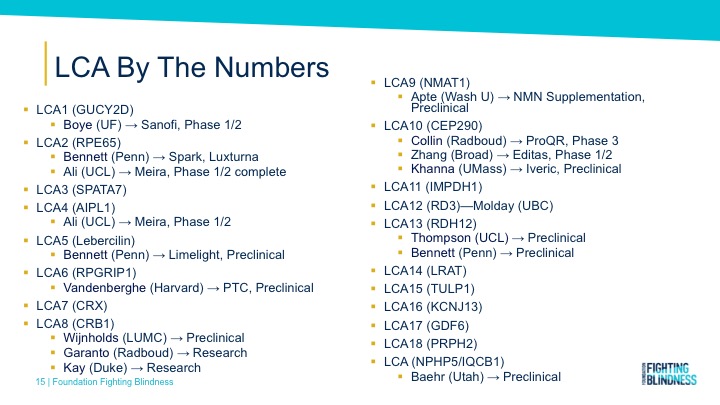
'LCA By The Numbers' slide from 2019 LCA Family Conference

He also delineated the LCA trials in progress in an “LCA by the Numbers” presentation. He discussed an emerging treatment for CEP290 (LCA10) by ProQR, which is in a Phase 2/3 clinical trial, and research also on CEP290 by Editas Medicine and Allergan, who are recruiting patients in a landmark clinical trial to test a gene-editing technique called CRISPR/Cas9.

“We all know it takes a village,” Dr. Yerxa said. “There are tons of people involved in these programs.”

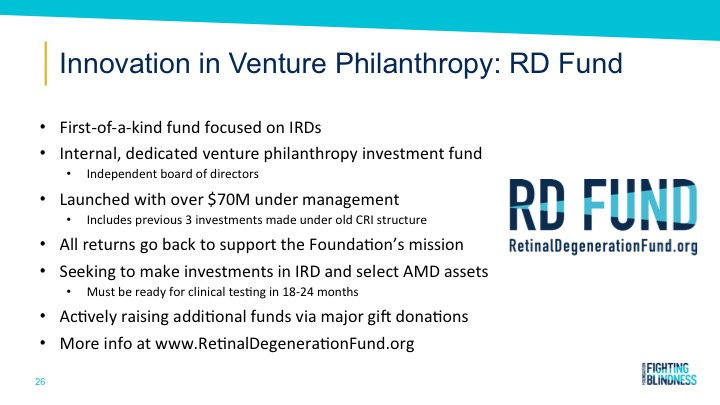
'Innovation in Venture Philanthropy: RD Fund' slide

He also detailed the Foundation’s new “Innovation in Venture Philanthropy: RD Fund,” a first-of-a-kind retinal degeneration fund focused on IRDs. It is an internal venture philanthropy investment account overseen by an independent board of directors. Donor dollars go to biotechnology companies as investments, with financial returns reinvested to support the Foundation’s mission. 

Among its contributions to research, the Foundation gave $10 million toward the development of LUXTURNA and $6 million to the Natural History of the Progression of Atrophy Secondary to Stargardt Disease or ProgStar studies that produced new knowledge and potential outcome measures. 

Dr. Yerxa also reported impressive gains in membership to My Retina Tracker® (MRT), the free and secure online international patient registry managed by the Foundation.

“I call it the LUXTURNA effect. Thanks to LUXTURNA, registration went up like a hockey stick.”

With membership at more than 23,000 and growing, the registry’s goal is to drive research toward prevention, treatments and cures for people living with Retinitis Pigmentosa (RP), Stargardt diseaseUsher syndrome and the whole spectrum of inherited retinal degenerative diseases, including LCA.

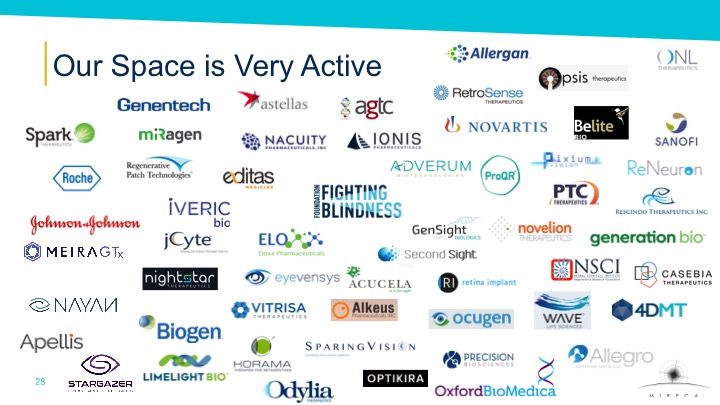
50 logos showing the involvement of biotechs in vision research

In a slide titled “Our Space is Very Active” showing a collage of more than 50 logos of biotech companies involved with vision research, Dr. Yerxa said, “More and more people are jumping into this space. 

“This is good news. Ocular is hot.”

Nicole Kear: When Losing Vision, Carpe Diem?

Nicole Kear faked it for a long time.

On a romantic getaway, as her boyfriend gazed at the starlit sky, she gazed at the vast darkness. Same with the twinkling lights at the tip of New York’s Staten Island.

“I was 19 years old when I discovered I couldn’t see stars.”

That’s when the actress and future author received her diagnosis of Retinitis Pigmentosa (RP), a rare, debilitating retinal disease. Her photo receptors were dying; no treatment, no cure.

Author of the memoir “Now I See You,” Kear told her story at “A Rare Opportunity” presented by Hope in Focus (formally Sofia Sees Hope), a global advocacy organization for the Leber congenital amaurosis (LCA) patient community and for those with other rare inherited retinal diseases (IRDs), such as RP.

Hearing she’d lose her vision by age 30 came as “absolute blindsiding news.”

Kear shared her story with more than 100 people gathered at Lake of Isles in North Stonington, CT, on March 30. Sofia Sees Hope Co-Founder Laura Manfre characterized the event – which also included a panel discussion – as “a chance to hear from incredible people who have faced head-on an almost unimaginable challenge and chosen hope over defeat.”

Kear felt incredulous at her diagnosis.

She’d always chalked up any stumbles in life to being accident prone, or “I thought I was some airhead who didn’t pay attention.”

She had plans: She was going to be a star of the stage, fall in love, get married, have children.

“Nowhere in these plans was room for losing my vision by 30.”

A River Called Denial

Upon her diagnosis, Kear did what a lot of people might not have expected: “I decided not to think about it.”

Plus, she thought, by the time she turned 30, “I would be ancient by then.”

She learned to drive, kind of. Kear didn’t need a car in New York, but when she temporarily moved to Los Angeles for acting, only three days passed before she realized she’d made a colossal mistake. She drove anyway, with her idiosyncratic driving posture, prompting her sister to tell her maybe she should lean back a little, an exchange recounted in her book:

“What are you talking about?” I snapped, concentrating on my left turn.

“You don’t notice how close your face is to the windshield?”

It was true. My nose was almost touching the glass, my chest nearly pressing the wheel …

“There’s no law about sitting too close to the windshield,” I shot back. “Just sit back and enjoy the ride.”

I couldn’t see my sister’s face, but I bet she looked like she was enjoying the ride about as much as a turn on the Tilt-A-Whirl with a stomach full of corn dogs …

My uncool driving notwithstanding, I did a decent job of getting from point A to point B without dying or killing anyone. In general.

Kear fared better in restaurants than on the road. She learned to order the Caesar salad because it’s usually on the menu she couldn’t see, and she’d ditto her dining partner’s choice for the main course.

She traveled to Paris and London. She enrolled in the San Francisco School of Circus Arts where she learned to be a contortionist and earned a red nose.

“Following every rainbow, climbing every mountain,” Kear told her audience, until she finally gave up the ruse.

“I had realized that my vision had an expiration date … I could carpe diem as much as I wanted, but I had to reckon with my vision loss.”

At 33, after falling in love, marrying and having two of her three children, she faced her diagnosis and reached out to New York’s services for the blind.

The gravity of support and resources empowered her, connecting her to visually impaired people around the world.

“I know now that anything is possible.”

Kear ended her presentation by reading one of the tips that accompany each chapter of her book.  

Tip #18: On glass doors. Walk into a glass door once, shame on the door. Walk into it twice, shame on you. Walk into it three times, get yourself a (*%&#*) game plan.

Simon Wheatcroft: The Power of Pushing Through

Simon Wheatcroft held his audience spellbound at the Global Genes conference in California where he detailed his journey from losing his sight as a teen-ager due to retinitis pigmentosa to competing in ultramarathons and overcoming many obstacles in between.

Simon recounted his amazing life experience at the Hotel Irvine in Huntington Beach, Calif., during the 6th Annual Global Genes RARE Patient Advocacy Summit on Sept. 14 and 15. More than 700 patients, caregivers, advocates and rare disease stakeholders gathered to share, learn and connect.

Simon, the conference’s opening keynote speaker, shared his journey of adapting technology, specifically on his smartphone, to achieve what seemed like impossible personal goals of learning to run solo outdoors. In his message of “Adaptability in the Face of Adversity,” Simon said he lost his sight at 17 due to retinitis pigmentosa, and seven months later, he ran his first ever race – a 100-mile road race.

Ultramarathons – races more than the traditional 26.2-mile marathon – present extreme physical and mental challenges for anyone, but with his loss of vision, Simon faces more complex obstacles. He trains with guide runners and uses memorization and technology.

To run solo, Simon forms a map of the area by using the smartphone app, RunKeeper. He memorizes the

Simon Wheatcroft running
Simon Wheatcroft held his audience spellbound at the Global Genes conference in California where he detailed his journey from losing his sight as a teen-ager to competing in ultramarathons and overcoming many obstacles in between.

course and applies course feedback from the app about his pace and distance. Now, with so much experience running solo, he has adapted to various courses and uses the app less often.

Simon, who is 35, said he believes his feelings of freedom and independence from running solo “far outweigh any anxiety over dangers. My successful footsteps must be something like 99.999%, and there’s just that one every now and again that goes wrong. I try to concentrate on the millions that go right rather than the 10 or 15 that go wrong.”

Simon taught all of us at this exceptional conference the power of pushing through and endurance, lessons that can help all of us in overcoming any adversity.

For more on Simon, click here.