2017 Rare Disease & Orphan Products Breakthrough Summit

A two-day conference in Washington, D.C., earlier this month offered the opportunity for organizations such as Hope in Focus (formally Sofia Sees Hope) to discover the latest in the rare disease community, meet the nation’s top rare-disease professionals, and gather resources and ideas to help with the Leber congenital amaurosis (LCA) community.

More than 670 people attended the first day of the 2017 Rare Disease & Orphan Products Breakthrough Summit on Monday, Oct. 16.

The summit, presented by the National Organization for Rare Diseases (NORD) , included a range of topics, from the challenges of healthcare costs, to the ethical guidelines for patient organizations and themes of collaboration, urgency and transparency.

The summit’s second day featured presentations by the Food & Drug Administration’s leading Division Directors and discussions of improving the lives of patients with rare diseases.

Peter L. Saltonstall headshot
Peter L. Saltonstall, President and CEO of NORD

The conference kicked off with a welcome by Peter L. Saltonstall, President and CEO of NORD, and Marshall L. Summar, M.D., Director of Children’s National Rare Disease Institute, Chief of Genetics and Metabolism at Children’s National Medical Center , and Chairman of NORD’s Board of Directors.

Key presentations included ensuring patient access, sustaining orphan drug development and availability, and reviewing achievements in rare disease drug, biologic and device development.

Mike Porath, founder and CEO of The Mighty and a parent of a child with a rare disease, gave a motivating, multi-faceted presentation in his keynote community address. His advice to families living with a rare disease included asking for help, embracing the moments and dreaming big to open doors for people with rare diseases.

Scott Gottlieb, M.D., Commissioner of the FDA, delivered the administration’s keynote address, talking about the group’s rare disease priorities, the rapid changes in rare disease product development and the basis of the Orphan Drug Act

Continuing to See Hope for IRD Treatments

At three o’clock Thursday afternoon, Beth Chiarella and I had a very public moment of tears and hugs at Baltimore–Washington International Airport as we received news that after a day of hearing testimony, the Federal Drug Administration’s Advisory Committee unanimously recommended approval of a gene therapy that could reverse or reduce vision loss due to an inherited retinal disease (IRD).

Sofia Sees Hope founder Laura Manfre testifying to Federal Drug Administration’s Advisory Committee about a gene therapy that would help those with RPE65 gene mutation form of LCA

The committee listened to Spark Therapeutics present their research and findings on LUXTURNA® (voretigene neparvovec), an investigational, potential one-time gene therapy, and heard testimonies from families whose lives have been changed dramatically by the therapy. Members then voted 16-0 without comment to endorse approval of the therapy for the treatment of patients with vision loss due to confirmed biallelic RPE65-mediated inherited retinal disease (IRD).

Federal Drug Administration’s Advisory Committee unanimously recommended approval of a gene therapy that could reverse or reduce vision loss due to an inherited retinal disease (IRD).

Alongside the brave individuals and their family members who were part of the clinical trials and traveled to Washington, D.C., to share their personal stories in support of this therapy, I played a small part in what is no doubt an historic moment for all LCA families. I’m grateful to Tami, the oldest participant in the RPE65 trial, who allowed me to share her experience with the panel, reinforcing that this treatment is life-changing at any age, and for any length of time. I’m also grateful to all of those who have made it possible for Sofia Sees Hope to play a role through their continued advice, support and enthusiastic cheerleading.

While this first treatment does not address the dozens of other genetic mutations that cause blindness for LCA and IRD individuals, we can hope that this endorsement will be followed by a potential FDA approval, in turn paving the way for continued research and treatment for my daughter and our entire LCA community. Thursday marked a positive step forward on the path to changing the lives for many people.

Read Laura’s full statement to the Advisory Committee here.

Presenting at FDA Hearing Thursday on RPE65 Genetic Therapy Drug

Hope in Focus (formally Sofia Sees Hope) Co-Founder Laura Manfre will help provide the LCA community’s perspective to a Food & Drug Administration panel Thursday about a proposed genetic therapy for Leber congenital amaurosis (LCA) caused by an RPE65 gene mutation.

“This is such an important event because it allows the patient population — the parents, and children and families — directly impacted by this very important decision-making process to be heard,” Manfre said. “The FDA has a critical job to do in weighing all of the potential risks and benefits with any drug approval, and they recognize that the voice and the experiences of those who are affected needs to be a part of that process.

“Part of Sofia Sees Hope’s mission is to help serve as a connection among families living with LCA,” Manfre continued. “We see this opportunity to offer testimony as another way to fulfill that mission.”  

As a presenter at the FDA’s public advisory meeting of the Cellular, Tissue and Gene Therapies Advisory Committee (CTGTAC), Manfre will be representing patients and families living with LCA and other rare inherited retinal diseases. The meeting begins at 8:30 Thursday  morning and runs to 5 p.m. at the FDA White Oak Campus in Silver Spring, MD.

The CTGTAC is meeting to make recommendations on the safety and effectiveness of biologics license application for voretigene neparvovec, submitted by Spark Therapeutics, Inc. The proposed gene therapy is to treat patients with vision loss due to confirmed biallelic RPE65 mutation-associated dystrophy.

RPE65 mutation-associated retinal dystrophy is an orphan disease, with an estimated 1,000-3,000 patients affected in the United States, according to A Shared Vision.

Manfre said research and bringing therapies to market provides hope to all LCA and IRD families.

“Though families may struggle with the day-to-day challenges, they can have hope that there just might be a light at the end of the tunnel,” she said.

“To help foster this effort,” she said, “Patients and families need to seek diagnoses,  participate in patient registries, and continue to generate awareness and make our voices heard.  Our disease is rare, which makes it more important than ever that we are working together to be advocate for our community and  to move treatment and cures for blindness forward.”

For the meeting, Spark submitted to the FDA a 149-page briefing detailing the history, background, studies and research that went into developing voretigene neparvovec, which has the proposed trade name LUXTURNA.

The FDA’s 42-page briefing details its analysis of the proposed treatment and offers discussion questions for the advisory committee that include at what age should patients receive treatment and what are the treatment’s potential risks and benefits.

Here are some links for more information about the meeting:

Webcast of the meeting: https://collaboration.fda.gov/ctgtac101217.

‘Walk Around With Your Blindness As a Badge of Triumph’

Doctors diagnosed Jack McCormick in high school with Leber congenital amaurosis due to mutations in the RPE65 gene. With a mix of feelings about his diagnosis, it was when he accepted his visual impairment that he began evolving into the young and innovative leader he is today.

Jack is smart, funny, creative, articulate, compassionate. The 20-year-old also has a passion for inclusion and he is an advocate for accessibility on all fronts.

He is an honors business student at Canada’s Wilfrid Laurier University in Waterloo, Ontario, and he is a member of the National Young Leaders Program for the Foundation Fighting Blindness.

Jack McCormick in a blue shirt sitting next to his black lab, Jake
Jack McCormick and his guide dog Jake.

For a long time, Jack, like many blind or visually impaired people, worked hard at hiding his blindness; he didn’t want people to judge him because of it. But all of that changed in his senior year of high school when he got Jake, his beloved guide dog. Jake immediately made Jack feel like he was wearing a sticker that said, “Hey, I can’t see,” which meant no more hiding.

Acceptance leads to respect and opens pathways to social accessibility and, in turn, helps fuel research, Jack explained before an international audience in Toronto at the Foundation Fighting Blindness Vision Quest 2016 conference.

“I accepted it in myself and that is the most important thing you can do,” he said. “To accept it in yourself and be so confident about it that you walk around with your blindness as a badge of triumph rather than a badge of sorrow or something you’re trying to hide.

“And in doing that, people are going to be very committed to you, they’re going to respect you and respect is a very powerful thing.”

That respect continues in social situations, such as securing a job, and in fostering research, because people will know that blindness is an issue.

“It’s visible,” he said. “If the community sees it, they know it exists. If you’re hiding it, no one knows.”

Along with acceptance, Jack encourages people with blindness to tell their story. “The most powerful thing in your life is your story, so share it. Share it. Because when you do, other people will hear it and they will tell other people and then you’ll have the opportunity to share it with more people and it’s a spiral.”

You can hear more from Jack in his “College Connection” column that appears in our quarterly newsletter, “Seeing Hope,” and on his personal blog. Watch a video about Jack.

Simon Wheatcroft: The Power of Pushing Through

Simon Wheatcroft held his audience spellbound at the Global Genes conference in California where he detailed his journey from losing his sight as a teen-ager due to retinitis pigmentosa to competing in ultramarathons and overcoming many obstacles in between.

Simon recounted his amazing life experience at the Hotel Irvine in Huntington Beach, Calif., during the 6th Annual Global Genes RARE Patient Advocacy Summit on Sept. 14 and 15. More than 700 patients, caregivers, advocates and rare disease stakeholders gathered to share, learn and connect.

Simon, the conference’s opening keynote speaker, shared his journey of adapting technology, specifically on his smartphone, to achieve what seemed like impossible personal goals of learning to run solo outdoors. In his message of “Adaptability in the Face of Adversity,” Simon said he lost his sight at 17 due to retinitis pigmentosa, and seven months later, he ran his first ever race – a 100-mile road race.

Ultramarathons – races more than the traditional 26.2-mile marathon – present extreme physical and mental challenges for anyone, but with his loss of vision, Simon faces more complex obstacles. He trains with guide runners and uses memorization and technology.

To run solo, Simon forms a map of the area by using the smartphone app, RunKeeper. He memorizes the

Simon Wheatcroft running
Simon Wheatcroft held his audience spellbound at the Global Genes conference in California where he detailed his journey from losing his sight as a teen-ager to competing in ultramarathons and overcoming many obstacles in between.

course and applies course feedback from the app about his pace and distance. Now, with so much experience running solo, he has adapted to various courses and uses the app less often.

Simon, who is 35, said he believes his feelings of freedom and independence from running solo “far outweigh any anxiety over dangers. My successful footsteps must be something like 99.999%, and there’s just that one every now and again that goes wrong. I try to concentrate on the millions that go right rather than the 10 or 15 that go wrong.”

Simon taught all of us at this exceptional conference the power of pushing through and endurance, lessons that can help all of us in overcoming any adversity.

For more on Simon, click here.

Living With LCA: Enzo’s Story

Enzo was born in 2014 in Lausanne, Switzerland, with a clubfoot. He immediately received physical therapy, then a plaster cast for three months and one minor surgery.

His parents – Laura Steinbusch, a post-doctoral fellow researching the neuroscience of diabetes, and Merlijn Meens, a scientist investigating cardiovascular function – felt confident as they were reassured through medical literature and by doctors that in time their son’s left foot would be fine.

But there was more to come. At 3 months, as Enzo’s therapy for his foot progressed, something seemed wrong with his vision and his ability to focus. Doctors diagnosed him with nystagmus, a condition in which Enzo’s eyes involuntarily moved side to side.

An MRI showed normal brain development and then doctors did an electroretinogram (ERG), placing electrodes on his eyes to measure the electric response of their light-sensitive cells. Enzo also underwent Visual Evoked Potential (VEP) testing, a non-invasive exam that measures his entire vision system.
Doctors fitted Enzo with glasses at 6 months and said the ERG and VEP results needed further study.

Enzo began rubbing his eyes, prompting people to ask Laura whether her son was tired or shy. A few months later, doctors diagnosed 10-month-old Enzo with Leber congenital amaurosis.

‘He is still our cheerful son’

“While walking home from this last doctor’s appointment, we were in shock, but after a while we realized that Enzo had not changed. He was still our cheerful son that likes to sing and cuddle,” Laura wrote in her blog for the Eye Association of the Netherlands.

“We wondered how we could raise Enzo as normal as possible and how we could help him discover the world. The solution turned out to be simple: We will not despair and (will) come up with creative solutions so he can participate in everything that this world has to offer.”

Enzo with Dad on a trail outside

That Christmas, Enzo’s parents designed their holiday in a way that greatly fostered their son’s vocabulary, sensory and motor skills, exposing him to chickens on a farm, rocks and water at the beach and a mountain climb with a summit lunch of pancakes and omelets.

Also, for the first time he said, “Dad,” “Mom” and a version of his own name, “Echoo.”

Leber congenital amaurosis genetic diagnosis

Then, at 18 months, Enzo received the genetic diagnosis of LCA10-CEP290. LCA10 is a severe retinal dystrophy caused by mutations in the CEP290 gene.

Laura interviewed doctors about research on LCA10-CEP290, becoming an intense advocate and learning myriad facets of the genetics behind Enzo’s disease and the stakeholders at work to find a treatment.
With global health organizations headquartered in the Lake Geneva region, Laura attended conferences, including a recent policy event about “the right to health” organized by Rare Diseases International.
She learned that researchers in the International Rare Diseases Research Consortium are working toward their goal of all people living with rare disease to receive diagnosis, care and therapy within a year “of coming to subspecialty medical attention.”

“Big visions and great goals,” Laura wrote in her blog for wonderbaby.org. “It made me hopeful for a future with inclusive education for all our children, job possibilities for all our children, a quick diagnosis for new patients and maybe a treatment for improved vision.”

Singing, reading, taking the bus

At home, Laura and Merlijn initially did not have access to many Braille and tactile books for Enzo so they created their own. For instance, they brought to life a picture-book hedgehog by fashioning spines with nails and duct tape.

Mom holding Enzo, they are both wearing rain coats

Laura now is working on a multilingual children’s songbook with songs in English, French, Dutch and German. She got the idea because Enzo easily learned new words in French or English through songs, especially when he already knew the song in Dutch. Two Dutch foundations said they want to help pay for part of the project, but Laura is still searching for funding and she is reaching out to ask whether anyone knows of groups she can contact for help in the United States, United Kingdom, Canada or Australia.

Enzo just turned 3. He loves playing with other children at nursery school and he is learning to be more independent. Also, doctors successfully treated his foot, with Enzo’s mom adding, “It was probably harder on us than on him.”

In September, he and his parents moved from Switzerland to their homeland, the Netherlands.
“Enzo is doing very well,” Laura said. “He loves listening to music, singing, reading books, everything that has to do with movement. He adores taking the bus, the train, the metro, the cable car, a bike ride…

“One of his favorite sentences nowadays is ‘What is that?’ (something he heard) or ‘Who is that?’ (someone talking), meaning that he is really curious.”


Read more stories of families living with LCA on our blog.

Sign up for our newsletter to stay in touch with the LCA community.

Alan’s Story: Gaining Independence with Aira Technology

Trust me when I tell you to grab a tissue. Or roll down your sleeves and get ready to wipe. Me? My eyes are welling up even as I type. Recently, I witnessed a miracle.

I’ll give you a little background while you look for a Kleenex. Twenty years ago, at the age of 8 weeks, my nephew Alan was diagnosed with Leber congenital amaurosis (LCA), a rare disease that limits retinal development. Holding her infant son, my sister Betsy and her husband David listened in disbelief as the retinal specialist explained that Alan would be visually impaired at best, and fully blind at worst. The doctor informed them there was no cure, no treatment, and no adaptive device to correct their son’s condition.

Like his sighted peers, Alan attended public school. His mobility instructor taught him to navigate familiar

Alan Brint, who is blind, is trailed by his mother Betsy and his dog Mo, tries out his new Aira glasses.
Alan Brint tries out his new Aira glasses. Aira’s platform works on a wearable device similar to Google glass, that can be paired with a smart phone. The tiny camera mounted on the device [cool sunglasses] provides instant feedback to a trained Aira agent who can safely guide [a wearer] in any activity.

Alan Brint, who is blind, is trailed by his mother Betsy and his dog Mo, tries out his new Aira glasses. Aira’s platform works on a wearable device similar to Google glass, that can be paired with a smart phone. The tiny camera mounted on the device [cool sunglasses] provides instant feedback to a trained Aira agent who can safely guide [a wearer] in any activity. Alan was navigating his way to his local train station using an unfamiliar route as a test of the technology.parts of his world with his white cane. By sixth grade, he could walk to school by himself. Now a junior at Beloit College, he’s doing just fine. That’s not the miracle.

Not to dismiss Alan’s role in his accomplishments, but his successes have been in some part reliant on a team of people. Still, there are limits to his independence. Spoiler alert: here comes the miracle.

Last week, Betsy called me. “Get outside now. Alan is walking to the train station. By himself. He’s near the library. Run.”

I ran. Turning the corner, I saw my nephew, cane in hand, walking a route new to him. Betsy trailed silently, about 10 feet behind.

“Hey Aunt Sally. Is that you?” Cue the tears. Remember, Alan is blind. He has never seen me coming his way. For 20 years, we’ve all come up to him and touched him, or spoken to him, or hugged him, letting him know we were there. For the first time, he “saw” me coming.

Alan was wearing an adaptive technology, and it was changing his life in front of my tearing eyes.

The technology is called Aira (eye-rah). According to their website, “Aira’s platform works on a wearable device similar to Google glass, that can be paired with a smart phone. The tiny camera mounted on the device [cool sunglasses] provides instant feedback to a trained Aira agent who can safely guide [a wearer] in any activity.”

Alan’s Aira glasses had arrived the day before. The device is free, and the glasses are free. Like a cell phone contract, users pay a monthly service fee based on the minutes they use. When it’s on, an agent sees a split screen. On one side is a GPS view, to map out the exact location of the route guidance. On the other screen, the agent sees the lens view from the user’s camera. Simple, yet genius.

I fell in step with Betsy, following Alan’s lead for the first time. He made it easily to the train station, then home via a different route. Since then, he’s walked to a local bagel shop and “read” menus. I asked Alan, “What do you like best about this?”

“I like walking somewhere that I’ve never walked to before, by myself, without learning the route. I like reading menus. I like finding people. I found you!”

I turned to my sister. “Well? What are you thinking?”

“It’s totally selfish. I want to be his eyes,” she said.

“Don’t you think you’ve been his eyes?”

“Yeah, I guess. And now I’m turning it over to somebody else.”

There wasn’t a dry eye between us.

Hope in Focus (formally Sofia Sees Hope) is dedicated to ending the isolation that LCA families can feel after their diagnosis by sharing their stories. Read more here. Would you like to share your story? Email info@hopeinfocus.org

Attention LCA Families: Sign up to receive the LCA Family Newsletter!

Hope in Focus (formally Sofia Sees Hope), a nonprofit focused on families living with Leber congenital amaurosis (LCA), will launch a quarterly newsletter in the fall of 2017.

Sofia Sees Hope funds research for diagnosis, treatments and cures for rare retinal disease and provides advocacy and information for the LCA community.

The newsletter will be specifically for LCA patient families to help them connect with each other and with the resources and organizations that can help them. The newsletter will have both a print and a digital version.

“There used to a be a newsletter for LCA families and it was a wonderful resource and a great way to stay informed,” said Sofia Sees Hope co-founder Laura Manfre. “When I attend conferences and hear from families the number one thing other patient families say to me, is they miss the newsletter. I’m happy that Sofia Sees Hope is now in a position to do this.”

September 2017 launch

The newsletter will include LCA research news; contact information for research and trials, family stories, fundraisers, an event calendar, and a section dedicated to education on the patient and family role in advancing research.

Sofia Sees Hope has assembled a team of former journalists to spearhead the project, ensuring that the information it contains will be factual and trustworthy for patient families.

To sign up for the newsletter — and other information from Sofia Sees Hope — please visit this page: https://hopeinfocus.org/resources/newsletter/

You can also send article suggestions to Sofia Sees Hope by visiting https://hopeinfocus.org/contact/.

Living with LCA: Juliet’s Story

Scott and Heather Soady and big sister Gillian welcomed baby Juliet two years ago, and life progressed in an understandably hectic way for the San Diego parents who also are practicing lawyers. But life soon became more complicated as the couple’s new baby was diagnosed with Leber congenital amaurosis.

Juliet was born with strabismus, also known as crossed eyes, a condition that often disappears with time. At the age of 4 months, Juliet’s pediatrician noticed she had involuntary eye movement, a condition called nystagmus. The doctor said Juliet presented the worst case she’d ever seen in a child.

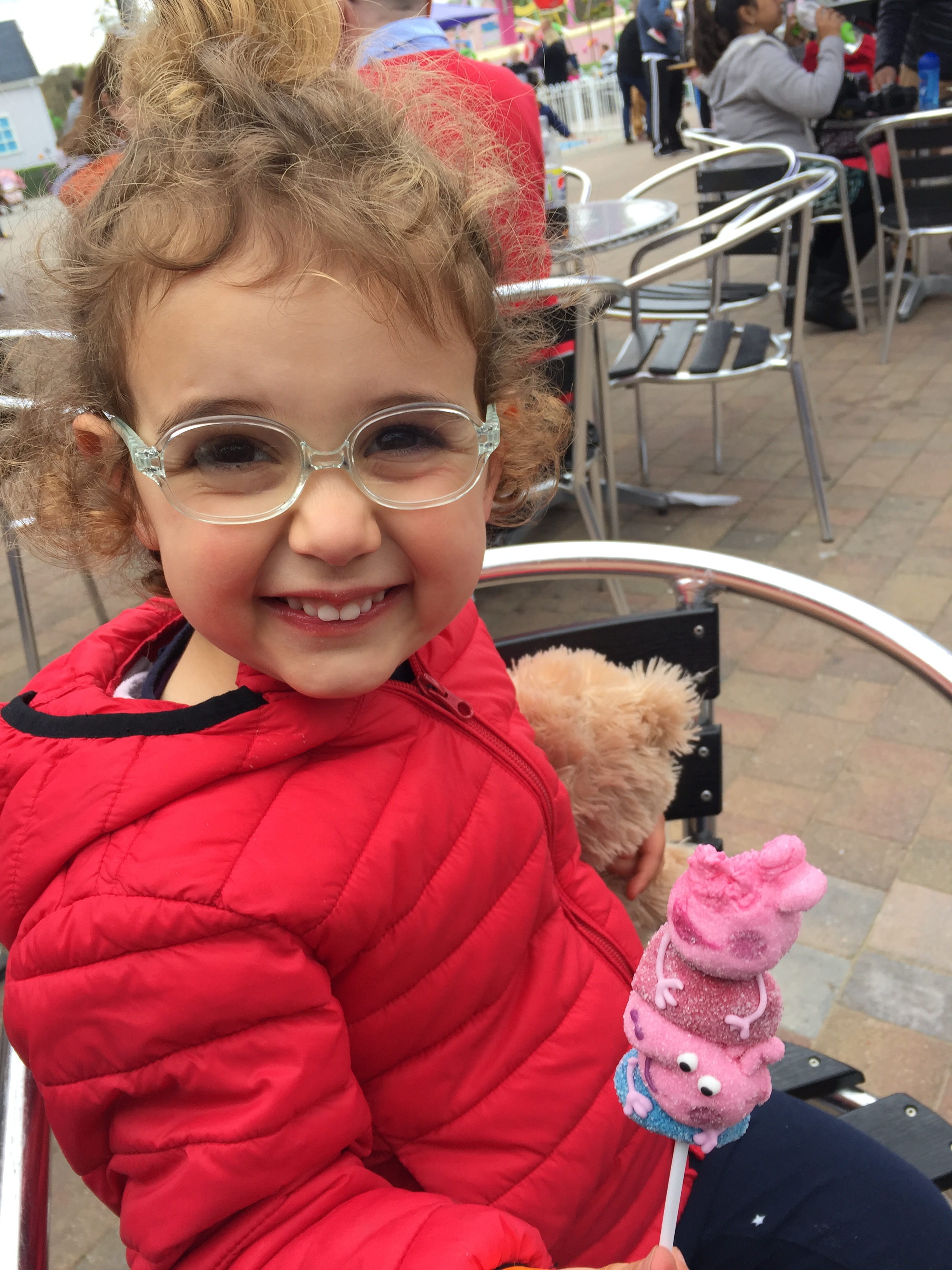
Juliet in a pink snow suit wearing a pooka dot hair and blue glasses
Juliet

Doctors placed Juliet under general anesthesia to scan her optic nerve and eliminate causes of her condition. It was a difficult time, Scott said, for Heather, especially, because she was breastfeeding and Juliet was only 4 months old.

When doctors told Scott, “It’s probably not brain cancer, ” he said, “I didn’t realize that was an option.”

Two months later, with Juliet again under anesthesia, a specialist measured her retina’s light perception by placing contact lenses with electrodes in her eyes. This procedure is called an Electroretinography (ERG) and is used to clinically diagnose LCA and other inherited retinal disorders such as Retinitis Pigmentosa (RP), cone-rod dystrophies, X-linked juvenile retinoschisis, achromatopsia and others. 

Twenty minutes later, the family received a confirmed clinical diagnosis of Leber congenital amaurosis.

“What you’re told is, there’s this condition you’ve never heard of, that’s extremely rare, that has no cure, that’s she’s going to be blind and there is nothing you can do about it,” Scott said.

“… You go through this grieving process of the life that you envisioned for your child. I would constantly think about these things, going to the beach, seeing a sunset, watching a movie, doing all of these things with her and sharing the world with her, and all of a sudden, that’s never going to happen with her.”

Gradually, his perspective changed: “You’re still going to do all these things, but you’re going to do it in a different way. … There is nothing in the world that tells you what that’s going to be like for her. … You have to adapt everything so that it will happen.”

At the age of 2, Juliet is legally blind. With glasses, her vision is 20/470. In other words, Scott said, the same object and details you can see at 470 feet away, she will only be able to see at 20 feet. Doctors say her vision may deteriorate over time.

Juliet on a swing

Looking for more information and answers, Scott attended the national VISIONS conference hosted by the Foundation Fighting Blindness last summer in Baltimore.

“That’s where I met Laura Manfre (Hope in Focus, or formally known as Sofia Sees Hope’s co-founder) and a bunch of other families that have kids with the same condition. That was truly amazing,” Scott said. “You feel so alone, the condition is so rare, there’s not going to be someone you just run into.”

He said he was touched that for the first time, people asked how he was doing.

Meeting parents who are dealing with LCA and seeing young people with LCA functioning as normal teen-agers gave Scott comfort and hope that everything’s going to be OK.

Through Laura, Scott and Heather connected with Spark Therapeutics’ “ID your IRD” initiative for Juliet’s genetic testing. Scott said he still held hope that maybe Juliet really did not have LCA, but the genetic findings confirmed otherwise.

The testing also revealed that Juliet has what is called a de novo mutation of the CRX gene, which caused it to be autosomal dominant rather than autosomal recessive. This means Juliet’s condition is a result of a gene mutation, rather than from inheriting it from her parents. It also means that Juliet could pass it on to her children.

“It’s not quite the normal LCA,” Scott said. Of those who have LCA, 1 percent to 5 percent have this gene mutation.

Genetic therapy also is more complicated. Rather than inserting a good gene and having the bad one go away or bypassed, the CRX dominant gene first needs to be turned off before a good gene can be inserted

The Soadys connected with a doctor who was conducting this research but had to stop for lack of funding.

“The light at the end of the tunnel got much dimmer,” Scott said of the end of the research. “It would be nice to see if there’s a potential cure.”

For now, the family is in the intense process of preparing Juliet for a new time in her life, from a home environment to a school environment, as she begins preschool. Gillian, who turns 5 in September, will be in kindergarten.

Feeling the Mission

There was nothing in my life to prepare me for the experience of Dinner in the Dark. I’ve supported many nonprofits, as a board member, consultant, and donor. I’ve been to many luncheons and galas where I heard many speeches, sat through many tug-at-the-heartstrings videos, and joined in many silent or live auctions that inflicted varying degrees of pain or entertainment. However, never have I attended an event that immersed me as deeply in the mission of the organization as Dinner in the Dark did.

It’s pretty basic. Hope in Focus (formally Sofia Sees Hope) fights rare, inherited retinal diseases like Leber congenital amaurosis (LCA) in hopes of curing blindness. Dinner in the Dark offers a multi-course, gourmet meal with wine pairings. While blindfolded. To say it’s challenging, and life-altering, is putting it mildly.

It’s harder to enjoy a fine meal when you can’t appreciate the presentation. Sometimes it was even hard to tell what was served, though the scents and tastes were tantalizingly familiar! It’s hard to carry on a conversation when you can’t make eye contact to interrupt, or to share a joke, and when you don’t even know if someone is still at the table. And it’s hard to savor nice wines when you can’t see them – especially when you’re afraid of knocking over a wineglass while attempting to locate your knife.

Don’t get me wrong – Dinner in the Dark is a tremendously fun event that will have you laughing and reflecting for months afterward. It’s also very challenging and very moving, and will make you truly appreciate the gift of your eyesight. And the ability to take off the blindfold to bid and to dance!