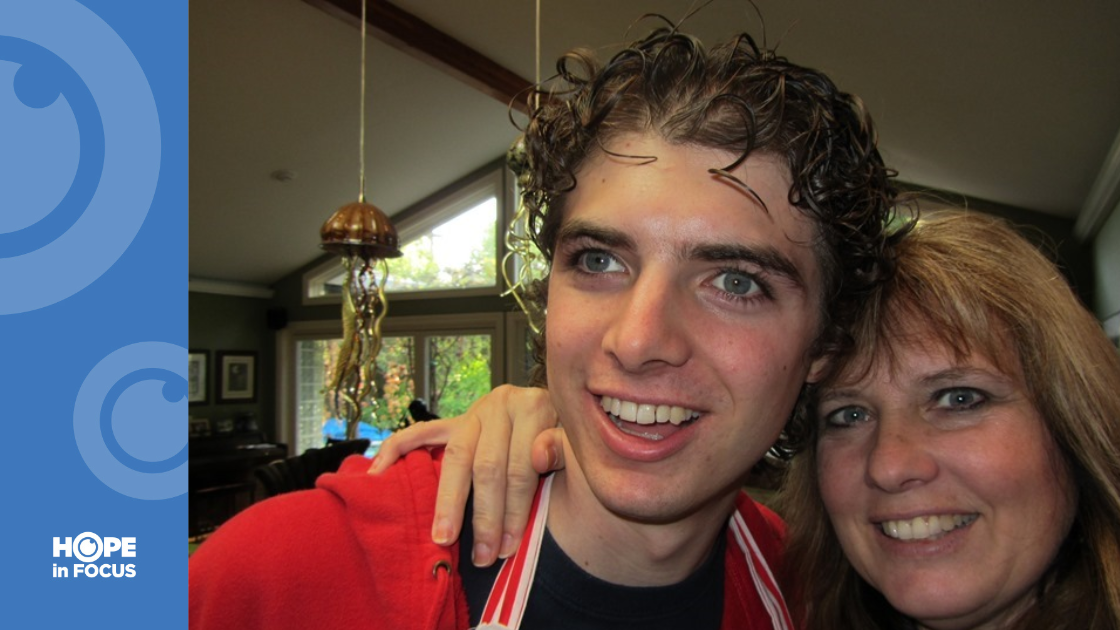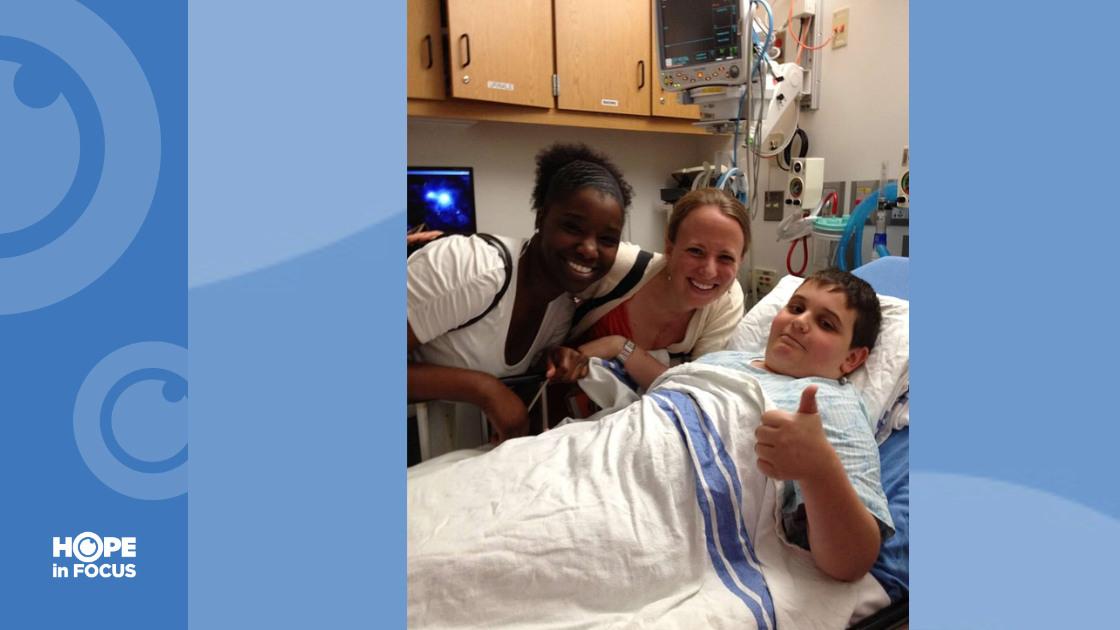
Misty Lovelace: ‘I Can See Little Things’

Told at age 12 she would be blind by 18 because of her Leber congenital amaurosis, Misty Lovelace of Kentucky participated in the gene therapy trials for LUXTURNA, to treat visual impairment caused by LCA-RPE65. At 18, the age when a doctor predicted Misty would be blind, she is ever so grateful for her sight.

Turning 18 marks a milestone for most teenagers, but for Misty Lovelace of Kentucky, turning 18 meant celebrating her ability to see vibrant colors and sparkling stars.

It wasn’t supposed to be this way.

Misty, recalling a doctor’s pronouncement six years ago, said: “One day, I’m going to wake up and I’m going to be completely blind and it’s going to happen before I’m 18.

“It’s really hard for a 12-year-old to hear that,” she said. “It was really sad, really sad.”

Misty was born in October 1999 and diagnosed at 3 months old with “some kind of blindness.”

“In 2000, genetically, things weren’t existing then.”

To understand Misty’s level of vision then, she says to imagine wearing very dark sunglasses and looking through a PVC pipe. With no peripheral vision, she had to move her head, rather than just her eyes, to see up and down.

It was 11 years after her first diagnosis that doctors determined she had Leber congenital amaurosis (LCA), a rare inherited retinal disease (IRD).

“They didn’t tell me much of anything,” she said. “They just label you and you just go on. It’s trial and error. You never know what the right problem is until you find it.”

Diagnosis: LCA-RPE65

Dr. Robert A. Sisk of Cincinnati Children’s Hospital Medical Center did find the right problem and he sent a sample of Misty’s blood off to Children’s Hospital of Philadelphia, where she was genetically diagnosed with LCA-RPE65.

Back then, Misty felt different about the idea of genetic testing. “It wasn’t tremendously important for me to get it. It’s an option we can do.”

Now, “Clearly, I would definitely recommend it and I would recommend it at a young age.”

Misty was 12 when she joined Dr. Sisk’s research project for gene-therapy treatment for LCA-RPE65.

“They sat me down and said the surgery could make it the same, make it better or make it worse. Facing a choice between waking up blind before 18 or the surgery’s going to do it, you gotta take a risk.”

As a preteen living with her grandparents, Misty consented to genetic therapy surgery as part of clinical trials for the recently approved drug called LUXTURNA™.

In December 2017, the Food and Drug Administration approved LUXTURNA™, developed by Spark Therapeutics , as a breakthrough genetic treatment in which a human-engineered virus containing copies of a normal gene is injected under the retina.  

Misty underwent the revolutionary treatment in 2013 when she was 13, and she experienced greatly improved vision in 24 hours.

“It’s amazing; I never thought that detail could be detail,” she said. “I can see hairlines, I can see little things that are so, just so nice. I see colors and bright neon colors.”

And now, at 18, the age when a doctor predicted Misty would be blind, she is ever so grateful for her sight.

Before getting into the clinical trial and having surgery, Misty began riding horses.

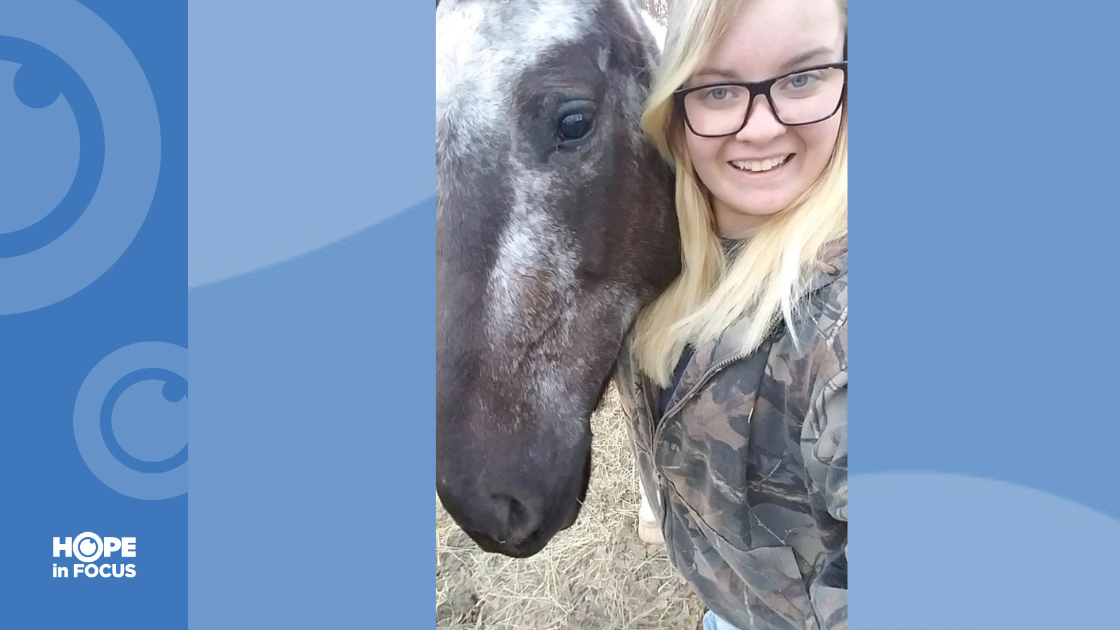
Misty Lovelace on a horse

And that was a whinny and a snort I heard in the background while we talked. And she did sound like she was on top of the world. And, indeed, she was, riding atop Sassy, her paint appaloosa in a windy Kentucky field.

“I train horses, I give lessons. I love to give horses their second shot,” she said. “People see a horse one time and don’t put a lot of effort into it. They break metal fences and knock down poles, trample people.

“I like it because the only way you can learn and expand your knowledge of horses is to find the troublemakers. That’s what my horse is, definitely the troublemaker.”

Misty said she would have continued her interest in horses even if she didn’t have the LUXTURNA treatment.

“It just helped me. It helped people trust me because not everyone is going to let a visually impaired or blind person ride a stubborn, crazy horse.”

She gets along with horses well because her visual impairment gave rise to what she calls a sixth sense. She said she often can feel people’s presence before it is obvious, and horses possess similar instincts.

“Horses are very, very, very amazing creatures. They can sense your emotions. They can read you like a book. They are very smart, intelligent animals.”

Misty’s also learned about human nature along the way and the desire to fit in.

She remembered when she was in fifth grade and someone brought in a big drum, which turned out to be a celestial telescope. Everyone in the class, except her, could see the stars.

“They drew them on a piece of paper. Kids asked if I could see them and I said, ‘Yeah,’ even though I didn’t really see. Kids are mean, they always have been. As soon as I went to middle school, I started to be put down. I was called Helen Keller, kids were absolutely awful.”

She left school in the middle of seventh grade to have the surgery and returned at the beginning of eighth grade.

“When I came back, everybody thought I was so different. They didn’t know what happened. It was a complete turnaround. Everybody wanted to be my friend.”

She now is homeschooled, calling it the best thing in the world.

“I would recommend it to anyone visually impaired. I get to wake up early, do my schooling and I ride my horse the rest of the day.”

She is particularly happy about one of the moments in her journey.

Before Misty’s mom passed away, shortly after her eye surgery, mother and daughter shared a special time.

“She got to see the moment of me first-ever seeing the stars,” Misty recalled. “It was funny, too, me and my sisters, we were all swimming in our Walmart swimming pool, being careful of the chlorine. I looked up at the sky and just started screaming, and I had no idea what they were and why they were there and why did they blink. (My mom’s) freaking out and I’m freaking out.”

Running out from the house, Misty’s mom thought chlorine had gotten in her daughter’s eyes, while Misty initially felt angry, a little betrayed, that the stars in the sky didn’t look at all like the five-pointed ones she’d seen in drawings.

Then she realized the stars she saw were the real deal.

“Now I love looking up in the sky and seeing the stars. I love thinking that at one point in time, they were imaginary for me.”

Ready, Set, Scheduled. Florida Boy Will Receive Gene Therapy Treatment to Reverse Vision Loss

This is the second in a series following the progress of Creed Pettit, a 9-year-old Florida third-grader, who completed treatment in March with the breakthrough gene-therapy drug called LUXTURNA™, approved as the first gene therapy for RPE65 genetic mutations and as the first-ever genetic therapy in the United States for an inherited disease.

Sarah St. Pierre Pettit and her son, Creed, made the six-hour trip to a Miami eye hospital many times in the past, but on their most recent visit, driving back home was different.

“We usually have hope when we leave from Miami,” said Sarah, referring to hope for a treatment for her 9-year-old son’s vision loss due to Leber congenital amaurosis.

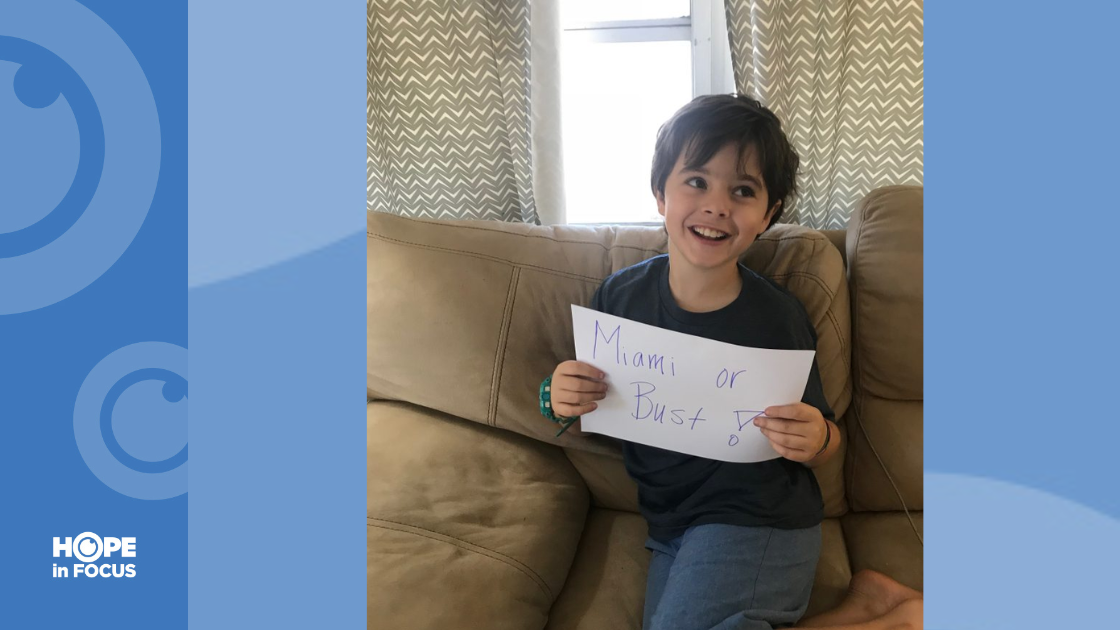
Creed Pettit holding his “surgery scheduled” paperwork with a big smile on his face
9-year-old Creed Pettit holding his “surgery scheduled” paperwork after he and his mom met with surgeons at Bascom Palmer Eye Institute in Miami to schedule his gene therapy treatment with LUXTURNA.

“This time was the first time I’ve ever come back home from Miami with a set date and hope.”

That date would be March 21st for genetic therapy surgery at Bascom Palmer Eye Institute  using LUXTURNA™, a revolutionary treatment to correct the RPE65 gene mutation in one of Creed’s eyes.

The next important date will be March 28th for the same surgery in Creed’s other eye.

“I am on CLOUD 9!!!” Sarah emailed Monday, Feb. 19, hours after meeting with a team of doctors at Bascom Palmer.

The news comes after Sarah’s insurance provider, working with the developer of LUXTURNA™, Spark Therapeutics, gave the go-ahead to schedule surgery. The company established Spark Therapeutics Generation Patient Services™ to support commercially insured patients and their caregivers in the United States and help them navigate the insurance process, according to a Spark Therapeutics’ news release.

Soon after doctors diagnosed her son at the age of 3, Sarah began raising money, totaling about $100,000 that has gone toward research into finding a treatment for LCA-RPE65.

Creed, Sarah, Sarah’s friend, Chad, and Sarah’s mom, Mary, drove from Mount Dora to Miami on Sunday, Feb. 18; on Monday, a team of nurses and doctors met them and talked about what to expect for the surgery.

Meeting the gene therapy team

Dr. Audina M. Berracol will be doing Creed’s surgery. She is a Professor of Clinical Ophthalmology, specializing in areas including vitreoretinal diseases and surgery.

“She was amazing,” Sarah said. “We just had a chance to really meet her.”

Dr. Berracol answered Sarah’s questions and put her mind at ease. Creed has a sensory issue with anything that is “sticky” and had difficulty with patches on his eyes. To help overcome this, the doctor sent them home with a roll of tape used for patches.

“It’s to get him used to it because he’s not going to be able to pull it off,” Sarah said.

Creed later asked his mom how many minutes are in 24 hours. She Googled it and found 1,440 minutes.

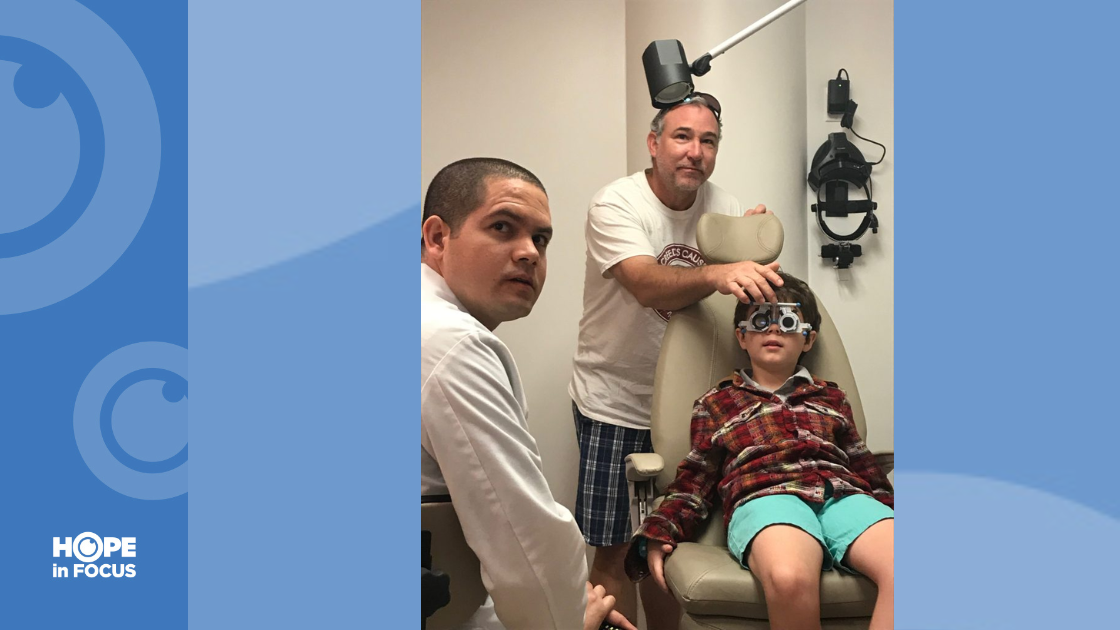
Creed and the doctor reading black book
9-year-old Creed Pettit being tested at Bascom Palmer Eye Institute in Miami in advance of his gene therapy treatment with LUXTURNA.

He wanted to know because that’s how long he’s going to have to wear an eye patch after surgery.

“So that’s fine,” she said. “We’ll count down from there.”

Sarah also wondered what happens after surgery if Creed cries. It’s OK to cry, as long as he doesn’t rub his eyes. A small blister, called a bleb, forms after the surgery, creating vision as if looking through a fish-eye lens.

“Once it pops (naturally), you know you’re in the clear” the doctors said.  

And Sarah asked about administering fluids intravenously, because Creed pulled out an IV after he woke up from having his tonsils out.

The doctor assured her that the IV will be placed so it can’t be pulled out.

She also learned the surgery usually lasts about an hour, much less time than she had imagined.

Back home, Sarah reflected that everything was just so overwhelming.

“It was a long trip home but worth every second of it.”

Creed said the trip was “a one-night stay and we went to Bascom Palmer Eye Institute.”

As for the surgery, Creed said, “I’m feeling a little nervous.”

So is mom. Two days after returning from Miami, new fears crept in as she thought about all the “what ifs” that could happen during surgery.

“I can say other LCA moms are feeling this same emotion,” she said. “Waves of excitement and worry all flow through.”

Her feelings are smoothing out as she and Creed get back to their usual routine for the next several weeks before driving back to Miami for the surgery.

“We’re just going to plug along with school, and Creed’s school has offered to meet with me as to how we’re going to keep him on track while we’re there.”

‘We know how important it is to know your gene. We’ve lived it.’

It took more than seven years to get a genetic diagnosis for our daughter. During that time, doctors were pretty sure she had LCA, although we also heard that maybe she had cone-rod dystrophy or perhaps Stargardt’s Syndrome. We argued with insurance over genetic testing, paid out-of-pocket, took time off work and school for trips out of state and sent blood work all over. Still, no one could give us a genetic diagnosis. Some labs never even bothered to return phone calls to tell us if they had any results.  

And then things changed. More genes had been identified and there were new and better ways of genetically diagnosing IRDs. Finally, in 2013, I we received a confirmed diagnosis for Sofia.

Flash forward another five years to today and there are even more changes. While many aspects of obtaining a genetic diagnosis are still challenging, thanks to continued research, increased awareness, and accessible testing programs, it’s no longer a seven-year ordeal. Patients can get tested today without incurring travel expense and are much more likely to receive a confirmed genetic diagnosis.  

Thanks to donations to our organization, we have been able to support accessible genetic testing for families. Thanks to our donors and supporters, we are also able to provide outreach and education to families, driving awareness and access for genetic testing and encouraging participation in natural history studies and patient registries.  

Our awareness campaign this year is Know Your Gene: Get Tested, Get Connected.  Knowledge is power and we are helping more families get tested so they can receive their genetic diagnosis and then connect in ways that will accelerate research for treatments and cures for IRDs. We want to stress the importance of connecting to a patient registry or a genetic counselor. We want to help families and individuals find each other for support and sharing of information. And we are driving those programs and communications that will continue to advance cures for blindness.

We know how important it is to know your gene. We’ve lived it.

Living with LCA: ‘Then All Our Dreams Were Realized’

Hannah Reif, 7, will be treated with LUXTURNA™ at Children’s Hospital of Philadelphia (CHOP) to cure her blindness caused by LCA-RPE65.

Amy Reif still can’t hold back tears when she recounts first hearing that a ground-breaking genetic-therapy treatment targeting her daughter’s LCA-RPE65 gene officially received approval.

Amy knew in October that the Food and Drug Administration was holding a meeting about LUXTURNA™, a gene therapy developed by Spark Therapeutics, and felt hopeful for a cure for her 7-year-old, Hannah’s vision loss.

“We didn’t actually realize there was a vote on it at the end, and it received unanimous support,” she recalled. She wondered, “Is this it?”

Hannah, center, with her mom Amy, dad Christopher and brothers Jacob and Matthew, standing in front of a giant bald eagle statue.

In October the FDA’s Cellular, Tissue and Gene Therapies Committee heard testimony, including that of Laura Manfre, co-founder and board chair of Sofia Sees Hope. 

The committee voted unanimously to recommend approval of the breakthrough drug.

“Then we realized it was a good next step in the process,” Amy said. “Then when the FDA approval actually happened in December – I can’t even talk about it without crying – we just had so much hope for seven years and all of a sudden all of our dreams were realized,” she said through her tears. “And it was just incredible.”

Amy, a 41-year-old mother of three living in Maple Glen, PA, with her husband, Christopher, still marvels at the idea that the genetic research focused on the same gene mutation as her daughter’s.

“What were the chances that was going to be her gene? It was just amazing.”

Hannah and her dad Christopher.

The first-grader will be treated with LUXTURNA™ at Children’s Hospital of Philadelphia (CHOP), where Jean Bennett, M.D., Ph.D., and Albert M. Maguire, M.D., researched and conducted studies, working with mice and dogs, resulting in this extraordinary gene therapy. LUXTURNA™ is the first genetic therapy treatment for LCA-RPE65, and it is the first treatment in the United States for any inherited disease.

Hannah and her family are serendipitously located 45 minutes from CHOP. Hannah has been seen by Dr. Maguire, the principal investigator for the clinical trials that led to the approval of LUXTURNA™ .

“We didn’t have to search far and wide,” Amy said.

Treatment likely this summer

The family met Feb. 12 with Bart P. Leroy, M.D., Ph.D., for their first appointment at CHOP to get ready for surgery, which probably will happen this summer. Dr. Leroy is director of Ophthalmic Genetics and Retinal Degenerations clinics in the Division of Ophthalmology and Center for Cellular and Molecular Therapeutics.

They discussed the surgery and took more photographs of Hannah’s eyes. They’re waiting to be scheduled for their next appointment.

Doctors told Amy that Hannah has one of the milder forms of LCA. She has night blindness that extends to any dimly-lit area any time of the day. She also has poor peripheral vision.  

An ophthalmologist who saw Hannah at 2 months old suggested LCA as the possible cause of her visual impairment and sent her to CHOP for an electroretinogram (ERG). 

At age 3 at CHOP, Hannah attempted to do simple tasks as part of getting into clinical trials, but she was too young, and the testing was difficult and upsetting. Two years later when they went back for their next ophthalmology appointment at CHOP, the trials were winding down.

“Had we had the opportunity to be in the trial, we would have, but it just didn’t work out.”

Over the last seven years, the family has raised more than $20,000 for Foundation Fighting Blindness through VisionWalk.

For help with the insurance process for Hannah’s surgery, Amy called Spark Therapeutics in January on the recommendation of other moms of children with LCA-RPE65. She said Spark is working with her insurance company on the $850,000 cost to treat both of Hannah’s eyes. The company has established Spark Therapeutics Generation Patient Services™ to support commercially insured patients and caregivers through the treatment experience and help them navigate insurance issues.

Amid all this preparation, Amy said she doesn’t know that Hannah has fully grasped what is going to happen.

“She knows that she’s going to see better, but I’m not sure at age 7 if she knows what that means. She knows that she can’t see stars and rainbows like other people can. At this point, we haven’t talked a lot about it because summer is several months away.

“She is very scared.”

Hannah and her mom Amy

Amy said her daughter had surgery for a lazy eye and still remembers having a hard time coming out of anesthesia and her eyes being crusty.

“She’s excited about the surgery, but she’s afraid she’s going to have crusty eyes. It doesn’t seem like a big deal to us, but for her it is.”

For now, though, Hannah’s enjoying life like any other kid. She attends regular first-grade classes and loves to play with her friends and with Barbies. She especially loves riding her scooter.

“The principal will be outside to meet the kids in the morning and he just sees her flying down the sidewalk on her scooter, and they know my child is visually impaired and they just can’t believe it.”

Hannah in red jacket with pink helmet riding her pink scooter.

Curing Blindness: The Road To Treatment With LUXTURNA™

This is the first in a series following the progress of Creed Pettit, a 9-year-old Florida third-grader, who is a candidate for the breakthrough gene-therapy drug called LUXTURNA™, approved as the first gene therapy for Leber congenital amaurosis (LCA), and as the first-ever genetic therapy in the United States for an inherited disease.

A birthday wish for 9-year-old Creed Pettit, diagnosed with LCA-RPE65, comes closer than ever to coming true today when the Florida boy and his mom meet with a surgeon to schedule treatment with LUXTURNA™, the just-approved, revolutionary gene therapy that corrects his specific gene mutation.

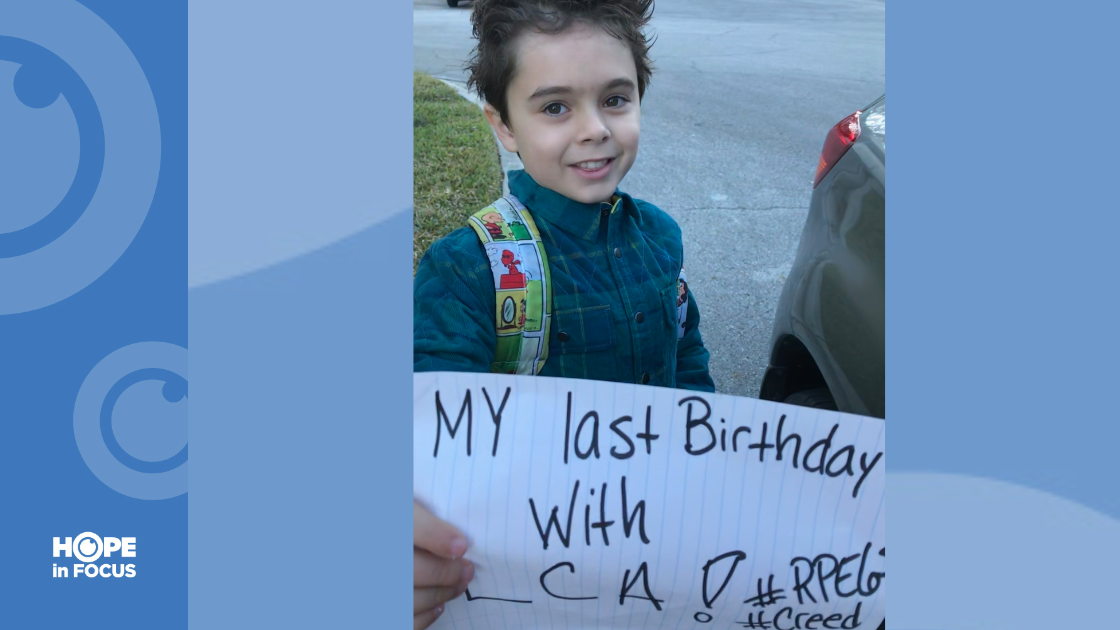
Creed smiling and holding up a piece of paper that writes, "My last birthday with LCA! #RPE65 #CREED
Creed, LCA2 RPE65

Creed had wished that his January 9th birthday would mark his very last with LCA-RPE65.

This third time might truly be the charm for Creed, as his mom, 41-year-old Sarah St. Pierre-Pettit of Mount Dora, Fla., twice tried to get her son, at ages 3 and 4, into clinical gene-therapy trials in Iowa. He was not approved for the trial because he could not perform steps required by the study, such as trying to navigate a maze.

Sarah learned a few days ago that her insurance company gave the go-ahead to schedule the surgery that costs $850,000.

“No more hurdles,” she wrote in an email. “I am a wreck of happy tears!!!”

Sarah and her son drove to Miami’s Bascom Palmer Eye Institute to meet today with Dr. Audina Berrocal to discuss the procedure and answer questions.

Brand new treatment

It was last October when decades of research culminated in a Food and Drug Administration advisory committee hearing in which the group recommended approval of LUXTURNA™, Spark Therapeutics’ breakthrough gene-therapy treatment.  

“One of the doctors spoke about my son in the FDA approval process, which was just amazing,” Sarah said. “That day I knew Creed could be treated.”

Creed and his mom Sarah sitting on steps.
Creed and his mom, Sarah St. Pierre-Pettit of Mount Dora, Fla. Creed meets with his surgeon Feb. 19 to schedule his treatment with LUXTURNA to reverse his blindness caused by LCA-RPE65.

Hope in Focus (formally Sofia Sees Hope) founder and board chair Laura Manfre also counted among those speaking on behalf of this ground-breaking treatment, sharing with the committee a story of a woman whose vision greatly improved in the clinical trials and changed her life.

The FDA granted approval of the treatment in December, paving the way for patients like Creed with LCA-RPE65 to receive, LUXTURNA™, the first genetic therapy treatment for an inherited retinal disease (IRD), and the first genetic therapy in the United States created for any inherited disease.

RPE65 is a form of Leber congenital amaurosis in which the body can’t make a protein needed by the retina to convert light into vision-enabling signals, which are sent to the brain. This new therapy involves injecting under the retina a human-engineered virus containing copies of a normal gene, so cells can express the protein. LCA is a rare inherited retinal disease, and nearly 30 gene mutations are associated with it.

Creed said that after the surgery, he can’t wait to see a real rainbow and he can’t wait to throw his canes in the lake.

His mom, on speakerphone last week while driving to pick up a new batch of “Creed’s Cause” T-shirts that she designed, talked about her most recent effort to help pay for medical bills not covered by insurance, and for travel expenses.

At $20 apiece, Sarah sells them locally and through Facebook and Instagram. When she’s not making T-shirts, she’s an elementary school physical education assistant, and hosts trivia nights at a brewery owned by her sister and brother-in-law.

Creed is a third-grader at Mount Dora Christian Academy, a school that better serves his needs than the public system. MDCA is like family to Creed and his mom, hosting lots of fundraisers, including a January basketball event that raised $5,000. The Douglas G. Halliday Foundation of Orlando recently made a generous contribution, adding to the more than $100,000 raised from 5K races, a CrossFit event and contributions from many friends and people she doesn’t even know.

In 2011, doctors diagnosed Creed with LCA; in the months following he received a genetic diagnosis of LCA-RPE65. Image: Toddler-aged Creed wearing patches over both eyes.

Sarah knew something was wrong with her baby shortly after he was born in January 2009.

“He missed all of the milestones. He would run into everything. He wasn’t walking. Instead, he did this weird Army crawl. He’d feel for his food and look up.

“Everything just said something’s not right.”

Then came the heartache of trying to figure out what was wrong. Doctors diagnosed Creed at 18 months old as autistic, and another said he had problems with his peripheral vision.

For the first year of Creed’s life, his mom thought he had colic because he would spend his days contentedly on a blanket outside, and at the end of the day when he went back into the house, he cried, all night.

An autism teacher advised Sarah to black out all the windows in the house, keep everything dark and not allow him to be in light, the exact opposite of what he needed.

She found the right advice from a woman specializing in depth perception and dyslexia. For the first time, and coming from a non-doctor, Sarah learned that her son probably was blind.

Creed with eye patches on his eyes, his mom is holding him
In 2011, doctors diagnosed Creed at 2 years and 8 months with LCA; in the months following he received a genetic diagnosis of LCA-RPE65. A week later, Sarah began her fundraising endeavors.

She also reached out for support that resulted in a team of therapists and specialists to address Creed’s movement, vision, speech, orientation, mobility and behavior.

Trying for a gene therapy trial

Sarah learned about RPE65 gene-therapy trials. She, her mother, Mary, and Creed traveled to Iowa twice for what turned out to be unsuccessful attempts to be part of the research.

Creed’s visual acuity is actually very good; when he has light, he can see. When he doesn’t have light, he can’t see anything. As Sarah says, “No light, no sight.”

He needed light and he got it, with his mom installing special bright lights all over the house.

“I’m positive they can see us in space,” she said of the lights in and around her home. Creed also has more light in school, including a light in his desk.

At school and in life, Creed has another light shining on him – his best buddy Michael, who bonded with him in first grade. He helps him be safe and gives Sarah updates about her son.

She said she can’t believe Michael’s maturity and sensitivity and believes he was put on this earth to help her son and others.

For Valentine’s Day, teachers filled bags with candy and sold them for $1 each, with proceeds going toward Creed’s expenses.

The words on the candy bag say, “Help Creed see how much we love him.”

Being Married to Brandon: “A Precious Exercise of Mindfulness”

When I met Brandon in September 2014, I thought that I was talking to the most interesting person I had ever met.

Not only was he the first American I had ever talked to, Brandon was also the opposite of the typical 20-something Italian: Not Catholic, vegetarian, mostly homeschooled, who preferred peanut butter over Nutella.

Besides the cultural diversities, I immediately liked his positive way of thinking, his unusual curiosity and his witty sense of humor.

Another particularity of Brandon was his blindness, which is actually the reason why we met.

I was giving a tour of my university, the University of Milano, Italy, for international students and I was asked to guide Brandon, who was there to study Italian for opera. Among a group of a hundred students, it would have been unlikely that I would have gotten to know any of them. Since Brandon was by my side, however, we had the chance to talk during the tour. And then we scheduled a date.

We were married two years later.

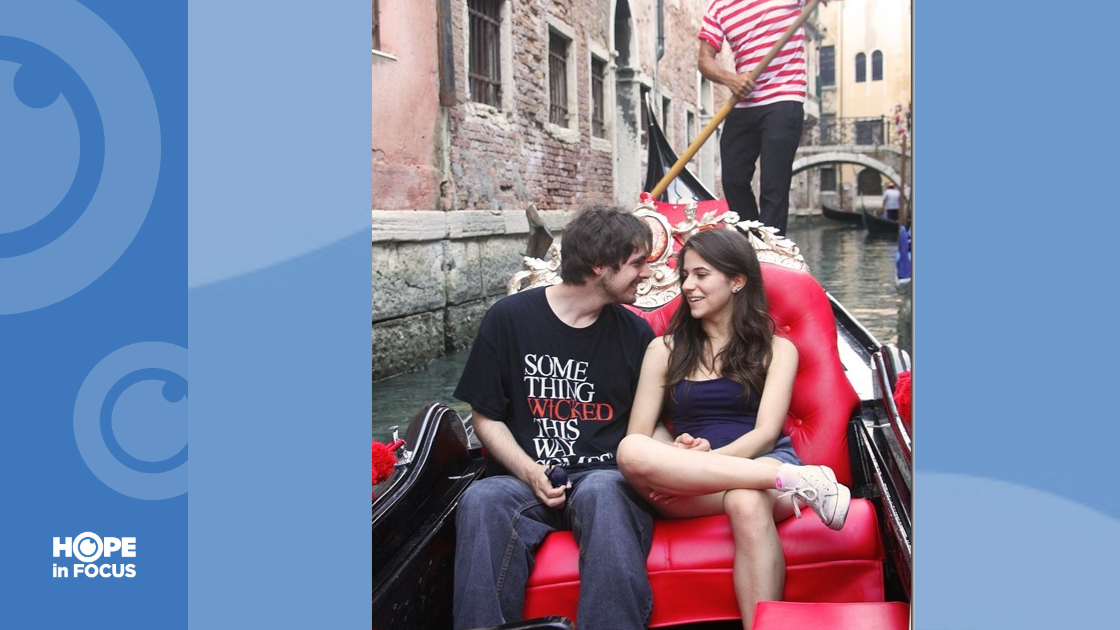
The last three years with Brandon have been quite a journey; we have been apart for several months, but we also managed to live in five countries and visit nine in total.

I have special memories for each of them, for example swimming in the crystal sea in Croatia for our honeymoon, walking through the Christmas markets in Vienna, visiting the Nobel Museum in Stockholm, making cheese on a Maltese farm, seeing “Matilda the Musical” in London. These are just a few of the unforgettable moments we have shared so far.

Currently, we are happily living on a houseboat on a little canal in the city of Groningen, Netherlands, where I am studying for my master’s in computational linguistics.

I consider living with a blind partner a precious exercise of mindfulness.

If I am alone, I walk in the street careful enough to be safe, but I am immersed in my thoughts, listening to music with my isolating headphones. When I am with Brandon, I acknowledge everything around me: people, buildings, colors, behaviors, my own emotions, and I feel that I am present in the moment.

At the same time, I acknowledge accessibility issues, which are a wide problem in south European countries. Sidewalks are too narrow, uneven or used for  parking by cars. Also, street lights without sound effects or unsafe driving behaviors are a cause of frustration for me. 

Previously I said that Brandon and I met because he was blind, which is not exactly the truth.

Brandon’s education, O&M (Orientation & Mobility) training, and his (now, also my,) incredible family have made him an independent, healthy and positive person, confident enough to decide to take a plane solo, cross the ocean and live abroad for one year to learn a new language.

Therefore, I am forever grateful to everyone who contributed to Brandon’s education. I am now happy to see Brandon helping his mum, Sonja, to build educational services that can have a significant impact on other young blind determined students.

Learn more about Brandon

Read Brandon’s mother’s story

Read Brandon’s father’s story

Atom Biggs: ‘The Greatest Adventure of My Life”

Raising a blind son has been one of the most exciting and inspiring experiences a dad can ever have. I’d like to tell you a little about our son, Brandon.

As a baby he had some vision, so his visual impairment wasn’t initially noticeable to us. About the time he started walking, it became clear something was unusual.

At first my wife and I thought he was clumsy or maybe a little absent-minded when he would collide with things. When we’d put food on the table in front of him, he’d feel around for it with his hands while his eyes looked off into space. When I’d try to look him in the eye, he’d look to the right or left of my face but couldn’t seem to make eye contact with me.

We were shocked when the ophthalmologist diagnosed Brandon with retinitis pigmentosa (RP). Now we were faced with new challenges.

Before we had children, my wife and I sat down and put together a plan on how we would raise them. Now we had to rethink everything. Our first step was to gather every resource available to us. We were quite surprised at how much lay within our reach. We read books, got him a free computer, visited the School for the Blind, and learned how to read Braille. We also organized his room with little baskets and cubbies, so he’d know where to find everything.

One of the most important stories I read was written by a blind man whose parents coddled him his whole life and were afraid to let him venture outside the safety of his home. I determined that was not going to be the story of our son. Instead, we looked for every opportunity for Brandon to experience the world around him.

We took our son to the zoo, on hikes, on field trips, exhibits, fairs and everything we thought might be experiential and educational. A blind person’s eyes are his fingers, so we always made it known that our son was blind and requested special permission for him to touch, even if the signs said, “no touching.”

We enrolled him in Junior 4H. I bought him a bicycle and tried to teach him how to ride; he persisted without my help and taught himself how to ride in our basement.

We met with his teachers and explained how blind children learn differently from sighted children and what accommodations Brandon would need in his classroom. We emphasized that he should be allowed to experience everything the other students experienced and not be left out of anything. They almost always listened to us and were grateful for our input.

We found that none of Brandon’s teachers had any experience with blind students, so we met with them frequently to make sure he didn’t get brushed aside. I think the most common excuse from teachers not to let Brandon participate was “we’re just concerned about his safety.” We’d explain that if they’d just let him tour the stage platform with his cane or have him buddy-up with a friend until he learned to walk the trail, he would be perfectly safe.

When our son was younger, we advocated for him, but as he got older we encouraged him to advocate for himself.

I think Brandon’s first major experience for self-advocacy was 7th-grade basketball. I told him I really didn’t think basketball was for him but that if he really wanted to play then he should arrange a meeting with the coach and the principal and voice his feelings. And so he did. He told them how much he wanted to play basketball, we were at the meeting and backed him up, and the coach was so impressed that he let Brandon on the team. He only played defense, but he played almost every game and the coach said Brandon was the most tenacious guard he’d ever had.

Brandon went on to advocate for audible traffic signals near our home, so he could safely cross the street and catch the bus. He touched models of cells in biology class, so he could feel what everyone else saw. Currently Brandon is advocating for the entire blind community to get them equal access to many online applications and software programs.

When Brandon was first diagnosed and we shared it with our friends, we got a lot of pity responses. I wasn’t sure what to say, but now I do.

Now when I tell people that my son is blind, and they say, “Oh, I’m so sorry!” I tell them there’s really nothing to be sorry about. It’s been the greatest adventure of my life and I’d have it no other way.

Learn more about Brandon

Read Brandon’s mother’s story

Read Brandon’s wife’s story

Sonja Biggs: “My Normal and His Normal Are Just Different”

Brandon Biggs is the chief financial officer with his mother Sonja in their company, he conducts accessibility research and he helps businesses make their software content more accessible to the visually impaired.

He is a 26-year-old self-taught programmer who is earning a master’s degree in Inclusive Design from OCAD University in Toronto while living on a houseboat in Groningen, Netherlands, with his Italian wife. Oh, and he’s an opera singer?

But he’s still Sonja Biggs’ little boy.

“Even with all the successes in his life and his own positive spirit toward blindness,” Sonja says, “I am still having a mom moment in my heart.”

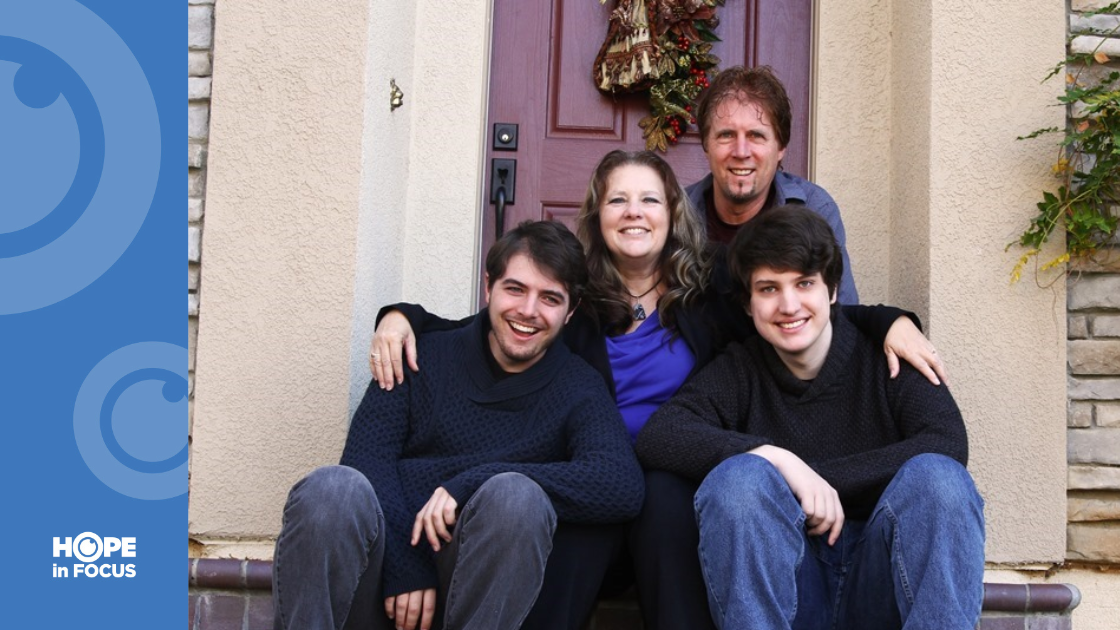
Brandon has Leber congenital amaurosis with a mutation in the CRB1 gene. He was diagnosed as a toddler, and subsequently, Sonja became a Teacher of the Blind and Visually Impaired, and an Orientation and Mobility Specialist. She, Brandon, and her husband (and Brandon’s dad), Atom, run Sonja Biggs Educational Services, Inc. Sonja and Atom live in Gilroy, Calif., and they also have a 22-year-old son, Joshua, a talented programmer, gifted in science and graphic art.

Brandon’s interests include theater and opera. He performed in many musical theater productions and in a professional production of “La Bohème.”

“I was introduced to opera by a voice teacher when I was 18,” Brandon says. “And I fell in love with the mysteriousness and power of singing something so emotional and powerful in another language.”

His mother said she and Atom always encouraged both their sons to explore. When they were interested in marine life, they went to the San Juan Islands; when they were interested in volcanoes, they went to Mt. St. Helens. Bats? They checked out zoos and bat houses.

“We never told them no,” she recalls. “We just immersed them in whatever they were interested in and made it real for them.”

Sonja likens the inaccessibility of common tools for the visually impaired to the process of making chocolate chip cookies by adding the chips to the cookies after they’ve baked and cooled.

She said her “mom-heart” sometimes gets in the way of what she knows in her head. She still sometimes grieves that Brandon is blind.

“All of a sudden, something triggers it along the way – ‘Your son has no sight,’ or his frustration over inaccessibility in an application.”

Any parent of a child with disabilities goes through different stages of grief, she says. “The grief never seems to go away; it crops up at inopportune moments.”

A vision appointment triggered the grief this time. Brandon has no measurable vision, seeing light and shadows. He said he does not even notice his sight disappearing.

“I look at the things that I see every day that are beautiful,” Sonja says, “and he’s never seen them.”
Brandon is married and he’s never seen his wife. “He’s felt her, but he’s never seen her,” she adds. To which Brandon replies, ‘Yeah, mom, I can tell how beautiful someone is by touching their elbow.’

She knows her son’s blindness does not make him any less an accomplished human being. “He’s a beautiful young man. He’s wonderful, and to him it’s just normal and I just have to remember that,” she notes.

“My normal and his normal are just different.”

Learn more about Brandon

Read Brandon’s father’s story

Read Brandon’s wife’s story

Living with LCA: Brandon Biggs

Brandon Biggs was diagnosed with vision loss — and ultimately with Leber congenital amaurosis (LCA) — as a toddler. His genetic mutation is LCA-CRB1, which can cause LCA, retinitis pigmentosa (RP) and cone-rod dystrophy. CRB1 is the second highest incidence (10%-13%) of the nearly 30 different LCA genes that cause the disease.

His mother, Sonja Biggs, described in a telephone interview from her California home that despite all her now-26-year-old son’s accomplishments, she still has her “Mom moments,” triggering grief for her son’s vision loss.

What we discovered in exploring Brandon’s story for our series “Living with LCA” is that different members of his family have differing views of their journey with this rare inherited retinal disease. And so we invited the Biggs family to each share their story revolving around Brandon — mom Sonja, dad Atom, and wife Claudia.

But first, a little about Brandon himself: In pursuing his master’s degree in Inclusive Design, Brandon is writing his thesis exploring multimodal representations of data. He is focusing on creating auditory maps for blind people showing, for instance, where the hurricane is in Texas, or where the wildfires are in California. He is also working on making auditory graphs, so blind students won’t be required to always read tactile graphs.

“As technology is developing faster and faster,” Brandon says, “it is becoming more and more difficult to make sure technology is accessible to blind users, especially in the work environment.”
As a business owner, Brandon sees how difficult it is for a blind person to work in a small business. “I evaluate systems, such as for accounting, payroll, HR, timekeeping, document storage . . . and it is scary that for many crucial systems, there are few accessible solutions and no user-friendly solutions (for the blind).

“I just evaluated around 20 accounting systems and there were only two systems that were partly accessible; all the others were completely inaccessible. This means that blind people who work at all with accounting can only successfully work at companies that use those two systems, and only about half as efficiently as their sighted counterparts. This half-efficiency is because the experience of the blind user was not taken into consideration when the system was developed.”

Despite these issues, Brandon is actively working with companies to make their systems more accessible. He performs user-experience reviews for companies and writes evaluations of their products from a blind user’s perspective. He recently evaluated Intuit’s QuickBooks Online, and Intuit invited him in to see what they are working on.

“They are very slowly making changes that I recommended, but it is very slow. There are two guys on accessibility out of the 8,000 employees at Intuit, and that is considered to be a big accessibility team.”
All the more reason that Brandon is devoting his life to making sure blind people have quality access to technology.

Read Sonja’s story

Read Atom’s story

Read Claudia’s story

Living with LCA: Life Through Vicky’s Eyes

Preschooler Vittoria shrieks with delight as she bounds down the cobblestone way, toward the big statue of the angel riding a chariot. Later we see the almost-4-year-old, nicknamed Vicky, tossing a coin in the azure waters of an elaborate fountain. Yet another image shows the little girl with glasses going bump, bump, bump, down the ancient marble steps on her bum.

This is all part of her parents’, Silvia and Enrico, effort to help their daughter see as much as she can while she still has vision.

The couple learned in April 2016 that their daughter had Leber congenital amaurosis (LCA). Vicky was 2½ and her mom was six months pregnant with little brother Filippo. That October, doctors genetically diagnosed Vicky with LCA-RDH12. Filippo carries the gene, but he is not affected by Leber congenital amaurosis.

On a recent trip to their native Italy from their home in the U.K., the family took in many sights, including Winged Victory, a majestic statue of the goddess Victoria riding a chariot pulled by four horses, atop the Altar of the Fatherland, and the stunningly ornate Trevi Fountain.

The images are from their Facebook video, “Come see with me . . . Rome!” or “Vieni con me a . . . Roma!” Vicky smiles and at times looks straight into the camera with her big brown eyes.

The video is among several “come-see-with-me” stories created by Silvia, and it represents one of the three goals the couple has for Vicky – to show her all they can while she still can see, before the effects of the Leber congenital amaurosis fully take hold.

Preschooler Vittoria “Vicky” Cerolini swimming with pink floaties and pink sunglasses.

The second goal is to support Vicky’s development despite her sight impairment. They look for the right kinds of social, educational and technological environments in which their daughter can thrive.  

“As parents, this is what you do,” Silvia said. “You invest all your effort in fighting for a better life for your kids.”

Their third goal is to do all they can to help find a cure. They have attended rare retinal disease symposiums, which led to an invitation to a family conference where they connected with researchers.

Silvia worked to find people around the globe – the U.K., Italy, Germany, South Africa, China, Australia, Canada and the U.S. – to partner with families and to raise money to fund research to correct the RDH12 gene.

They’ve connected with a group of U.S. families who are part of the RDH12 Fund for Sight. One of those families is Allison Galloway and her husband, Michael, who live in Colorado with their children, 6-year-old Logan and 4-year-old Zoe, both of whom have the RDH12 mutation. They also joined with people in Europe through Candle in the Dark.

Silvia and Enrico learned quickly that much needs to be done – and fast – to find treatments and cures. They’ve launched campaigns to support their near-future goal of funding the work of two researchers concentrating on RDH12.

Amid these efforts, Silvia said she has good days and bad days.

The family had a terrible scare recently when Vicky could see nothing for a few seconds as she rode on an escalator. “The thought of going suddenly black was really, really frightening,” Silvia said.

Then there was the time when their school of choice for Vicky made them feel as if they “shut their door in front of us,” saying they had no experience with sight loss and showing no willingness to learn or support the child.

Preschooler Vittoria “Vicky” Cerolini in a bright red jacket and eyeglasses, enjoying an outdoor cafe.

“It was really, really heartbreaking. This complete, cold, concrete reality,” Silvia recalled.  

They found another school, where Vicky is flourishing. To help educators understand Vicky’s level of sight, a visual-impairment teacher brought glasses simulating Vicky’s vision for the regular teacher to try. Silvia said the teacher’s jaw dropped when she learned she was experiencing how Vicky sees now.

Silvia said it is incredible what her daughter can accomplish. Vicky does everything all the other kids do. She climbs and plays, she’s vibrant and full of energy, and she loves pizza and hearing stories.

“Now she’s into the fairies and princesses. Every night we have to read three books and she always asks for more.”

Vicky, who will turn 4 on Christmas Eve, does not quite understand her sight loss. “We haven’t fully told her yet; she knows she wears glasses and they help her see better … I know the worst is yet to come.

“On the other side, we have committed now to do everything we can to help, including fundraising for an RDH12 cure. It’s actually liberating because it’s given us purpose and initiative in life.”

Silvia’s thoughts on the future:

“Maybe the message is cliché, but it’s really about hope and doing everything we can. I don’t want to give up. I feel a sense of urgency because I feel it might come a little too late.

“I want to say 50 years from now, I’ve done everything I can. In the worst-case scenario, it’s going to help future kids, and still it is going to show Vicky the importance of fighting for your hopes and beliefs.

“In the best-case scenario, imagine a cure is coming in time and we can help kids like Vicky see for longer! If I had even a little role in making this happen, imagine how fulfilling that would feel.”

Follow Vicky’s journey here.