RPE65 Trial Patient Tami Morehouse: “There’s So Much To See”

Tami Morehouse made research history in the Leber congenital amaurosis world, and in the nation, when at age 44 she became the oldest person in a successful LCA-RPE65 genetic therapy trial, and the first patient to receive the retinal therapy in both eyes.

It’s been a long road for Tami, now 53 and living in the Cleveland area with her husband, Mike.

With no LCA diagnosis until her 30s, Tami made her way through life doing whatever she had to do. Sink or swim, she developed good coping and resource skills.

“I did what I had to do,” she said. “I had enough vision to make it work.”

No one noticed her vision problems until she was about a year old, when nighttime came, and she couldn’t see well at all. Attention focused on the idea she had night blindness.

It is difficult to detect vision clarity in small children, but her mom and dad knew something wasn’t quite right. Doctors picked up on it when she was 5, during an exam in which she recalled she was scared to death, screaming and crying, because they were poking around her eyes.

They determined she had issues with the clarity and clearness of vision, known as visual acuity.

She just adapted

From kindergarten into her 20s, she adapted to her surroundings and to her level of vision. She had difficulty seeing the chalkboard, reading a paper or deciphering bulletin-board postings.

“All of my teachers knew I had a hard time. I needed more light than the average kid. I remember the hallways of my elementary school were very, very dim and I had a hard time making my way around.”

Something her father said a long time ago helped her along the way. Her dad, who always called her Timmer, said, “‘Timmer, we all have our troubles, and if you want me to take you anywhere or do anything, just ask me.’ They just treated me like the typical kid I was not.”

Studying social work at Edinboro University in Pennsylvania, Tami scheduled classes in familiar and comfortable places. She avoided night classes, and when she couldn’t, she’d figure out how to get there, walking in better lit areas.

She realized that all her life she was a tweener – someone poised in-between.

“I was a tweener for forever because I did most things like everyone else did and there was that part that everyone else didn’t know.”

Since she was young, some sort of eye doctor tracked her through the years, but it wasn’t until she got her first social-work job and her then-boyfriend, now-husband, Mike, said they needed to explore potential options.

Specialists diagnosed her under the retinitis-pigmentosa umbrella and told her she would lose her vision. They said it was good she already had her education and she should consider having her children now. “It was a heartbreaker day,” Tami recalled.

As she aged, so did her retina and its ability to function well. She went from reading storybooks to her three children to reading Dr. Seuss alphabet books. Some days she saw only hazy grays and browns and needed the brightest lights to see.

“It was really very scary. At that point, before the trial, I had more poor-vision days, than OK-vision days. Sometimes I was scared to death to set my alarm. What if tomorrow is the day I wake up and my vision doesn’t get better? What if I wake up and I can’t see?”

But one Sunday morning, Tami was in the house, and her husband was out in the garage. He suddenly barreled in. He had heard on the radio that a study was being done on children with LCA in Philadelphia by Dr. Jean Bennett and Dr. Albert McGuire. Mike called Bennett the next day, and the wheels turned fast. Bennett opened the study at Children’s Hospital of Philadelphia to older patients and invited Tami to take part in the Spark Therapeutics trial that would change her life.

In March 2009, doctors injected her left eye with healthy cells to help her retina perform more efficiently and regenerate healthy cells.

Several days later, she and her husband were having dinner in Philadelphia and Tami reached over and picked up her drink.

‘Do you know that you just reached over and picked that up, you didn’t feel for it?,’ Mike asked. ‘You just looked out and saw it and picked it up!’

The injection in her right eye in November 2010 brought more brightness and clarity, to the point where she could see some eye-chart letters.

In spring at a baseball practice for one of her sons, she noticed colors more than ever before.

“It was color and light and movement and the kind of stuff people take for granted every day, which may seem small if you have it. Once you lose those little things and then get them back, you realize how important they were. For me it was huge.”

Tami also got to see her daughter taunting the opposing pitcher on her softball team, as she frequently danced up and down the third-base line to almost always steal home.

‘Don’t give up’

Her only wish was that the therapy had been an option sooner, because as the years passed, her retinas kept deteriorating.

“If this was a life-threatening illness,” she quipped, “I would have died a long time ago.”

She advises anyone with LCA-RPE65 to investigate whether the therapy is an option, saying, “Time is of the essence. Don’t give up. There were a lot of us in that trial and we all seem to have different levels of benefits from procedures, whether you have a little vision or a lot of vision. I just value my vision so much, I just think everybody needs to act and respect whatever level you have and just be glad to have it. There’s so much to see. It’s an incredible gift.”

College Connection: Three Things Parents Can Do For Their Visually Impaired Child

Parents want nothing but the best for their children. This is why I am so often asked questions like, “I have a 6-year-old son who has a vision impairment. What can I do to help him become independent when he grows up?” I am lucky to have the parents I do because they have done many things that have helped me become the confident and independent person I am today. I am going to share a few examples of what they did for me in the hopes that you can help someone in your life, too.

Never Say “No”

“No” was never a word I heard growing up unless I was misbehaving (not that I ever did that). Once around the age of 8, I was talking about what I wanted to be when I grow up and my Dad, a financial planner, said “Jack, maybe you can take over my business.” My response was “I can’t do that, you drive lots for meetings and I am not allowed to drive.” Instead of agreeing with me, my parents simply replied,  “Jack, you could just have the clients come to you.”

I was never given an easy way out because I couldn’t see well. Instead I was intentionally challenged, which helped me develop many skills. In my preschool years, my parents would go for walks after dinner when it was dark. Most nights I would follow them on my tricycle. I have never been able to see in the dark. My parents didn’t always know this but when they found out, they didn’t stop me riding the tricycle in the dark. I believe that this helped me gain the excellent orientation and mobility skills that I have today.

Children who are different are often targeted by bullies. I was bullied frequently but I always knew that I could go to my parents for help. Being there also refers to being your child’s biggest advocate. Relentlessly advocate for an accessible education for your child because without that he or she will never be independent.

I hope that you can apply these examples to your own life and that you are inspired by my parent’s actions – I know that I am! As always, feel free to reach out online.

Jack McCormick is a 21-year-old honors business student at Canada’s Wilfrid Laurier University in Waterloo, Ontario, and he is a member of the National Young Leaders Program for the Foundation Fighting Blindness. Jack was diagnosed in high school with Leber congenital amaurosis due to mutations in the RPE65 gene. He is also a Hope in Focus (formally Sofia Sees Hope) Ambassador, helping people living with LCA and IRDs.

Tell Us Your Story: Allison Galloway

Somehow I made it through 37 years of life without ever meeting a blind person.

Then my 3-year-old son was diagnosed with a rare genetic disease called Leber congenital amaurosis (LCA) that will cause him to go blind in his teens or twenties. My world was set into a whirlwind of grief, confusion and anger.

How was it possible that two completely healthy parents who did everything the doctors told us to do before and during pregnancy, could have a child with such a traumatizing diagnosis?

As the weeks went on my grief turned to anger, my anger to guilt, my guilt to a desire to solve the problem to which there was no solution.

This disease caused my son’s body to lack the ability to create a simple enzyme called retinal dehydrogenase, which assists in the cleaning and health of the rods and cones in his eyes. It is an autosomal recessive gene defect that appears when each parent has a mutation on the same gene in the same place. There is a 25 percent chance that each child they create will have this disease. The odds were against us, I suppose.

A year and a half later, we learned the odds were even worse than we thought. Our son was 5 and our daughter was 3. One day at dinner I noticed my daughter’s eye started to bounce from side to side. I immediately knew what it meant. A nystagmus means that the eye is weak and sick. I didn’t need the gene results to know that not only did my son have LCA, but my beautiful little girl did too. A 6 percent chance …

LCA diagnosis is truly life changing

There are social repercussions to a diagnosis like this. I lost friends because they couldn’t cope with the thought of a child losing his sight. My son has had kids tell him he can’t do certain things because he is the “blind kid” (and he is only in kindergarten). People told me that what I was feeling about my kids’ diagnosis —that sense of loss or death of the life that you thought your child would have —was the wrong way to feel.

What fueled my determination to speak out for all those parents dealing with a similar heart-sinking diagnosis occurred at our eye doctor’s of all places. I walked into the office determined to figure out what was wrong with my son’s eyes. After an hour and a half, the doctor handed me my child’s diagnosis on a piece of paper. She told me to schedule a procedure under anesthesia for my son at Children’s Hospital with no explanation of why or what we were looking for and then told me to follow up in a year “if I wanted to.”

I Googled what was written on that paper. The first word I saw was “blind” and the second phrase that stood out was “no cure.” That was all I had. I am a nurse practitioner but I had very little knowledge of the eye. I knew then and there that I quickly had to learn all I could. The problem is that so many families get the same kind of “rare disease news” and have no idea what to do. They trust their doctors to be the knowledgeable ones. If a doctor says there is no cure, well then there is no cure, right? Nothing left to do but learn how to accept it, scared and alone.

I want to stand up for all those parents out there who don’t know where to go once they hear something hard about their child. I have met many families who have had similar diagnoses as my children and the doctors tell them that there is no cure yet, so there is no need to do anything but deal. This infuriates me.  The lack of assistance given to parents is astounding.  If I had not had the financial means, the education, and the network, I would have taken the advice of my first doctor and just followed up ” if I wanted to.”

As time has gone on I have met so many amazing parents, families, teachers, and researchers who are determined to cure many of these rare diseases. Social media has opened so many doors. I was lucky to find a group of 18 families whose children all have the same gene defect as mine, RDH12. Together we created a network of motivated parents who have formed a 501(c)(3) named RDH12.org to raise money. We work with scientists around the world to fund research. We support each other even if we live in the U.S., Italy, Australia or Saudi Arabia. We try to advocate the importance of all children diagnosed with a rare disease to get genetic testing. Without it we would have never known what our children had, let alone how to cure it.

Use the resources

There are amazing things out there like the website, Myretinatracker.org, which was created to generate a database of everyone with inherited retinal disease so scientists can easily access a population to use for clinical trials. Everyone should be on it if they have a genetic disorder.

Genetic testing is free in many instances and all it requires is a simple blood test. Spark Therapeutics has just started an ID YOUR IRD gene testing initiative for free to patients that aims to help inform as many people as possible of their specific gene test. Knowing the gene is a critical step towards getting treatment if it is available or toward helping advance the research that will lead to cures. It is for this reason that I am writing to you. There is so much that we can do if we have the knowledge to do so and we spread the word.

This rare disease is what comes between my children and the world. It limits them. Rare has flipped our world upside down and forever changed me. It keeps me searching for answers and fighting for all those families out there. We know our love is what keeps us going on the days that feel impossible. Love is what will keep us moving on the days when the news at appointments is less than positive. We never give up on our children, and we will never stop fighting for their well-being.  All we want is for our children to not have to fight so hard to simply be.

Allison Galloway lives in Westminster, Colorado, with her husband Michael and their two children, 6-year-old Logan and 4-year-old Zoe. 

Living With LCA: Annie’s Story

Annie Cohane takes singing lessons and piano lessons, she runs track, she’s working on swimming, and she’s a second-grader at an elementary school in Norwell, Mass.

She’s 8 years old and an emerging Braille reader.

“She’s a happy, very happy-go-lucky, strong-willed, little girl,” Annie’s mom, Jenny, said.

The goal for Jenny and her husband, Kevin, is for Annie to become as independent as possible.

She rides the bus to school, she goes on play dates.

Annie Cohane in sunglasses with her mom Jenny.
Annie was diagnosed with Leber congenital amaurosis (LCA) at 3 months of age. Genetic testing later showed a mutation in her CEP290 gene.

“She just figured out she was blind in the last few years,” Jenny recently said. “So far, it turns out it doesn’t affect her at all.”

In 2009 when Annie was 2 months old, she involuntarily moved her eyes side to side, prompting a diagnosis of nystagmus, a condition affecting about 24 out of 10,000 children.

A month later Annie underwent an electroretinogram (ERG), showing a diagnosis of Leber congenital amaurosis (LCA)  and that Annie was blind.

“I was shocked,” Kevin said. “I probably didn’t take a breath for 50, 90 seconds, trying to figure out what that meant. You never imagined your child would be anything but happy and healthy.”

Genetic testing later showed a mutation in her CEP290 gene.

The Cohanes had hope, however, because doctors assured them that cures and treatments were in the pipeline to help people like Annie with LCA.

Annie Cohane laughs with her dad Kevin.

Barely wrapping their heads around the life-changing news, they needed to tell their families. Jenny already had moved onto the planning side of caring for Annie, while Kevin made calls to family and friends.

“We were only concerned about Annie,” Kevin said. “They were concerned about Annie and us.”

While still processing the news, Jenny and Kevin – who met while training for triathlons, literally and figuratively crossing each other’s paths – got busy.

Early intervention specialists came to the house weekly, and then Annie enrolled in an infant/toddler program at the Perkins School for the Blind until she was 3. They worked to ensure their little girl’s access to any available resources to help her become confident and independent – just like any other child.

Annie Cohane and her big brother Petey at the beach

Clearly these specialists – social workers, occupational therapists, vision specialists, physical therapist, speech therapists – helped Jenny and Kevin navigate this unfamiliar world with Annie and her older brother, Petey.

Then, these endurance athletes, who happen to have fund-raising experience, decided after attending Foundation for Retinal Research conferences to help fund research into LCA.

Jenny came up with the idea of giving parents a nice night out, and in 2012, they turned their backyard into a big fund-raising party with plenty of donated food, drink and live music.

The parties, each with a theme, became a platform for learning from Annie. They chose themes in which partygoers could take away their experience and apply it to their lives. They ranged from stop-and-smell-the-rosemary to back-to-basics.

“That is how we try to live our life,” Jenny said.

Two years ago, 350 people came to their barn and backyard. This past September, they raised more than $37,000, bringing their total over the years to more than $160,000. They originally gave the funds to the Foundation for Retinal Research, and now they go to the Foundation Fighting Blindness  since the FRR rolled into the FFB. Also, this year more than $2,400 went to New England Adaptive Sports.

Attending this year’s Dinner in the Dark  presented by Sofia Sees Hope also gave the Cohanes hope. At the event, Jenny and Kevin sat next to Jack McCormick and his 5-year-old lab/golden-mix guide dog, Jake. Jack is a 20-year-old business honors student in Ontario, Canada. He also is a thoughtful, well-spoken advocate for accessibility, and he is a mentor, urging people with LCA to tell their stories to boost self-confidence and attract researchers.

“He was phenomenal,” Jenny said. “He’s exactly what I want Annie to be.”

Eight years ago when Kevin came home after getting Annie’s diagnosis, he took a nap, and when he woke up, he told Jenny he had a dream that Annie was sitting across from him in a hospital room.

“She was 13, 14, and I could tell she could see me, and I started crying, and she said, ‘Dad, why are you crying?’”

He told her, “I’m just so happy that you can finally see what we look like.”

She replied: “But I’ve known what you looked like all along.’’

Kevin believed then, as he does now, that his dream foreshadows a time when researchers find a cure for LCA-CEP290 and Annie will see.

In October, the FDA recommended approval for genetic therapy for the LCA-RPE65 gene, one of more than 25 genes associated with LCA. If approved, the therapy would be the first of its kind for LCA and the first in the nation for any genetic disease. Also, the research in progress when Annie was an infant is now well into later stages of study.

Kevin said after the dream he felt an amazing sense of peace.

“I just felt confident we’d be able to get through it, even if we didn’t know what we were facing, he said. “All we have to do is love her to our best ability and everything is going to be fine in the end.”

‘Walk Around With Your Blindness As a Badge of Triumph’

Doctors diagnosed Jack McCormick in high school with Leber congenital amaurosis due to mutations in the RPE65 gene. With a mix of feelings about his diagnosis, it was when he accepted his visual impairment that he began evolving into the young and innovative leader he is today.

Jack is smart, funny, creative, articulate, compassionate. The 20-year-old also has a passion for inclusion and he is an advocate for accessibility on all fronts.

He is an honors business student at Canada’s Wilfrid Laurier University in Waterloo, Ontario, and he is a member of the National Young Leaders Program for the Foundation Fighting Blindness.

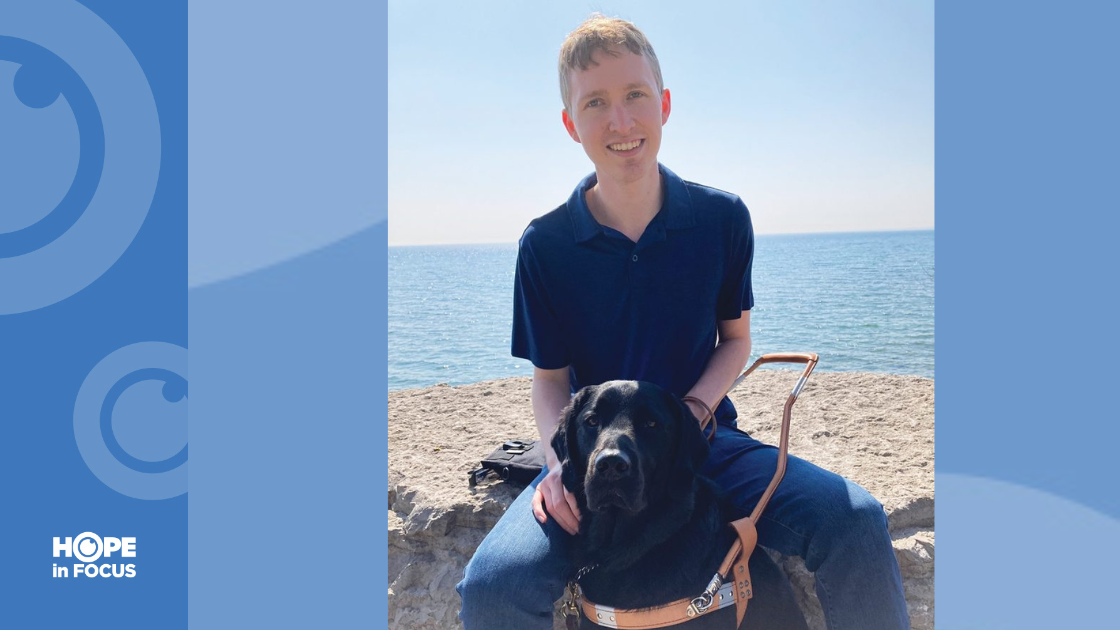
Jack McCormick in a blue shirt sitting next to his black lab, Jake
Jack McCormick and his guide dog Jake.

For a long time, Jack, like many blind or visually impaired people, worked hard at hiding his blindness; he didn’t want people to judge him because of it. But all of that changed in his senior year of high school when he got Jake, his beloved guide dog. Jake immediately made Jack feel like he was wearing a sticker that said, “Hey, I can’t see,” which meant no more hiding.

Acceptance leads to respect and opens pathways to social accessibility and, in turn, helps fuel research, Jack explained before an international audience in Toronto at the Foundation Fighting Blindness Vision Quest 2016 conference.

“I accepted it in myself and that is the most important thing you can do,” he said. “To accept it in yourself and be so confident about it that you walk around with your blindness as a badge of triumph rather than a badge of sorrow or something you’re trying to hide.

“And in doing that, people are going to be very committed to you, they’re going to respect you and respect is a very powerful thing.”

That respect continues in social situations, such as securing a job, and in fostering research, because people will know that blindness is an issue.

“It’s visible,” he said. “If the community sees it, they know it exists. If you’re hiding it, no one knows.”

Along with acceptance, Jack encourages people with blindness to tell their story. “The most powerful thing in your life is your story, so share it. Share it. Because when you do, other people will hear it and they will tell other people and then you’ll have the opportunity to share it with more people and it’s a spiral.”

You can hear more from Jack in his “College Connection” column that appears in our quarterly newsletter, “Seeing Hope,” and on his personal blog. Watch a video about Jack.

Simon Wheatcroft: The Power of Pushing Through

Simon Wheatcroft held his audience spellbound at the Global Genes conference in California where he detailed his journey from losing his sight as a teen-ager due to retinitis pigmentosa to competing in ultramarathons and overcoming many obstacles in between.

Simon recounted his amazing life experience at the Hotel Irvine in Huntington Beach, Calif., during the 6th Annual Global Genes RARE Patient Advocacy Summit on Sept. 14 and 15. More than 700 patients, caregivers, advocates and rare disease stakeholders gathered to share, learn and connect.

Simon, the conference’s opening keynote speaker, shared his journey of adapting technology, specifically on his smartphone, to achieve what seemed like impossible personal goals of learning to run solo outdoors. In his message of “Adaptability in the Face of Adversity,” Simon said he lost his sight at 17 due to retinitis pigmentosa, and seven months later, he ran his first ever race – a 100-mile road race.

Ultramarathons – races more than the traditional 26.2-mile marathon – present extreme physical and mental challenges for anyone, but with his loss of vision, Simon faces more complex obstacles. He trains with guide runners and uses memorization and technology.

To run solo, Simon forms a map of the area by using the smartphone app, RunKeeper. He memorizes the

Simon Wheatcroft running
Simon Wheatcroft held his audience spellbound at the Global Genes conference in California where he detailed his journey from losing his sight as a teen-ager to competing in ultramarathons and overcoming many obstacles in between.

course and applies course feedback from the app about his pace and distance. Now, with so much experience running solo, he has adapted to various courses and uses the app less often.

Simon, who is 35, said he believes his feelings of freedom and independence from running solo “far outweigh any anxiety over dangers. My successful footsteps must be something like 99.999%, and there’s just that one every now and again that goes wrong. I try to concentrate on the millions that go right rather than the 10 or 15 that go wrong.”

Simon taught all of us at this exceptional conference the power of pushing through and endurance, lessons that can help all of us in overcoming any adversity.

For more on Simon, click here.

Living With LCA: Enzo’s Story

Enzo was born in 2014 in Lausanne, Switzerland, with a clubfoot. He immediately received physical therapy, then a plaster cast for three months and one minor surgery.

His parents – Laura Steinbusch, a post-doctoral fellow researching the neuroscience of diabetes, and Merlijn Meens, a scientist investigating cardiovascular function – felt confident as they were reassured through medical literature and by doctors that in time their son’s left foot would be fine.

But there was more to come. At 3 months, as Enzo’s therapy for his foot progressed, something seemed wrong with his vision and his ability to focus. Doctors diagnosed him with nystagmus, a condition in which Enzo’s eyes involuntarily moved side to side.

An MRI showed normal brain development and then doctors did an electroretinogram (ERG), placing electrodes on his eyes to measure the electric response of their light-sensitive cells. Enzo also underwent Visual Evoked Potential (VEP) testing, a non-invasive exam that measures his entire vision system.
Doctors fitted Enzo with glasses at 6 months and said the ERG and VEP results needed further study.

Enzo began rubbing his eyes, prompting people to ask Laura whether her son was tired or shy. A few months later, doctors diagnosed 10-month-old Enzo with Leber congenital amaurosis.

‘He is still our cheerful son’

“While walking home from this last doctor’s appointment, we were in shock, but after a while we realized that Enzo had not changed. He was still our cheerful son that likes to sing and cuddle,” Laura wrote in her blog for the Eye Association of the Netherlands.

“We wondered how we could raise Enzo as normal as possible and how we could help him discover the world. The solution turned out to be simple: We will not despair and (will) come up with creative solutions so he can participate in everything that this world has to offer.”

Enzo with Dad on a trail outside

That Christmas, Enzo’s parents designed their holiday in a way that greatly fostered their son’s vocabulary, sensory and motor skills, exposing him to chickens on a farm, rocks and water at the beach and a mountain climb with a summit lunch of pancakes and omelets.

Also, for the first time he said, “Dad,” “Mom” and a version of his own name, “Echoo.”

Leber congenital amaurosis genetic diagnosis

Then, at 18 months, Enzo received the genetic diagnosis of LCA10-CEP290. LCA10 is a severe retinal dystrophy caused by mutations in the CEP290 gene.

Laura interviewed doctors about research on LCA10-CEP290, becoming an intense advocate and learning myriad facets of the genetics behind Enzo’s disease and the stakeholders at work to find a treatment.
With global health organizations headquartered in the Lake Geneva region, Laura attended conferences, including a recent policy event about “the right to health” organized by Rare Diseases International.
She learned that researchers in the International Rare Diseases Research Consortium are working toward their goal of all people living with rare disease to receive diagnosis, care and therapy within a year “of coming to subspecialty medical attention.”

“Big visions and great goals,” Laura wrote in her blog for wonderbaby.org. “It made me hopeful for a future with inclusive education for all our children, job possibilities for all our children, a quick diagnosis for new patients and maybe a treatment for improved vision.”

Singing, reading, taking the bus

At home, Laura and Merlijn initially did not have access to many Braille and tactile books for Enzo so they created their own. For instance, they brought to life a picture-book hedgehog by fashioning spines with nails and duct tape.

Mom holding Enzo, they are both wearing rain coats

Laura now is working on a multilingual children’s songbook with songs in English, French, Dutch and German. She got the idea because Enzo easily learned new words in French or English through songs, especially when he already knew the song in Dutch. Two Dutch foundations said they want to help pay for part of the project, but Laura is still searching for funding and she is reaching out to ask whether anyone knows of groups she can contact for help in the United States, United Kingdom, Canada or Australia.

Enzo just turned 3. He loves playing with other children at nursery school and he is learning to be more independent. Also, doctors successfully treated his foot, with Enzo’s mom adding, “It was probably harder on us than on him.”

In September, he and his parents moved from Switzerland to their homeland, the Netherlands.
“Enzo is doing very well,” Laura said. “He loves listening to music, singing, reading books, everything that has to do with movement. He adores taking the bus, the train, the metro, the cable car, a bike ride…

“One of his favorite sentences nowadays is ‘What is that?’ (something he heard) or ‘Who is that?’ (someone talking), meaning that he is really curious.”


Read more stories of families living with LCA on our blog.

Sign up for our newsletter to stay in touch with the LCA community.

Alan’s Story: Gaining Independence with Aira Technology

Trust me when I tell you to grab a tissue. Or roll down your sleeves and get ready to wipe. Me? My eyes are welling up even as I type. Recently, I witnessed a miracle.

I’ll give you a little background while you look for a Kleenex. Twenty years ago, at the age of 8 weeks, my nephew Alan was diagnosed with Leber congenital amaurosis (LCA), a rare disease that limits retinal development. Holding her infant son, my sister Betsy and her husband David listened in disbelief as the retinal specialist explained that Alan would be visually impaired at best, and fully blind at worst. The doctor informed them there was no cure, no treatment, and no adaptive device to correct their son’s condition.

Like his sighted peers, Alan attended public school. His mobility instructor taught him to navigate familiar

Alan Brint, who is blind, is trailed by his mother Betsy and his dog Mo, tries out his new Aira glasses.
Alan Brint tries out his new Aira glasses. Aira’s platform works on a wearable device similar to Google glass, that can be paired with a smart phone. The tiny camera mounted on the device [cool sunglasses] provides instant feedback to a trained Aira agent who can safely guide [a wearer] in any activity.

Alan Brint, who is blind, is trailed by his mother Betsy and his dog Mo, tries out his new Aira glasses. Aira’s platform works on a wearable device similar to Google glass, that can be paired with a smart phone. The tiny camera mounted on the device [cool sunglasses] provides instant feedback to a trained Aira agent who can safely guide [a wearer] in any activity. Alan was navigating his way to his local train station using an unfamiliar route as a test of the technology.parts of his world with his white cane. By sixth grade, he could walk to school by himself. Now a junior at Beloit College, he’s doing just fine. That’s not the miracle.

Not to dismiss Alan’s role in his accomplishments, but his successes have been in some part reliant on a team of people. Still, there are limits to his independence. Spoiler alert: here comes the miracle.

Last week, Betsy called me. “Get outside now. Alan is walking to the train station. By himself. He’s near the library. Run.”

I ran. Turning the corner, I saw my nephew, cane in hand, walking a route new to him. Betsy trailed silently, about 10 feet behind.

“Hey Aunt Sally. Is that you?” Cue the tears. Remember, Alan is blind. He has never seen me coming his way. For 20 years, we’ve all come up to him and touched him, or spoken to him, or hugged him, letting him know we were there. For the first time, he “saw” me coming.

Alan was wearing an adaptive technology, and it was changing his life in front of my tearing eyes.

The technology is called Aira (eye-rah). According to their website, “Aira’s platform works on a wearable device similar to Google glass, that can be paired with a smart phone. The tiny camera mounted on the device [cool sunglasses] provides instant feedback to a trained Aira agent who can safely guide [a wearer] in any activity.”

Alan’s Aira glasses had arrived the day before. The device is free, and the glasses are free. Like a cell phone contract, users pay a monthly service fee based on the minutes they use. When it’s on, an agent sees a split screen. On one side is a GPS view, to map out the exact location of the route guidance. On the other screen, the agent sees the lens view from the user’s camera. Simple, yet genius.

I fell in step with Betsy, following Alan’s lead for the first time. He made it easily to the train station, then home via a different route. Since then, he’s walked to a local bagel shop and “read” menus. I asked Alan, “What do you like best about this?”

“I like walking somewhere that I’ve never walked to before, by myself, without learning the route. I like reading menus. I like finding people. I found you!”

I turned to my sister. “Well? What are you thinking?”

“It’s totally selfish. I want to be his eyes,” she said.

“Don’t you think you’ve been his eyes?”

“Yeah, I guess. And now I’m turning it over to somebody else.”

There wasn’t a dry eye between us.

Hope in Focus (formally Sofia Sees Hope) is dedicated to ending the isolation that LCA families can feel after their diagnosis by sharing their stories. Read more here. Would you like to share your story? Email info@hopeinfocus.org

Living with LCA: Juliet’s Story

Scott and Heather Soady and big sister Gillian welcomed baby Juliet two years ago, and life progressed in an understandably hectic way for the San Diego parents who also are practicing lawyers. But life soon became more complicated as the couple’s new baby was diagnosed with Leber congenital amaurosis.

Juliet was born with strabismus, also known as crossed eyes, a condition that often disappears with time. At the age of 4 months, Juliet’s pediatrician noticed she had involuntary eye movement, a condition called nystagmus. The doctor said Juliet presented the worst case she’d ever seen in a child.

Juliet in a pink snow suit wearing a pooka dot hair and blue glasses
Juliet

Doctors placed Juliet under general anesthesia to scan her optic nerve and eliminate causes of her condition. It was a difficult time, Scott said, for Heather, especially, because she was breastfeeding and Juliet was only 4 months old.

When doctors told Scott, “It’s probably not brain cancer, ” he said, “I didn’t realize that was an option.”

Two months later, with Juliet again under anesthesia, a specialist measured her retina’s light perception by placing contact lenses with electrodes in her eyes. This procedure is called an Electroretinography (ERG) and is used to clinically diagnose LCA and other inherited retinal disorders such as Retinitis Pigmentosa (RP), cone-rod dystrophies, X-linked juvenile retinoschisis, achromatopsia and others. 

Twenty minutes later, the family received a confirmed clinical diagnosis of Leber congenital amaurosis.

“What you’re told is, there’s this condition you’ve never heard of, that’s extremely rare, that has no cure, that’s she’s going to be blind and there is nothing you can do about it,” Scott said.

“… You go through this grieving process of the life that you envisioned for your child. I would constantly think about these things, going to the beach, seeing a sunset, watching a movie, doing all of these things with her and sharing the world with her, and all of a sudden, that’s never going to happen with her.”

Gradually, his perspective changed: “You’re still going to do all these things, but you’re going to do it in a different way. … There is nothing in the world that tells you what that’s going to be like for her. … You have to adapt everything so that it will happen.”

At the age of 2, Juliet is legally blind. With glasses, her vision is 20/470. In other words, Scott said, the same object and details you can see at 470 feet away, she will only be able to see at 20 feet. Doctors say her vision may deteriorate over time.

Juliet on a swing

Looking for more information and answers, Scott attended the national VISIONS conference hosted by the Foundation Fighting Blindness last summer in Baltimore.

“That’s where I met Laura Manfre (Hope in Focus, or formally known as Sofia Sees Hope’s co-founder) and a bunch of other families that have kids with the same condition. That was truly amazing,” Scott said. “You feel so alone, the condition is so rare, there’s not going to be someone you just run into.”

He said he was touched that for the first time, people asked how he was doing.

Meeting parents who are dealing with LCA and seeing young people with LCA functioning as normal teen-agers gave Scott comfort and hope that everything’s going to be OK.

Through Laura, Scott and Heather connected with Spark Therapeutics’ “ID your IRD” initiative for Juliet’s genetic testing. Scott said he still held hope that maybe Juliet really did not have LCA, but the genetic findings confirmed otherwise.

The testing also revealed that Juliet has what is called a de novo mutation of the CRX gene, which caused it to be autosomal dominant rather than autosomal recessive. This means Juliet’s condition is a result of a gene mutation, rather than from inheriting it from her parents. It also means that Juliet could pass it on to her children.

“It’s not quite the normal LCA,” Scott said. Of those who have LCA, 1 percent to 5 percent have this gene mutation.

Genetic therapy also is more complicated. Rather than inserting a good gene and having the bad one go away or bypassed, the CRX dominant gene first needs to be turned off before a good gene can be inserted

The Soadys connected with a doctor who was conducting this research but had to stop for lack of funding.

“The light at the end of the tunnel got much dimmer,” Scott said of the end of the research. “It would be nice to see if there’s a potential cure.”

For now, the family is in the intense process of preparing Juliet for a new time in her life, from a home environment to a school environment, as she begins preschool. Gillian, who turns 5 in September, will be in kindergarten.

It’s April Fool’s Day, and we’ve got a great post to share with you!

“We can all make our lives much happier if we choose to laugh, live our lives more intentionally and find joy in the little things.”

Jack McCormick headshot
Jack McCormick

The quote above is from our friend, Jack McCormick’s blog. You may know seen the video, Jack’s Story, at Dinner in the Dark last year, or on Facebook or our website. Jack’s story is one of clinical misdiagnosis – something that happens all too frequently. It’s also about living with a visual impairment, the role his parents played in his life, and getting to a correct diagnosis. (Spoiler alert! Jack has LCA.) If you haven’t seen it yet, take a few minutes to watch!

If you’re raising a blind child, then we also recommend this post from Jack, Let’s Laugh: At Me! There are so many emotions and worries that keep parents up at night, and Jack’s post is a reminder that our kids are not just rare and beautiful, but sometimes just plain goofy, and a little humor and laughter can go a long way!