
On Rare Disease Day, Shining A Light

Lisa Kurec never heard of the National Organization for Rare Disorders (NORD) until Wednesday, but after many years of finding no answers for her son’s rare disease, she decided to attend NORD’s Rare Disease Day event in Hartford at the Legislative Office Building.  She joined patients, families, caregivers, medical professionals, industry representatives and legislators, all gathered on Rare Disease Day to help shine a light on these conditions.

Over the years Kurec, of Middletown, took her son to 25 doctors, all unable to determine why he suffered from painful ulcers throughout his body. Some symptoms were even attributed to age-appropriate conditions, such as acne.

She finally took him to a dentist, who sent him to the emergency room, where he was referred to an infectious disease doctor. By 2014, her now 26-year-old son was diagnosed with Behcet’s disease (pronounced beh-CHETS), a rare disorder that causes blood vessel inflammation throughout the body. Signs and symptoms seem unrelated at first, and include mouth sores, eye inflammation, skin rashes and lesions, and genital sores.

At Wednesday’s event, hosted by NORD, the official sponsor of Rare Disease Day in the United States, and NORD’s Connecticut Rare Action Network, Kurec immediately learned about NORD’s Patient Assistance programs and much more to help her find support for her son.

NORD President Peter Saltonstall told the gathering of about 120 people that there are about 7,000 rare diseases, with fewer than 500 having FDA-approved therapies; that leaves 95 percent of patients with no available treatment.

“There’s still a lot of work to be done,” he said, adding, “NORD is the voice for the rare disease patient.” Thirty million Americans have rare diseases, including 300,000 in Connecticut.

He noted that NORD receives more than a million hits monthly on its website from people looking for help and said Rare Disease Day is the one day people come together globally to close the gap between the number of rare diseases and the number of available treatments.

NORD has more than 260 member organizations, including Hope in Focus (formally Sofia Sees Hope), which unite to promote patient and caregiver advocacy, and research for treatment and cures for those with rare diseases.

Speakers at Wednesday’s event promoted Connecticut as a good place for investment in research and development in creating new treatments, and for job opportunities and economic growth. They reached out to legislators, asking them to keep in mind tax incentives and other ways of encouraging the business of research in the state.

Legislators attending included Republican State Sen. Len Fasano, who said, “In this building, people care. Republicans and Democrats care. This is not a Republican or Democrat issue.”

He introduced Hunter Pageau, an articulate 7th grader who is one of 80 people in the world with Spinal Muscular Atrophy with Respiratory Distress or SMARD.

Hunter said he founded a new group called Youth Empowerment Society or YES, and he told the gathering, “While a disease may be rare, hope never should be.”

Democratic State Rep. Joe Aresimowicz, Speaker of the House, said rare disease advocacy and research needs “money and legislation to fully understand what is going on.”

“We genuinely care,” he said. “We want to be helpful.”

The Speaker introduced Greta Stifel, who has a rare cancer called neuroendocrine tumor carcinoid cancer (NET).

She told the group, “We have a set of struggles that other patients don’t have.”

She directed people to #RareLivesMatter and said, “We do matter. We need more funding, more visibility.”

Dr. Mridu Gulati, a pulmonary disorder specialist at Yale School of Medicine and chair of the Connecticut General Assembly’s Task Force to Study Rare Diseases , thanked the many, many legislators, medical experts and rare disease advocates that she and task force members have met with since February 2016.

She said the group plans to hold more meetings examining rare disease research, diagnoses, treatment and education, and the task force will make recommendations for creating a permanent group of experts to advise Connecticut’s Department of Public Health on rare diseases.


‘We know how important it is to know your gene. We’ve lived it.’

It took more than seven years to get a genetic diagnosis for our daughter. During that time, doctors were pretty sure she had LCA, although we also heard that maybe she had cone-rod dystrophy or perhaps Stargardt’s Syndrome. We argued with insurance over genetic testing, paid out-of-pocket, took time off work and school for trips out of state and sent blood work all over. Still, no one could give us a genetic diagnosis. Some labs never even bothered to return phone calls to tell us if they had any results.  

And then things changed. More genes had been identified and there were new and better ways of genetically diagnosing IRDs. Finally, in 2013, I we received a confirmed diagnosis for Sofia.

Flash forward another five years to today and there are even more changes. While many aspects of obtaining a genetic diagnosis are still challenging, thanks to continued research, increased awareness, and accessible testing programs, it’s no longer a seven-year ordeal. Patients can get tested today without incurring travel expense and are much more likely to receive a confirmed genetic diagnosis.  

Thanks to donations to our organization, we have been able to support accessible genetic testing for families. Thanks to our donors and supporters, we are also able to provide outreach and education to families, driving awareness and access for genetic testing and encouraging participation in natural history studies and patient registries.  

Our awareness campaign this year is Know Your Gene: Get Tested, Get Connected.  Knowledge is power and we are helping more families get tested so they can receive their genetic diagnosis and then connect in ways that will accelerate research for treatments and cures for IRDs. We want to stress the importance of connecting to a patient registry or a genetic counselor. We want to help families and individuals find each other for support and sharing of information. And we are driving those programs and communications that will continue to advance cures for blindness.

We know how important it is to know your gene. We’ve lived it.

CT Rare Disease Day: Patients Must Be Advocates

On Rare Disease Day – Wednesday, February 28 – doctors, researchers, advocates, patients, caregivers, industry representatives and legislators will come together in Connecticut and around the globe to focus on the critical role patients play in understanding rare diseases and in developing innovative treatments and cures.

Research is the 2018 theme for Rare Disease Day, and this year’s slogan is “Patients are not only subjects but proactive actors in research.” Nearly 7,000 diseases are considered rare in the United States and about 300,000 people in Connecticut have a rare disease.

Hosted by the National Organization for Rare Disorders (NORD) and the NORD’s Connecticut Rare Action Network, Rare Disease Day will be celebrated on the last day of February from 8:30 to 10:30 a.m. in the 2nd Floor Atrium of the Legislative Office Building, 300 Capitol Ave., Hartford.

The event, held nationally and in more than 85 countries, serves as an opportunity to hear from the many voices of those dealing with rare diseases and the daily challenges patients and their families face in Connecticut.

NORD President Pete Saltonstall and a bi-partisan team of Connecticut General Assembly (CGA) members will open the event. The governor is expected to honor the day with an official proclamation.

Dr. Mridu Gulati, a pulmonary disorder specialist at Yale School of Medicine and chair of the CGA’s Task Force to Study Rare Diseases, will report on the group’s findings. The task force, created in 2015 under Public Act 15-242, comprises legislators, medical experts and rare disease advocates. It is charged with examining rare disease research, diagnoses, treatment and education. The group also makes recommendations for creating a permanent group of experts to advise Connecticut’s Department of Public Health on rare diseases.
Also, within the legislative session, Jean Kelley, whose son has X-linked Adrenoleukodystrophy, will give an update on ALD and newborn screening.

Speaking on behalf of research will be: Dr. Emily Germain-Lee of Connecticut Children’s Medical Center and University of Connecticut, Albright Syndrome; Stormy Chamberlain, Ph.D., of University of Connecticut, Angelman’s Syndrome and Prader Willi; and Dr. Thomas Carpenter of Yale, X-linked Hypophosphatemia.

Event organizer Lesley Bennett said discussion is open to other rare diseases, such as Leber congenital amaurosis and other rare inherited retinal diseases. Advocates could add their concerns in the patient-issues portion of the event, which includes legislators and rare disease patients.

A five-member business panel will help inform the CGA about patient organizations in our state, patient participation in clinical trials and helping to fund research to develop therapies for rare disorders.

Bennett is part of NORD’s Rare Action Network and she is Connecticut’s Volunteer State Ambassador. For more information, please email her at Lesley.bennett@rareaction.org

#KnowYourGene: AGTC Working On Multiple IRD Treatments

Applied Genetic Technologies Corporation (AGTC), a clinical stage biotech company that focuses on rare inherited retinal diseases (IRDs), develops therapies that replace “broken” genes with normal functional genes – treatments that allow a patient’s own body to produce proteins to treat their disease.

As a headline touts from an AGTC website story: “Imagine That the Power to Beat Genetic Disease Lies Within Us.”

The work that companies such as AGTC undertake serves to underscore the importance of genetic testing in the treatment of rare inherited retinal diseases. This month, Sofia Sees Hope has launched a #KnowYourGene campaign in advance of International Rare Disease Day on Feb. 28.

A clinical diagnosis of a named disease is not enough to help find cures and treatments for these and other rare IRDs.

For meaningful and productive research to advance, patients need to take the most important step to help further research into correcting the mutated genes affecting their vision:

  • Get a definitive genetic diagnosis of their eye condition with genetic testing. Talk to your doctor about ordering a test through one of several laboratories or contact Foundation Fighting Blindness (FFB) about free testing.

Genetic testing is key

AGTC (headquartered in Alachua, Fla., with offices in Cambridge, Mass.) strives to get the word out through their patient advocacy work headed by Jill Dolgin, Pharm.D. The company partners with Hope in Focus (formally Sofia Sees Hope (SSH)), which helps fund FFB’s free genetic testing and genetic counseling program.

A priority for AGTC is to find and educate people with rare inherited retinal diseases and encourage them to get genetic testing. Patients with the same gene mutations studied by AGTC could potentially participate in one of their clinical trials.

The company also is collaborating with advocacy groups to inform individuals with the conditions for which AGTC is conducting clinical research, including:

  • Achroma Corp. , an organization providing support and education to those affected individuals and families with Achromatopsia
  • MomsForSight, which provides information to affected individuals and families with X-Linked Retinoschisis
  • Foundation Fighting Blindness of US and Canada
Applied Genetic Technologies Corporation (AGTC), a clinical stage biotech company that focuses on rare inherited retinal diseases (IRDs), develops therapies that replace “broken” genes with normal functional genes – treatments that allow a patient’s own body to produce proteins to treat their disease.

AGTC also reaches people with rare inherited retinal diseases through online and print articles, social media, medical publications, national vision conferences and their website.

The conditions for which treatments are under Phase 1 and Phase 2 clinical investigation include:

X-linked retinoschisis (XLRS) is the leading cause of macular degeneration in males. An inherited form of retinal degeneration affecting young males, patients affected by XLRS present with poor vision by school age. Visual acuity usually worsens during the teenage years and then can lead to serious complications such as vitreous hemorrhage or retinal detachment during adulthood.

Mutations in the RS1 gene cause early onset retinal disease. In animal models of XLRS, treatment with an AGTC gene-therapy candidate leads to long-term improvement in retinal function and preventing retinal cell degeneration. Based on preclinical proof-of-concept data, AGTC is conducting a clinical study to evaluate the safety and efficacy of an investigational gene therapy in patients with XLRS.

Achromatopsia causes visual acuity loss, extreme light sensitivity resulting in daytime blindness and reduced or complete loss of color distinction. About 75 percent of cases are associated with mutations in the CNGB3 and CNGA3 genes, also known as ACHM B3 and ACHM A3 genes, respectively. The company is currently evaluating a gene therapy in a Phase 1/ 2 trial for individuals diagnosed with Achromatopsia caused by mutations in either the CNGB3 gene or CNGA3 gene.

To better understand the condition, researchers from the University of Pennsylvania School of Veterinary Medicine and the Michigan State University College of Veterinary Medicine filmed a dog with ACHM B3 unsuccessfully trying to navigate a maze. Four months later, after receiving gene therapy treatment developed by AGTC, the pooch easily finds its way through the maze.

Check out the video showing how sheep affected by achromatopsia due to ACHM A3 mutations also were able to successfully navigate a maze following gene therapy administration.

X-Linked Retinitis Pigmentosa (XLRP) is an inherited condition that causes progressive vision loss in boys and young men. Symptoms begin with night blindness in young boys followed by progressive constriction of the field of vision. Affected men become legally blind at about 45 years of age, on average. AGTC is currently recruiting for a Natural History Study, intended to gather information about the condition over time for a better understanding of the disease’s progression and its effect on the individual’s quality of life, and for a Phase 1/ 2 clinical trial.

AGTC is committed to advancing clinical programs to deliver novel gene-based therapies for rare conditions without any available treatment options. The company would like to express its deep appreciation to patients who have participated in their clinical trials and is grateful to its partners for their dedication and continued support.

First, Diagnosis. Then, Genetic Testing. It’s Important.

My Retina Tracker® is a free and secure online registry launched by the Foundation Fighting Blindness that helps connect families dealing with rare inherited retinal diseases to feel less alone, and to find help.

Parents feel shock and isolation when they are told their babies have no vision or limited vision caused by a rare inherited retinal disease. They do adapt and pursue resources, but that feeling of isolation often persists because of the disease’s rarity. It’s unlikely you will bump into someone in the grocery store whose child also has retinitis pigmentosa.

My Retina Tracker® is a free and secure online registry launched by the Foundation Fighting Blindness (FFB) that helps alleviate those feelings of isolation. An individual goes from being one with an inherited retinal disease to becoming part of a growing community of people (currently 6,500) sharing similar concerns and hopes.

The goal of My Retina Tracker® is to drive the research toward prevention, treatments and cures for people living with retinitis pigmentosa (RP), Stargardt disease, Usher syndrome and the whole spectrum of inherited retinal degenerative diseases, including Leber congenital amaurosis (LCA).

The global registry includes rare inherited retinal disease patient disease information from Europe, North, South and Central America, Asia and the Pacific.

Dr. Brian Mansfield, FFB’s deputy research officer who managed the registry’s launch three years ago, said people registering take an active role in advancing research to find treatments and cures for specific rare inherited retinal diseases, affording the opportunity to join others and “stand up and be counted.”

“Whether you’re in the middle of New York City or in a small town in West Virginia,” Dr. Mansfield said, “you’re equal to everyone else in that registry. It removes isolation. You’re literally standing up.”

My Retina Tracker® notifies registrants of clinical trials and gives researchers access to their disease data – but not their personal information – to advance research and therapy development associated with IRDs.

To optimize the power of My Retina Tracker®, registrants should seek a genetic diagnosis. The registry facilitates that by making registrants eligible for free genetic testing. In today’s world, it is helpful to be genetically diagnosed if you want to participate in research.

Details of My Retina Tracker® can come none too soon for some. Dr. Mansfield said after LUXTURNA® recently came to market as the first genetic therapy for LCA patients with an RPE65 gene mutation, he came across information about a person who set up a crowd-funding site asking for $5,000 to travel to Texas because he needed a genetic test.

“You don’t have to raise $5,000 to get a genetic test,” Dr. Mansfield said. “You don’t have to travel to Texas to get a genetic test.”

Helping families get tested

Hope in Focus (formally Sofia Sees Hope) well understands the importance of genetic testing for those with rare inherited retinal disease. Part of its mission is to educate individuals and families about the importance of becoming part of patient registries and getting genetically tested. SSH also makes genetic testing accessible to those who cannot afford it.

“Last year, we supported FFB’s (genetic testing) program as a small test grant,” said SSH founder Laura Manfre. “This year, with the success of the test and thanks to the tremendous support of our donors, we are happy that we were able to more than quadruple our contribution, enabling many more individuals to receive free testing and genetic counseling.”

Dr. Mansfield thanked Sofia Sees Hope for for its $65,000 donation to FFB, earmarked for genetic testing.

“The help was truly appreciated,” he said. “I’m very proud of the relationship we have with Sofia Sees Hope.”

How My Retina Tracker® works

Go to myretinatracker.org, click on Register Now and follow the prompts to establish a username and password and to answer questions to build your personalized retinal health profile. You are then guided through a series of questionnaires developed by retinal clinicians, geneticists, genetic counselors and rare inherited retinal disease researchers.

If you have any questions, call the My Retina Tracker® coordinator at 800-683-5555 or email to Coordinator@MyRetinaTracker.org.

Once you’ve registered, send a request to Coordinator@MyRetinaTracker.org asking to be genetically tested and you’ll receive information and guidance on how to order the test.

The registry becomes your personal retinal health record, updated by you and your doctors. Your history and testing results create a critical resource in tracking the progress of your disease and becoming part of a comprehensive database.

The registry employs state-of-the-art database technology to protect privacy and adheres to the highest standards of confidentiality and ethics, following policy and protocol set by the National Institutes of Health’s Institutional Review Board.

Your disease information is accessible only to you,  FFB registry staff, and researchers who meet a rigorous scientific review application process to use the data for studies and to reach individuals to participate in clinical trials, natural history studies or focus groups. Your personal information is never shared with researchers.

Large commercial biotech companies use this pool of data to find people for clinical trials, a common research challenge. Rather than calling clinicians one by one, the data is accessible in one place and often updated.

Clinical trials are out there

The data helps inform researchers about the therapies patients want, the risks they are willing to take for different levels of vision improvement and when and how their vision loss progresses.

Personal updates, such as when someone had to stop driving because of increased vision loss, help track the progress of the patient’s disease.

“Then you have a clinical longitudinal timeline as to how vision is changing for the patient,” Dr. Mansfield said.

Before My Retina Tracker®, the foundation used a paper list of about 12,000 names accumulated over FFB’s 40 years. The names transferred to the new registry to total about 17,500, but many are outdated.

There are about 6,500 people actively engaging in the online portal profile, with about 150 new registrations a month.

Dr. Mansfield wants to reach a minimum goal of 20,000 registrants in the next four years, although 50,000 would be preferable, as it would make for an extremely effective base of data for phase 2 and phase 3 studies that create demand for more trial enrollees.

He also made the distinction that private labs hold onto their data tightly, whereas FFB’s goal is the opposite.

“We want to share it, we want to move the whole field forward,” Dr. Mansfield said. “After all, our goal is to ensure the treatment and cures of all retinal diseases.”

Tell Us Your Story: Allison Galloway

Somehow I made it through 37 years of life without ever meeting a blind person.

Then my 3-year-old son was diagnosed with a rare genetic disease called Leber congenital amaurosis (LCA) that will cause him to go blind in his teens or twenties. My world was set into a whirlwind of grief, confusion and anger.

How was it possible that two completely healthy parents who did everything the doctors told us to do before and during pregnancy, could have a child with such a traumatizing diagnosis?

As the weeks went on my grief turned to anger, my anger to guilt, my guilt to a desire to solve the problem to which there was no solution.

This disease caused my son’s body to lack the ability to create a simple enzyme called retinal dehydrogenase, which assists in the cleaning and health of the rods and cones in his eyes. It is an autosomal recessive gene defect that appears when each parent has a mutation on the same gene in the same place. There is a 25 percent chance that each child they create will have this disease. The odds were against us, I suppose.

A year and a half later, we learned the odds were even worse than we thought. Our son was 5 and our daughter was 3. One day at dinner I noticed my daughter’s eye started to bounce from side to side. I immediately knew what it meant. A nystagmus means that the eye is weak and sick. I didn’t need the gene results to know that not only did my son have LCA, but my beautiful little girl did too. A 6 percent chance …

LCA diagnosis is truly life changing

There are social repercussions to a diagnosis like this. I lost friends because they couldn’t cope with the thought of a child losing his sight. My son has had kids tell him he can’t do certain things because he is the “blind kid” (and he is only in kindergarten). People told me that what I was feeling about my kids’ diagnosis —that sense of loss or death of the life that you thought your child would have —was the wrong way to feel.

What fueled my determination to speak out for all those parents dealing with a similar heart-sinking diagnosis occurred at our eye doctor’s of all places. I walked into the office determined to figure out what was wrong with my son’s eyes. After an hour and a half, the doctor handed me my child’s diagnosis on a piece of paper. She told me to schedule a procedure under anesthesia for my son at Children’s Hospital with no explanation of why or what we were looking for and then told me to follow up in a year “if I wanted to.”

I Googled what was written on that paper. The first word I saw was “blind” and the second phrase that stood out was “no cure.” That was all I had. I am a nurse practitioner but I had very little knowledge of the eye. I knew then and there that I quickly had to learn all I could. The problem is that so many families get the same kind of “rare disease news” and have no idea what to do. They trust their doctors to be the knowledgeable ones. If a doctor says there is no cure, well then there is no cure, right? Nothing left to do but learn how to accept it, scared and alone.

I want to stand up for all those parents out there who don’t know where to go once they hear something hard about their child. I have met many families who have had similar diagnoses as my children and the doctors tell them that there is no cure yet, so there is no need to do anything but deal. This infuriates me.  The lack of assistance given to parents is astounding.  If I had not had the financial means, the education, and the network, I would have taken the advice of my first doctor and just followed up ” if I wanted to.”

As time has gone on I have met so many amazing parents, families, teachers, and researchers who are determined to cure many of these rare diseases. Social media has opened so many doors. I was lucky to find a group of 18 families whose children all have the same gene defect as mine, RDH12. Together we created a network of motivated parents who have formed a 501(c)(3) named RDH12.org to raise money. We work with scientists around the world to fund research. We support each other even if we live in the U.S., Italy, Australia or Saudi Arabia. We try to advocate the importance of all children diagnosed with a rare disease to get genetic testing. Without it we would have never known what our children had, let alone how to cure it.

Use the resources

There are amazing things out there like the website, Myretinatracker.org, which was created to generate a database of everyone with inherited retinal disease so scientists can easily access a population to use for clinical trials. Everyone should be on it if they have a genetic disorder.

Genetic testing is free in many instances and all it requires is a simple blood test. Spark Therapeutics has just started an ID YOUR IRD gene testing initiative for free to patients that aims to help inform as many people as possible of their specific gene test. Knowing the gene is a critical step towards getting treatment if it is available or toward helping advance the research that will lead to cures. It is for this reason that I am writing to you. There is so much that we can do if we have the knowledge to do so and we spread the word.

This rare disease is what comes between my children and the world. It limits them. Rare has flipped our world upside down and forever changed me. It keeps me searching for answers and fighting for all those families out there. We know our love is what keeps us going on the days that feel impossible. Love is what will keep us moving on the days when the news at appointments is less than positive. We never give up on our children, and we will never stop fighting for their well-being.  All we want is for our children to not have to fight so hard to simply be.

Allison Galloway lives in Westminster, Colorado, with her husband Michael and their two children, 6-year-old Logan and 4-year-old Zoe. 

Successful Strategies for Patient Organizations

Your voice counts! Lawmakers on the state level need to hear from people living with Leber congenital amaurosis (LCA) and other rare diseases to help secure funding for research, patients’ needs, costs associated with living with a rare disease and accessibility on all fronts.

Your voices and those of organizations representing the rare disease community need to be heard by your state senators and representatives now to prevent elimination or reduction in funding, especially in these times of tight budgets.

This advice came during a conference workshop – Successful Strategies for Patient Organizations – at the recent 2017 Rare Disease & Orphan Products Breakthrough Summit presented by the National Organization for Rare Disorders (NORD).

Rare diseases number more than 7,000. You can make a difference because of the power in numbers. Start making contacts now as we approach Rare Disease Day on Feb. 28, 2018. Plan to combine efforts with other rare disease organizations in your state and rally for cures, regardless of the disease/gene that you represent.

Rare disease community members represent 10 percent of legislators’ constituents. Know that number before you meet. For instance, if 20,000 people live in your district, 2,000 live with rare diseases.

The legislators in any state’s capital, work for you. Don’t be intimidated; realize the impact you can have by reaching out and/or meeting with your representative or senator. Research them in advance online, find out on which committees they serve, when and where they are in session, and contact their offices regularly.

For instance, in Connecticut, the Human Services Committee  has jurisdiction over all matters relating to the Department of Social Services and would include services for the rare disease community.

Meeting with legislators or their staff does not have to happen at their offices. Build a relationship by inviting them to key events and meeting them at theirs. Always say hello so you stand out from the crowd. Keep calling and keep emailing.

Tell them your personal rare disease stories. Talking from the heart has impact. Even if they oppose your proposals for legislation, they’ve heard your story and you’ve offered them a worthwhile perspective that in the end may help change their minds.

Brings notes to keep on-point. Avoid making your pitch sound too complex and don’t share irrelevant information. Leave behind business cards and notepads or pens imprinted with your organization’s logo. Follow up the meeting with a thank-you card and a phone call.

Also, your best friends in the world of lawmakers are their staff members. Staffers keep track of legislators’ calendars and decide when meetings take place. If you do secure a meeting with staff and not the legislator, don’t be insulted as this often is the first step in meeting with a lawmaker in person. Staffers will relay your key points.

Remember, legislators want to do a good job representing the people in their district. They do that by receiving pertinent information from you and your organizations so they can make a difference by developing, sponsoring and enacting legislation beneficial to our rare disease community.

2017 Rare Disease & Orphan Products Breakthrough Summit

A two-day conference in Washington, D.C., earlier this month offered the opportunity for organizations such as Hope in Focus (formally Sofia Sees Hope) to discover the latest in the rare disease community, meet the nation’s top rare-disease professionals, and gather resources and ideas to help with the Leber congenital amaurosis (LCA) community.

More than 670 people attended the first day of the 2017 Rare Disease & Orphan Products Breakthrough Summit on Monday, Oct. 16.

The summit, presented by the National Organization for Rare Diseases (NORD) , included a range of topics, from the challenges of healthcare costs, to the ethical guidelines for patient organizations and themes of collaboration, urgency and transparency.

The summit’s second day featured presentations by the Food & Drug Administration’s leading Division Directors and discussions of improving the lives of patients with rare diseases.

Peter L. Saltonstall headshot
Peter L. Saltonstall, President and CEO of NORD

The conference kicked off with a welcome by Peter L. Saltonstall, President and CEO of NORD, and Marshall L. Summar, M.D., Director of Children’s National Rare Disease Institute, Chief of Genetics and Metabolism at Children’s National Medical Center , and Chairman of NORD’s Board of Directors.

Key presentations included ensuring patient access, sustaining orphan drug development and availability, and reviewing achievements in rare disease drug, biologic and device development.

Mike Porath, founder and CEO of The Mighty and a parent of a child with a rare disease, gave a motivating, multi-faceted presentation in his keynote community address. His advice to families living with a rare disease included asking for help, embracing the moments and dreaming big to open doors for people with rare diseases.

Scott Gottlieb, M.D., Commissioner of the FDA, delivered the administration’s keynote address, talking about the group’s rare disease priorities, the rapid changes in rare disease product development and the basis of the Orphan Drug Act

Presenting at FDA Hearing Thursday on RPE65 Genetic Therapy Drug

Hope in Focus (formally Sofia Sees Hope) Co-Founder Laura Manfre will help provide the LCA community’s perspective to a Food & Drug Administration panel Thursday about a proposed genetic therapy for Leber congenital amaurosis (LCA) caused by an RPE65 gene mutation.

“This is such an important event because it allows the patient population — the parents, and children and families — directly impacted by this very important decision-making process to be heard,” Manfre said. “The FDA has a critical job to do in weighing all of the potential risks and benefits with any drug approval, and they recognize that the voice and the experiences of those who are affected needs to be a part of that process.

“Part of Sofia Sees Hope’s mission is to help serve as a connection among families living with LCA,” Manfre continued. “We see this opportunity to offer testimony as another way to fulfill that mission.”  

As a presenter at the FDA’s public advisory meeting of the Cellular, Tissue and Gene Therapies Advisory Committee (CTGTAC), Manfre will be representing patients and families living with LCA and other rare inherited retinal diseases. The meeting begins at 8:30 Thursday  morning and runs to 5 p.m. at the FDA White Oak Campus in Silver Spring, MD.

The CTGTAC is meeting to make recommendations on the safety and effectiveness of biologics license application for voretigene neparvovec, submitted by Spark Therapeutics, Inc. The proposed gene therapy is to treat patients with vision loss due to confirmed biallelic RPE65 mutation-associated dystrophy.

RPE65 mutation-associated retinal dystrophy is an orphan disease, with an estimated 1,000-3,000 patients affected in the United States, according to A Shared Vision.

Manfre said research and bringing therapies to market provides hope to all LCA and IRD families.

“Though families may struggle with the day-to-day challenges, they can have hope that there just might be a light at the end of the tunnel,” she said.

“To help foster this effort,” she said, “Patients and families need to seek diagnoses,  participate in patient registries, and continue to generate awareness and make our voices heard.  Our disease is rare, which makes it more important than ever that we are working together to be advocate for our community and  to move treatment and cures for blindness forward.”

For the meeting, Spark submitted to the FDA a 149-page briefing detailing the history, background, studies and research that went into developing voretigene neparvovec, which has the proposed trade name LUXTURNA.

The FDA’s 42-page briefing details its analysis of the proposed treatment and offers discussion questions for the advisory committee that include at what age should patients receive treatment and what are the treatment’s potential risks and benefits.

Here are some links for more information about the meeting:

Webcast of the meeting: https://collaboration.fda.gov/ctgtac101217.

Alan’s Story: Gaining Independence with Aira Technology

Trust me when I tell you to grab a tissue. Or roll down your sleeves and get ready to wipe. Me? My eyes are welling up even as I type. Recently, I witnessed a miracle.

I’ll give you a little background while you look for a Kleenex. Twenty years ago, at the age of 8 weeks, my nephew Alan was diagnosed with Leber congenital amaurosis (LCA), a rare disease that limits retinal development. Holding her infant son, my sister Betsy and her husband David listened in disbelief as the retinal specialist explained that Alan would be visually impaired at best, and fully blind at worst. The doctor informed them there was no cure, no treatment, and no adaptive device to correct their son’s condition.

Like his sighted peers, Alan attended public school. His mobility instructor taught him to navigate familiar

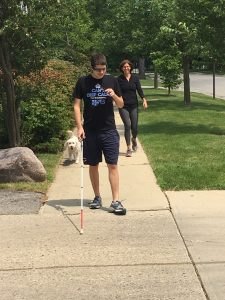
Alan Brint, who is blind, is trailed by his mother Betsy and his dog Mo, tries out his new Aira glasses.
Alan Brint tries out his new Aira glasses. Aira’s platform works on a wearable device similar to Google glass, that can be paired with a smart phone. The tiny camera mounted on the device [cool sunglasses] provides instant feedback to a trained Aira agent who can safely guide [a wearer] in any activity.

Alan Brint, who is blind, is trailed by his mother Betsy and his dog Mo, tries out his new Aira glasses. Aira’s platform works on a wearable device similar to Google glass, that can be paired with a smart phone. The tiny camera mounted on the device [cool sunglasses] provides instant feedback to a trained Aira agent who can safely guide [a wearer] in any activity. Alan was navigating his way to his local train station using an unfamiliar route as a test of the technology.parts of his world with his white cane. By sixth grade, he could walk to school by himself. Now a junior at Beloit College, he’s doing just fine. That’s not the miracle.

Not to dismiss Alan’s role in his accomplishments, but his successes have been in some part reliant on a team of people. Still, there are limits to his independence. Spoiler alert: here comes the miracle.

Last week, Betsy called me. “Get outside now. Alan is walking to the train station. By himself. He’s near the library. Run.”

I ran. Turning the corner, I saw my nephew, cane in hand, walking a route new to him. Betsy trailed silently, about 10 feet behind.

“Hey Aunt Sally. Is that you?” Cue the tears. Remember, Alan is blind. He has never seen me coming his way. For 20 years, we’ve all come up to him and touched him, or spoken to him, or hugged him, letting him know we were there. For the first time, he “saw” me coming.

Alan was wearing an adaptive technology, and it was changing his life in front of my tearing eyes.

The technology is called Aira (eye-rah). According to their website, “Aira’s platform works on a wearable device similar to Google glass, that can be paired with a smart phone. The tiny camera mounted on the device [cool sunglasses] provides instant feedback to a trained Aira agent who can safely guide [a wearer] in any activity.”

Alan’s Aira glasses had arrived the day before. The device is free, and the glasses are free. Like a cell phone contract, users pay a monthly service fee based on the minutes they use. When it’s on, an agent sees a split screen. On one side is a GPS view, to map out the exact location of the route guidance. On the other screen, the agent sees the lens view from the user’s camera. Simple, yet genius.

I fell in step with Betsy, following Alan’s lead for the first time. He made it easily to the train station, then home via a different route. Since then, he’s walked to a local bagel shop and “read” menus. I asked Alan, “What do you like best about this?”

“I like walking somewhere that I’ve never walked to before, by myself, without learning the route. I like reading menus. I like finding people. I found you!”

I turned to my sister. “Well? What are you thinking?”

“It’s totally selfish. I want to be his eyes,” she said.

“Don’t you think you’ve been his eyes?”

“Yeah, I guess. And now I’m turning it over to somebody else.”

There wasn’t a dry eye between us.

Hope in Focus (formally Sofia Sees Hope) is dedicated to ending the isolation that LCA families can feel after their diagnosis by sharing their stories. Read more here. Would you like to share your story? Email info@hopeinfocus.org