
Living With LCA: Annie’s Story

Annie Cohane takes singing lessons and piano lessons, she runs track, she’s working on swimming, and she’s a second-grader at an elementary school in Norwell, Mass.

She’s 8 years old and an emerging Braille reader.

“She’s a happy, very happy-go-lucky, strong-willed, little girl,” Annie’s mom, Jenny, said.

The goal for Jenny and her husband, Kevin, is for Annie to become as independent as possible.

She rides the bus to school, she goes on play dates.
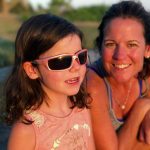
Annie Cohane in sunglasses with her mom Jenny.
Annie was diagnosed with Leber congenital amaurosis (LCA) at 3 months of age. Genetic testing later showed a mutation in her CEP290 gene.

“She just figured out she was blind in the last few years,” Jenny recently said. “So far, it turns out it doesn’t affect her at all.”

In 2009 when Annie was 2 months old, she involuntarily moved her eyes side to side, prompting a diagnosis of nystagmus, a condition affecting about 24 out of 10,000 children.

A month later Annie underwent an electroretinogram (ERG), showing a diagnosis of Leber congenital amaurosis (LCA)  and that Annie was blind.

“I was shocked,” Kevin said. “I probably didn’t take a breath for 50, 90 seconds, trying to figure out what that meant. You never imagined your child would be anything but happy and healthy.”

Genetic testing later showed a mutation in her CEP290 gene.

The Cohanes had hope, however, because doctors assured them that cures and treatments were in the pipeline to help people like Annie with LCA.
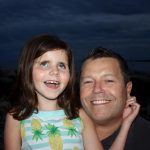
Annie Cohane laughs with her dad Kevin.

Barely wrapping their heads around the life-changing news, they needed to tell their families. Jenny already had moved onto the planning side of caring for Annie, while Kevin made calls to family and friends.

“We were only concerned about Annie,” Kevin said. “They were concerned about Annie and us.”

While still processing the news, Jenny and Kevin – who met while training for triathlons, literally and figuratively crossing each other’s paths – got busy.

Early intervention specialists came to the house weekly, and then Annie enrolled in an infant/toddler program at the Perkins School for the Blind until she was 3. They worked to ensure their little girl’s access to any available resources to help her become confident and independent – just like any other child.
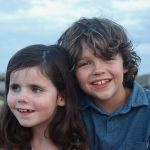
Annie Cohane and her big brother Petey at the beach

Clearly these specialists – social workers, occupational therapists, vision specialists, physical therapist, speech therapists – helped Jenny and Kevin navigate this unfamiliar world with Annie and her older brother, Petey.

Then, these endurance athletes, who happen to have fund-raising experience, decided after attending Foundation for Retinal Research conferences to help fund research into LCA.

Jenny came up with the idea of giving parents a nice night out, and in 2012, they turned their backyard into a big fund-raising party with plenty of donated food, drink and live music.

The parties, each with a theme, became a platform for learning from Annie. They chose themes in which partygoers could take away their experience and apply it to their lives. They ranged from stop-and-smell-the-rosemary to back-to-basics.

“That is how we try to live our life,” Jenny said.

Two years ago, 350 people came to their barn and backyard. This past September, they raised more than $37,000, bringing their total over the years to more than $160,000. They originally gave the funds to the Foundation for Retinal Research, and now they go to the Foundation Fighting Blindness  since the FRR rolled into the FFB. Also, this year more than $2,400 went to New England Adaptive Sports.

Attending this year’s Dinner in the Dark  presented by Sofia Sees Hope also gave the Cohanes hope. At the event, Jenny and Kevin sat next to Jack McCormick and his 5-year-old lab/golden-mix guide dog, Jake. Jack is a 20-year-old business honors student in Ontario, Canada. He also is a thoughtful, well-spoken advocate for accessibility, and he is a mentor, urging people with LCA to tell their stories to boost self-confidence and attract researchers.

“He was phenomenal,” Jenny said. “He’s exactly what I want Annie to be.”

Eight years ago when Kevin came home after getting Annie’s diagnosis, he took a nap, and when he woke up, he told Jenny he had a dream that Annie was sitting across from him in a hospital room.

“She was 13, 14, and I could tell she could see me, and I started crying, and she said, ‘Dad, why are you crying?’”

He told her, “I’m just so happy that you can finally see what we look like.”

She replied: “But I’ve known what you looked like all along.’’

Kevin believed then, as he does now, that his dream foreshadows a time when researchers find a cure for LCA-CEP290 and Annie will see.

In October, the FDA recommended approval for genetic therapy for the LCA-RPE65 gene, one of more than 25 genes associated with LCA. If approved, the therapy would be the first of its kind for LCA and the first in the nation for any genetic disease. Also, the research in progress when Annie was an infant is now well into later stages of study.

Kevin said after the dream he felt an amazing sense of peace.

“I just felt confident we’d be able to get through it, even if we didn’t know what we were facing, he said. “All we have to do is love her to our best ability and everything is going to be fine in the end.”
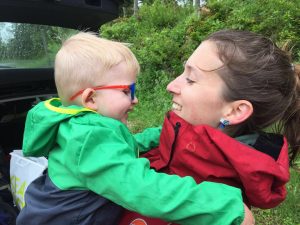
Living With LCA: Enzo’s Story

Enzo was born in 2014 in Lausanne, Switzerland, with a clubfoot. He immediately received physical therapy, then a plaster cast for three months and one minor surgery.

His parents – Laura Steinbusch, a post-doctoral fellow researching the neuroscience of diabetes, and Merlijn Meens, a scientist investigating cardiovascular function – felt confident as they were reassured through medical literature and by doctors that in time their son’s left foot would be fine.

But there was more to come. At 3 months, as Enzo’s therapy for his foot progressed, something seemed wrong with his vision and his ability to focus. Doctors diagnosed him with nystagmus, a condition in which Enzo’s eyes involuntarily moved side to side.

An MRI showed normal brain development and then doctors did an electroretinogram (ERG), placing electrodes on his eyes to measure the electric response of their light-sensitive cells. Enzo also underwent Visual Evoked Potential (VEP) testing, a non-invasive exam that measures his entire vision system.
Doctors fitted Enzo with glasses at 6 months and said the ERG and VEP results needed further study.

Enzo began rubbing his eyes, prompting people to ask Laura whether her son was tired or shy. A few months later, doctors diagnosed 10-month-old Enzo with Leber congenital amaurosis.

‘He is still our cheerful son’

“While walking home from this last doctor’s appointment, we were in shock, but after a while we realized that Enzo had not changed. He was still our cheerful son that likes to sing and cuddle,” Laura wrote in her blog for the Eye Association of the Netherlands.

“We wondered how we could raise Enzo as normal as possible and how we could help him discover the world. The solution turned out to be simple: We will not despair and (will) come up with creative solutions so he can participate in everything that this world has to offer.”

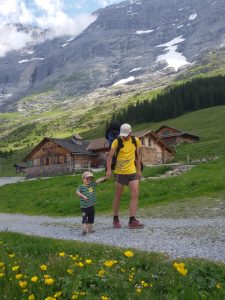
Enzo with Dad on a trail outside

That Christmas, Enzo’s parents designed their holiday in a way that greatly fostered their son’s vocabulary, sensory and motor skills, exposing him to chickens on a farm, rocks and water at the beach and a mountain climb with a summit lunch of pancakes and omelets.

Also, for the first time he said, “Dad,” “Mom” and a version of his own name, “Echoo.”

Leber congenital amaurosis genetic diagnosis

Then, at 18 months, Enzo received the genetic diagnosis of LCA10-CEP290. LCA10 is a severe retinal dystrophy caused by mutations in the CEP290 gene.

Laura interviewed doctors about research on LCA10-CEP290, becoming an intense advocate and learning myriad facets of the genetics behind Enzo’s disease and the stakeholders at work to find a treatment.
With global health organizations headquartered in the Lake Geneva region, Laura attended conferences, including a recent policy event about “the right to health” organized by Rare Diseases International.
She learned that researchers in the International Rare Diseases Research Consortium are working toward their goal of all people living with rare disease to receive diagnosis, care and therapy within a year “of coming to subspecialty medical attention.”

“Big visions and great goals,” Laura wrote in her blog for wonderbaby.org. “It made me hopeful for a future with inclusive education for all our children, job possibilities for all our children, a quick diagnosis for new patients and maybe a treatment for improved vision.”

Singing, reading, taking the bus

At home, Laura and Merlijn initially did not have access to many Braille and tactile books for Enzo so they created their own. For instance, they brought to life a picture-book hedgehog by fashioning spines with nails and duct tape.

Mom holding Enzo, they are both wearing rain coats

Laura now is working on a multilingual children’s songbook with songs in English, French, Dutch and German. She got the idea because Enzo easily learned new words in French or English through songs, especially when he already knew the song in Dutch. Two Dutch foundations said they want to help pay for part of the project, but Laura is still searching for funding and she is reaching out to ask whether anyone knows of groups she can contact for help in the United States, United Kingdom, Canada or Australia.

Enzo just turned 3. He loves playing with other children at nursery school and he is learning to be more independent. Also, doctors successfully treated his foot, with Enzo’s mom adding, “It was probably harder on us than on him.”

In September, he and his parents moved from Switzerland to their homeland, the Netherlands.
“Enzo is doing very well,” Laura said. “He loves listening to music, singing, reading books, everything that has to do with movement. He adores taking the bus, the train, the metro, the cable car, a bike ride…

“One of his favorite sentences nowadays is ‘What is that?’ (something he heard) or ‘Who is that?’ (someone talking), meaning that he is really curious.”


Read more stories of families living with LCA on our blog.

Sign up for our newsletter to stay in touch with the LCA community.