Living with LCA: ‘Then All Our Dreams Were Realized’

Hannah Reif, 7, will be treated with LUXTURNA™ at Children’s Hospital of Philadelphia (CHOP) to cure her blindness caused by LCA-RPE65.

Amy Reif still can’t hold back tears when she recounts first hearing that a ground-breaking genetic-therapy treatment targeting her daughter’s LCA-RPE65 gene officially received approval.

Amy knew in October that the Food and Drug Administration was holding a meeting about LUXTURNA™, a gene therapy developed by Spark Therapeutics, and felt hopeful for a cure for her 7-year-old, Hannah’s vision loss.

“We didn’t actually realize there was a vote on it at the end, and it received unanimous support,” she recalled. She wondered, “Is this it?”
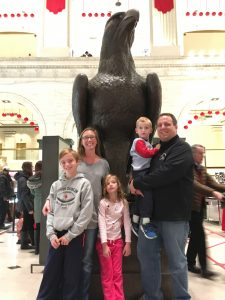
Hannah, center, with her mom Amy, dad Christopher and brothers Jacob and Matthew, standing in front of a giant bald eagle statue.

In October the FDA’s Cellular, Tissue and Gene Therapies Committee heard testimony, including that of Laura Manfre, co-founder and board chair of Sofia Sees Hope. 

The committee voted unanimously to recommend approval of the breakthrough drug.

“Then we realized it was a good next step in the process,” Amy said. “Then when the FDA approval actually happened in December – I can’t even talk about it without crying – we just had so much hope for seven years and all of a sudden all of our dreams were realized,” she said through her tears. “And it was just incredible.”

Amy, a 41-year-old mother of three living in Maple Glen, PA, with her husband, Christopher, still marvels at the idea that the genetic research focused on the same gene mutation as her daughter’s.

“What were the chances that was going to be her gene? It was just amazing.”
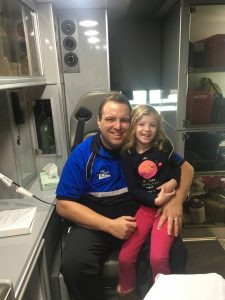
Hannah and her dad Christopher.

The first-grader will be treated with LUXTURNA™ at Children’s Hospital of Philadelphia (CHOP), where Jean Bennett, M.D., Ph.D., and Albert M. Maguire, M.D., researched and conducted studies, working with mice and dogs, resulting in this extraordinary gene therapy. LUXTURNA™ is the first genetic therapy treatment for LCA-RPE65, and it is the first treatment in the United States for any inherited disease.

Hannah and her family are serendipitously located 45 minutes from CHOP. Hannah has been seen by Dr. Maguire, the principal investigator for the clinical trials that led to the approval of LUXTURNA™ .

“We didn’t have to search far and wide,” Amy said.

Treatment likely this summer

The family met Feb. 12 with Bart P. Leroy, M.D., Ph.D., for their first appointment at CHOP to get ready for surgery, which probably will happen this summer. Dr. Leroy is director of Ophthalmic Genetics and Retinal Degenerations clinics in the Division of Ophthalmology and Center for Cellular and Molecular Therapeutics.

They discussed the surgery and took more photographs of Hannah’s eyes. They’re waiting to be scheduled for their next appointment.

Doctors told Amy that Hannah has one of the milder forms of LCA. She has night blindness that extends to any dimly-lit area any time of the day. She also has poor peripheral vision.  

An ophthalmologist who saw Hannah at 2 months old suggested LCA as the possible cause of her visual impairment and sent her to CHOP for an electroretinogram (ERG). 

At age 3 at CHOP, Hannah attempted to do simple tasks as part of getting into clinical trials, but she was too young, and the testing was difficult and upsetting. Two years later when they went back for their next ophthalmology appointment at CHOP, the trials were winding down.

“Had we had the opportunity to be in the trial, we would have, but it just didn’t work out.”

Over the last seven years, the family has raised more than $20,000 for Foundation Fighting Blindness through VisionWalk.

For help with the insurance process for Hannah’s surgery, Amy called Spark Therapeutics in January on the recommendation of other moms of children with LCA-RPE65. She said Spark is working with her insurance company on the $850,000 cost to treat both of Hannah’s eyes. The company has established Spark Therapeutics Generation Patient Services™ to support commercially insured patients and caregivers through the treatment experience and help them navigate insurance issues.

Amid all this preparation, Amy said she doesn’t know that Hannah has fully grasped what is going to happen.

“She knows that she’s going to see better, but I’m not sure at age 7 if she knows what that means. She knows that she can’t see stars and rainbows like other people can. At this point, we haven’t talked a lot about it because summer is several months away.

“She is very scared.”
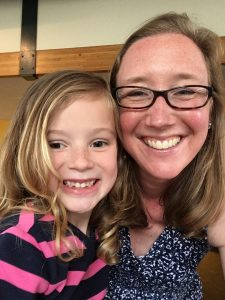
Hannah and her mom Amy

Amy said her daughter had surgery for a lazy eye and still remembers having a hard time coming out of anesthesia and her eyes being crusty.

“She’s excited about the surgery, but she’s afraid she’s going to have crusty eyes. It doesn’t seem like a big deal to us, but for her it is.”

For now, though, Hannah’s enjoying life like any other kid. She attends regular first-grade classes and loves to play with her friends and with Barbies. She especially loves riding her scooter.

“The principal will be outside to meet the kids in the morning and he just sees her flying down the sidewalk on her scooter, and they know my child is visually impaired and they just can’t believe it.”

Hannah in red jacket with pink helmet riding her pink scooter.

Curing Blindness: The Road To Treatment With LUXTURNA™

This is the first in a series following the progress of Creed Pettit, a 9-year-old Florida third-grader, who is a candidate for the breakthrough gene-therapy drug called LUXTURNA™, approved as the first gene therapy for Leber congenital amaurosis (LCA), and as the first-ever genetic therapy in the United States for an inherited disease.

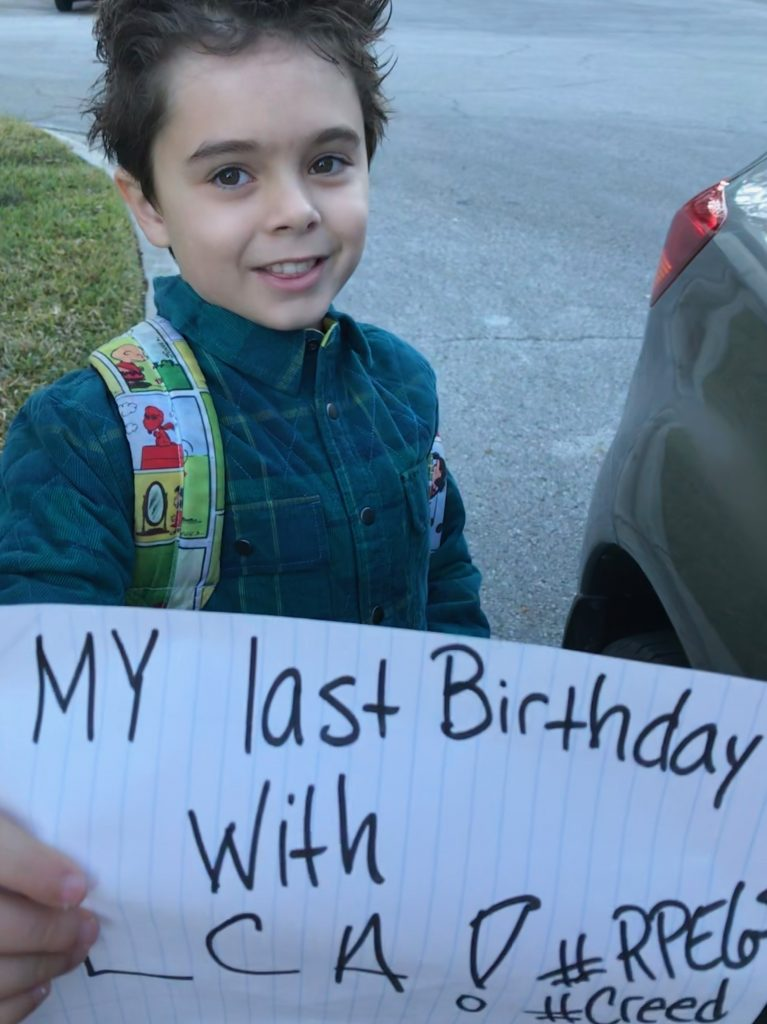
A birthday wish for 9-year-old Creed Pettit, diagnosed with LCA-RPE65, comes closer than ever to coming true today when the Florida boy and his mom meet with a surgeon to schedule treatment with LUXTURNA™, the just-approved, revolutionary gene therapy that corrects his specific gene mutation.

Creed smiling and holding up a piece of paper that writes, "My last birthday with LCA! #RPE65 #CREED
Creed, LCA2 RPE65

Creed had wished that his January 9th birthday would mark his very last with LCA-RPE65.

This third time might truly be the charm for Creed, as his mom, 41-year-old Sarah St. Pierre-Pettit of Mount Dora, Fla., twice tried to get her son, at ages 3 and 4, into clinical gene-therapy trials in Iowa. He was not approved for the trial because he could not perform steps required by the study, such as trying to navigate a maze.

Sarah learned a few days ago that her insurance company gave the go-ahead to schedule the surgery that costs $850,000.

“No more hurdles,” she wrote in an email. “I am a wreck of happy tears!!!”

Sarah and her son drove to Miami’s Bascom Palmer Eye Institute to meet today with Dr. Audina Berrocal to discuss the procedure and answer questions.

Brand new treatment

It was last October when decades of research culminated in a Food and Drug Administration advisory committee hearing in which the group recommended approval of LUXTURNA™, Spark Therapeutics’ breakthrough gene-therapy treatment.  

“One of the doctors spoke about my son in the FDA approval process, which was just amazing,” Sarah said. “That day I knew Creed could be treated.”

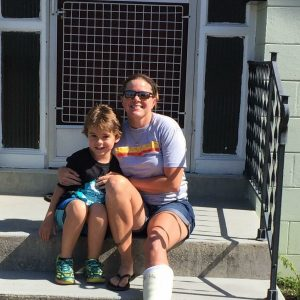
Creed and his mom Sarah sitting on steps.
Creed and his mom, Sarah St. Pierre-Pettit of Mount Dora, Fla. Creed meets with his surgeon Feb. 19 to schedule his treatment with LUXTURNA to reverse his blindness caused by LCA-RPE65.

Hope in Focus (formally Sofia Sees Hope) founder and board chair Laura Manfre also counted among those speaking on behalf of this ground-breaking treatment, sharing with the committee a story of a woman whose vision greatly improved in the clinical trials and changed her life.

The FDA granted approval of the treatment in December, paving the way for patients like Creed with LCA-RPE65 to receive, LUXTURNA™, the first genetic therapy treatment for an inherited retinal disease (IRD), and the first genetic therapy in the United States created for any inherited disease.

RPE65 is a form of Leber congenital amaurosis in which the body can’t make a protein needed by the retina to convert light into vision-enabling signals, which are sent to the brain. This new therapy involves injecting under the retina a human-engineered virus containing copies of a normal gene, so cells can express the protein. LCA is a rare inherited retinal disease, and nearly 30 gene mutations are associated with it.

Creed said that after the surgery, he can’t wait to see a real rainbow and he can’t wait to throw his canes in the lake.

His mom, on speakerphone last week while driving to pick up a new batch of “Creed’s Cause” T-shirts that she designed, talked about her most recent effort to help pay for medical bills not covered by insurance, and for travel expenses.

At $20 apiece, Sarah sells them locally and through Facebook and Instagram. When she’s not making T-shirts, she’s an elementary school physical education assistant, and hosts trivia nights at a brewery owned by her sister and brother-in-law.

Creed is a third-grader at Mount Dora Christian Academy, a school that better serves his needs than the public system. MDCA is like family to Creed and his mom, hosting lots of fundraisers, including a January basketball event that raised $5,000. The Douglas G. Halliday Foundation of Orlando recently made a generous contribution, adding to the more than $100,000 raised from 5K races, a CrossFit event and contributions from many friends and people she doesn’t even know.

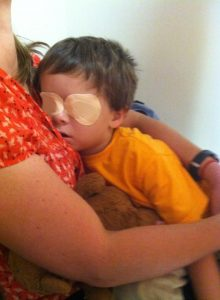
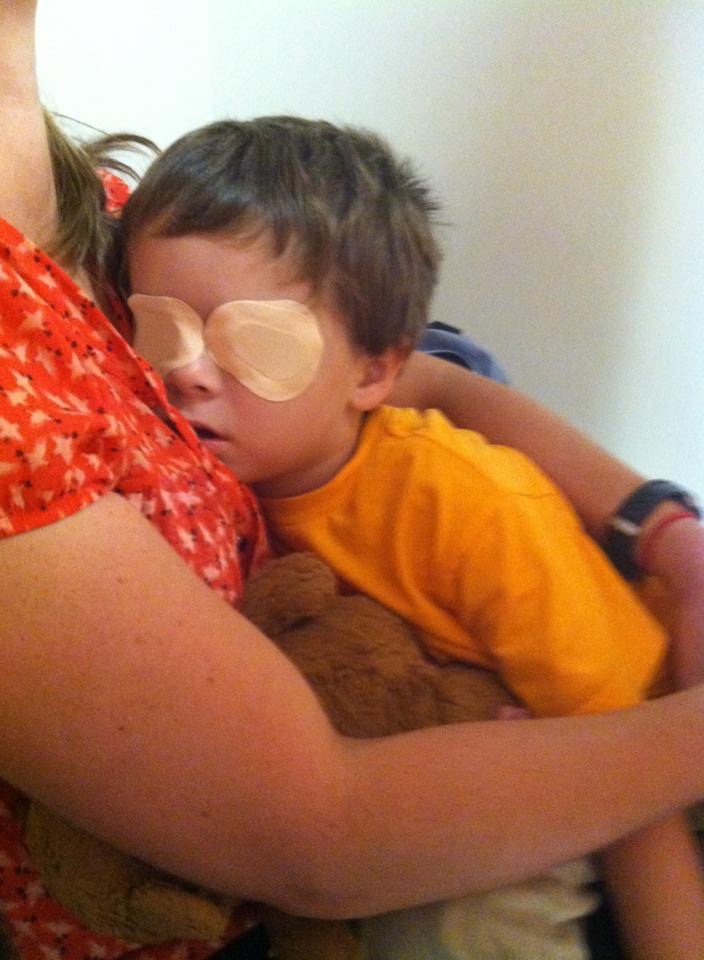
In 2011, doctors diagnosed Creed with LCA; in the months following he received a genetic diagnosis of LCA-RPE65. Image: Toddler-aged Creed wearing patches over both eyes.

Sarah knew something was wrong with her baby shortly after he was born in January 2009.

“He missed all of the milestones. He would run into everything. He wasn’t walking. Instead, he did this weird Army crawl. He’d feel for his food and look up.

“Everything just said something’s not right.”

Then came the heartache of trying to figure out what was wrong. Doctors diagnosed Creed at 18 months old as autistic, and another said he had problems with his peripheral vision.

For the first year of Creed’s life, his mom thought he had colic because he would spend his days contentedly on a blanket outside, and at the end of the day when he went back into the house, he cried, all night.

An autism teacher advised Sarah to black out all the windows in the house, keep everything dark and not allow him to be in light, the exact opposite of what he needed.

She found the right advice from a woman specializing in depth perception and dyslexia. For the first time, and coming from a non-doctor, Sarah learned that her son probably was blind.

Creed with eye patches on his eyes, his mom is holding him
In 2011, doctors diagnosed Creed at 2 years and 8 months with LCA; in the months following he received a genetic diagnosis of LCA-RPE65. A week later, Sarah began her fundraising endeavors.

She also reached out for support that resulted in a team of therapists and specialists to address Creed’s movement, vision, speech, orientation, mobility and behavior.

Trying for a gene therapy trial

Sarah learned about RPE65 gene-therapy trials. She, her mother, Mary, and Creed traveled to Iowa twice for what turned out to be unsuccessful attempts to be part of the research.

Creed’s visual acuity is actually very good; when he has light, he can see. When he doesn’t have light, he can’t see anything. As Sarah says, “No light, no sight.”

He needed light and he got it, with his mom installing special bright lights all over the house.

“I’m positive they can see us in space,” she said of the lights in and around her home. Creed also has more light in school, including a light in his desk.

At school and in life, Creed has another light shining on him – his best buddy Michael, who bonded with him in first grade. He helps him be safe and gives Sarah updates about her son.

She said she can’t believe Michael’s maturity and sensitivity and believes he was put on this earth to help her son and others.

For Valentine’s Day, teachers filled bags with candy and sold them for $1 each, with proceeds going toward Creed’s expenses.

The words on the candy bag say, “Help Creed see how much we love him.”

Continuing to See Hope for IRD Treatments

At three o’clock Thursday afternoon, Beth Chiarella and I had a very public moment of tears and hugs at Baltimore–Washington International Airport as we received news that after a day of hearing testimony, the Federal Drug Administration’s Advisory Committee unanimously recommended approval of a gene therapy that could reverse or reduce vision loss due to an inherited retinal disease (IRD).

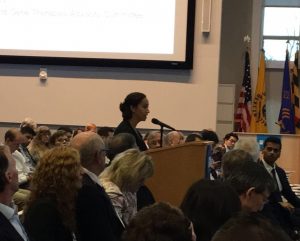
Sofia Sees Hope founder Laura Manfre testifying to Federal Drug Administration’s Advisory Committee about a gene therapy that would help those with RPE65 gene mutation form of LCA

The committee listened to Spark Therapeutics present their research and findings on LUXTURNA® (voretigene neparvovec), an investigational, potential one-time gene therapy, and heard testimonies from families whose lives have been changed dramatically by the therapy. Members then voted 16-0 without comment to endorse approval of the therapy for the treatment of patients with vision loss due to confirmed biallelic RPE65-mediated inherited retinal disease (IRD).

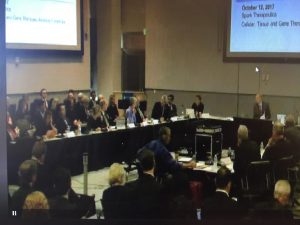
Federal Drug Administration’s Advisory Committee unanimously recommended approval of a gene therapy that could reverse or reduce vision loss due to an inherited retinal disease (IRD).

Alongside the brave individuals and their family members who were part of the clinical trials and traveled to Washington, D.C., to share their personal stories in support of this therapy, I played a small part in what is no doubt an historic moment for all LCA families. I’m grateful to Tami, the oldest participant in the RPE65 trial, who allowed me to share her experience with the panel, reinforcing that this treatment is life-changing at any age, and for any length of time. I’m also grateful to all of those who have made it possible for Sofia Sees Hope to play a role through their continued advice, support and enthusiastic cheerleading.

While this first treatment does not address the dozens of other genetic mutations that cause blindness for LCA and IRD individuals, we can hope that this endorsement will be followed by a potential FDA approval, in turn paving the way for continued research and treatment for my daughter and our entire LCA community. Thursday marked a positive step forward on the path to changing the lives for many people.

Read Laura’s full statement to the Advisory Committee here.

Presenting at FDA Hearing Thursday on RPE65 Genetic Therapy Drug

Hope in Focus (formally Sofia Sees Hope) Co-Founder Laura Manfre will help provide the LCA community’s perspective to a Food & Drug Administration panel Thursday about a proposed genetic therapy for Leber congenital amaurosis (LCA) caused by an RPE65 gene mutation.

“This is such an important event because it allows the patient population — the parents, and children and families — directly impacted by this very important decision-making process to be heard,” Manfre said. “The FDA has a critical job to do in weighing all of the potential risks and benefits with any drug approval, and they recognize that the voice and the experiences of those who are affected needs to be a part of that process.

“Part of Sofia Sees Hope’s mission is to help serve as a connection among families living with LCA,” Manfre continued. “We see this opportunity to offer testimony as another way to fulfill that mission.”  

As a presenter at the FDA’s public advisory meeting of the Cellular, Tissue and Gene Therapies Advisory Committee (CTGTAC), Manfre will be representing patients and families living with LCA and other rare inherited retinal diseases. The meeting begins at 8:30 Thursday  morning and runs to 5 p.m. at the FDA White Oak Campus in Silver Spring, MD.

The CTGTAC is meeting to make recommendations on the safety and effectiveness of biologics license application for voretigene neparvovec, submitted by Spark Therapeutics, Inc. The proposed gene therapy is to treat patients with vision loss due to confirmed biallelic RPE65 mutation-associated dystrophy.

RPE65 mutation-associated retinal dystrophy is an orphan disease, with an estimated 1,000-3,000 patients affected in the United States, according to A Shared Vision.

Manfre said research and bringing therapies to market provides hope to all LCA and IRD families.

“Though families may struggle with the day-to-day challenges, they can have hope that there just might be a light at the end of the tunnel,” she said.

“To help foster this effort,” she said, “Patients and families need to seek diagnoses,  participate in patient registries, and continue to generate awareness and make our voices heard.  Our disease is rare, which makes it more important than ever that we are working together to be advocate for our community and  to move treatment and cures for blindness forward.”

For the meeting, Spark submitted to the FDA a 149-page briefing detailing the history, background, studies and research that went into developing voretigene neparvovec, which has the proposed trade name LUXTURNA.

The FDA’s 42-page briefing details its analysis of the proposed treatment and offers discussion questions for the advisory committee that include at what age should patients receive treatment and what are the treatment’s potential risks and benefits.

Here are some links for more information about the meeting:

Webcast of the meeting: https://collaboration.fda.gov/ctgtac101217.