As someone with a visual impairment, getting around once felt overwhelming. I was plagued by the “what ifs.” What if I got lost? What if I missed a bus or got off at the wrong stop? What if I couldn’t find the right platform at the train station? If you or a loved one is dealing with these concerns, this article is for you.
The good news is that over time, navigating has become easy for me. Because of my experiences, I’d like to share some tips for moving through the world with a visual impairment.
Step 1: Orientation & Mobility
It is important to learn how to use a cane and practice using it every day. Many people with vision loss live in denial of their visual impairment. If you’re not currently using a cane or a guide dog and have recently bumped into something you didn’t see, start using one.
Once you’ve mastered the basics of the cane, learn to navigate independently in your immediate neighborhood. (Parents, this is when you need to step back.) Have a friend or family member walk beside you the first time, pointing out obstacles and naming streets as you cross them. When starting out, it can be helpful to count how many streets you cross before you need to turn. Consider making notes on your phone to help you remember. For example, “To get to the doctor’s office, turn right out of my house, turn left at the first intersection, turn left after walking under the train bridge, and cross two streets before turning right. The doctor’s office is the first building on the left.”
If you are nervous the first time you try the route alone, have someone walk behind you and ask them not to talk to you unless you get completely lost. It is okay to get a bit lost! Part of becoming a better navigator is making mistakes. You can also video call a friend or family member if you need help.
Step 2: Generalization
Eventually, you will start to notice patterns such as how buildings are spaced, that street addresses with odd numbers are usually on the east or south sides of the street, and the typical layout of train stations, etc.
At this point, you won’t need someone’s help traveling a route for the first time. Instead, you will use the tools available to you—reviewing routes before you leave your home, leveraging GPS along the way, and not being afraid to ask someone to confirm your location or that you are at the correct building.
Step 3: Challenge Yourself
When I was in my second year of university, I was invited to attend an event to receive a scholarship I’d won. But it was two hours away. I called my mom to ask for a ride. She lived an hour from me in the opposite direction from the event. She said that if I wanted to go, I’d need to figure out how to use the bus on my own. It was one of her best parenting decisions.
I was terrified and had to ask a lot of people for help along the way, but I did it. It was an eye-opening experience and set the wheels in motion for me to feel comfortable traveling. In previous articles, I’ve talked about hiking in the mountains and trekking up Mount Kilimanjaro. These amazing experiences wouldn’t have been possible without a lot of experience negotiating daily life with my visual impairment. With enough practice, I am confident that you can reach a point where you can travel as easily as I do.
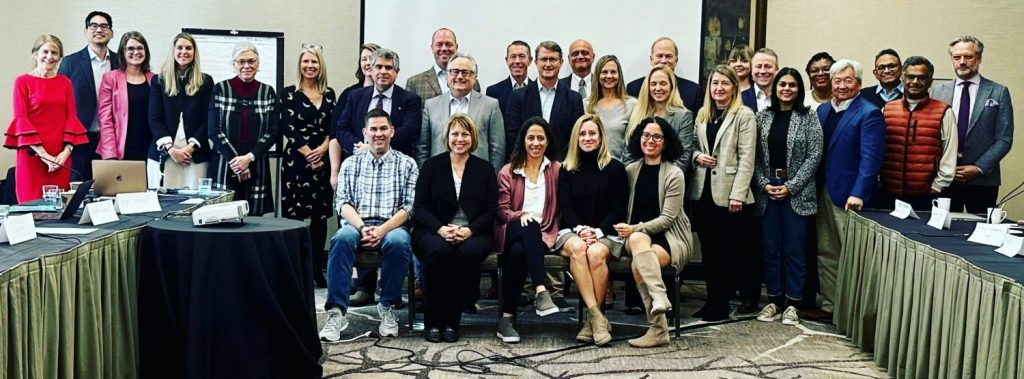
The 2025 LCA Family Conference in Minneapolis, MN, offered four informational panel sessions, where the 135 attendees learned about living with Leber congenital amaurosis (LCA) and other inherited retinal diseases (IRDs), participating in clinical trials, and the latest research and therapy updates.
The first session, “Living with an IRD,” was moderated by Laura Manfre, co-founder and Board Chair of Hope in Focus. This session is often a highlight for families wanting to learn how to support their children diagnosed with an IRD.
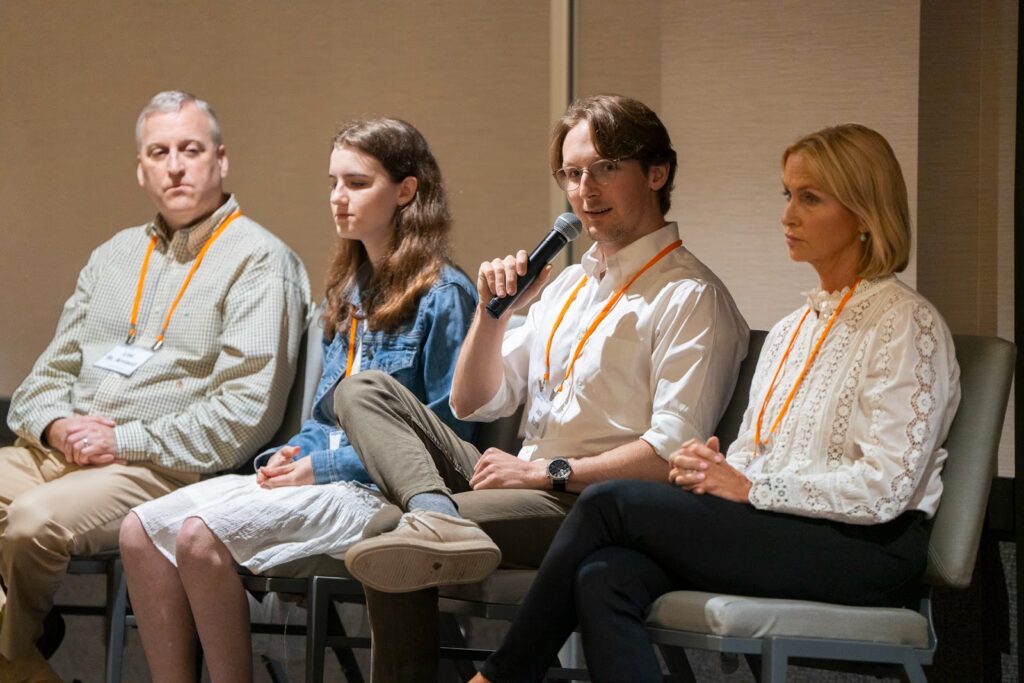
Laura Manfre, Lee St. Arnaud, Elle St. Arnaud, Jack Morris, Leslie Morris
Laura posed questions to the four panel participants, which included 18-year-old Elle St. Arnaud, who has LCA IQCB1/NPHP5 and is attending Boston University this fall, and her father Lee St. Arnaud, and 22-year-old Jack Morris, who has RP CRB1and is a recent graduate of Brown University, and his mother Leslie Morris.
Below are some of the panelists’ edited responses to Laura’s questions.
What has your school journey been like? What challenges have you faced, and how did you advocate for yourself?
Elle St. Arnaud
Elle was educated in the public schools with a paraprofessional supporting her in class from preschool through fourth grade. She said that a key to her success was learning to advocate for herself early on by participating in her individualized education plan (IEP) meetings, explaining her accommodations to teachers, and taking responsibility for communicating her needs, especially regarding her vision. Elle reflected on the importance of self-advocacy and how it has shaped her life.
“It’s vital for kids to be able to explain their accommodations, as others often don’t fully understand visual impairments,” she said. “While I’ve had positive experiences, I’ve also faced challenges, such as being discouraged from joining the debate team or taking advanced classes. I pursued both anyway, proving that being blind doesn’t limit one’s ability to succeed. Self-advocacy and standing up for your needs are essential life skills.”
Jack Morris
Jack started in public schools and later switched to a private school. His vision was relatively good throughout most of his schooling. Jack thought he might have done even more to advocate for himself. Still, regular meetings with teachers and advisors proved very helpful. He said, “When people understand what you need, they generally want to help.” Although at the university level, he said some professors were resistant to making accommodations.
He stressed that “Accommodations are not favors—they are necessary for success. Blind individuals are not less intelligent; they simply need equal access to materials to perform just as well as others. Having confidence in advocating for these needs is crucial, and legal protections like the ADA support this.”
As parents, can you share a little about your journey? How was it seeking a diagnosis, and what are some things you wish you’d known earlier?
Lee St. Arnaud
Lee explained that Elle and her older brother, Patrick, both have LCA. When trying to diagnose Patrick’s vision issues, he shared how difficult it was when the doctor offered only a brief response, instructing them to return in five months to confirm their son’s blindness. Overwhelmed, the family immediately reached out to resources like the Chicago Lighthouse for the Blind, which connected them with supportive networks and foundations.
Lee stressed the importance of parents being proactive and finding tools like a detailed year-by-year visual goals guide, which they used effectively in IEP meetings to advocate for their children’s needs. He emphasized the importance of being prepared, pushing for necessary services, and actively advocating for the child and family.
The St. Arnauds encouraged their children to participate in outside activities like adaptive climbing and the live hockey association. “So many times we were nervous and sweating bullets. But by the time we got done, the kids were like, you know what? We can do this!” Lee said.
Leslie Morris
Leslie said that Jack’s diagnosis with a recessive form of RP at age five came as a shock because there was no family history. She described feeling heartbroken and overwhelmed by a sense of loss and isolation. Despite these emotions, Leslie and her husband, Jason, chose not to accept discouraging responses from doctors. Instead, they took action—connecting with others affected by IRDs and becoming involved with the Foundation Fighting Blindness, where both serve as trustees.
Advocacy became like a second job for the Morris family, as they worked to ensure Jack had every opportunity for a full and meaningful life. Leslie said they didn’t want the disease to define their son, and they encouraged him to try various activities like baseball, football, swimming, wrestling, and guitar. “We focused on letting Jack decide when to step away from activities while gently steering him toward pursuits that offered long-term fulfillment,” Leslie said.
How do you give your child enough independence to grow and to learn, while also wanting to protect and keep them safe?
Lee St. Arnaud
Lee felt that they didn’t experience significant disagreements with Elle or Patrick regarding their ability to self-manage. He stressed the importance of balancing caution with encouragement and supporting early opportunities for independent experiences in the community without rushing the process. He also reflected on the importance of understanding your child’s interests as they mature.
Elle St. Arnaud
Elle immediately spoke up after her father, expressing her childhood frustration and conflict with her parents over having to take Orientation and Mobility (O&M) training particularly the inconvenience and social discomfort of being taken out of school. Despite hating it at the time, she admitted the lessons had long-term value, especially in promoting independence. She noted the importance of starting children early with independent tasks at home, like cooking and laundry, while pacing community-based skills more carefully. “I think parents should keep their children engaged in O&M even if the child resists,” Elle said. “Because it equips them with critical life skills—such as safely crossing the street—that pay off later.”
Leslie Morris
Leslie emphasized the importance of parental teamwork and unity, particularly when supporting a child’s journey toward independence. She admitted to being a bit of a helicopter mom. “My husband, Jason, and I agreed on things before letting Jack go out and try them,” she said. “Having somebody by your side through this journey is very important.” She added that when parents are aligned in decisions and approaches, it helps minimize conflict and makes the process smoother.
Jack Morris speaking at the 2025 LCA Family Conference
Jack Morris
Jack didn’t recall having major conflicts and expressed gratitude for the trust his parents placed in him. One slight regret he had was not wearing sunglasses earlier, due to self-consciousness. Jack said he appreciated the opportunity to try things—even fail—while still feeling supported and safe.
Much to the amusement of the conference attendees, Jack recounted a brief period when he was legally allowed to drive, a decision made with medical guidance that, in hindsight, seemed very questionable.
“I appreciated that my parents trusted me to be able to take care of myself. This journey makes you resilient, tough, and resourceful,” Jack said. “Kids can be very clever in planning solutions to their unique circumstances, and my parents trusted me in that.”
Community members have expressed that mental wellness and accepting vision loss can be difficult. Elle and Jack, what are your thoughts?
Elle St. Arnaud
“Not wanting someone to see your pain and not wanting to wear sunglasses or use a cane will likely peak around middle school,” Elle said. “No one wants to be different, and you want to be ‘on trend’ with everybody else.”
She added that having a para in the classroom with her all of the time was an inhibitor and made it harder for her to talk with other kids. “Parents should try not to hover when their child is with other children because it can make them feel less confident or social,” she said.
Elle said she made it a priority to share her experiences as a blind person with her sighted friends. “We’d make jokes about it, and I talk about it constantly. I’d share what I’ve experienced and every blind story I’ve had,” she explained. “I think that’s important because when you need to ask your friends for help, they are a lot more understanding because you’ve explained it and talked about it so many times with them.”
For example, she told her friends about walking into a door, which helped them be more aware that she might not see it, allowing them to take the initiative to guide her when needed. “I think the easiest way to be accepted is to talk more about your blindness so it feels more normal,” Elle said.
Jack Morris
“I think there’s a line to be found between letting a disease define you and rejecting that it’s a part of you, because retinitis pigmentosa (RP) has been a huge part of my story—a beautiful but also a tough part. It’s something that feels different and lonely, but also unifying and community-building,” Jack said. “If we can find ways to live in and with our disease rather than despite it, that’s where truth and freedom lie for me.”
He offered advice to parents, saying that they needed to be strong in ways that aren’t obvious. “One of the hardest things for parents is watching their child struggle. But sometimes the biggest strength is allowing them to struggle. Kids need to feel the full spectrum of emotions—challenge, loneliness, empowerment, and togetherness,” Jack said. “If parents can be there as a foundation, even when things are hard, and let them be hard before stepping in with action, that’s one of the most powerful and meaningful things they can do for their children.”
Luxturna®, the only approved treatment for one of 27 identified forms of Leber congenital amaurosis (LCA), cost $500 million to develop and took more than 12 years to come to market.
With such an enormous investment in time and money, it would make sense to use that same platform for developing new treatments to improve vision or halt progression of blindness.
Every individual clinical study must complete a set of rigorous requirements – which cost time and money – to receive regulatory approval from the Food and Drug Administration (FDA).
Chad R. Jackson
The Foundation’s translational research program steps up the pace of preclinical studies toward clinical studies involving humans through proactive management and industry-level advice to drive research leading to prevention, treatment, and vision restoration for degenerative retinal diseases.
A Hope in Focus partner, the Foundation has raised nearly $900 million since its founding in 1971 and funds more than 90 programs worldwide, including no-cost genetic testing and the My Retina Tracker® patient registry. The Foundation also launched a Retinal Degeneration Fund (RD Fund) to help accelerate life-changing outcomes for people with retinal degenerations through direct mission-related investments in therapeutic companies.
Chad and other presenters shared information about drug development, gene therapies, and non-gene therapies during two sessions of the Hope in Focus 2023 LCA Family Conference* in Indianapolis this summer.
More than 100 people attended the forum to hear the latest in LCA research and to network with families living with LCA and other rare inherited retinal diseases (IRDs).
Bringing a drug from inception to market takes 10 to 15 years, Chad said, and costs tens and tens of millions of dollars. He said bringing a developing drug from preclinical studies to the FDA requires three steps:
Identify your target to know what you’re seeking to do; conduct invitro studies by expressing patient cells in a lab or as it’s referred to, retinas in a dish; and perform animal-model studies, which save time and money to determine whether emerging therapies are safe and perhaps ready to move toward clinical trials using humans.
Gene-Agnostic Therapies
Chad moderated a panel discussion about research moving beyond single-gene correction to gene-independent therapies to help delay progression of blindness or restore levels of vision.
Eric Daniels
Kiora Pharmaceuticals’ Chief Development Officer Eric J. Daniels, MD, MBA, discussed the company’s first-in-human study for a non-gene therapy treatment for retinitis pigmentosa (RP), a group of inherited eye diseases that cause progressive vision loss. It is characterized by the gradual death of light-sensitive photoreceptor cells in the retina, known as rods and cones, responsible for converting light into neutral signals sent to the brain.
Dr. Daniels said his company’s technology shifts retinal ganglion cells from their off state, in which they respond to decreases in light. Kiora has discovered a way to shift these cells into their on state in the presence of light through channeled photoswitch molecules.
According to Kiora, the mutation-agnostic treatment has the potential for use in any of the various genetic forms of RP, as well as other retinal degenerative diseases; its intravitreal injection allows for more consistent and tolerable administration, and the small molecule can be manufactured and provided to patients at a much lower expense than the $450,000 per eye cost of Luxturna.
Huma Qamar, MD, MPH, CMI, the head of Clinical Development and Medical Affairs for Ocugen, discussed the biotech’s work on treatments for LCA10 (CEP290), RP, and other IRDs. One of their clinical trials involves a novel gene therapy, OCU400, consisting of a functional copy of a nuclear hormone receptor gene delivered to target retinal cells using an adeno-associated viral (AAV) vector. Expression of this receptor within the retina may potentially help stabilize cells and rescue photoreceptor degeneration, Dr. Qamar said.
Huma Qamar
Ocugen demonstrated the potential of a novel modifier gene therapy to elicit broad-spectrum benefits in early and intermediate stages of RP and LCA, based on animal studies, showing the potential for a mutation-agnostic treatment.
Since the conference, Ocugen reported an update on its Phase 1/2 clinical trial for OCU400 for 12 patients who had follow-ups from six to 12 months after a subretinal injection in one eye. The developing drug had a favorable safety profile in this trial phase. Also eight of the 12 patients showed stabilization or improvement in the visual function measures of best corrected visual acuity, low-luminance visual activity, and navigating a multi-luminance mobility test.
The trial is currently enrolling patients, including pediatric patients with LCA10.
Gene Therapies
In the conference’s final session, moderated by Foundation Vice President of Science Communications Ben Shaberman, four panelists discussed their work on LCA gene therapies.
Shannon E. Boye
Shannon Boye, PhD, Co-Founder, Director, and Acting Chief Science Officer of Atsena Therapeutics, said the road to drug development is long and bumpy. She helped design early studies on LCA1 (GUCY2D) in 2001.
With the process going so slowly, Shannon reached out to then-Foundation CEO Ben Yerxa, who helped push her and her husband into starting their own company.
In 2019 doctors dosed the first patient. Earlier this year, in a Phase 1/2 clinical trial, their LCA1 gene therapy, known as ATSN-101, showed clinically meaningful improvements in vision at the highest dose with no drug-related serious adverse events at six months after treatment.
Ash JayagopalBen Yerxa
At Opus Genetics, Chief Scientific Officer Ash Jayagopal, PhD, discussed the biotech’s progress for various programs in, or advancing toward, early-stage clinical trials.
Opus, headed by CEO Ben Yerxa, PhD, is the first spin-out company internally conceived and launched by the Foundation’s RD Fund. The Fund’s purpose is to accelerate advancing research into gene therapy for several forms of LCA and other retinal degenerative diseases.
Opus’ most advanced program for LCA5 (lebercilin), OPGx-LCA5, is dosing patients, while two other LCA programs involving LCA13 (RDH12) and LCA9 (NMNAT1) are in preclinical development.
Thomas Mendel, MD, PhD, talked about his research at The Ohio State University, where he is Assistant Professor of Ophthalmology and Vitreoretinal Surgery at the university’s Havener Eye Institute, Department of Ophthalmology & Visual Sciences. He is building a research program to develop and implement gene therapies for Professor of Ophthalmology and Vitreoretinal patients with inherited retinal disease.
Bikash R. Pattnaik
Thomas Mendel
The goal is to build a translational lab with a team and accelerate development and clinical trials with gene-based treatments.
Bikash R. Pattnaik, PhD, told the audience about his work at the University of Wisconsin-Madison (UWM), where he is a professor and Clinical Director for Electrophysiology in the departments of Pediatrics, Ophthalmology, and Visual Sciences.
This summer, the National Institutes of Health awarded UWM a $29 million grant to develop gene-editing therapies for two inherited retinal conditions: LCA16 (KCNJ13) and Best disease. Bikash said the LCA16 treatment in development could be in clinical trials next year.
*Please go to our Hope in Focus website to see our previous three stories detailing sessions from our 2023 LCA Family Conference. Click here to see a video about the conference.
The community of people living with Leber congenital amaurosis caused by mutations in the RDH12 gene moved closer to realizing the shared goal of establishing a clinical trial to find a treatment for the blinding disease.
More than 40 people gathered for the Second Global RDH12 Scientific Conference in Baltimore. The daylong meeting in November offered perspectives from clinicians, patients, parents, advocates, academia, regulators, and industry.
Silvia Cerolini, founder of Eyes on the Future, one of three organizations under the umbrella of the Global RDH12 Alliance, said the conference made tremendous progress toward a common goal: Designing a successful clinical trial to find a treatment to improve or stabilize vision in people living with RDH12. Current LCA13 RDH12 research is in preclinical stages, with the hope that the first clinical trials may start in 12 to 24 months.
Silvia Cerolini and her 9-year-old daughter, Vicky
As one woman living with RDH12 voiced during the conference: “Any quantity of vision is everything for us.”
This recent conference brought together an international group of scientific, medical, advocacy, and industry experts to identify and prioritize potential elements in designing a clinical trial and its key components: Outcome measures and endpoints.
Outcome measures are used to assess a patient’s vision. Performed at the start of a clinical trial, the measures provide baseline information that can be compared with the same outcome measures done after an intervention or treatment, determining progress and efficacy.
Participants in the Second Global RDH12 Scientific Conference
Endpoints are outcome measures selected as the most relevant and clinically meaningful measurements that can be measured objectively to determine whether the intervention being studied is beneficial.
Selecting the most appropriate and patient-relevant outcome measures as endpoints for each specific IRD is a big challenge for the entire field of inherited retinal dystrophies.
The heterogeneity (diverseness) of IRD phenotypes (characteristics) poses significant challenges to understanding disease pathology, predicting treatment benefit, and selecting outcome measures and endpoints for clinical trials. Challenges in recent clinical trials failing to demonstrate treatment efficacy show the need for innovation in trial design and outcome measures’ selection.
Organizers cited four key challenges unique to treating RDH12 mutations: (1) Severe impairment of retina/vision from early life; (2) Uncertain expectations of stabilization/preservation versus improvement/restoration of vision; (3) Heterogeneity of the RDH12 phenotypes (and IRDs in general); and (4) Slow expected pace of detectable changes after treatment.
Conference highlights included stories from people living with the disease and the constructive dialog among industry representatives, clinicians, scientists, and regulators, Coates said.
“Most significant were the RDH12 patients and parents sharing their experiences with progressive vision loss and their hopes for a treatment,” she said. “The day marked a meaningful step toward successful trials and, hopefully, will become a model as other gene-mutation studies progress to trials.”
For Maria Fiore, mother of 17-year-old Bella who lives with RDH12, the day brought hope.
“The input – from the academic side, opinions from the regulatory side, and the competitive nature of having multiple interests on the industry side – gives me a lot of hope that we’re getting closer to an RDH12 clinical trial,” said Fiore, a member of the Board of Directors for RDH12 Fund for Sight.
“We appear to be closer than ever, and events like the conference help to keep the motivation and drive to bring this to the finish line a real possibility.”
Bella and Vicky are part of the global RDH12 community that includes more than 200 families from 20 countries. Children and adults living with the rare inherited retinal disease hail from the United States, Europe, South America, China, India, and Russia.
The families communicate through Facebook and an email newsletter, with some local groups emerging to involve more people and remove language barriers.
The Global RDH12 Alliance organizes twice-yearly virtual community calls to review progress on clinical developments and discuss common challenges. Collectively, the three RDH12 organizations have raised more than $3.5 million since 2011 to advance research and find treatments.
Click here to see a video of people living with RDH12 introducing themselves.
Cerolini said it had been far from easy to wrestle all the participants down for one full day.
“But we came together as one big team to optimize the chances of trial success for our RDH12 community. There is still work to do to give Vicky and all our RDH12 community hope to see the world,” she said.
“It is not easy. But we are as close as ever to the first human clinical trials and we need to keep going. What we are learning about RDH12 can help the entire IRD field.”
The gathering watched a video of children and adults with RDH12 describing difficulties with sight loss and the hope that research will lead to a treatment.
Coates said people from several countries expressed their desires to have a chance to better their vision or at least maintain it.
“The heartfelt presentation reminded everyone in the room why we were there.”
Individuals and their families at the conference comprised a group of nine, sharing worldwide perspectives about trial design and outcome. They said they would accept stabilizing visual function as a “significant win” in the pursuit of a treatment.
Adult patients talked about the importance of keeping whatever light perception they have and shared stories of struggles in knowing where they are in their space, including the perils of bumping and bruising their foreheads when navigating spaces.
As one woman characterized the quest: “Any quantity of vision is everything for us.”
Their comments led to discussions with regulators and clinicians about the complexities of retinal function and the validity of certain endpoints and outcomes.
Clinicians and academics shared unpublished data on RDH12 natural history and thought-provoking perspectives from the latest IRD trials.
Tomas S. Aleman, MD, PhD, presented insight from an RDH12-associated IRD natural history study and the latest expectations for treatment. He talked about differences between the LCA13 RDH12 and LCA2 RPE65 mutations, and the structural and functional relationship in the RDH12 mutation that causes central vision loss resulting in blurring.
L-R: Debra A. Thompson, Jean Bennett, Maria Fiore, Allison Galloway, and Tomas S. Aleman
Despite functional and structural degradation of photoreceptors, he said, RDH12 gene therapy may have the potential to improve outcomes, even in adults, once certain toxins can be degraded.
Dr. Aleman is Professor of Ophthalmology and Director of the Hereditary Retinal Degeneration Clinics at the Scheie Eye Institute’s Perelman Center for Advanced Retinal and Ocular Therapeutics (CAROT) at the University of Pennsylvania.
***
Jean Bennett, MD, PhD, discussed outcomes and endpoints from studying the RPE65 gene mutation while developing voretigene neparvovec, known as LUXTURNA®, and whether they can be translated to RDH12 clinical trials.
The U.S. Food & Drug Administration (FDA) in 2017 approved LUXTURNA to help improve vision for people living with RPE65. The therapy remains the first and only approved ocular gene therapy and the only gene therapy treatment for any inherited disease in the United States.
The breakthrough treatment developed at Children’s Hospital of Philadelphia (CHOP) and Spark Therapeutics in Cambridge began with the successful treatment of a special being, Lancelot, the first in a line of Briard herding dogs, who helped drive research to bring the gene therapy to market.
Dr. Bennett told the group the development of a novel patient-relevant endpoint – a multi-luminance mobility test (MLMT) to measure functional vision, or how a person navigates in a vision-related activity across a range of light levels in daily living – was instrumental in demonstrating how voretigene neparvovec could improve vision in RPE65 patients, leading to LUXTURNA’s approval.
The navigational test, though, can be cumbersome and time-consuming, given the elaborate setup with lighting controls, videotaping, analysis, and such. Alternatively, researchers are working on virtual-reality tests, created as time-savers with more versatility. The task would be to design a functional vision test using a virtual-reality obstacle course.
Drs. Bart P. Leroy, Jean Bennett, and Daniel C. Chung
Dr. Bennett is Professor of Ophthalmology at CAROT and the F.M. Kirby Emeritus Professor of Ophthalmology at the Perelman School of Medicine at UPenn.
***
Dr. Robert E. MacLaren, Professor of Ophthalmology at the University of Oxford, discussed lessons drawn from recent IRD clinical trials and vector delivery. He is working on a trial assessing the effects of retinal gene therapy with an adeno-associated viral (AAV) vector encoding genome particles.
LUXTURNA gene therapy employs a human-engineered AAV vector containing copies of a normal gene injected under the retina to express a protein necessary for vision.
Prof. MacLaren discussed opening the door to a new concept in the IRD space where researchers look for statistically significant improvements that show the vector is working and be more flexible in the immediate argument of whether that has a clinically significant improvement in that patient’s visual function, there and then.
Professor Bart P. Leroy, MD, PhD, discussed information learned from recent IRD clinical trials and gene therapies in clinical practice.
He co-authored the PERCEIVE study that analyzed the Year 2 interim research on LUXTURNA, concluding the drug demonstrated safety and effectiveness when used in clinical practice following its regulatory approval. The study also identified a new adverse drug reaction called chorioretinal atrophy, causing inflammation in some patients. So far, the reaction has not affected visual function and will be tracked as the study progresses.
He emphasized working toward shared goals and communicating with regulatory agencies on design and outcomes for IRD clinical trials. Saying children are not little adults, Dr. Leroy said questions about specific designs and patient-reported outcomes need to be adapted to the study population.
Dr. Leroy is Professor of Ophthalmology, Ophthalmic Genetics, and Visual Electrophysiology at Ghent University, and Head of the Ophthalmology Department at Ghent University Hospital, Ghent, Belgium.
***
Adam M. Dubis, PhD, Associate Professor, University College of London Institute of Ophthalmology Global Business School for Health, and Advanced Human Retinal Imaging Specialist at Moorfields Eye Hospital, presented information on work planned around data-driven solutions for RDH12 clinical trial support.
Meira GTxCEO RobertK. Zeldin, MD, PhD, updated the group on the biotech’s RDH12 clinical development. The company is enrolling participants in the US, UK, and Europe for a natural history study and is planning a Phase 1/2 trial to assess safety and tolerability of potential gene therapy treatment.
Opus Genetics’ CEO Ben Yerxa, PhD, discussed capitalizing on key lessons in LUXTURNA’s development. Opus has three LCA-related projects in its pipeline, including one in early stages for RDH12. The company concentrates on preclinical projects in, or advancing toward, early-stage clinical trials to move research forward, with the goal of a successful trial or trials.
The FDA’s Dr. Wiley A. Chambers and the EMA’s Jane Moseley discussed trial-design parameters and outcome measures. They articulated their points of view, offering actionable advice on novel endpoints, including structural versus functional measures, virtual-reality mobility mazes, and patient-reported outcomes.
Todd A. Durham, Foundation Fighting Blindness Sr. VP of Clinical & Outcomes Research, talked about Patient-Reported Outcome Measures (PROMS), questionnaires designed to capture how a patient feels or functions, without input or interpretation from anyone else.
PROMS are developed using qualitative information, such as experiences, priorities, and contextual information from well-defined patient populations. Durham described ways the information could help advance research into treatments for people living with RDH12 and other IRDs, and he recommended steps toward creating a draft PROM strategy to begin conversations with regulators and payors.
Elin Haf Davies, PhD, CEO of Aparito, presented information on patient-centered clinical outcome assessments and the importance of quality of life for people living with rare diseases, such as RDH12.
Attendee Perspectives
The conference, chock-full of experts in myriad aspects of working to find a treatment for people living with RDH12, manifested hope and excitement toward its goal of launching clinical trials. Here are a few reflections from people in attendance:
Vicky, Silvia Cerolini’s daughter
“The level of engagement and willingness to share knowledge, experiences, and perspectives from this multi-stakeholder group was inspiring and motivating,” Astraea’s Sue Lacey said. “And I’m sure this will translate into increased momentum and robust clinical development programs for RDH12.”
From Prof. Bart P. Leroy: “A big thank you for organizing a day that took RDH12-IRD patients considerably closer to gene therapy. The maturity and respect during the day allowed for an open and fruitful discussion.”
Dr. Daniel C. Chung with SparingVision thanked organizers for putting together a great meeting and said, “The free exchange of thoughts and points of view was incredibly enriching. We look forward to continuing this conversation and developing concrete solutions for further development until one day a patient will have the option of a treatment.”
Three people who received diagnoses of Leber congenital amaurosis (LCA) in recent years – but lived most of their lives thinking they had retinitis pigmentosa (RP) – gave us the opportunity to hear their stories at a special session of the VISIONS 2022 conference this summer.
An RP diagnosis is currently given to patients with photoreceptor degeneration but good central vision within the first decade of life; an LCA diagnosis is given to patients who are born blind or who lose vision within a few months after birth.
Ultimately, though, that difficulty did not hold back these individuals from creating happy and productive lives because they did not allow their blindness to define them.
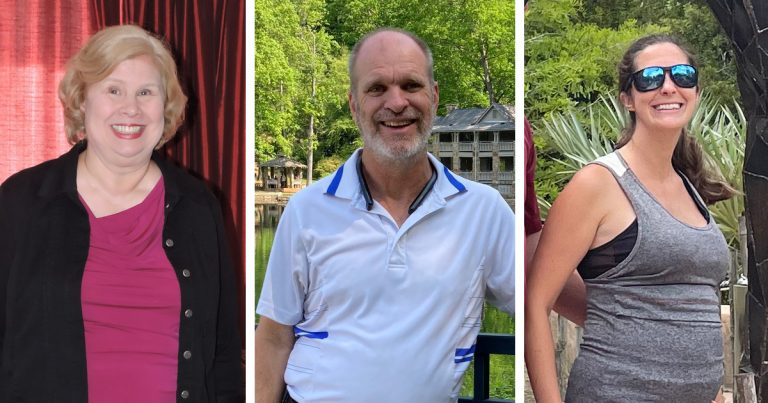
Linda Joy Wirth, Russ Davis, and Emily Townsend Cobb
Linda Joy Wirth
Blind since birth, Linda Joy Wirth, now 75 and living in Lakewood, Colo., was diagnosed with RP in the 1960s. Because she was told from an early age that nothing could be done for her blindness, she stopped thinking about her diagnosis and focused on her education, marriage, and children.
Then she thought: “You can never cure something if you can’t diagnose it.”
In the 1990s, she sought out a highly recommended doctor who treated her with a strong dose of cruel words.
“ ‘You’re blind. What do you want me to tell you?’ ” she recalled the doctor saying. “I was so distraught by the visit; I did not go back to the doctor for years and years and years.”
About 10 years ago, though, she went to a Foundation conference, where she received a referral to a Denver retinal specialist by the name of Dr. Alan Kimura, who changed her life.
“When I finally saw Dr. Kimura, I said I don’t even know why I’m here. I walked out two hours later, and I was walking on cloud nine. It’s so important to have the right retinal doctor.”
Dr. Kimura told her she had LCA. Genetic testing gave her a confirmed genetic diagnosis of LCA10, caused by mutations in the CEP290 gene.
Linda encourages people to get genetically tested to pinpoint the diagnosis, and then, like her, to be aware of the possibility of participating in a clinical trial to advance research into treatments and cures.
People told Linda along the way that because of her blindness, she shouldn’t marry or have children or follow her passion for acting. And, of course, she heard those stinging words from that earlier doctor: “ ‘You’re blind. There’s nothing we can do.’ ”
Linda is a retired clinical social worker in geriatric long-term care, an actor in a theater company, a Foundation volunteer, a mother of four, a grandmother of seven, a motivational speaker, and the author of “Just Because I Am Blind Does Not Mean I Can’t See!”
Russ Davis
Russ Davis, 60, of Jacksonville, Fla., still gets confusing information about the cause of his rare inherited retinal disease.
“One minute I hear it’s probably LCA, or no, that it’s classic RP. I got that at the conference.”
Some retinal experts do consider LCA to be a severe form of RP.
In 2019, Russ received a genetic diagnosis of LCA2, caused by a mutation in the RPE65gene. Dr. Stephen Russell at the University of Iowa told Russ he could have RP or LCA.
“ ‘It could be either one,’ ” he recalled the doctor saying. “ ‘But at your age with so few retinal cells, we’re not going to know.’ ”
Russ said he’s a little frustrated with the lack of a certain label for the disease, but it’s not going to change his life.
“The blindness part, that’s fine. I am who I am. It doesn’t control my life. But I’d like to have answers.”
These days, Russ is going with LCA.
His vision loss occurred at birth. Growing up he could read a book with a bright light, ride a bike, and he enjoyed long-distance running.
“I could see most everything, except at night when everything disappeared. When the sun went down, I was toast,” he said. “There was nothing there. There was darkness and light bulbs.”
His vision worsened early in his career in his mid-20s working for the State of Florida, looking for people who owed child support and wanted to stay missing. The job was fun for 30 years but about 10 years ago, with his vision getting worse and work getting harder, he retired.
Russ and his partner, Denise Valkema, were like a comedy team at the LCA session, riffing off each other’s words and making the Mix & Mingle group erupt in rounds of laughter.
Denise, who lives with optic nerve hypoplasia, which is an underdevelopment of the optic nerve, met Russ through the National Federation of the Blind. Denise served as NFB’s Florida Affiliate President for seven years.
They both serve on the organization’s board. Their priorities include working with Congress on myriad pieces of legislation to bring about better accessibility to medical care, computer technology, banking, voting, and more.
“The blind community is still not able to participate fully in society because we don’t have access to all the aspects of living that the sighted community has,” Russ said. “Try finding a talking blood pressure cuff.”
Russ advocates for people with diminishing eyesight, reassuring them that that life will go on.
“It’s all about your attitude. I try to tell them, no, that it’s not going to be easy. Lots of times, it’s going to be difficult. There are a lot of things to adjust to. You simply find new ways to do the things you were doing before.
“You can’t let your loss of eyesight define who you are or control you. You have to own it and not let it control you.”
And he lives his words.
“There’s so many times in life, you have the option to laugh or to cry, and I’m going to pick laughter. It would be very easy to pick the other one.”
Emily Townsend Cobb
With a 2½-year-old daughter, another one on the way, and a pediatric physical therapy career, we were lucky we had the chance to talk with Emily Townsend Cobb at the LCA session.
Doctors diagnosed Emily with RP at age 3. Now, 33, she received a confirmed genetic diagnosis in 2019 of LCA13, caused by a mutation in the RDH12 gene.
Emily is in that age group of people misdiagnosed for years before the advent of genetic testing.
“Thirty and over, that’s how it went,” she said.
Getting the confirmed diagnosis didn’t really change her life, especially because LCA13 research is in preliminary stages.
“Now I sit and wait for my number to be called,” Emily said, referring to the possibility of a treatment or cure for her form of LCA. “While we wait for all these things to happen, we have to live life.”
Emily’s husband, and her mom and dad accompanied her at the conference. Her father, Clay, introduced himself, saying, “Oh, I’m the proud father of two girls with RDH12 and I’d do anything to help them.”
As he broke into tears, his wife, Sue, leaned into him, saying, “He’s a crier.”
Without having to say much more, it became clear why Emily credits her family for their loving support and positive approach toward life.
She said she receives 150 percent support from her family.
“That support is so important for anybody, but especially if you have a disability.”
Doctors also diagnosed her 31-year-old sister, Ashley, with RP, and she later received a genetic diagnosis of LCA13 (RDH12).
Emily remembers reading newsprint as a pre-teen and playing soccer, but her vision profoundly worsened as a teen-ager, a tough time for any kid, but especially for her as she was losing her sight.
About the same time, she learned she had LCA but didn’t undergo genetic testing because genetic data was still being mapped out.
We talked with Emily after the session when she returned to her home in Jacksonville, Fla., where early on, she said, her mom set her up with a therapist who had RP, which helped build her confidence as a teen-ager.
She put off using a cane until college and in her sophomore year got her guide dog, a black lab named Fergie, now retired to pet life after 11 years of service.
“She’s currently snuggled up to me on the couch while I fold laundry,” Emily said as her little girl, Elora, napped.
Her second daughter is due in October. And, oh, did we mention she runs half-marathons and is a triathlete?
Emily takes part in triathlons with her husband, Ryan; they are tethered during the running and swimming races and ride a tandem bike for the cycling portion.
“If you ever want to test the strength of a marriage, blindfold one of you and tether to the other,” Emily quipped.
She and Ryan talked about the chances of their children being born with LCA. She recalled her husband saying, “ ‘Emily, if they’re going to end up as awesome as you, I want to.’ ”
They knew their children could be born with LCA, but they also knew the rarity of the disease. Emily said the chances of having a child with LCA are about one in 400.
“I’ll take those odds,” she said. “I’m pretty happy that I’m here.”
We learned about this research from Dr. Daniel C. Chung, Chief Medical Officer of SparingVision, an ocular genomic medicine company focusing on gene-agnostic or gene-independent therapy and gene-editing approaches to combat blinding diseases.
Dr. Daniel C. Chung
Hope in Focus featured Dr. Chung in its June 21, 2022, webinar episode titled “Let’s Chat About…Gene Independent Therapies for Rare Inherited Retinal Diseases.” Courtney Coates, Director of Outreach and Development, moderated the session which can be viewed here. “Let’s Chat About…” is our free webinar series bringing together researchers, advocates, industry leaders, and people living Leber congenital amaurosis (LCA) or other IRDs for conversations important to the rare retinal disease community.
Before his recruitment to SparingVision, Dr. Chung worked with Spark Therapeutics and focused on developing LUXTURNA®. The medicine injected under the retina became the first, and so far, only, gene therapy approved by the U.S. Food and Drug Administration (FDA) and the European Medicines Agency (EMA) for use in a blinding genetic disease called LCA. The drug targets IRDs due to variants in the RPE65 gene, known as LCA2 (RPE65), which is one of 27 identified forms of LCA, and helped improve vision in people who underwent the procedure that involves a subretinal injection of the medicine into each eye.
Dr. Chung served as the Ophthalmology Therapeutic Leader for Spark, where he led the medical affairs group and contributed to clinical development and operations, marketing, business development, patient advocacy, and preclinical research and development.
With more than 300 genes causing IRDs, and research underway involving myriad programs in academia and the biotech industry, Dr. Chung explained the focus of the company headquartered in Paris with offices in Philadelphia.
“What we are trying to do at SparingVision is to look at some of the ways we could do gene-independent approaches, which means we’re not necessarily correcting the genetic defect, but using other genetic parameters where we can help slow down the degeneration of disease in a gene-independent way.”
Slowing down retinal disease progression
Dr. Chung said one of the company’s preclinical research programs seeks to preserve cone function in people living with rod-cone dystrophies, concentrating on the most common form, retinitis pigmentosa (RP), which is a group of related eye disorders that cause progressive vision loss as the retina’s light-sensing cells deteriorate. The disease affects 2 million people worldwide, or about 1 in 3,500 individuals.
RP affects rod photoreceptors that provide periphery vision, along with night, dim light, and side vision, while cone photoreceptors in the middle of the eye provide the best visual acuity, color vision, and daytime vision.
The team, which also included Dr. Saddek Mohand-Said, was the first to hypothesize and demonstrate that rod photoreceptors produce a protein that rescues cone photoreceptors, thereby maintaining – and prolonging – light-adapted and high-resolution vision.
They discovered what they call Rod-derived Cone Viability Factor or RDCVF, produced by the NXNL1 gene, which has two forms – a short form and a long form.
“Basically, the short form is a survival factor,” Dr. Chung said, “a factor that occurs naturally in everyone’s eyes, where these rods cells that are on the periphery secrete a protein that attaches to cone cells, and through this long mechanism of metabolic activity helps to protect the cone cells and keeps them functioning and their structure moving forward. So that’s what happens normally.
“But in diseases where you have rod cell death, you don’t have that factor being produced anymore and that’s why it’s gene independent because it really doesn’t matter why your rods are dying. It simply matters that they’re not there to produce that factor and that factor’s necessary to keep your cones functioning, to preserve vision.
“So, by using gene therapy, we’re putting that factor, RDCVF, back into the eye of patients and hopefully we’re able to slow down the degeneration of their cones, and the cones are again for your central vision, your daytime and color vision, and we hope to be able to extend that a significant period of time. As you know, most RP types have a relatively slow degeneration, so if we were able to slow that down by 40 or 50 percent, you would have significantly longer usable vision.”
The gene produces two different factors, the secreted short form and another long form that acts as a powerful antioxidant. We’ve all heard about eating your blueberries and cranberries because they are healthy and high in antioxidants, he said.
“That’s something that works within the retina as well because the retina uses more oxygen than any other organ in the body by gram weight. And because of that, there’s a lot of reactive oxygen species that are produced and so you have to dampen those, and this is what we call the long form of RDCVF.
“The long form works by being a powerful antioxidant, so that coupled with the other property of the secreted form, the two act together to help cone survival.”
Restoring Cone Cell Function
SparingVision’s second research program focuses on another factor. Preclinical research under the guidance of SparingVision Chief Scientific Officer Dr. Deniz Dalkara deals with restoring function to cone cells that have lost the ability to function, but their cell body remains.
These dormant cones are viable cones with diminished outer segments that no longer respond to light, as such that the patients’ light response decreases, and they become unable to see. Since the phototransduction cascade – the process through which photons, or elementary particles of light, are converted into electrical signals, which allows for normal vision – occurs in the outer segment of the cones, these dormant cones are no longer capable of converting light into an electric signal, leaving patients with decreased vision and, as the disease progresses, blindness.
SparingVision research involves an injection that provides dormant cone cell bodies with a channel protein that would allow to restore a short phototransduction cascade within the dormant cone, restoring electric signals, and thereby possibly restoring light sensitivity, visual acuity, and color vision.
“This we believe will actually restore function to cone cells that have lost the ability to function, but their cell body remains. In retinal degeneration, we see that the function is lost, and certain types of structure is lost, but the main cell body stays intact,” he said.
“You can revive those dormant cone cells and thereby restore some level of vision. Again, it doesn’t matter why they degenerated, so it’s not gene dependent because we’re not correcting the gene that caused the degeneration, but we’re adding another factor in that.
Dr. Chung said human trials will start “we hope, very soon.”
He also described the company’s CRISPR gene-editing research, in which the therapy acts as molecular scissors, cutting or editing out gene misspellings that cause dysfunction.
Regarding the company’s research projects, Dr. Chung said, “We’ve gone from one end, where we are gene independent and then we’ve gone all the way to the other side, where CRISPR is not only gene dependent, but it’s also dependent on the misspelling within that gene, and each gene has a lot of misspellings that can cause disease, and so this is a little more targeted.”
Genetic Testing Still Necessary
Dr. Chung said it is still critical that people get a confirmed genetic diagnosis through genetic testing, accompanied by genetic counseling.
“Even though we may be gene independent, I think that the idea is we still want to encourage people to get their genetic diagnosis.”
A definitive diagnosis will help people understand their retinal disease, learn about rates of disease progression, and get connected with patient community organizations, such as Hope in Focus, he said.
On SparingVision, Dr. Chung said the business is not just a gene therapy company.
“We totally think of ourselves as a genomic medicine company, and that’s really using all the genetic tools that are in the toolbox to combat these inherited retinal diseases or ocular diseases in general.”
The company wants to work on many different approaches to have more choices for a tailored therapeutic option.
“We just want to do as many different strategies as we can to try and get more options for patients. I think obviously it would be great to be in a world where it’s not a matter of having one therapeutic option but to have several therapeutic options that are tailored toward where you are in your disease progression and what fits best for you and the inherited retinal disease or ocular disease that you have.”
After crazy months of looking for answers to questions about her infant’s vision, Melissa Matias learned her baby girl, Dylan, had a form of Leber congenital amaurosis known as LCA6 caused by mutations in her RPGRIP1 gene, a protein needed for healthy photoreceptors.
“I put my big-girl pants on and said, ‘This is the card she and I have been handed.’ ” The Georgetown, Texas, mom added: “There’s a reason for this.”
When Dylan received her confirmed genetic diagnosis in May 2020 at age 5 months, her mother did not assume someone else had the time or resources to search for a treatment or cure for her daughter’s form of blindness. Melissa organized people, advocates, and information. She created the RPGRIP1.com website and began collaborating with the nonprofit biotech Odylia Therapeutics on a $4 million fundraising effort to advance therapy for the RPGRIP1 LCA6 program.
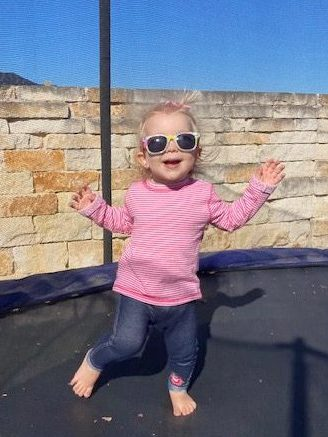
The Atlanta-based biotechnology company is in late-stage preclinical trials, with the goal to be in clinical trials in about two years. Melissa is hoping Dylan – a gregarious trampoline-jumping gymnast – will benefit from this developing gene therapy.
Dylan on her trampoline
“We aren’t trying to fix or change Dylan. There’s nothing wrong with her. But if there’s a chance for gene therapy to enhance her life, you would want to do that,” she said. “Blindness doesn’t mean darkness. It means ‘I can do this; I just might need to do it in a different way.’ ”
Dylan’s doctor told the Matias family that the possibility of sight-saving therapy coming to fruition was not a matter of if, but when.
“This therapy, if it’s in reach, let’s get going,” Melissa said. “Let’s get the word out and open the door to gene therapy, not just for RPGRIP1, but for other genetic visual impairments and rare diseases.”
Financing poses the major obstacle. Melissa enlisted the help of patient families and organizations, such as Hope in Focus, to help spread the word and secure necessary funding to bring the treatment to market. About $115,000 has been raised, including donations from Dylan’s brothers, 8-year-old Colton and 12-year-old Brayden.
Funded by Massachusetts Eye and Ear and the Usher 2020 Foundation, Odylia Therapeutics started in 2017 with the goal of facilitating treatments for low-prevalence retinal disease with proof-of-concept science to Phase I/II/III clinical trials.
LCA6/RPGRIP1 Gene Therapy – Following LUXTURNA® Path
The gene therapy uses vector technology developed by Odylia Co-founder Luk Vandenberghe, PhD, Director of the Grousbeck Gene Therapy Center at Mass Eye and Ear, and Assistant Professor of Ophthalmology at Harvard Medical School. The research builds on proof-of-concept data generated at Mass Eye in the labs of Vandenberghe and Eric Pierce, MD, PhD, a physician and surgeon at Mass Eye and the William F. Chatlos Professor of Ophthalmology at Harvard Medical School.
LUXTURNA® currently is the only gene therapy on the market. Developed by Spark Therapeutics and federally approved in 2017, the drug treats a form of LCA known as LCA2(RPE65), and it is the only gene therapy approved in the United States for any inherited disease.
Odylia hopes to follow in LUXTURNA’s path with its research. Delivered by injection under the retina in each eye, LUXTURNA® has helped improve vision in patients for the last four years.
“The success of LUXTURNA has proven to be life changing for many patients,” Odylia said in a news release. “It’s very exciting that with the efforts of Odylia, those affected with RPGRIP1 mutation could possibly have the same opportunity in the near future.”
Developing treatments and administering them to young patients is paramount to stall vision deterioration, as LCA6, along with the more than 27 forms of LCA, is degenerative.
Odylia says its goal is to bring proven therapeutics to patients, regardless of the number of people with the disease or the opportunity for a company to make money.
By identifying promising treatments, the company said it can partner with patient groups, community experts, and financial sponsors to develop strategic, scientific, and clinical plans. Through collaboration with industry and foundations, the organization said it can move treatments from concept through development and to patients with rare diseases.
These partnerships are needed for the estimated $3.9 to $4.3 million in development costs to advance the research through toxicology studies and fund clinical manufacturing costs. Odylia says it will work to lower costs and reduce overall expenses.
Partnerships and funding also will help with Odylia submitting an Investigative New Drug (IND) application to the U.S. Food and Drug Administration. Federal law requires that a drug be the subject of an approved marketing application before it is transported or distributed across state lines. Because a sponsor will probably want to ship the investigational drug to clinical investigators in many states, it must seek an exemption from that legal requirement. The IND is the means through which the sponsor technically obtains this exemption from the FDA.
“Receiving orphan drug and rare pediatric disease designations represents an important milestone for Odylia and recognizes the potential of this gene therapy to deliver life-changing results to LCA6 patients and RPGRIP1 associated retinal dystrophies,” according to Ashley Winslow, PhD, Odylia’s Chief Scientific Officer.
Between 400 and 600 people are affected with LCA6 in the U.S., with about 20,000 globally.
Orphan drug designation is granted to therapeutics intended for treatment, diagnosis, or prevention of diseases affecting fewer than 200,000 people in the United States. Rare pediatric disease designation is granted to serious or life-threatening rare diseases that primarily affect individuals under age 18. Orphan drug and rare pediatric designations provide companies like Odylia with benefits, including access to research grants to support clinical studies, waiver of regulatory fees, seven-year marketing exclusivity, and eligibility for a priority review voucher.
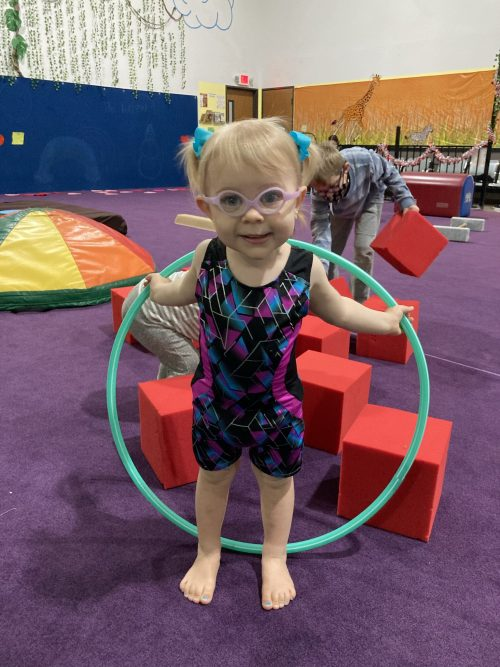
At the gym
Struggle to Find Confirmed RPGRIP1 Diagnosis
Melissa’s persistence pushed her through incredibly trying times, having six back-to-back miscarriages during 2016 and 2017 after having her two sons. Two years later, she and her husband, James, got the news she was pregnant with Dylan.
“She was so meant to be,” Melissa said. “It was unreal when it came time to deliver. Everyone in that room was crying.
“They had all seen on my chart that I had 10 pregnancies. They were all just like…” she said trailing off. “It was such an emotional time.”
Two months later, though, Melissa and James realized something didn’t seem right with Dylan’s vision; her eyes jerked from side to side from a condition known as nystagmus. It was February 2020 with the tentacles of COVID spreading over the globe, creating an overworked, overwhelmed medical world focusing on patients infected with this strange new virus.
Finding an initial diagnosis for Dylan proved extremely difficult, especially when one doctor said nothing was wrong, probably just delayed maturation of vision, and another mentioned LCA but brushed it off. So, Melissa did what we all do now when we don’t get answers: She Googled the disease.
“The more I learned about LCA, I knew in my heart right away what we were looking at. But I’d also think, it’s so rare, what are the chances?”
She also learned the next step to move forward with treatment or care for 2-month-old Dylan depended on a confirmed genetic diagnosis determined through genetic testing.
No genetic testing, not now, she was told. Not until COVID is over. Melissa wasn’t waiting for the end of the pandemic, now into its third year. She knew she needed a doctor’s order but hadn’t yet connected with a retinal specialist; she sought out the help of Dylan’s pediatrician, a doctor she characterized as amazing, who ordered the test.
Waiting for the results, Dylan’s parents scheduled an appointment for May 28with a Houston retinal specialist; the confirmed diagnosis of LCA6/RPGRIP1 came through May 27, paving the way to finding resources in orientation, mobility, and education for Dylan.
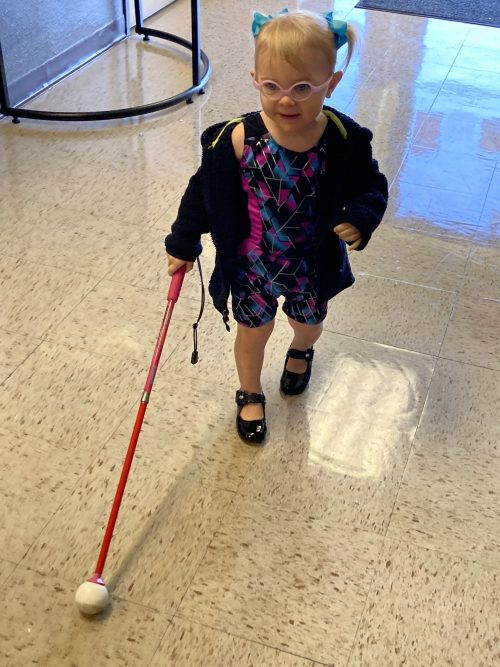
Dylan using her cane
Living with LCA6/RPGRIP1 / Like Mother, Like Daughter: Stubborn and Persistent
Dylan is now 2 years old. Her parents believe she has tunnel vision and does best seeing objects 10 or 15 feet away. She’s better now at keeping her glasses on, rather than ripping them off all the time like she used to.
On her first day of Orientation and Mobility training, she picked up a cane and used it just the right way, a milestone the instructor said he had never seen in a child her age.
“Indoors, she’s just amazing,” Melissa said. “She loves picture flashcards, playing in her toy kitchen, always wants someone to read her books, and she loves her new mini trampoline she got for Christmas. And music – she loves to sing and dance.”
Dylan takes her time in new environments and is a little more cautious than other toddlers because of her visual limitations. With photophobia being one of the symptoms of LCA, Melissa said her daughter finds bright outdoor sunlight to be the most challenging and where she relies more on her cane skills.
The little girl also is very vocal and visual.
“Her vocabulary is comparable to a child much older than 2,” Dylan’s mom said. “We know she is very visual, something we feel blessed with, since LCA can present with a wide range of visual capabilities. We’ve actually had to teach her to bend down and feel for objects she drops, because her instinct is always to look for something first.”
She’s also persistent.
“She has a very strong desire for mastery, having to do things over and over again. She likes a challenge.
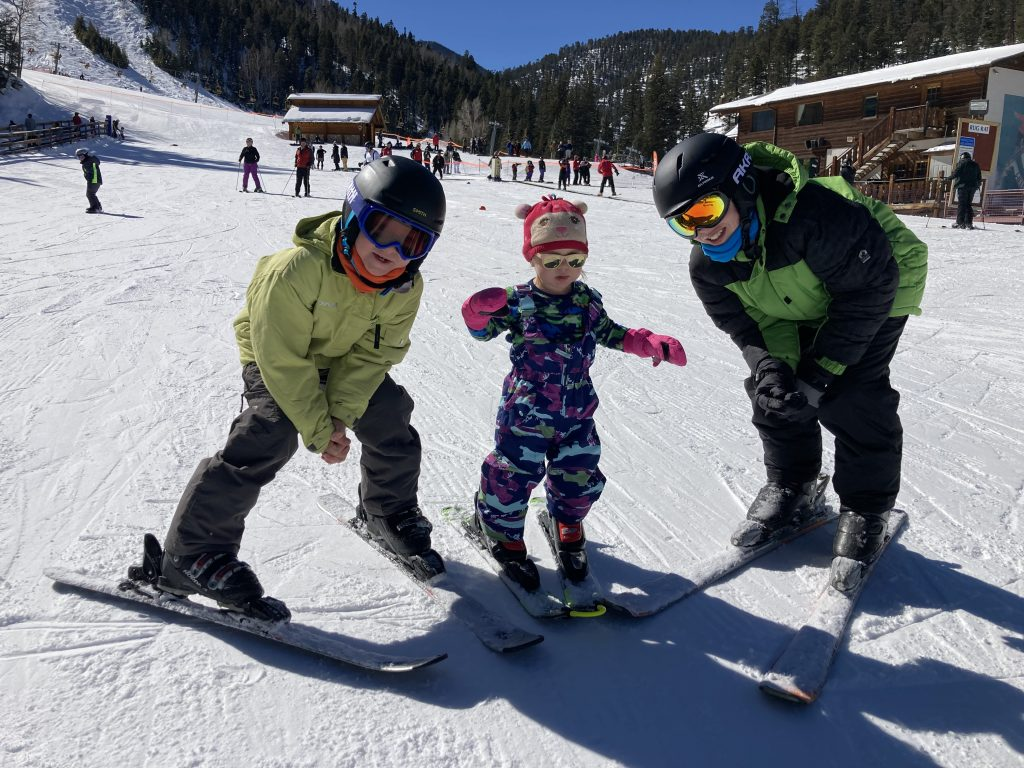
“I have no doubt this girl is going to change the world. No matter what happens if gene therapy comes about for her or not. She’s going to be on skis this winter. I’m not going to give her an excuse not to do something or at least to not try.
“She can and will do anything she wants, just in her own ways. Stubborn and persistent, exactly what she needs.”
Daniel de Boer told a Hope in Focus webinar audience that his company’s mission is to help patients by creating RNA (ribonucleic acid) therapies that aim to stop vision loss or even reverse some of the symptoms caused by IRDs.
Daniel de Boer
“We see that there’s a large unmet medical need, as there are more than 5 million people in the world who have a form of an inherited retinal disease and just very few of them have treatments available for them and at ProQR our plan it to change that,” de Boer said in our January session, which can be viewed here.
In the episode called “Let’s Chat About…ProQR’s work in treatments for inherited retinal disease,” he described the company’s projects involving sepofarsen, explained RNA therapy versus DNA therapy, and discussed the method of administering the treatment to patients. The session is part of our free monthly series developed with those living with LCA and IRDs in mind but open to anyone interested in what’s happening in our communities.
After one of de Boer’s children was diagnosed with a rare disease, he started the Dutch biotechnology company to develop RNA therapies for rare diseases. Under his leadership, ProQR developed a platform that yielded a diversified pipeline of potential treatments for rare diseases and raised more than $400 million in funding. Before starting ProQR, he founded several technology companies.
De Boer also is co-founder and strategic advisor to Amylon Therapeutics and Wings Therapeutics, strategic advisor at Frame Therapeutics, Meatable, Algramo, and a member of the advisory board at the Termeer Foundation. He was named “Emerging Entrepreneur of the Year” in 2018 by EY, the multinational professional services network Ernst & Young, and in 2019 was selected for the Young Global Leader program at the World Economic Forum.
Sepofarsen and multiple studies on LCA10 and other IRDs
De Boer said ProQR expects results in the coming months from its Phase 2/3 Illuminate clinical trial of sepofarsen in LCA10 caused by a mutation in the CEP290 gene.
Sepofarsen is an investigational RNA therapy that aims to restore vision in people living with LCA10 due to the p.Cys998X mutation in the CEP290 gene.
Researchers initiated the trial based on data from a Phase 1/2 study that indicated patients treated 12 months with sepofarsen showed improvement in visual acuity measured by best-corrected visual acuity (BCVA).
Earlier this month marked the end of the Phase 2/3 trial, when de Boer said, “The last patient having completed their 12-month visit is an important milestone toward the top-line results from the Phase 2/3 Illuminate trial of our lead program for sepofarsen for LCA10.”
Other major projects underway at ProQR include:
Brighten, a clinical study for children under age 8 living with LCA10;
Aurora, a clinical trial of QR-1123 in Phase 1/2 for RP, due to the P23H mutation, also known as c.68C>A, in the rhodopsin (RHO) gene;
QR-504a, an investigational RNA therapy that aims to slow down degeneration of the cornea and thereby vision loss in people with Fuchs endothelial corneal dystrophy due to the most common mutation.
You can learn more about ProQR’s studies by visiting the company’s website and/or emailing Andy Bolan, Associate Director of Patient and Community Engagement at patientinfo@proQR.com
RNA therapies repair DNA without changing DNA
De Boer explained in the webinar: “RNA therapy is innovative technology that treats genetic eye conditions such as LCA10 or Usher Syndrome and it is important because the RNA help to carry out the instructions that are in the DNA to make proteins.
“We’re all familiar with genes and DNA that we have in our cells and the RNA is essentially helping to carry out the instructions that are described in the DNA, which is to make certain proteins and these proteins are critical to the healthy functioning of a cell.”
In LCA10 the gene mutation gets copied into the RNA and causes a loss of protein so that the protein is not functioning or missing altogether, leading to a cell unable to work well or even die over time, he said.
ProQR is developing RNA therapies for a range of diseases, including their lead sepofarsen therapy.
“RNA therapies can repair the DNA without altering or changing the DNA, so we don’t have to touch the DNA. We don’t have to change any of the genes, we can leave all of that untouched and we can alter the RNA in between so that cell can make its own functional and healthy proteins.”
Explaining the difference between RNA therapies and DNA therapies, de Boer began with the billions of cells, our DNA, the library of our genes.
“The DNA is copied into the RNA and the RNA is essentially a blueprint that then makes proteins and proteins are expressing in your cells through all kinds of different tasks and essentially that is what makes our bodies function.
“Now, with RNA therapy, what we can do is we can repair the blueprint so we give it an RNA therapy that repairs the blueprint and from this repaired blueprint, the cell can now make its own new functional protein.”
On the other hand, DNA therapy, or gene therapy, replaces the gene into the DNA, which then expresses RNA that makes protein.
Different delivery mechanisms in RNA and gene therapies
De Boer also made the distinction between the delivery systems of RNA therapy and gene therapy and described the advantages of the RNA route.
Gene therapies often require a viral vector, meaning that the therapy is packaged in a virus made in a way that it is no longer harmful to humans. The treatment is delivered through subretinal injection.
“It is used as a delivery system, so this virus is then loaded with the new gene and injected into the back of the eye where it then is entering the cells and expressing the protein.”
RNA therapy is delivered through intravitreal injection (IVT), which entails an injection in the side part of the eye – the wide part of the eye – in a 15-minute procedure.
“Through that route of administration, we have a big advantage that we can treat the entire retina, so only with a small injection in the side of the eye, the RNA therapy will distribute itself throughout the entire eye and will go to all different parts of the retina. That means that we can treat the central retina, as well as the peripheral, which allows us, for example, also to treat early-stage disease, which generally started in the outer part, in the peripheral part of the retina.”
RNA therapies generally need to be administered twice a year in each eye for a sustained benefit over lengthy periods of time.
Lab-grown retinas enhance research process
ProQR is among those biotechnology companies finding new ways to improve efficiency in research, thereby accelerating the process in bringing retinal disease treatments and cures to market.
The company’s researchers grow organoids from skin samples to produce a human retina in the lab.
“From this retina we can then test the activity of our therapeutics so we can administer drugs on these retinal organoids, which then tell us in the lab already if they’re going to be functional, if the drug is going to work once we give it to a person.
“All of this is obviously in a testing phase still, so we can’t have 100 percent certainty that the preclinical model will always be predictive, but so far we have seen that in both sepofarsen and in Usher, the model was spot-on in predicting the activity and also the active dose level that we had to give once we started clinical trials.
“If you think about that I think there is really potential to find more synergies and speed up the development from preclinical to approval once we generate some more data across more of these programs that can help us to validate the correlation with the preclinical models to potentially really accelerate the development timelines.”
ProQR’s beginnings
Daniel de Boer started ProQR about 10 years ago after his son was born with cystic fibrosis (CF). He focused on CF until another company developed a good therapy for the rare disease.
Headquartered in Leiden, Netherlands, with offices in Cambridge, Mass., ProQR reinvented itself over time as a global ophthalmology company.
De Boer developed a partnership with Professor Rob Collin, PhD, from Radboud University in the Netherlands. The molecular geneticist had discovered an LCA10 RNA therapy that evolved into sepofarsen, and clinical trials began in 2017.
By the next year, an interim analysis showed examples of transformational improvements in vision, de Boer said.
One participant began by only being able to perceive light – day or night, no shape, motion, form, or color.
“After a single dose of sepofarsen, this participant then improved his vision such that he could now read, he could recognize people’s faces, and he could essentially navigate the world independently for the first time in decades.
“We saw the hypothesis confirmed that RNA therapy in the eye could potentially make a really meaningful impact. So fast forward to today, we completed our Illuminate Phase 2/3 pivotal trial for sepofarsen recently and are now awaiting the results.”
The rare disease causes hearing loss, balance problems, difficulty with gaze stabilization, and progressive vision loss. In childhood or by early adolescence, individuals with USH1F will develop retinitis pigmentosa (RP), an eye disease that causes night blindness and a gradual loss of peripheral vision.
“The main purpose of a study like this is to help design clinical trials in the hopes of accelerating the research process, making sure the design is well-targeted, not too onerous and not too burdensome,” said Todd Durham, Foundation Vice President of Clinical & Outcomes Research. He described the study during a recent Sofia Sees Hope webinar about the Foundation’s My Retina Tracker® patient registry.
“If we can develop a way to measure the progress of the disease in the absence of a treatment, we can decide whether the follow-up period after administration of that treatment should be two years, would one year suffice, and what tools do we ultimately judge the efficacy of that new treatment.”
Joseph F. Smith has been legally blind since birth. He lost what little sight he had in his mid-30s, when he learned he had Leber congenital amaurosis (LCA). Thirty years later, genetic testing revealed a mutation in his CRB1 gene, a diagnosis known as LCA8.
More than 40 leading experts in ophthalmology and gene research gathered virtually for more than five hours in February to share research and patient perspectives on CRB1 and identify the next steps to advance treatment for the patient community.
The CRB1 gene provides the body with instructions for making a protein that plays an essential role in normal vision. This protein is found in the brain and the retina, which is the specialized tissue at the back of the eye that detects light and color.
Alice and Joe
While the biology for CRB1 is particularly complex, early research produced the discovery of a new version, or isoform, called CRB1b. Preclinical studies give rise to new questions as to whether CRB1a or CRB1b expression, or both, should be the target of a gene therapy. Click here to view the webinar.
In his letter, Joe wrote: “I won the CRB1 lottery 76 years ago and spoke briefly during the webinar.”
When we spoke to Joe by phone, he wanted to know what he could do to reassure parents of children who are blind or visually impaired that they can thrive.
Joe earned a law degree from Cornell Law School after graduating as a math major at Alfred University in upstate New York. He worked at the New York City Corporation Counsel’s Office in the Real Estate Tax Division for three years.
While working, Joe began his teaching career at New York’s Dominican College where he taught a business law course. He taught law at the University of Baltimore Law School in 1973, and three years later accepted a job at Fort Lauderdale’s Nova Southeastern University School of Law, where he became a tenured professor and taught for more than 30 years.
He is retired, living in Florida with his wife of 51 years, Alice.
The Importance of Learning Braille
Joe’s 76-year journey began long before the enactment of the Individuals with Disabilities Education Act and the Americans with Disabilities Act, Congressional civil rights legislation prohibiting discrimination and guaranteeing that people with disabilities would have the same opportunities as everyone else. He said he was fortunate to receive scholarships from an earlier version of the Rehabilitation Act of 1973 to fund his higher education.
People with vision difficulty or other challenges must still vigorously advocate for accessibility and equality, but those roads were even bumpier in the past.
Before retiring, Joe developed a course on the rights of people with disabilities. He also created a program in which he supervised students working for organizations providing services for people with disabilities.
He understands that ever-evolving technology greatly helps people with vision loss, but he is a proponent of learning braille.
“One thing I do think is very important is that a child who is losing sight or is blind needs to learn braille. I know many educators will say with accessible computers, cell phones, and recorded materials, braille is unnecessary. My simple response is, ‘All that technology is available to sighted people, but they still use pens and pencils.’
“If you learn braille, you have something to keep in your mind. You have a physical image of the written word.”
With CRB1, Supportive Parents and Friends
Joe believes much of the credit for his success goes to his blue-collar parents who did not graduate from high school.
“I can’t imagine what it must have been like for them to find out I was blind and with no explanation as to why.”
Early on he could distinguish basic colors and he can still see red and orange in his mind’s eye.
Growing up in the 1950s, “back in the dark ages,” Joe said his parents knew that the local Catholic school was not going to work for him because it offered no resources. His mother wanted to wait a year for him to go to first grade, but his father said no. A learning disability kept Joe’s dad back a year because he could not read, prompting him to quit school in eighth grade to play baseball.
“He knew that education was important.”
Joe attended Lavelle School for the Blind run by Dominican nuns in the Bronx, leaving home Sunday nights and returning Friday afternoons, through eighth grade.
Lavelle served Joe well, but he wanted to attend a regular high school – any school that would take him, as mainstreaming was not a big goal back then and schools were not obligated to accept students who were blind.
He went to Archbishop Stepinac High School in White Plains run by the Archdiocese of New York. His senior year, another blind student was accepted to the school.
Math books in braille were in short supply and books in general were hard to get, so his mom read to him – a lot.
His dad also rarely said no to him trying new things. He rode around the neighborhood on his bike, enjoyed daredevil sledding, and loved cars in high school. His dad took him to an empty parking lot and taught him how to drive a stick-shift.
But the pièce de resistance for this self-described car nut came when he slid behind the wheel of an automatic BMW for the ride of his life on the skidpad at a defensive driving school.
“Truth be told, my wife was taking the course, but the instructors snuck me out for an unforgettable hour of bliss.”
I guess what I’m trying to say is a child who is blind should be encouraged to develop interests in and to try activities, which, at first blush, might not seem suitable for a child with limited or no sight.
His best friend in grammar school read him comic books, and as they got older, car magazines. They didn’t go to the same school, but they managed to get into trouble together and often double dated.
He excelled in math and thought he might be an engineer, toyed with psychology, and after Alfred University, decided to go to law school.
Practicing and Teaching Law
Joe met Alice on a blind date in his second year of law school when she was a sophomore at New York’s Wells College. She earned a Bachelor of Arts and worked in the Criminal Division of the Legal Aid Society of Westchester County while pursuing her master’s degree in early childhood education at Manhattanville College. They married in 1970.
Joe did well in law school and said he knew if he were not blind, he would have received more than one job offer after graduation. He received many rejection letters, heard many excuses, and sometimes heard nothing at all after interviews.
Still, he almost did not interview for that one job offer; only after repeated urgings from different people, he did so and got the job at New York City’s Corporation Counsel’s Office, which already employed a blind lawyer in the Real Estate Tax Division.
Recounting his getting the job despite almost not interviewing, Joe invoked an ancient adage: “Luck is what happens when preparation meets opportunity,” words from Roman philosopher Seneca, reminding us that we make our own luck.
After three years of practicing tax law, Joe wanted to try something else, perhaps be a trial lawyer or a teacher. He and Alice drove out to Colorado where he planned to take the Colorado bar exam, but the day after they arrived, he was offered a teaching job at the University of Baltimore.
Before returning East, he and Alice goofed off and he learned how to ski, loving the feeling of freedom, and losing his fear of speeding down a mountain.
When they moved to Baltimore, Alice, who worked at the Baltimore Museum of Art, read for Joe from textbooks.
“Most importantly, from that time until I retired from teaching in 2007, she read all of my exams and papers to me.”
Getting a Confirmed CRB1 Genetic Diagnosis
Joe was diagnosed in his late 20s with retinitis pigmentosa (RP), but he thought it wasn’t correct for several reasons, including that people with RP lose peripheral vision and, in his case, he lost central vision.
Joe and Alice met Gordon and Lulie Gund while learning to ski at Snowmass in Colorado. The Gunds co-founded Foundation Fighting Blindness in 1971 to fund research for treatments and cures for blinding retinal diseases after Gordon was diagnosed with RP and ultimately lost his vision in 1970. He is a Foundation director and chairman emeritus.
Gordon came back into Joe’s life in the 1990s when he invited him to a Foundation dinner. There he met Iowa State University’s Edwin Stone, MD, PhD, who spoke of emerging research into gene therapy targeting a form of LCA and suggested Joe get genetically tested.
Joe and Alice
Joe’s genetic test showed his LCA was due do a mutation in his CRB1 gene, not the RPE65 gene, the focus of the research that led to the 2017 federal approval of LUXTURNA®, the first gene therapy for the eye or an inherited condition. People with LCA2 (RPE65) cannot make a protein needed by the retina to convert light into vision-enabling signals, which are sent to the brain. The breakthrough therapy involves injecting under the retina a human-engineered virus containing copies of a normal gene, so cells can express the protein.
In the CRB1 Research Update webinar, Joe said he was fortunate to have lived near a teaching hospital where he could learn about the cause of his blindness. In the Q&A, he asked where people with visual impairment should turn for help when living in rural areas with less accessibility to universities or large hospitals.
In answer, Ben Shaberman, Senior Director of Scientific Outreach and Community Engagement for the Foundation, said a team is working nationwide to educate eye-care professionals about LCA and other rare inherited retinal diseases (IRDs), so they can refer patients to specialists. He also encouraged people to email the Foundation at info@fightingblindness.org for contacts in the academic and medical worlds of retinal specialists and researchers.
Laura Manfre, Sofia Sees Hope Co-Founder and President, said people can follow the Foundation and Sofia Sees Hope websites for information and research news. They also can email their questions and concerns to info@sofiaseeshope.org.
As a lawyer, a law professor and a man diagnosed only a decade ago with CRB1, Joe said, “I’m not trying to paint an overly rosy picture of the challenges we face. I realize I am a minority, as I’ve been employed continuously from law school graduation to retirement. I also know with my class rank, I should have had more than just one job offer coming out of law school. At the same time, I realize that technology that was not available to me then has opened up many more opportunities for us …
“I guess what I’m trying to say is a child who is blind should be encouraged to develop interests in and to try activities, which, at first blush, might not seem suitable for a child with limited or no sight.”