Raising Awareness by Sharing Rare Disease Stories

Had he received a more definitive rare disease diagnosis in 2003, Alan Gunzburg said he might not have lost so much vision and still might be able to drive.

In 2016 – 13 years after his initial diagnosis – the Greenwich, Conn., man learned his vision and hearing loss was caused by Adult Refsum Disease (ARD), a genetic metabolic disorder with symptoms that perhaps he could have staved off years ago through dietary restrictions. 

Doctors initially diagnosed Gunzburg with retinitis pigmentosa (RP) – a rare inherited retinal disease (IRD) causing progressive loss of peripheral and night vision. Those are also symptoms of Refsum disease, which, if undiagnosed, can be life-threatening. 

The disorder results in a buildup in the nerves and liver of phytanic acid, a type of fat found in certain foods. Other symptoms are loss of smell and hearing, numbness, unsteadiness, itchy skin, and shortened fingers and toes.

Gunzburg joined more than two dozen speakers who shared their stories during a Feb. 26 virtual Connecticut Rare Disease Day celebration sponsored by the National Organization for Rare Disorders (NORD) and the Connecticut Rare Action Network (RAN)

Read Hope in Focus (formally Sofia Sees Hope) 2021 Rare Disease Day letter to our elected representatives

His story reflects the plight of many people living with a rare disease because the more than 7,000 rare diseases in the United States are just that – rare. 

It’s difficult to correctly diagnose rare diseases when little information exists about them.

Some families living with rare disease find they must create their own advocacy avenues to educate the public and the medical community about diseases they’ve never heard of.

Gunzburg created the Global DARE Foundation with the mission of Defeating Adult Refsum Everywhere. His website gets the word out about the disease and gives information on symptoms, treatments, and research. 

Laura Manfre, co-founder and board president of Hope in Focus (formally Sofia Sees Hope), took that same route in 2014 after doctors genetically diagnosed her daughter with a form of Leber congenital amaurosis (LCA). As a global patient advocacy organization, Sofia Sees Hope helps transform the lives of those affected by blindness caused by LCA and IRDs by generating awareness, supporting affected families, and raising funds to advance research for diagnosis, treatments, and cures.

Creating Rare Disease Advisory Councils

The global phenomenon of Rare Disease Day exists to create awareness of rare disease, characterized in the United States as affecting fewer than 200,000 people. With more than 7,000 rare diseases, 25 million to 30 million Americans are affected by rare disease. That means one in 10 Americans suffer from rare diseases, and more than half of them are children. The European Organization for Rare Disorders (EURODIS) organizes the international campaign.

Nationally, Rare Disease Day brings together each state’s RAN ambassador – in Connecticut’s case, Volunteer State Ambassador Lesley Bennett – along with patients, caregivers, doctors, advocates, legislators, academics, and business and biotech leaders to generate awareness, increase patient and caregiver support, and drive research for treatment and cures.

This year’s event focused on creating Rare Disease Advisory Councils (RDACs) in all 50 states through NORD’s Project RDAC. Councils are made up of various stakeholders, including patients, caregivers, doctors, insurers, biotechnology companies, researchers, and state officials.

Project RDAC’s goals are to optimize existing councils and increase the number of groups nationally by opening collaborative opportunities among councils, creating educational resources to guide them, and helping more states pass legislation that establishes high-functioning councils.

More than a dozen states have RDACs, 12 are pursuing RDAC legislation, and another 23 states do not have an RDAC.

Connecticut is working toward creating a permanent RDAC task force, after a temporary group disbanded in 2019. Check out this map to see if your state has an RDAC or if NORD is working on legislation to create one. To start an effort in a state, click here

NORD’s Kristen Angell moderated the virtual celebration that featured more than two dozen people, sharing stories about the struggles and successes in the world of rare disease. A recording of the celebration will be available soon.

Suzanne Candela literally told an uplifting story as outreach and mission coordinator for Patient Airlift Services (PALS) with the motto: “Going Above and Beyond to Lift People Up.”

Volunteer pilots help eliminate logistical barriers to treatments by using their own aircraft, fuel, and time to fly patients to appointments. Over the course of 10 years, the company helped 2,900 families in 23,000 flights, covering more than 5.4 million miles. Candela told of a girl flown from northern Maine to Boston for repeated cancer treatments. The patient has flown on PALS flights about 60 times and counting.

The service could eliminate transportation barriers for participants in out-of-state clinical trials. The company also has flown 900 flights bringing combat-wounded veterans to appointments.

Connecticut State Sen. Cathy Osten described the story behind proposed legislation that she and State Rep. Christine Conley introduced this session to help a local family struggling to pay for special food for their two children diagnosed with phenylketonuria (PKU). The family’s share of the cost is about $36,000 per child per year. Osten said insurance companies hesitate to pay but the expense is well worth it when it comes to the quality of life for people with PKU.

David Leeds of Avon has the rare disease Hereditary Angioedema with normal C1 Inhibitor (HAE-nC1Inh), a new form of hereditary angioedema (recurring episodes of swelling) identified in 2000.

If he goes to the hospital in this time of the COVID pandemic and no one knows about his rare condition and no one can speak on his behalf, Leeds said, “We just have to hope that my rare disease doesn’t kill me before they send me home.

“I have to know everything about my disease because my doctors don’t.”

John Hopper, one of the emcees of the virtual celebration, heads the Greenwich-based Fibrolamellar Cancer Foundation that advocates for people living with fibrolamellar carcinoma, a rare liver cancer that usually occurs in adolescents and young adults with no history of liver disease.

Hopper, who also co-chairs NORD’s Rare Cancer Coalition, said his strategy is to be what he calls “the mouse that roared.” 

“That means we know we’re small, but we know we have to be loud,” Hopper explains on his foundation’s website. “Most people don’t know about rare diseases. Unfortunately, a lot of people don’t care about them. Our strategy is to be that loud voice – that leader – to make sure that every stakeholder from government to academia to pharmaceutical pays attention to this cancer and understands that working on this small cancer may lead to bigger things too for the rest of them.”

Hopper encouraged all the participants in the virtual rare disease day event to be that mouse that roars.

Retinal Disease Gene Therapy Breakthroughs Trace Their Roots to 19th Century Research

Theodor Karl Gustav von Leber would be proud. So would Adolphe Franceschetti and Carl-Henry Alström

Their research from the 19th and 20th centuries laid the foundation for groundbreaking gene therapy to treat Leber congenital amaurosis (LCA) and other rare inherited retinal diseases (IRDs). Translational research focused on LCA helped bring forth unprecedented numbers of genetic clinical trials now underway for IRD treatments and cures.

Dr. Tomas S. Aleman, associate professor of ophthalmology and director of the Hereditary Retinal Degeneration Clinics at the Perelman Center for Advanced Medicine and the Center for Advanced Retinal and Ocular Therapeutics at the University of Pennsylvania, discussed the beginnings of research into retinal degeneration as part of his presentation at the Hope in Focus (formally Sofia Sees Hope) second LCA Family Conference in Philadelphia last summer.

Dr. Aleman joined three panelists in a conference session called “One Disease, Many Approaches,” moderated by Brian Mansfield, PhD, executive vice president of research and interim chief scientific officer for the Foundation Fighting Blindness

In a research paper published in 1871, Dr. Theodor Karl Gustav von Leber recognized early-infancy severe retinal disease with pupils that are “amaurotic,” related to amaurosis, meaning dimming, darkening, dark or obscure. Amaurotic pupils do not relate to light normally, expanding and contracting more slowly than normal or not responding to light at all. A large group of early-onset inherited retinopathies causing blindness carry his name as Leber’s Congenital Amaurosis. 

“His descriptions still endure,” Dr. Aleman told his audience of more than 80 people from across the country and Mexico.

The evolution of research

Dr. Tomas S. Aleman, associate professor of ophthalmology and director of the Hereditary Retinal Degeneration Clinics at the Perelman Center for Advanced Medicine and the Center for Advanced Retinal and Ocular Therapeutics at the University of Pennsylvania

Dr. Adolphe Franceschetti authored more than 500 articles throughout his life (1896-1968), realizing the retinal origin of the blindness and working on ocular genetics, Dr. Aleman said. A specific behavior comprised of poking, pressing and rubbing the eyes with a knuckle or finger to mechanically evoke perception of light is called Franceschetti’s oculo-digital sign and is characteristic of LCA. Researchers suspect this behavior in affected children may contribute to deep-set eyes and keratoconus, a condition in which the normally round cornea thins and bulges into a cone-like shape, causing distorted vision.

Dr. Carl-Henry Alström confirmed that LCA is genetic in nature, and he is credited with recognizing in the 1950s syndromic forms of LCA and other early-onset retinopathies such as Bardet-Biedl Syndrome, a rare genetic disorder with highly variable symptoms that may include retinal degeneration, obesity, reduced kidney function and many other features.

LCA occurs in 1 in 30,000 to 1 in 80,000 people and makes up 5 percent of all retinal dystrophies. Twenty percent of children with visual impairment and attending special schools have LCA.  

LCA, thought of as one disease until 40 years ago, now consists of more than 27 forms.

“It’s a large pack of diseases,” Dr. Aleman said.

He characterized LCA as a molecularly heterogenous or diverse group of diseases with most primary disease location within the cells that perceive light or photoreceptors. Dr. Aleman detailed the complexities of clinical exams, vision testing and the spectrum of severity of vision loss observed in LCA. One such scenario, known as structural-functional dissociation, occurs when the loss of vision is disproportional to the loss of photoreceptors and is frequently seen in LCA, particularly very early in life. Such scenario represents the ideal for gene corrective treatment strategies. 

RPE65-LCA studies led by a group of researchers at the University of Pennsylvania dating back to the late 1990s solidly demonstrated LCA could be treated. Dr. Aleman  cited the importance of the translational research and clinical trials that led to federal approval of LUXTURNA™, a gene therapy treatment for LCA2 or RPE65-LCA, saying other, more frequent and neglected diseases have gotten attention through the RPE65 story.

He singled out two researchers, Jean Bennett, MD, PhD, who joined him on the conference panel, and her partner in research and marriage, Dr. Albert M. Maguire. He pointed out that their foresight and drive pushed research beyond the initial gratification granted by the spectacular results of early multi-institutional RPE65 gene therapy trials, to fulfill the practical need of an approved treatment for use in the clinic. The treatment, which produces dramatic gains in visual sensitivity, is the first and is, to date, the only gene therapy product approved for clinical use for an inherited retinal disease in the United States and Europe.

More patients have been treated with LUXTURNA since its approval in December 2017 by the U.S. Food and Drug Administration than those who received the medication during the clinical trials.

“I like to think that if it wasn’t for Jean and Albert, we wouldn’t be where we are today,” he told the gathering of patients, patient advocates, family members, researchers, doctors and biotechnology leaders.

Having one retinal gene therapy approved for use in the clinic, 900 patients enrolled in trials across 30 sites, and progress on therapies for the most severe forms of LCA, Dr. Aleman said, “That should stimulate ourselves to continue.”

He noted that much work remains to be done: LCA has not been cured, and researchers do not have a solution for every type of LCA. Gene therapy may not be enough for every patient or form of LCA, and the potential outcomes after treatments should not be expected to be the same across the heterogeneous group of diseases under the LCA umbrella.

In closing his presentation, Dr. Aleman posed three questions regarding LCA treatment and research: 

  • Can we treat hereditary retinal degenerations/LCA? “Yes, the answer is yes.
  • Can we defeat LCA? “And the answer is also yes.” 
  • Do we have the tools and people to do it? “The answer is also yes.”

In her presentation, Dr. Jean Bennett described how the RPE65 gene, when mutated, causes LCA2 or RPE65-LCA. In early research, Briard herding dogs that carried the mutated gene gained improved vision after receiving subretinal injections of an engineered virus of the human RPE65 gene. The treatment works by encoding an enzyme that converts light into electrical signals interpreted by the brain.

Dr. Bennett was one of the first investigators to use viral vectors, in which a virus is used as a vector or carrier that is genetically engineered to deliver the gene to specific cells in the retina. She is professor of ophthalmology at the Center for Advanced Retinal and Ocular Therapeutics and the F.M. Kirby Center for Molecular Ophthalmology at the Perelman School of Medicine. Please see a related story detailing her conference presentation

Pam Stetkiewicz, PhD, vice president of program management at Editas Medicine, described a different approach using gene editing technology developed by Editas. The treatment uses molecular biology to create genomic medicine that precisely edits – by locating and removing – the targeted mutation in LCA10 or CEP290-LCA. She said the technology builds on the foundation inspired by Dr. Bennett’s gene replacement therapy.

Pam Stetkiewicz, PhD, vice president of program management at Editas Medicine

Editas Medicine, based in Cambridge, Mass., in partnership with Allergan, based in Dublin, Ireland, use CRISPR/Cas9 gene-editing technology to accomplish DNA editing. The treatment, called EDIT-101, cuts out the mutation and is delivered to photoreceptors by subretinal injection. The editing permanently corrects the original, non-functioning protein essential for vision.

Dr. Stetkiewicz said Editas hopes to use the medicine to treat LCA10. Additionally, the company is developing experimental medicines to treat Usher Syndrome 2A and Retinitis Pigmentosa, among other IRDs. Editas is also working to develop engineered cell medicines to treat cancers and blood diseases, including Sickle Cell Disease

The FDA approved the company’s 10,000-page data package, securing the required Investigational New Drug (IND) application to begin clinical studies with EDIT-101 in humans.

Editas and Allergan currently are recruiting patients with CEP290-LCA for a natural history study that will create the basis to test safety and efficacy in the Phase 1/2 clinical trial of EDIT-101.

Dr. Stetkiewicz said preclinical data shows that EDIT-101 is well-tolerated, efficacious and safe. Measurement of editing intended DNA versus unintended DNA is called specificity. Human retinal explants, pieces of tissue cultured for growth, treated with EDIT-101 resulted in a high level of intended editing with zero unintended editing, meaning the treatment has an excellent genomic specificity profile.

“So, we’re thrilled with this result,” she said. 

Phase 1/2 clinical trials will begin in the second half of this year with 18 patients age 3 years and older at clinical sites in Massachusetts, Florida, Oregon and Michigan.

Michael Schwartz, M.S., MBA, is vice president of ophthalmology at ProQR Therapeutics and is the global project leader for Sepofarsen (QR-110), an RNA therapy under development.

Panelist Michael Schwartz, M.S., MBA, is vice president of ophthalmology at ProQR Therapeutics and is the global project leader for Sepofarsen (QR-110), an RNA therapy under development. 

ProQR, based in The Netherlands with offices in Cambridge, Mass., is developing an antisense oligonucleotide (AON) product, Sepofarsen (QR-110), designed as a disease-modifying therapy for LCA due to the c.2991 +1655A>G mutation (p.Cys998X) in the CEP290 gene. The company is developing AON products, which are RNA therapies primarily for ophthalmic inherited disease. AON are short, single-stranded RNA molecules that interact with messenger RNA to prevent translation of a targeted gene.

Sepofarsen works like genetic tape to block the mutation p.Cys998X in the CEP290 gene.

To help understand what this means, Schwartz presented background on DNA, RNA and LCA:

The body comprises many different cells, and we have DNA in each of these cells. DNA contains many instructions for making all the different proteins, which are important building blocks needed by a cell.

When the cell needs a building block, it first copies instructions to a shorter blueprint called RNA; the RNA is then used to guide how to make a new protein, like CEP290. Together, these different proteins make sure the cell works as it should, resulting in normal vision.

But things don’t always go right. Inherited diseases are caused by mistakes in the DNA, and then these mistakes are copied into the RNA, as in the p.Cys998X mutation in CEP290.

This means that the proteins also will have the mistakes in them. They can’t work properly, and the cell cannot function as it should. This is what causes LCA.

He also detailed the workings of RNA therapies, saying they consist of short RNA molecules, with the aim to repair the mutation in a patient’s RNA – without changing the DNA – and to restore the function of the protein and the cell to hopefully improve vision.

A normal CEP290 protein maintains cilium structure in the photoreceptors of the retina and enables normal protein transport to the photoreceptor outer segment.

The CEP290 p.Cys998X mutation creates an environment that results in an aberrant exon that disrupts the splicing code of genes by truncating the CEP290 protein, ultimately leading to the degeneration of the photoreceptor cells.

Sepofarsen, delivered by intravitreal injection, blocks the recognition of the aberrance, and that results in favoring production of normal protein. 

“We can actually reverse the phenotype of that mutation,” Schwartz said.

ProQR is finalizing interim results of its ongoing Phase 1/2 trial involving 11 people from ages 8 to 44. Schwartz said most of the patients had clinically meaningful improvement. The company’s Phase 2/3 trial began, with the first patient dosed in April. The 24-month trial expects to enroll 30 patients.

He cited an exceptional patient responder in the Phase 1/2 trial in which an adult with only light perception vision before the trial could now read letters on the eye chart.

“They said they could see things out of the treated eye that they had not seen for decades.”

Explosive Growth Seen in Field of Rare Inherited Retinal Disease Research

Advances in genetic sequencing boosted research into rare inherited retinal diseases (IRDs), making a tremendous impact on the number of clinical trials underway for genetic treatments.

“There are 37 trials in IRDs; 10 years ago, you could count them on your fingers,” said Foundation Fighting Blindness Chief Executive Officer Benjamin Yerxa, Ph.D

Also, genetic testing zoomed from zero-possibility to an individual being able to receive a full genetic sequence within a few weeks for a couple of thousand dollars.

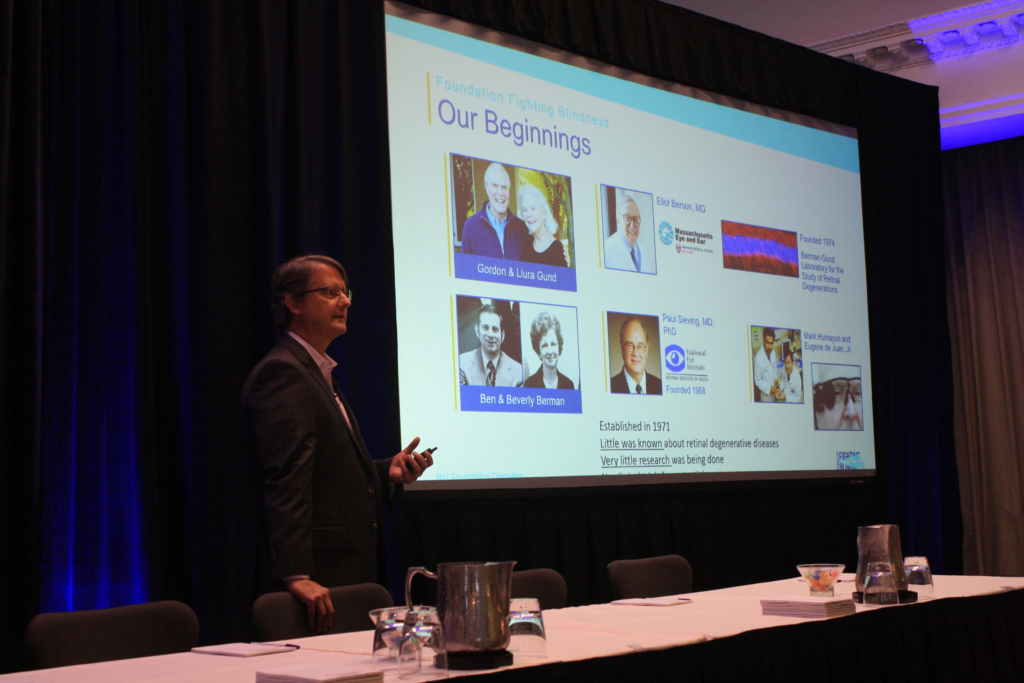
Dr. Ben Yerxa presenting
Dr. Ben Yerxa at the LCA Family Conference in July.

Dr. Yerxa opened the Hope in Focus (formally Sofia Sees Hope) second LCA Family Conference on July 27 in Philadelphia before an audience of more than 80 people from 15 states and Mexico. They represented patients and families living with Leber congenital amaurosis (LCA), other rare diseases (retinal and otherwise), and advocates, doctors, researchers and biotech leaders. 

He delivered updates on the Foundation’s work in his presentation, “Accelerating Translation of New Treatments for IRDs – A Foundation’s Perspective.” The Foundation, the world’s largest private funding source for research into treatments and cures for IRDs, has raised more than $750 million toward its mission since its founding in 1971. Sofia Sees Hope partners with the Foundation by helping provide families with free access to genetic testing, and funding research.

Advances in genetic sequencing

Dr. Yerxa credited the Human Genome Project (HGP) – costing an inflation-adjusted $5 billion – with netting continued advances in genetic sequencing and making great gains in the IRD field.

Researchers have identified the mutated genes in 65 percent of people with retinal disease who get genetically tested, and in 2017, the U.S. Food and Drug Administration approved LUXTURNA™, the first approved gene therapy for the eye or an inherited condition. LUXTURNA is for people with mutations in the RPE65 gene, one of the more than 25 genes that, when mutated, can lead to LCA.

Dr. Yerxa said that approximately 200,000 people in the United States have an IRD, with each condition meeting the definition of an orphan disease

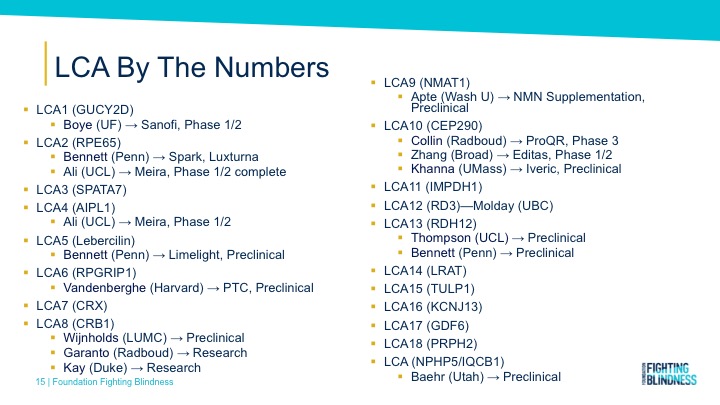
'LCA By The Numbers' slide from 2019 LCA Family Conference

He also delineated the LCA trials in progress in an “LCA by the Numbers” presentation. He discussed an emerging treatment for CEP290 (LCA10) by ProQR, which is in a Phase 2/3 clinical trial, and research also on CEP290 by Editas Medicine and Allergan, who are recruiting patients in a landmark clinical trial to test a gene-editing technique called CRISPR/Cas9.

“We all know it takes a village,” Dr. Yerxa said. “There are tons of people involved in these programs.”

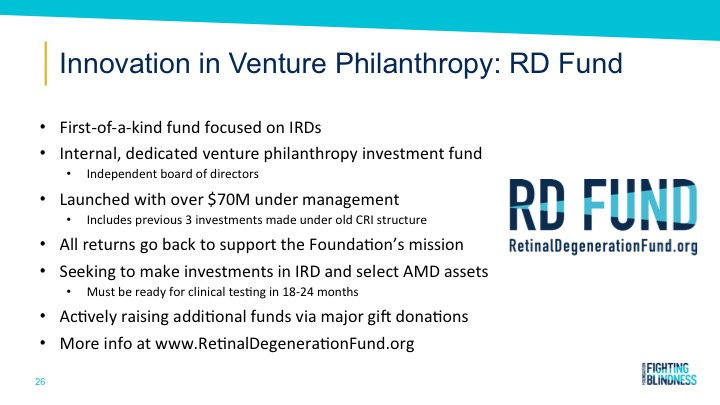
'Innovation in Venture Philanthropy: RD Fund' slide

He also detailed the Foundation’s new “Innovation in Venture Philanthropy: RD Fund,” a first-of-a-kind retinal degeneration fund focused on IRDs. It is an internal venture philanthropy investment account overseen by an independent board of directors. Donor dollars go to biotechnology companies as investments, with financial returns reinvested to support the Foundation’s mission. 

Among its contributions to research, the Foundation gave $10 million toward the development of LUXTURNA and $6 million to the Natural History of the Progression of Atrophy Secondary to Stargardt Disease or ProgStar studies that produced new knowledge and potential outcome measures. 

Dr. Yerxa also reported impressive gains in membership to My Retina Tracker® (MRT), the free and secure online international patient registry managed by the Foundation.

“I call it the LUXTURNA effect. Thanks to LUXTURNA, registration went up like a hockey stick.”

With membership at more than 23,000 and growing, the registry’s goal is to drive research toward prevention, treatments and cures for people living with Retinitis Pigmentosa (RP), Stargardt diseaseUsher syndrome and the whole spectrum of inherited retinal degenerative diseases, including LCA.

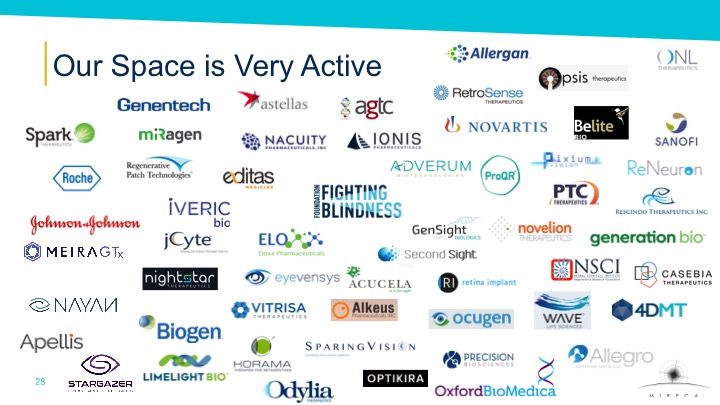
50 logos showing the involvement of biotechs in vision research

In a slide titled “Our Space is Very Active” showing a collage of more than 50 logos of biotech companies involved with vision research, Dr. Yerxa said, “More and more people are jumping into this space. 

“This is good news. Ocular is hot.”

Nicole Kear: When Losing Vision, Carpe Diem?

Nicole Kear faked it for a long time.

On a romantic getaway, as her boyfriend gazed at the starlit sky, she gazed at the vast darkness. Same with the twinkling lights at the tip of New York’s Staten Island.

“I was 19 years old when I discovered I couldn’t see stars.”

That’s when the actress and future author received her diagnosis of Retinitis Pigmentosa (RP), a rare, debilitating retinal disease. Her photo receptors were dying; no treatment, no cure.

Author of the memoir “Now I See You,” Kear told her story at “A Rare Opportunity” presented by Hope in Focus (formally Sofia Sees Hope), a global advocacy organization for the Leber congenital amaurosis (LCA) patient community and for those with other rare inherited retinal diseases (IRDs), such as RP.

Hearing she’d lose her vision by age 30 came as “absolute blindsiding news.”

Kear shared her story with more than 100 people gathered at Lake of Isles in North Stonington, CT, on March 30. Sofia Sees Hope Co-Founder Laura Manfre characterized the event – which also included a panel discussion – as “a chance to hear from incredible people who have faced head-on an almost unimaginable challenge and chosen hope over defeat.”

Kear felt incredulous at her diagnosis.

She’d always chalked up any stumbles in life to being accident prone, or “I thought I was some airhead who didn’t pay attention.”

She had plans: She was going to be a star of the stage, fall in love, get married, have children.

“Nowhere in these plans was room for losing my vision by 30.”

A River Called Denial

Upon her diagnosis, Kear did what a lot of people might not have expected: “I decided not to think about it.”

Plus, she thought, by the time she turned 30, “I would be ancient by then.”

She learned to drive, kind of. Kear didn’t need a car in New York, but when she temporarily moved to Los Angeles for acting, only three days passed before she realized she’d made a colossal mistake. She drove anyway, with her idiosyncratic driving posture, prompting her sister to tell her maybe she should lean back a little, an exchange recounted in her book:

“What are you talking about?” I snapped, concentrating on my left turn.

“You don’t notice how close your face is to the windshield?”

It was true. My nose was almost touching the glass, my chest nearly pressing the wheel …

“There’s no law about sitting too close to the windshield,” I shot back. “Just sit back and enjoy the ride.”

I couldn’t see my sister’s face, but I bet she looked like she was enjoying the ride about as much as a turn on the Tilt-A-Whirl with a stomach full of corn dogs …

My uncool driving notwithstanding, I did a decent job of getting from point A to point B without dying or killing anyone. In general.

Kear fared better in restaurants than on the road. She learned to order the Caesar salad because it’s usually on the menu she couldn’t see, and she’d ditto her dining partner’s choice for the main course.

She traveled to Paris and London. She enrolled in the San Francisco School of Circus Arts where she learned to be a contortionist and earned a red nose.

“Following every rainbow, climbing every mountain,” Kear told her audience, until she finally gave up the ruse.

“I had realized that my vision had an expiration date … I could carpe diem as much as I wanted, but I had to reckon with my vision loss.”

At 33, after falling in love, marrying and having two of her three children, she faced her diagnosis and reached out to New York’s services for the blind.

The gravity of support and resources empowered her, connecting her to visually impaired people around the world.

“I know now that anything is possible.”

Kear ended her presentation by reading one of the tips that accompany each chapter of her book.  

Tip #18: On glass doors. Walk into a glass door once, shame on the door. Walk into it twice, shame on you. Walk into it three times, get yourself a (*%&#*) game plan.

The Role of the Patient Voice in Rare Disease Advocacy

It’s you. It’s all about you.

The journey from identifying a rare disease, to conducting studies, to approving a treatment, is long – but it always starts with the patient, and the information patients share among the medical, biotechnological and advocacy communities, as well as within the patient community.

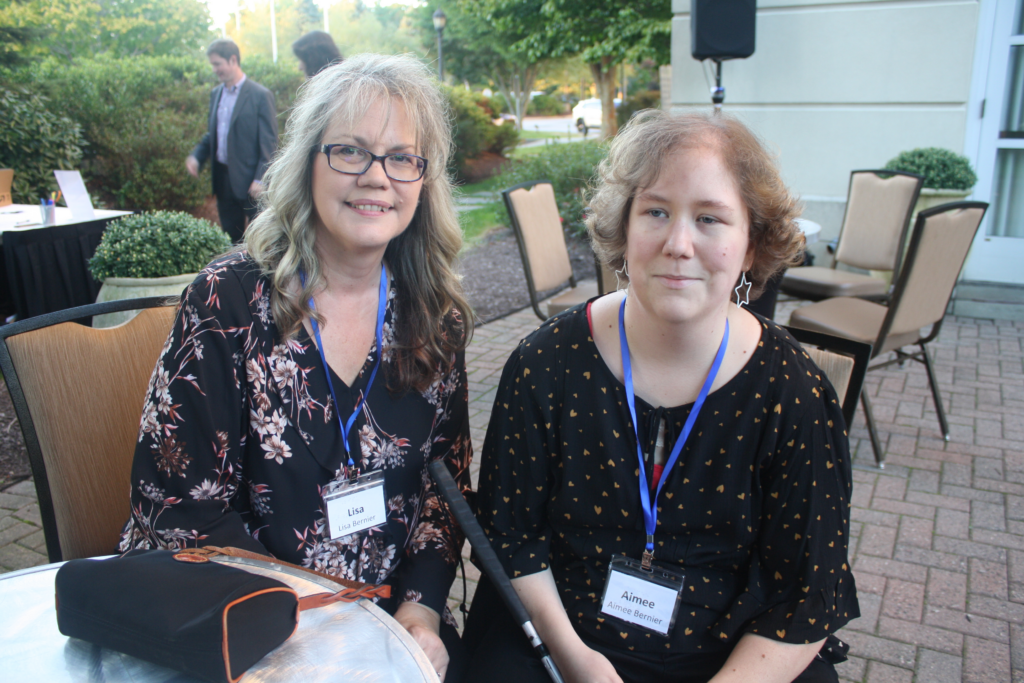
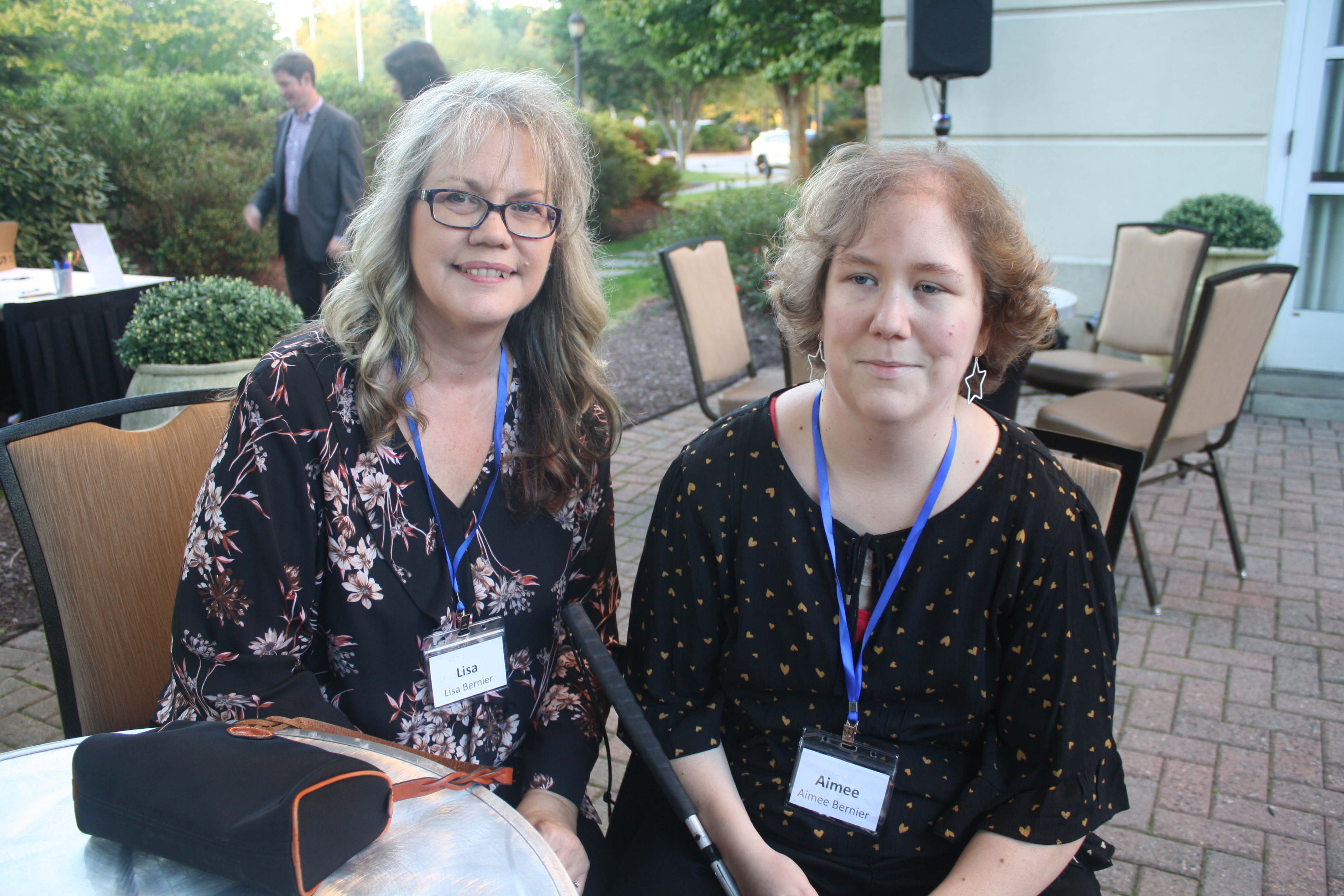
At a fall gathering of families living with Leber congenital amaurosis (LCA) and other rare inherited retinal diseases (IRDs), Lisa Bernier found help and support for her visually impaired daughter for the first time in seven years. Bernier and her 25-year-old daughter, Aimee, traveled to the first-ever Hope in Focus (formally Sofia Sees Hope) LCA Family Conference at the insistence of Aimee’s optometrist.

“Advocacy ends after school ends,” Bernier says.

Lisa and Aimee Bernier

Aimee has Bardet-Biedl Syndrome (BBS), a complex disorder affecting many parts of the body, including the retina. She and others with BBS have retinal degeneration similar to retinitis pigmentosa (RP). Aimee had good experiences at the Perkins School for the Blind and graduated in 2011. Then it became difficult for her mother to find support.

“We’re basically on our own, to advocate for ourselves,” Bernier says. Her 30-year-old son also has BBS with many, but not all, of the same characteristics, and his vision loss is five years’ advanced.

(Editor’s note: Laws vary from state to state, but typically, public education is required to provide services to students in need until age 21, even after high school graduation. Children with learning disabilities who receive services under the Individuals with Disabilities Education Act (IDEA) or the Rehabilitation Act of 1973 (RA) in public elementary and secondary school may continue to have legal rights under federal laws in college programs and in employment. When students graduate from high school or reach age 21, their rights under the IDEA come to an end. As resources can vary greatly from state to state, finding support and resources for a child may fall on the family post-graduation.)

During the early years, Bernier searched for any information on BBS and RP through reading the New England Journal of Medicine, which described those with BBS as having low cognitive skills and dying from kidney failure. Even when Aimee was born, the doctors didn’t understand BBS. Bernier and her husband were grateful to be introduced to the doctors and genetic staff at Shriners Hospitals for Children in Springfield, Mass., where they helped with the health care needs of Aimee and her brother until they were 18.

Bernier said she was thrilled to be at the conference in a roomful of retinal experts, patient advocates, and families attending the Oct. 6 gathering.

Active Patient Community Is Key

During multiple sessions, attendees heard updates on research, learned about the roles played by organizations developing treatments, and gained insight into how an active patient community can support and accelerate treatment.

Spark Therapeutics,  Applied Genetic Technologies Corporation (AGTC), National Organization for Rare Disorders (NORD),  Foundation Fighting Blindness (FFB), and Sofia Sees Hope are among the many partners working to collaborate with and learn from the patient community to propel research momentum.

More than 50 people from New England, across the country and Mexico attended the conference, including the session titled “The Role of the Patient Voice in Developing Treatments for Rare Disease.” Sofia Sees Hope Executive Director Annette Tonti moderated a three-member panel comprised of:

• Jamie Ring, Head of Patient Advocacy at Spark Therapeutics, which developed the gene therapy called LUXTURNA™ that helps restore vision to people with RPE65 genetic mutations;

Jill Dolgin headshot
Jill Dolgin

• Jill Dolgin, PharmD, Head of Patient Advocacy at AGTC, a clinical stage biotechnology company focusing on rare IRDs and developing therapies that replace “broken” genes with normal, functional genes;

• Kristen Angell, Associate Director of Advocacy at NORD, a voice for the 30 million Americans with rare diseases and the official U.S. sponsor of Rare Disease Day, which takes place annually on the last day of February.

Personal experiences of family and/or friends dealing with rare diseases motivated all three women to become advocates for patients. As Angell paradoxically put it: “Rare disease has always been common in my family.”

Ring, Dolgin and Angell are a critical part of a relatively new profession – patient advocacy – to help people find support and learn how to become engaged in the process of drug development and research to find treatments for rare diseases.

Kristen Angell headshot
Kristen Angell

Ring from Spark Therapeutics said she has a passion for helping amplify the voices of the patients and their families and making sure those voices are understood and considered.

“People feel their story doesn’t matter,” she said. “The thing in rare disease is that YOU ARE the expert,” and patient information is critical to doctors and biotechnology companies alike. “At Spark, we want to make sure that patient voice has a seat at the table.”

“There’s no one-size-fits-all,” Ring said. “Simply connecting with other people is probably the most important thing you can do … and having the clarity of your diagnosis allows you to do that most effectively.”

For IRDs, it is essential to know your gene and it’s a good idea to register with My Retina Tracker, a confidential, online, patient registry managed by the Foundation Fighting Blindness. Patient data tracked through registries and collected by researchers helps scientists and biotechnology companies develop clinical drug trials.

AGTC’s Dolgin told the audience that 7,000 rare diseases exist, but fewer than 15 percent have advocacy groups that can assist patients with resources, advocate for clinical research, and find access to vital therapies.

Dolgin, a trained pharmacist, emphasized: “As patient advocates in the pharmaceutical industry, we’re representing the patient at the corporate table.” A priority for the company is to find and educate people with IRDs and encourage them to get genetically tested.

Patients need to be identified, encouraged to enroll in natural history studies, and followed systematically through natural history studies long before beginning the clinical drug trials necessary to seek approval for commercial use from the U.S. Food and Drug Administration. Natural history studies are critical components to clinical research, providing an understanding of the rate of disease progression without treatment to the rate of disease progression after treatment.

Angell said NORD developed 20 patient registries for 20 different diseases in the last few years. She oversees the Rare Action Network, with 5,000 members nationally and ambassadors in 32 states, including Connecticut. The network empowers patients and families to directly reach out to lawmakers to encourage and support the rare disease community.

Angell also encouraged using social media and suggested setting up programs with local chambers of commerce to make people aware of patients in their own community.

“Awareness goes hand in hand with advocacy.”

The role of the patient voice continues even more so after development of a treatment. Ask the people with families living with LCA. Sofia Sees Hope has been working to connect these families who have similar concerns and many of them have supported one another and become friends.

Tami Morehouse attended the patient advocacy session and served as panelist in a conference session earlier in the day called “The Road to Treatment: Understanding How Therapies Are Developed.” She is a pioneering LCA patient, in that at age 44 in 2009, Morehouse became the oldest person at the time to take part in the successful Phase 1 RPE65 gene therapy trial, a precursor to the FDA’s December 2017 approval of LUXTURNA.

She’s had many conversations with people involved in the process of LCA treatment or are hopeful they might be involved in a future clinical trial. The first person she talked with was Sarah St. Pierre Schroeder, the mother of now 10-year-old Creed Pettit. They communicated last April on the eve of the boy’s surgery in which doctors at Miami’s Bascom Palmer Eye Institute would inject under his retina a human-engineered virus that gives instructions on how to produce an essential protein for vision.

“I kept thinking about her and Creed in the days prior to Creed’s procedure,” Morehouse said. “I remembered how I felt when I was in their shoes and couldn’t help but reach out to them on the night before Creed’s procedure. As it turned out, Sarah seemed very open and happy to talk with someone who had been there and understood a little about all that they were feeling and wondering about.”

Creed’s mom felt enormous relief in talking with Morehouse.

“I will never forget the emotions I felt when Tami reached out to me,” St. Pierre Schroeder said. “Every sentence in her email brought me more comfort about what I was doing for Creed. She was so open about her journey, I felt like we had known each other forever.”

LUXTURNA took decades of research, many millions of dollars and countless advocacy connections to come to fruition. It is a long journey that begins with the patient and comes full circle.

Living with LCA: ‘It does no good to have pity’

Mikayla Larson, a 30-year-old mother living with a rare inherited retinal disease (IRD) called Leber congenital amaurosis (LCA) wants to reassure children living with the same disease that they’re going to be OK.

“I feel that there are a lot of parents out there that are terrified for their kids to live this life,” she says from her southeastern Texas home. “And while it’s not ideal, it doesn’t mean that they aren’t capable of living a fulfilled life and love it like they should.”

Larson’s form of LCA, known as LCA6 caused by a mutation of the RPGRIP1 gene, is considered rare even within the realm of rare disease, accounting for only about 5 percent of the total LCA patient population. LCA in its more than two dozen genetic mutations affects fewer than 4,000 people in the United States; it accounts for 5 percent of all retinal dystrophies and 20 percent of blindness in school-age children.

Photoreceptors lacking RPGRIP1 are unable to maintain the retina’s light-sensing outer segments, resulting in patients losing retinal functions at an early age but retaining photoreceptors in the central retina well into adulthood, according to the National Institutes of Health.

Having grown up with vision loss, Larson says children born with LCA need the support of knowing that others have gone through life with the same inherited retinal disease and survived the bullying, mistreatment or embarrassment.

“I think I’d tell any parent that getting their child into therapy is a necessity,” she says. “Most of us need help navigating these very important emotional things in life. Like when you get made fun of, or when your sibling or friends get their driver’s license and you can’t. Just coping with what this will mean for their life and how to navigate it.”

Larson speaks from experience. More than anything, she wants to take the element of pity out of dealing with the disease.

“It does no good to have pity, or on the other side, to put people on a pedestal for doing things everyone can do,” she says. “It’s demeaning and degrading as a human to get praise for doing something everyone else can do, just because we can’t see well.”

She has some light perception and equates her field of vision to about the length of a drinking straw. With lenses, her visual acuity is 20/200 and 20/400.

Larson had vision loss early and began learning Braille at age 4. She was diagnosed at age 12, although incorrectly, with Retinitis Pigmentosa (RP). She worked with specialists to improve her independence but being around other kids never was easy. She was teased.

“You need extra help. You don’t want to stick out,” she recalls. “I made myself want to fly under the radar.”

By middle school, she didn’t want to deal with Braille or learn more about skills and concepts to help her get around and to be more independent.

“It was something that I just despised. I don’t want to be identified that way. I don’t want to be that kind of person.”

Larson did, however, go to Arizona State School for the Deaf and Blind in Tucson for her last two years of high school, graduating in 2007. She pursuing job training through the state’s Vocational Rehabilitation (VR) services, but the program lacked funding and was not accepting new clients.

While on the VR program waiting list in 2008, she met Andrew, who is now her husband, and in 2009 became pregnant with their first child.

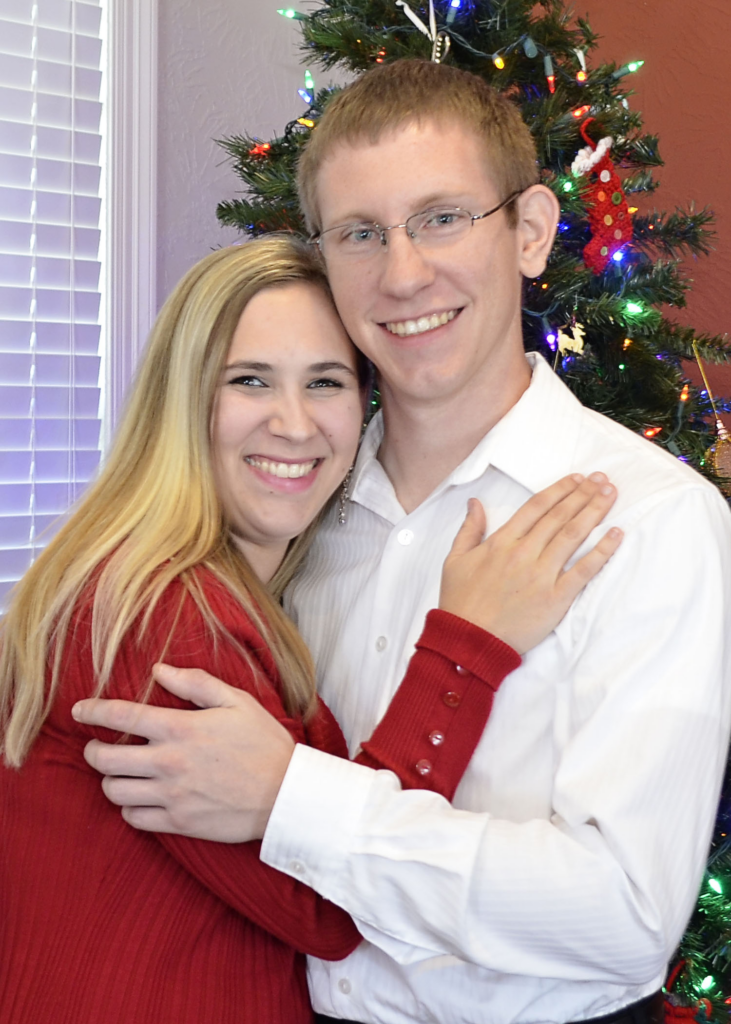
Mikayla in a red shirt and Andrew next to her in a white shirt. There is a Christmas tree in the background
Mikayla and Andrew Larson

They married in 2011, when their first-born, Conner, was 1. The day after the wedding, she was pregnant with her little girl, Aubrie. They lived outside of Phoenix and then moved even farther from family, southeast to a small Arizona town for Andrew’s first job as a chemical engineer.

The family moved in 2013 to another small town in southeastern Texas.

She is the mother of four children, “three here and one in heaven.” Their son Liam died from Sudden Infant Death Syndrome on April 3, 2015. He was 4 months old.

“My kids are very independent,” she says of 8-year-old Conner, 6-year-old Aubrie and Carter, 5. “They get up on their own with an alarm and get themselves dressed, and then Andrew and I make breakfast and make sure they have brushed teeth and are ready for school.” 

Not being able to drive is a big deal, especially in rural Texas with no public transportation. Her children are picked up for school and driven home. Cooking has gotten easier and more comfortable with the advent of Air Fryers and Instant Pots.

Tripping over toys and three cats – Max, Teddy and Chester – is part of life. She shops with family and reads with the help of reading glasses and her phone’s camera, zooming in for small print.

“I would say I’m pretty self-reliant and just do what I need without any real thought.” She does suffer from anxiety.

“Once we lost Liam, the anxiety kind of crossed over into other parts of my life.” She is seeking help and open to resources.

Her biggest advocate, Andrew, contacted Spark Therapeutics, the developer of a new gene therapy called LUXTURNA™ for LCA2 (RPE65) because he thought she might have that form of LCA. The company suggested she receive genetic testing.

When Larson visited an ophthalmologist for a genetic testing referral, she was met with disbelief. The doctor said she couldn’t have LCA. “It’s too rare. That’s not possible,” he told her.

She finally got the doctor’s signature for testing, and, in January 2017 at age 28, her test revealed a mutation in her RPGRIP1 gene, also known as LCA6.

Larson says she was then in touch with Eric Pierce, MD and PhD, who is conducting lab-based research on RPGRIP1 at Massachusetts Eye and Ear. Dr. Pierce’s gene research involves evaluating the latest treatment version in a mouse model, with the plan to generate a gene-therapy vector for toxicology studies, ultimately leading to clinical trials.

While hopeful for a treatment, Larson prides herself on helping others and moving forward.

“We are still smart and capable. We have different challenges but that doesn’t mean we aren’t able.”

IRD Milestones: Reasons to Be Excited

1971 – Just those numbers in white on a black page appeared on the big screen.

That’s how Brian Mansfield, PhD., began his presentation to families and patients living with Leber congenital amaurosis at Hope in Focus (formally Sofia Sees Hope) LCA Family Conference on Saturday, Oct. 6, in Groton, CT.

The year on that otherwise empty page marked the founding of Foundation Fighting Blindness – a time when patients losing vision often heard, “Go home. Learn Braille. You are going to go blind.”

Mansfield’s audience at the conference was made up of people diagnosed with a variety of rare inherited retinal diseases, including LCA, their caregivers and relatives, and representatives of various bio-tech and pharmaceutical companies working in the IRD arena. It was Sofia Sees Hope’s first such conference.

Dr. Brian Mansfield headshot
Dr. Brian Mansfield

Mansfield is the foundation’s senior vice president of research. He brought his audience up to date with information about clinical trials for inherited retinal diseases (IRDs), the rich preclinical therapeutic pipeline, how the Foundation uses money to move treatments forward and what people can do to drive change for IRD treatments and therapies.

His presentation culminated in a projected slide filled with logos of bio-technology and pharmaceutical firms, many of which are in contact with the Foundation, and represent the ever-expanding research and development field to help people with visual impairment.

$725 million in funding

In its 47 years, Foundation Fighting Blindness has raised more than $725 million toward research, development and public health education. It partners with several dozen U.S. non-profit organizations, including Sofia Sees Hope.

Mansfield traced the rapid trajectory of identifying genes causing retinal disease, from the founding of the National Eye Institute in 1968 through the Foundation’s funding of the Berman-Gund Laboratory for the Study of Retina Degenerations in 1971. It included the 1989-90 work identifying the rhodopsin gene as the genetic cause of Retina Pigmentosa (RP), and conducting the first retinal disease gene therapy trials in 2007. And of course culminated in last December’s federal approval LUXTURNA™, a gene therapy that helps restore vision in people with LCA2 (RPE65).

For people affected by LCA, more than 80 percent can now get a clear genetic diagnosis. For IRDs, more than 260 retinal disease genes have been identified, and the overall success in providing a clear genetic diagnosis is 65 percent.

Mansfield said that 23 gene-based clinical trials targeting 13 different genes are currently underway, including the LCA4 (AIPL1) gene trial by MeiraGTx.

He said the gene therapy preclinical pipeline is promising, with 100 genes under investigation. Researchers also are conducting preclinical studies of optogenetic gene therapies, in which light is used to control genetically modified retinal cells.

ProQR is planning a pivotal Phase 2/3 gene patch clinical trial for the LCA10 (CEP290) gene that involves injecting a short DNA molecule to cover up the faulty instruction the gene otherwise gives to act incorrectly. Also, Mansfield said, Editas Medicine is close to gene editing clinical trials, called “cut and paste” because an enzyme seeks out and repairs the defective gene. Another editing therapy in the pipeline, called base editing, essentially backspaces over the mutation and types the correction over it.

Also underway are more than 20 retinal cell therapy trials in which lost cells are put back to replace missing cells or used as biofactories to produce factors that help stabilize the retinal cells.

To help propel research and trials, the Foundation funds Career Development Awards to attract and retain clinician researchers dedicated to retinal disease research. The Foundation also provides awards to the brightest minds in the field, individually or as a team, to drive research.

It also gave 16 years of preclinical research support amounting to $10 million toward Spark Therapeutics’ commercial gene therapy, LUXTURNA, the first directly administered gene therapy approved in the United States that targets a disease caused by mutations in a specific gene – LCA RPE65.

Mansfield talked about how Applied Genetics Technology Corp. (AGTC) leveraged an early Foundation investment to garner $265 million to develop genetic therapies, some of which are in clinical trials.

The Foundation also supports 20 centers – the International Clinical Consortium – that have standardized assessment protocols for clinical trials.

To continue to attract industry interest, Mansfield detailed the Foundation’s My Retina Tracker registry, with its tagline “Track your vision. Drive the research.” It’s a free, secure, online patient registry that notifies registrants of clinical trials and gives researchers access to their disease data – but not their personal information – to advance studies on any number of research and therapy development efforts associated with IRDs.

The power of My Retina Tracker is optimized by registrants getting a genetic diagnosis. Sofia Sees Hope donated $65,000 to help people receive genetic testing and counseling.

Mansfield emphasized to his audience the vital importance of their knowledge, what they carry with them, and that patient input is critical to drug development.

First, Diagnosis. Then, Genetic Testing. It’s Important.

My Retina Tracker® is a free and secure online registry launched by the Foundation Fighting Blindness that helps connect families dealing with rare inherited retinal diseases to feel less alone, and to find help.

Parents feel shock and isolation when they are told their babies have no vision or limited vision caused by a rare inherited retinal disease. They do adapt and pursue resources, but that feeling of isolation often persists because of the disease’s rarity. It’s unlikely you will bump into someone in the grocery store whose child also has retinitis pigmentosa.

My Retina Tracker® is a free and secure online registry launched by the Foundation Fighting Blindness (FFB) that helps alleviate those feelings of isolation. An individual goes from being one with an inherited retinal disease to becoming part of a growing community of people (currently 6,500) sharing similar concerns and hopes.

The goal of My Retina Tracker® is to drive the research toward prevention, treatments and cures for people living with retinitis pigmentosa (RP), Stargardt disease, Usher syndrome and the whole spectrum of inherited retinal degenerative diseases, including Leber congenital amaurosis (LCA).

The global registry includes rare inherited retinal disease patient disease information from Europe, North, South and Central America, Asia and the Pacific.

Dr. Brian Mansfield, FFB’s deputy research officer who managed the registry’s launch three years ago, said people registering take an active role in advancing research to find treatments and cures for specific rare inherited retinal diseases, affording the opportunity to join others and “stand up and be counted.”

“Whether you’re in the middle of New York City or in a small town in West Virginia,” Dr. Mansfield said, “you’re equal to everyone else in that registry. It removes isolation. You’re literally standing up.”

My Retina Tracker® notifies registrants of clinical trials and gives researchers access to their disease data – but not their personal information – to advance research and therapy development associated with IRDs.

To optimize the power of My Retina Tracker®, registrants should seek a genetic diagnosis. The registry facilitates that by making registrants eligible for free genetic testing. In today’s world, it is helpful to be genetically diagnosed if you want to participate in research.

Details of My Retina Tracker® can come none too soon for some. Dr. Mansfield said after LUXTURNA® recently came to market as the first genetic therapy for LCA patients with an RPE65 gene mutation, he came across information about a person who set up a crowd-funding site asking for $5,000 to travel to Texas because he needed a genetic test.

“You don’t have to raise $5,000 to get a genetic test,” Dr. Mansfield said. “You don’t have to travel to Texas to get a genetic test.”

Helping families get tested

Hope in Focus (formally Sofia Sees Hope) well understands the importance of genetic testing for those with rare inherited retinal disease. Part of its mission is to educate individuals and families about the importance of becoming part of patient registries and getting genetically tested. SSH also makes genetic testing accessible to those who cannot afford it.

“Last year, we supported FFB’s (genetic testing) program as a small test grant,” said SSH founder Laura Manfre. “This year, with the success of the test and thanks to the tremendous support of our donors, we are happy that we were able to more than quadruple our contribution, enabling many more individuals to receive free testing and genetic counseling.”

Dr. Mansfield thanked Sofia Sees Hope for for its $65,000 donation to FFB, earmarked for genetic testing.

“The help was truly appreciated,” he said. “I’m very proud of the relationship we have with Sofia Sees Hope.”

How My Retina Tracker® works

Go to myretinatracker.org, click on Register Now and follow the prompts to establish a username and password and to answer questions to build your personalized retinal health profile. You are then guided through a series of questionnaires developed by retinal clinicians, geneticists, genetic counselors and rare inherited retinal disease researchers.

If you have any questions, call the My Retina Tracker® coordinator at 800-683-5555 or email to Coordinator@MyRetinaTracker.org.

Once you’ve registered, send a request to Coordinator@MyRetinaTracker.org asking to be genetically tested and you’ll receive information and guidance on how to order the test.

The registry becomes your personal retinal health record, updated by you and your doctors. Your history and testing results create a critical resource in tracking the progress of your disease and becoming part of a comprehensive database.

The registry employs state-of-the-art database technology to protect privacy and adheres to the highest standards of confidentiality and ethics, following policy and protocol set by the National Institutes of Health’s Institutional Review Board.

Your disease information is accessible only to you,  FFB registry staff, and researchers who meet a rigorous scientific review application process to use the data for studies and to reach individuals to participate in clinical trials, natural history studies or focus groups. Your personal information is never shared with researchers.

Large commercial biotech companies use this pool of data to find people for clinical trials, a common research challenge. Rather than calling clinicians one by one, the data is accessible in one place and often updated.

Clinical trials are out there

The data helps inform researchers about the therapies patients want, the risks they are willing to take for different levels of vision improvement and when and how their vision loss progresses.

Personal updates, such as when someone had to stop driving because of increased vision loss, help track the progress of the patient’s disease.

“Then you have a clinical longitudinal timeline as to how vision is changing for the patient,” Dr. Mansfield said.

Before My Retina Tracker®, the foundation used a paper list of about 12,000 names accumulated over FFB’s 40 years. The names transferred to the new registry to total about 17,500, but many are outdated.

There are about 6,500 people actively engaging in the online portal profile, with about 150 new registrations a month.

Dr. Mansfield wants to reach a minimum goal of 20,000 registrants in the next four years, although 50,000 would be preferable, as it would make for an extremely effective base of data for phase 2 and phase 3 studies that create demand for more trial enrollees.

He also made the distinction that private labs hold onto their data tightly, whereas FFB’s goal is the opposite.

“We want to share it, we want to move the whole field forward,” Dr. Mansfield said. “After all, our goal is to ensure the treatment and cures of all retinal diseases.”

Atom Biggs: ‘The Greatest Adventure of My Life”

Raising a blind son has been one of the most exciting and inspiring experiences a dad can ever have. I’d like to tell you a little about our son, Brandon.

As a baby he had some vision, so his visual impairment wasn’t initially noticeable to us. About the time he started walking, it became clear something was unusual.

At first my wife and I thought he was clumsy or maybe a little absent-minded when he would collide with things. When we’d put food on the table in front of him, he’d feel around for it with his hands while his eyes looked off into space. When I’d try to look him in the eye, he’d look to the right or left of my face but couldn’t seem to make eye contact with me.

We were shocked when the ophthalmologist diagnosed Brandon with retinitis pigmentosa (RP). Now we were faced with new challenges.

Before we had children, my wife and I sat down and put together a plan on how we would raise them. Now we had to rethink everything. Our first step was to gather every resource available to us. We were quite surprised at how much lay within our reach. We read books, got him a free computer, visited the School for the Blind, and learned how to read Braille. We also organized his room with little baskets and cubbies, so he’d know where to find everything.

One of the most important stories I read was written by a blind man whose parents coddled him his whole life and were afraid to let him venture outside the safety of his home. I determined that was not going to be the story of our son. Instead, we looked for every opportunity for Brandon to experience the world around him.

We took our son to the zoo, on hikes, on field trips, exhibits, fairs and everything we thought might be experiential and educational. A blind person’s eyes are his fingers, so we always made it known that our son was blind and requested special permission for him to touch, even if the signs said, “no touching.”

We enrolled him in Junior 4H. I bought him a bicycle and tried to teach him how to ride; he persisted without my help and taught himself how to ride in our basement.

We met with his teachers and explained how blind children learn differently from sighted children and what accommodations Brandon would need in his classroom. We emphasized that he should be allowed to experience everything the other students experienced and not be left out of anything. They almost always listened to us and were grateful for our input.

We found that none of Brandon’s teachers had any experience with blind students, so we met with them frequently to make sure he didn’t get brushed aside. I think the most common excuse from teachers not to let Brandon participate was “we’re just concerned about his safety.” We’d explain that if they’d just let him tour the stage platform with his cane or have him buddy-up with a friend until he learned to walk the trail, he would be perfectly safe.

When our son was younger, we advocated for him, but as he got older we encouraged him to advocate for himself.

I think Brandon’s first major experience for self-advocacy was 7th-grade basketball. I told him I really didn’t think basketball was for him but that if he really wanted to play then he should arrange a meeting with the coach and the principal and voice his feelings. And so he did. He told them how much he wanted to play basketball, we were at the meeting and backed him up, and the coach was so impressed that he let Brandon on the team. He only played defense, but he played almost every game and the coach said Brandon was the most tenacious guard he’d ever had.

Brandon went on to advocate for audible traffic signals near our home, so he could safely cross the street and catch the bus. He touched models of cells in biology class, so he could feel what everyone else saw. Currently Brandon is advocating for the entire blind community to get them equal access to many online applications and software programs.

When Brandon was first diagnosed and we shared it with our friends, we got a lot of pity responses. I wasn’t sure what to say, but now I do.

Now when I tell people that my son is blind, and they say, “Oh, I’m so sorry!” I tell them there’s really nothing to be sorry about. It’s been the greatest adventure of my life and I’d have it no other way.

Learn more about Brandon

Read Brandon’s mother’s story

Read Brandon’s wife’s story

Simon Wheatcroft: The Power of Pushing Through

Simon Wheatcroft held his audience spellbound at the Global Genes conference in California where he detailed his journey from losing his sight as a teen-ager due to retinitis pigmentosa to competing in ultramarathons and overcoming many obstacles in between.

Simon recounted his amazing life experience at the Hotel Irvine in Huntington Beach, Calif., during the 6th Annual Global Genes RARE Patient Advocacy Summit on Sept. 14 and 15. More than 700 patients, caregivers, advocates and rare disease stakeholders gathered to share, learn and connect.

Simon, the conference’s opening keynote speaker, shared his journey of adapting technology, specifically on his smartphone, to achieve what seemed like impossible personal goals of learning to run solo outdoors. In his message of “Adaptability in the Face of Adversity,” Simon said he lost his sight at 17 due to retinitis pigmentosa, and seven months later, he ran his first ever race – a 100-mile road race.

Ultramarathons – races more than the traditional 26.2-mile marathon – present extreme physical and mental challenges for anyone, but with his loss of vision, Simon faces more complex obstacles. He trains with guide runners and uses memorization and technology.

To run solo, Simon forms a map of the area by using the smartphone app, RunKeeper. He memorizes the

Simon Wheatcroft running
Simon Wheatcroft held his audience spellbound at the Global Genes conference in California where he detailed his journey from losing his sight as a teen-ager to competing in ultramarathons and overcoming many obstacles in between.

course and applies course feedback from the app about his pace and distance. Now, with so much experience running solo, he has adapted to various courses and uses the app less often.

Simon, who is 35, said he believes his feelings of freedom and independence from running solo “far outweigh any anxiety over dangers. My successful footsteps must be something like 99.999%, and there’s just that one every now and again that goes wrong. I try to concentrate on the millions that go right rather than the 10 or 15 that go wrong.”

Simon taught all of us at this exceptional conference the power of pushing through and endurance, lessons that can help all of us in overcoming any adversity.

For more on Simon, click here.