FROM THE WALL: Pushing Boundaries, Building Confidence

Throughout her 29 years, Michelle Ward Caton has embraced life with unwavering curiosity and gusto. Determined to test her abilities and not be limited by vision loss from Leber congenital amaurosis (LCA), she is, among other things, a competitive adaptive rock climber and teacher of the visually impaired (TVI).

Growing up in North Haven, Connecticut, Michelle’s route to an LCA diagnosis took time. Initially, her parents noticed that she wasn’t focusing on faces. “Once I was walking, I bumped into a lot of things! But when this was discussed with my pediatrician, he said it was Michelle being Michelle,” she said. “When I was three, we moved into a new house, and while running around, I hit my head on the kitchen island overhang. My concerned parents took me to a pediatric ophthalmologist, where my poor eyesight was finally confirmed.”

Several years later, the eye doctor detected white blood cells in her eyes and sent her to a Boston eye specialist. By the time they got to Boston, the white cells were gone. However, it wasn’t until she did genetic testing during high school that Michelle was diagnosed with LCA8 from a mutation in the CRB1 gene.
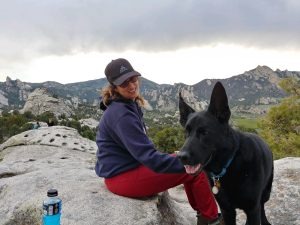
Michelle Ward Caton sits outdoors during a climbing trip with her first guide dog, Ryder, wearing climbing gear
Michelle with her guide dog, Ryder

The Journey

Early intervention services started at age three, and by age five, Michelle had a TVI. Refusing to be sidelined, she did everything that her older sister did at the same time. “If she learned to bike ride or swim, I did too!” Michelle said. We were only a year apart, and it was almost like being twins. But determined to keep up, I did many daring things for a blind person.”

Her resolve to play softball in elementary school was dashed, she said, “When my dad took me outside and tossed a few softballs at me until I realized I couldn’t play. When you’re a kid, you think you can do anything. Sometimes, you have to realize you can’t.”

Michelle’s parents exposed her to various activities, including the piano, flute, and bass guitar. Later, she participated in gymnastics and was a ballroom dancer throughout high school. “I did Brazilian jiu jitsu and then Muay Thai, a form of kickboxing, which my dad practiced with me, allowing me to get the rhythm of the sport and have incredible workouts,” she said.

In college, Michelle tackled the gym and weightlifting, and when she was at UMass Boston working on her TVI degree, she met a friend who did rock climbing. “I began climbing with an adaptive climbing group that participated in competitions,” she said. “I went to nationals and placed second, got on the United States team, and went to the international competition in France,” she said.

Rock Climbing Lessons

Michelle and her husband, Jason, continue to climb and discuss competing again. “It’s important to go out of your comfort zone. I still have some vision, and being outside and up high with a view is incredible,” she said. “When I’m climbing in the gym and hit the spot where I’ve fallen many times and finally figure out the right move and body positioning, it’s a small victory. It’s great getting to the top of the wall, whether I can see it or not. The top of the wall isn’t necessarily the prize. It’s the fact that you did it that builds confidence.”

Michelle at the 2019 national adaptive climbing competition
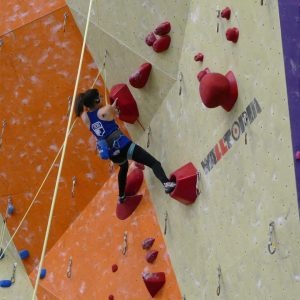
Michelle in a blue shirt and black pants climbing a wall indoors
Michelle Ward Caton competes on a climbing wall at the national adaptive climbing competition

Children with visual impairments often find body awareness and balance difficult, but these can also be tough for adults. Sometimes, when Jason tells Michelle how to move on the climbing wall, getting her correct body part to the right location is challenging. “Jason might say to move my right foot three feet, and I move my left foot one foot,” she said.

Helping children with body awareness is something Michelle focused on teaching in her preschool classes during TVI training. “I’d set up obstacle courses for the children to climb over, under, or step through or over,” she said. “I think climbing and jiu-jitsu are some of the best sports for kids with vision impairments because they help build body awareness.”

Vision Changes

When Michelle was about 26, her vision dramatically worsened. “I abruptly lost acuity, and my nystagmus got much worse. There was no time to adjust,” she said. “I’ve always had some nystagmus but could focus through it; now my vision always vibrates.”

As a TVI, Michelle teaches braille, but she also uses it to access all of the appliances in her home. She also does most of her visual work in the morning because the nystagmus exhausts her by evening. “You have to adapt your scenario to your specific needs. It feels like I’m constantly adjusting. I keep puzzling things together to see what works,” she said. “This is the reality for everyone with LCA; each situation is different, and you must finesse things until something works.”

The Right People

Dating during college helped Michelle discern that “it’s the people that don’t care about my vision that make the best friends. I’d meet someone, and when they found out about my vision impairment, they would shift from ‘You’re cute!’ to ‘You’re a science project.’ They’d ask me how many fingers they held up and what I could see. I got all of the stereotypical questions.”

Michelle loves that her husband doesn’t care that she is blind. “Jason does things for me that I don’t even notice. I’ll be looking for something, and he will grab it, hand it to me, and walk away without commenting. Or he will get out of the car and offer me his arm. We never talked about my limitations—he just got it!”

She said finding supportive people who don’t coddle is essential. “Jason encourages me to learn new things that a friend might say are dangerous. Instead, he teaches me how to do it. He doesn’t make assumptions about what’s possible for me.”

A sense of humor is vital for navigating a degenerative condition; Michelle explained, “I trip and fall and knock things over all the time! My visual decline in the last couple of years has been very tough, which makes it essential to find someone who laughs with you. Being morose doesn’t work!”

Family Interactions

Reflecting on growing up with LCA, she said, “My parents always treated me like my sister. Being blind was a characteristic that only meant I did things differently. My sister didn’t acknowledge my being blind for a long time. I don’t think she fully realized what it meant. Instead, she would stare at me and say, ‘Just do it,’ which is what a big sister does.”

“My parents never wallowed in my diagnosis, and we had many real-life conversations about my vision loss. But my dad struggled because he knew my vision would get worse, and I would face lifelong challenges.” Michelle said. “In high school, we met Robin Clark, a teacher passionate about ensuring kids had the independent living skills to live successfully. We implemented creative strategies, worked on things at home, and discussed what would help.”

TVI Responsibilities

As a TVI, Michelle travels between schools in New Hampshire, helping elementary through high school-aged students based on their individualized education plans (IEPs). “I love working with the teams that work daily with the kids to support their vision in class,” she said. “Life with LCA is like rock climbing. Starting out, you have no idea what you are doing, but you feel your way along, and eventually, you’re competing!” 
Let’s Chat About … Self-Advocacy and Supporting Your Child’s Education with Beth Borysewicz

Children living with visual impairment become more independent and empowered when parents set high expectations for their kids and challenge them every day.

Just ask Beth Borysewicz. In her role with Connecticut’s Bureau of Education Services for the Blind, she makes a living helping children with visual disabilities realize their potential as strong, self-determined adults. And she’s the first one to say, often with tears in her eyes, that her job is to work herself out of a job.

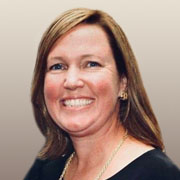
Beth Borysewicz headshot
Beth Borysewicz

She described her work in helping children from birth to 22 years old with visual impairment or blindness become more independent as adults as part of the Hope in Focus “Let’s Chat About …” webinar series. Our March episode, moderated by Courtney Coates, Director of Outreach and Development, featured Borysewicz, an Education Consultant for the Department of Aging and Disabilities, Bureau of Education Services for the Blind.

We developed the series with those living with Leber congenital amaurosis (LCA) and other rare inherited retinal diseases (IRDs) in mind, but we invite all members of our community, including those in research, industry, and the regulatory communities to join any of the sessions, as we look ahead to a common goal of advancing treatments for rare retinal disease. Click here to view this episode.

Borysewicz found her passion working with the blind and low-vision community unexpectedly 16 years ago, when she had a 3-year-old student named Sofia, who was diagnosed with LCA. Yes, that would be the same Sofia as in Sofia Sees Hope, our organization’s original name until a recent rebranding to Hope in Focus. Borysewicz also is Vice Chair of our Board of Directors.

She said parents need to be the biggest advocates for their children.

“If you think your child is not getting what they need, you can ask for it.”

She also encouraged connections with people who have been on this journey before, bringing to mind the Hope in Focus Family Connections program that helps ease feelings of isolation that can arise when a family member is diagnosed with a rare disease.

“It’s the people that have already gone through it who will help you the most, including Hope in Focus. That’s why I’m on the board. What Hope in Focus does for families is immeasurable.”

All the Little Things We Do Every Day

As a Teacher of Students with Visual Impairments (TVI), Borysewicz focuses on teaching students self-advocacy and exploring the Expanded Core Curriculum (E.C.C.), distinguished from a school’s standard core curriculum consisting of courses in math, science, reading, and the like.

E.C.C. comes from the perspective of teaching students with blindness or low-vision and encompasses nine areas: Compensatory Skills, Orientation and Mobility, Social Interaction, Independent Living, Recreation and Leisure, Sensory Efficiency, Assistive Technology, Career Education, and Self-Determination.

The curriculum is more than a checklist or lesson plans for learners with a visual impairment, according to The E.C.C. and Me website. It’s all the little things we do every day, done with intention so children with visual impairments can learn skills they need for a fulfilling life.

Hope in Focus Let's Chat About ... logo

“I wish everyone would do what I do,” Borysewicz told her webinar audience. “There is a shortage worldwide of TVIs.”

She advised parents to set expectations high for their children, challenge them every day, and give them a safe place to learn.

“Children can do anything they set their minds to. Do anything you can do to empower them,” she said. “Celebrate everything. Celebrate every little thing.”

She talked about self-determination, saying it’s her favorite part of the curriculum and the most important.

“It’s teaching a child to believe in themselves and just take that leap,” she said. “It’s taking that step off the curb to cross the street with a cane or initiating a conversation at a lunch table that builds self-confidence.”

Her work with people from birth to age 22 encompasses figuring out resources for newly diagnosed children, for school-aged students, and for young adults transitioning to the workforce or college.

“I switch hats from appointment to appointment every day,” she said. “As you can tell, I love my job.”

Working with individualized education plans (IEP), she and her team helps students become the best they can be in all the E.C.C. areas.

“It’s so important for the student to say, ‘This is what I need and why I need it,’ and just building those skills will make them successful as adults.”

And a lot of it is fun, especially with Borysewicz who excels in the Recreation and Leisure department. It goes back to when she was growing up and her dad always told her she was good at playing with people and should get a degree in play.

She implements that play degree often by creating board games to make math more fun or putting together programs to help students from prekindergarten through grade 3 explore the nine E.C.C. areas in their daily lives.

In an Expedition to Explore, students in the Young Passport Program worked on accumulating life skills at home over the summer. Each student has a passport consisting of pages designated for each of the nine E.C.C. areas, with a slant toward adventure. For example, “Career Education Caves” focuses on conversational skills, encouraging children to stay connected with their friends over the summer, known in the business world as networking, and holding mock interviews with their siblings or stuffed animals.

In “Self-Determination Safari,” a goal is to get the child to ask for help. A parent asks a child to do an unfamiliar chore, such as taking out the trash or putting toys away but doesn’t give guidance on how to do it or where to put the trash or toys, prompting or encouraging the child to ask for assistance or directions.

“Social Skills Glaciers” encourages children to spread kindness to neighbors and the community and recommends an online guide called “100 Acts of Kindness for Kids.” Activities include listening, following directions, taking turns, ignoring distractions, cooperating, and showing empathy. (Sounds great for adults, too!)

Resources for People with Blindness or Low Vision

Borysewicz talked about her work from the perspective of Connecticut and said services may differ from state to state.

She authors a blog dedicated to professionals, families, and students called I Love Brl (Braille) and she provided webinar viewers this list of resources:

9 More than Core; The Independent Little Bee; Expanded Core Curriculum Ideas for Preschoolers and Early Elementary; Is My Child Getting a Quality V1 Program?; Integrating E.C.C. Activities into Literacy Instruction; Family Connect; and Wonder Baby.