Starting high school or going off to college is not easy; new people, classes and sometimes even a new city makes for a stressful transition. Doing it all with a vision impairment adds some additional complexity. I am going to share with you my experience of moving to college with a vision impairment. Hopefully you can learn from my experiences and apply it to your own life.
Four years ago I knew that I wanted to attend Wilfrid Laurier University. When I received my acceptance letter I immediately started to plan, which proved to be incredibly important. I was able to connect with various people at the university: getting a larger dorm room at no additional cost to accommodate my guide dog, speaking with the Accessible Learning Center to arrange exam accommodations (I write my exams on a computer in a private room), and connecting with professors before classes started.
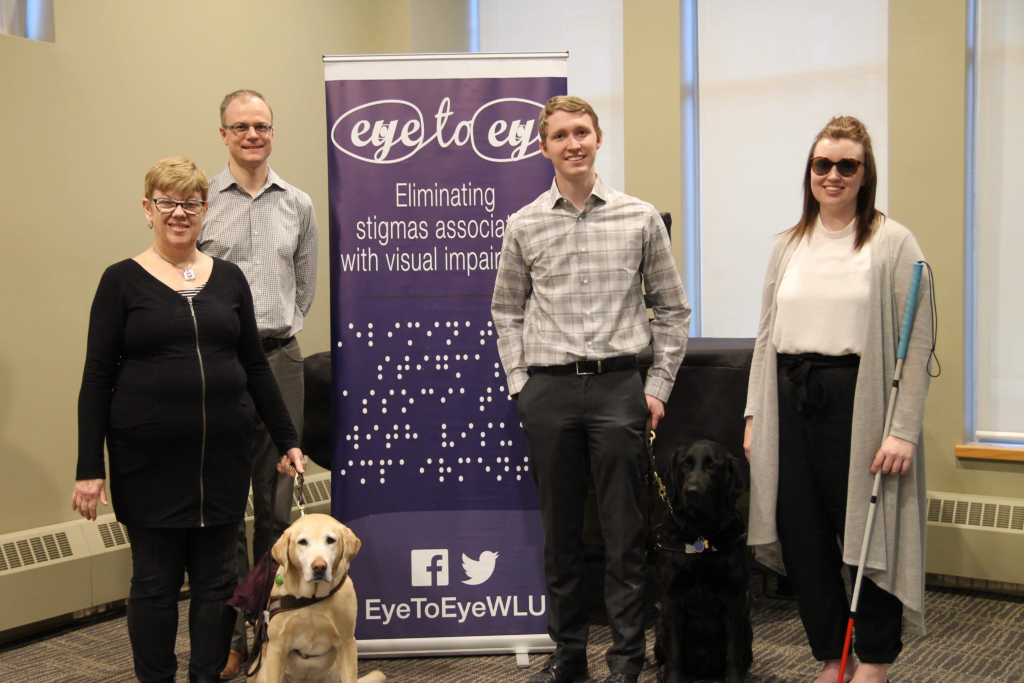
Jack McCormick and his guide dog Jake, center, at a recent “Eye To Eye” event Jack organized at his college. On the left is Dr. Penny Hartin, CEO of the World Blind Union, the guest speaker at the event.
For someone with vision loss it can be challenging to navigate a new place and college campuses are no different. It is so important to learn the layout of your college before move in day because I am telling you, you won’t have time during frosh week and you will want to know where your classes are before they start. There are a lot of benefits to knowing the layout of your campus beyond being able to find your classes and places to eat.
If you know where things are better than the people on your floor, then you can help them find their classes. It’s a good way to get to know people and show them that you don’t let your vision loss stand in your way.
Getting involved with campus organizations is a great way to have some fun and get to know like-minded people. These organizations aren’t going to meet in the same places as your classes. So you need to be able to find them or you are going to miss out on one of the best parts of college life!
“So, Jack, I’ve planned and learned the layout of campus. What about the first day? How do I make friends? I am worried that people will judge me because of my vision impairment.”
Remember that all people are nervous during their first days of college. You are not alone!
Own your vision impairment, tell people about it and be open to answering questions (you will get some dumb ones). This eliminates any awkwardness that people may have about your vision loss and soon you will find a great group of friends!
I hope this helps as you move away to college!
Jack McCormick is a 21-year-old honors business student at Canada’s Wilfrid Laurier University in Waterloo. Jack was diagnosed in high school with Leber congenital amaurosis due to mutations in the RPE65 gene. He is a Hope in Focus (formally Sofia Sees Hope) ambassador, helping people living with LCA and IRDs. Read his blog at jackdamccormick.wordpress.com
This is the fifth in a series following the progress of Creed Pettit, a 9-year-old Florida third-grader, who completed treatment in March with the breakthrough gene-therapy drug called LUXTURNA™, approved as the first gene therapy for RPE65 genetic mutations and as the first-ever genetic therapy in the United States for an inherited disease.
Life looks a lot brighter for Creed Pettit, the Florida boy who just became one of the first LCA-RPE65 patients to have eye surgery using the brand-new gene therapy treatment LUXTURNA™.
For the very first time, Creed built the entire track of his wooden train set, and he did it in the garage rather than in the house with all the lights on.
“He played with it for over two hours,” said his mom, Sarah St. Pierre Pettit. “He played with it like a kid should play with it.”
Before the surgery, Creed and his mom would have what she called “taught play,” with her little boy doing only what he was taught or told.
“All of a sudden, he was playing with these things, interactive play, putting doors on the train, making the bridges of the train set.”
Even digging into the box with the train-set pieces is a new experience. Before, Creed wouldn’t look in the box because it was dark, and he couldn’t see anything. Now, he’s looking into the box and pulling out curved pieces of track.
Creed is back home in Mount Dora, Fla., from having his second surgery, this time on his left eye, on March 28 at Bascom Palmer Eye Institute in Miami.
He and his family came home to a house decorated by friends with streamers, balloons and a big home-made sign that said, “Welcome Home Creed.”
Creed is one of a handful of the first LCA-RPE65 patients to receive the genetic therapy treatment LUXTURNA™ developed by Spark Therapeutics.
The U.S. Food and Drug Administration granted approval of the revolutionary drug in December. Soon after, preparations began for administering the treatment to the first patients the week of March 19. The surgery entails injecting under the retina a human-engineered virus containing copies of a normal gene, prompting the making of more RPE65.
As Creed came into the operating room last week, he heard “I’ll Be There For You,” coming from the speakers; it’s the theme song from the television show “Friends,” and the same song Creed and his mom – and the whole surgical team – sang while waiting out a short delay before his first eye surgery.
After performing surgery on his right eye on March 21, Dr. Audina M. Berracol found new growth in the eye’s photoreceptor. Creed will return to Miami on Monday for high-resolution scanning, called Optical Coherence Tomography, (OCT) on his left eye.
Back at home using just basic lighting, Creed reads “Diary of a Wimpy Kid.” And he looks down at his food now.
“It’s really, really neat,” Sarah said. “Every day has just shocked me.”
He watched “Peanuts,” one of his favorite shows, and then went on a long walk.
“It’s just so cool to watch him. He has his sunglasses on, he’ll just stare, looking at different trees, touching them.”
No more flashlights, either. Years ago, Creed’s mom outfitted their home with bright lights and lots of flashlights, so he could see things if they dropped under the table.
The third-grader also stopped by his school to see his friends and he kept looking at the designs on the floor and asking people what they were eating.
“It’s a hamburger,” his mom said. “It’s almost like teaching a toddler all these things.”
Speaking of school, after Creed returns from Miami for his follow-up appointment on Monday, he goes back to school Tuesday and plans to wear a new T-shirt, much to his mother’s chagrin.
Sarah wanted to buy Creed something special to celebrate the success of the surgeries and his new-found look on life. She wanted to buy him a watch or something cool at one of the popular stores.
“Look, here’s a neon one,” she said, pointing to a big watch. “Anything you want.”
Instead, he picked out a shirt with words on it, “totally not something I’d ever buy,” Sarah said. The shirt says, “I was going to do my homework, but my hands are full,” and shows an image of two hands holding a game console.
She thinks he picked it out because he could read the letters.
“He’s never gotten in trouble (at school). He thought it was hilarious that it said that.”
Sarah said she was thankful that her mom and her fiancée accompanied her and Creed to Miami and helped keep her calm after waiting nine years for Creed’s treatment come to fruition.
“I think I cried harder on the second one,” Sarah said after this latest surgery.
“Oh my gosh! It’s done! We’re done! We beat this! We never stopped fighting and look where we are now.”
This is the fourth in a series following the progress of Creed Pettit, a 9-year-old Florida third-grader, who completed treatment in March with the breakthrough gene-therapy drug called LUXTURNA™, approved as the first gene therapy for RPE65 genetic mutations and as the first-ever genetic therapy in the United States for an inherited disease.
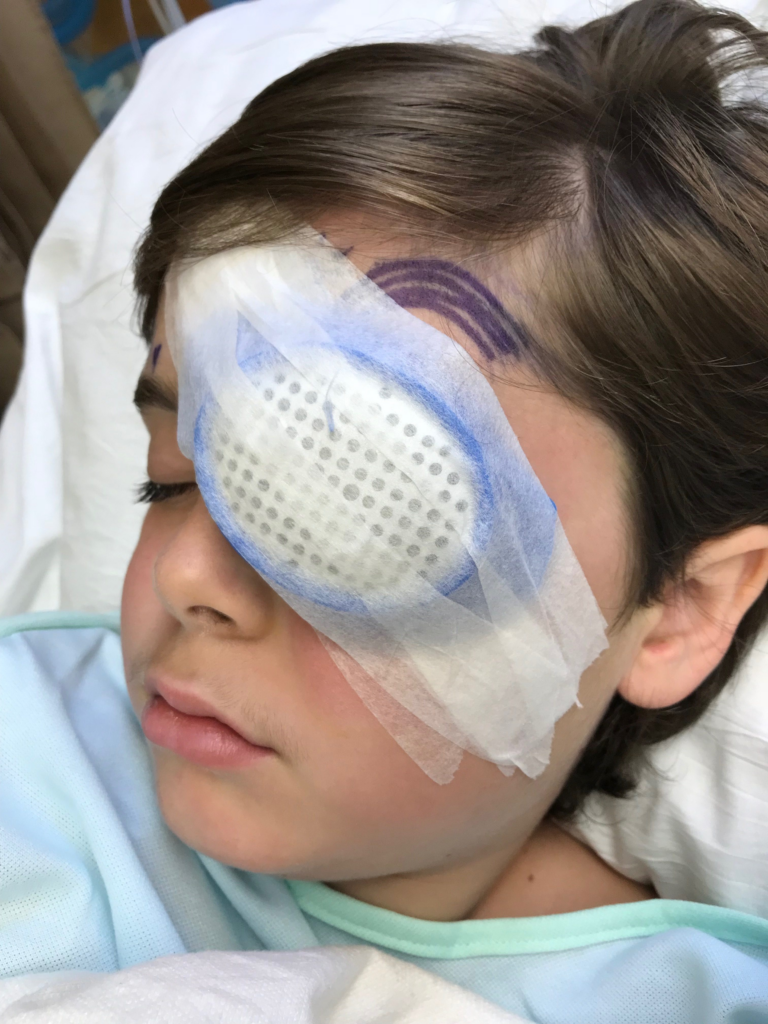
A rainbow drawn over Creed Pettit’s left eye on Wednesday, March 28, marked the correct eye to receive surgery, but even more so, the arc symbolizes what the third-grader from Mount Dora, Fla., hopes to see after his recovery.
The 9-year-old with LCA-RPE65 underwent his second surgery that afternoon – this time on his left eye – with the revolutionary genetic therapy drug LUXTURNA™.
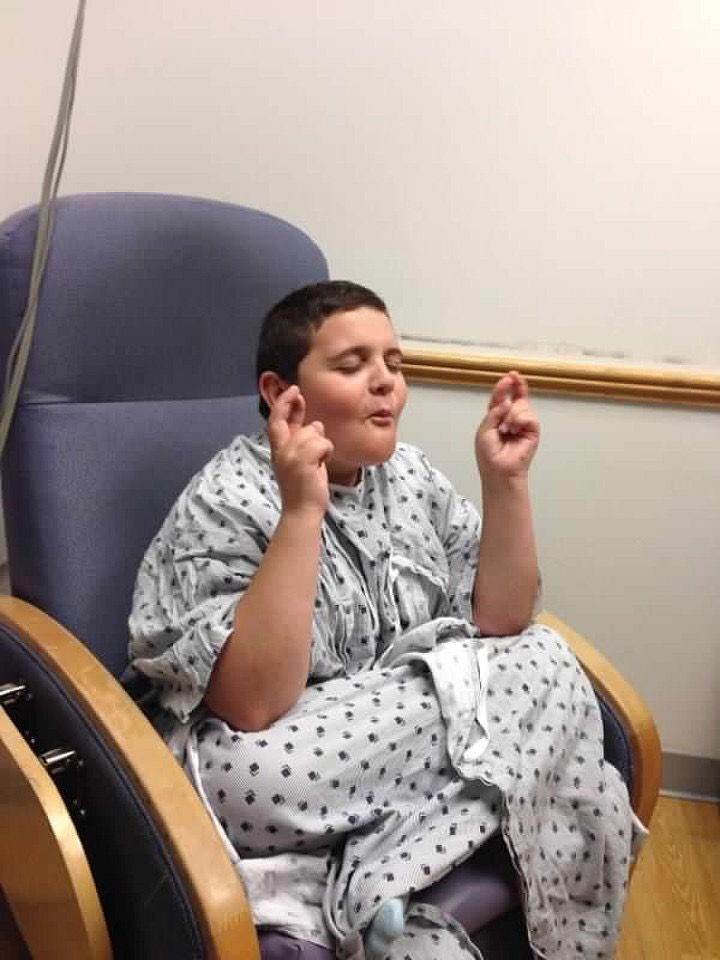
Creed, recovering from his second surgery March 28 to reverse his vision loss caused by LCA-RPE65.
Creed’s mom, Sarah St. Pierre Pettit, said in a Tuesday email that her son’s right eye shows distinct improvement since surgery last Wednesday, March 21.
“The doctor already saw new growth in the photoreceptor yesterday (Monday, March 26),” Sarah said about improvements already showing in the right eye. “She was so excited.”
Six days after the first surgery, the boy’s mom wrote, “Creed’s spirits are so high.”
“He keeps saying ‘I did it without light,’ when he reads or eats or draws. It’s so cool,” Sarah said. “I am loving every moment but must admit I’m completely exhausted.”
She said that he is asking so many questions about what things are. “It’s wild.”
In 2011, doctors diagnosed Creed at almost 3 years old with LCA. He later received a confirmed genetic diagnosis of LCA-RPE65. Sarah tried to get him into clinical trials for LUXTURNA™ when he was 3 and 4, but her little boy could not perform tasks required by the study, such as trying to navigate a maze.
He had told his mom that after surgery, he couldn’t wait to see a real rainbow and he couldn’t wait to throw his canes in the lake.
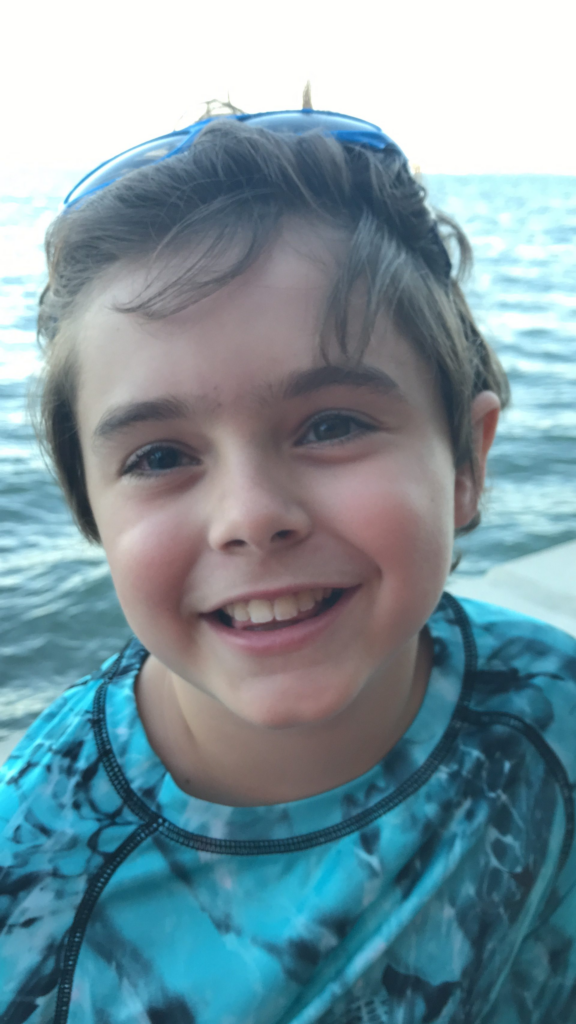
Creed 4 days after his first surgery to reduce his vision loss caused by LCA-RPE65. He is smiling at the camera, because he can see the camera.
Since Creed’s first surgery, Sarah has taken photographs of him pointing to her without any lights on and smiling at the camera after being able to see it.
Before the first surgery there had been a few delays, so to help pass the time, Creed and his mom sang “I’ll be there for you,” the theme song from the television show “Friends.”
Sarah said she cried a lot.
Before today’s surgery, Sarah wrote: “The experience was mind-blowing. Our LUXTURNA™ arrived and
we waited for it to be mixed. It felt like an eternity waiting. Mom (Sarah’s mother), Chad (Sarah’s fiancée) and I fasted with Creed.
“The team was amazing. They were so good with Creed and I, explaining everything and allowing me to hold him as we went back and (allowing us to) stand next to him as he went to sleep. It was so hard to leave. Yet I felt this sense of comfort knowing they truly had a love for Creed.”
Christian Guardino underwent experimental eye surgery five years ago with a revolutionary genetic treatment called LUXTURNA™, forever changing his life by restoring his vision that was lost due to Leber congenital amaurosis-RPE65.
On the heels of government approval of this extraordinary drug, the 18-year-old from Long Island recently had the opportunity to thank Spark Therapeutics, makers of this transformative treatment.
The senior from Patchogue-Medford High School recounted his experience of receiving the drug during clinical trials and thanked Spark for their incredible, life-changing work that the Food and Drug Administration approved in December 2017.
Christian’s 2013 surgery involved injecting a human-engineered virus containing copies of a normal gene so that the cells could express a protein needed by the retina to convert light into vision-enabling signals sent to the brain. LUXTURNA™ also is the first treatment of its kind in the United States for any inherited disease.
Before surgery, Christian had difficulty seeing even in very bright light; after surgery, the teen-ager, who also is an accomplished singer, experienced something astonishing as he stalled offstage, preoccupied with the night sky before performing outdoors at Long Island’s Adventureland.
“My eyes were glued to the sky and I was looking at the moon for the first time,” Christian said. “That was pretty cool.”
During his meeting with Spark, Christian also sang three songs.
He offered a true treat, singing a very bluesy version of “Who’s Loving You” by the Jackson 5, the same song he performed for his audition a year ago on “America’s Got Talent,” where host Howie Mandel hit the “Golden Buzzer” button, speeding him forward to live competition.
During that appearance, Christian answered Simon Cowell’s introductory questions with the tentativeness of any 16-year-old on stage before a packed house and millions of television viewers. Seconds before the audition, the camera flashed to audience members in hold-your-breath anticipation. When the music began, Christian brought the microphone to his mouth and belted out a soulful, strong, self-confident performance, belying his youth and bringing the audience to its feet.
Christian, whose musical heart is in soul and the Motown sound, recently said: “There’s just so much truth and meaning in soul and Motown. To have that kind of soul, you have to be really down in life.”
At the meeting with Spark, Christian also sang “Rise Up” by Andra Day and “Don’t Stop Believing” by Journey.
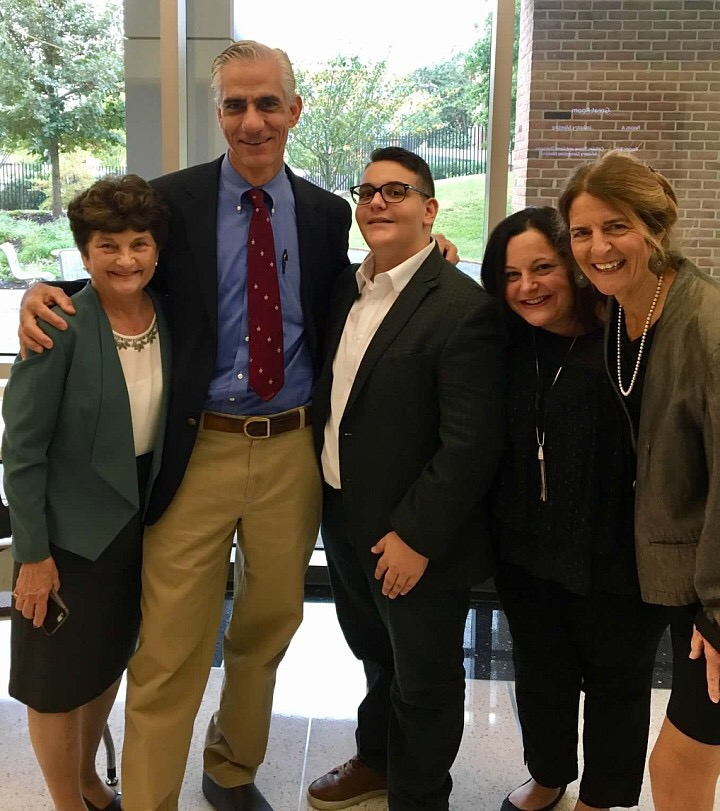
From left, Children’s Hospital of Philadelphia Research Coordinator Kathy Marshall, Dr. Albert Maguire, Christian, Christian’s mom, Beth, Dr. Jean Bennett; at Oct. 2017 FDA Advisory Committee LUXTURNA meeting.
From that meeting, Christian, his mom, Beth, dad, Nino, and younger brother, Nicholas, traveled to Orlando, Fla., where he was one of 10 national champion ambassadors – patients who triumphed over great odds – for the Children’s Miracle Network Hospitals (CMN Hospitals), a national organization raising funds and awareness for 170 children’s hospitals.
He represented Children’s Hospital of Philadelphia (CHOP), as their national champion, at the invitation of LUXTURNA™ developers, Drs. Jean Bennett and Albert Maguire.
After performing there, Hunter Hayes, a Grammy-nominated singer/songwriter, surprised Christian by telling him he was a big fan and inviting him to a future studio session.
The hunt for a genetic diagnosis
Christian’s mother, Beth, noticed that his eyes did not track when was about 3 months old and that he did not make eye contact, rather gravitating to light sources. Doctors suspected some sort of eye disease, including LCA.
His family noticed something else different before he was even 6 months old, when a visual therapist worked with Christian to track the song “Twinkle, twinkle, little star” on video.
“All of a sudden, in his bouncy seat,” Beth said, “He starts humming, ‘Twinkle, twinkle, little star, how I wonder what you are…’ ”
“Is that normal?” she asked the therapist, who looked at her and said, “Noooo!”
He would repeat everything he heard, singing scales and la-la-la-la-la-la-la-la all over the house.
“His musical ability, even as an infant and a toddler, was just off the charts,” Beth said. “I knew it was really something different.”
After having “every test under the sun,” doctors diagnosed Christian with LCA at 9 months old.
“At the time, so little was known about LCA. They didn’t give us much information.”
Doctors told her then that his vision would be stable or slightly improved, which turned out not to be true.
A pediatrician then referred Christian to a geneticist, to no avail.
“That’s one thing that actually surprises me now. Even back in 2000, they were not able to identify his gene.
“There was nothing we could do. We enrolled him in early intervention and had to accept the fact that he was visually impaired. We just did the best with what we had.”
When he was about 10 or 11, Christian started missing things, even in bright light, and when he didn’t recognize a friend at a church barbeque, Beth knew something was not OK.
She found information online and signed up for a family conference in Philadelphia sponsored by the Foundation for Retina Research, which has since melded into the Foundation Fighting Blindness (FFB).
“We found out during a presentation that he was going to go completely blind,” Beth said. “Here we were, sitting in a roomful of acquaintances, that was kind of hard to hear.
“It was really, really overwhelming, and I literally had to fight not running out of that room because I was really so completely…,” she paused saying through tears, “It’s emotional.”
Joining the clinical trial
Christian was genetically tested at that summer 2012 conference and received results in March 2013. Dr.
Christian in June 2015 at his second-year follow-up at Children’s Hospital of Philadelphia.
Bennett also tested the sample in her lab and was 90 percent sure he had RPE65.
“We agreed to be part of the research,” Beth said. “Whatever we can do to help get things further along.”
Three months later, Christian underwent surgery.
“The first thing was really when I woke up, I was in a very, very dark room with one little lamp. ‘Dominique, is that you?’ ” Christian asked, referring to Dominque Cross, a CHOP research coordinator sitting in the room.
“I didn’t even know what to think because I’ve never really seen in a dark room. It was hard to get used to because I was used to what I saw before.”
His eyes were treated a week apart.
Beth said, “My husband and I were sitting in the room.” The doctor took off the patch and “his head turned in our direction. ‘Mom, Pop, is that you sitting there?’ ”
The whole room erupted.
Returning to school as an eighth-grader, Christian said, “It was kind of crazy because I could walk down the hall and see someone waving to me, instead of being antisocial. I wasn’t actually antisocial (before) but I seemed antisocial. Now I could see who I was talking to. It was pretty awesome.”
Shortly after surgery, he began performing with Idolmaker USA, a local talent-show company, and then went on to win Amateur Night at the Apollo Theater, marking his entrance into the real world of singing.
Christian’s now a senior and even as he talked, he couldn’t believe he’s so close to graduating.
“I graduate in June and that’s in, like, three months. It’s really just hitting me now.”
But it’s not like Christian doesn’t have plans.
“I just want to follow my career, singing, get in the studio and put out some of my own stuff.”
He recently worked with Sacha Skarbek, a British songwriter and record producer who has written songs for James Blunt and Miley Cyrus and worked with Adele, Lana Del Ray, Tears for Fears and others.
The songwriter chose one of his songs for Christian to record and then donated it to the Vision of Children Foundation, which is making a documentary called “Vision Hero.”
The name of the song and its lyrics are top secret for now, but Christian did say he recorded the song last month in Los Angeles.
“Andddddd we’re off 💓,” Sarah St. Pierre Pettit wrote Saturday afternoon as she, her son, Creed, and her fiancée, Chad, piled into their SUV. They’re headed south for Miami’s Bascom Palmer Eye Institute where doctors await Creed’s arrival for ground-breaking, gene-therapy eye surgery using LUXTURNA™ to correct his LCA RPE65 gene mutation.
LUXTURNA™, developed by Spark Therapeutics, is a revolutionary genetic treatment in which a human-engineered virus containing copies of a normal gene is injected under the retina. Creed’s surgery will be among the first since the Food and Drug Administration in December approved LUXTURNA™, which also is the first-ever genetic treatment in the United States for any inherited disease.
Emotions have been running high for Creed’s mom, Sarah of Mount Dora, Fla., and they kicked into even higher gear Friday. That’s when Sarah’s mom picked up Creed’s dog, Annie, to stay with her while Creed and company readied for Saturday’s five-hour ride to Miami.
She said it “hit hard,” when her mom picked up Annie, described as a pound dog, not a service dog.
“I lost it,” she wrote in an email. “This is it. 9 years of fighting and it’s finally here. So crazy.”
Sarah’s mom, Mary, will leave the pooch with family and friends and meet up with the family in Miami on Tuesday.
Today, Creed is undergoing pre-op tests and could learn when doctors will perform the surgery. The original dates were Wednesday for Creed’s first eye, and a week later, March 28, for his second. Sarah said Creed is sick of waiting, but he is excited for the surgery.
This morning, Creed asked Sarah’s fiancée, Chad, to bring all of Creed’s canes after the second eye surgery so he can throw them in the bay.
Told at age 12 she would be blind by 18 because of her Leber congenital amaurosis, Misty Lovelace of Kentucky participated in the gene therapy trials for LUXTURNA, to treat visual impairment caused by LCA-RPE65. At 18, the age when a doctor predicted Misty would be blind, she is ever so grateful for her sight.
Turning 18 marks a milestone for most teenagers, but for Misty Lovelace of Kentucky, turning 18 meant celebrating her ability to see vibrant colors and sparkling stars.
It wasn’t supposed to be this way.
Misty, recalling a doctor’s pronouncement six years ago, said: “One day, I’m going to wake up and I’m going to be completely blind and it’s going to happen before I’m 18.
“It’s really hard for a 12-year-old to hear that,” she said. “It was really sad, really sad.”
Misty was born in October 1999 and diagnosed at 3 months old with “some kind of blindness.”
“In 2000, genetically, things weren’t existing then.”
To understand Misty’s level of vision then, she says to imagine wearing very dark sunglasses and looking through a PVC pipe. With no peripheral vision, she had to move her head, rather than just her eyes, to see up and down.
“They didn’t tell me much of anything,” she said. “They just label you and you just go on. It’s trial and error. You never know what the right problem is until you find it.”
Back then, Misty felt different about the idea of genetic testing. “It wasn’t tremendously important for me to get it. It’s an option we can do.”
Now, “Clearly, I would definitely recommend it and I would recommend it at a young age.”
Misty was 12 when she joined Dr. Sisk’s research project for gene-therapy treatment for LCA-RPE65.
“They sat me down and said the surgery could make it the same, make it better or make it worse. Facing a choice between waking up blind before 18 or the surgery’s going to do it, you gotta take a risk.”
As a preteen living with her grandparents, Misty consented to genetic therapy surgery as part of clinical trials for the recently approved drug called LUXTURNA™.
In December 2017, the Food and Drug Administration approved LUXTURNA™, developed by Spark Therapeutics , as a breakthrough genetic treatment in which a human-engineered virus containing copies of a normal gene is injected under the retina.
Misty underwent the revolutionary treatment in 2013 when she was 13, and she experienced greatly improved vision in 24 hours.
“It’s amazing; I never thought that detail could be detail,” she said. “I can see hairlines, I can see little things that are so, just so nice. I see colors and bright neon colors.”
And now, at 18, the age when a doctor predicted Misty would be blind, she is ever so grateful for her sight.
A passion for horses
Before getting into the clinical trial and having surgery, Misty began riding horses.
And that was a whinny and a snort I heard in the background while we talked. And she did sound like she was on top of the world. And, indeed, she was, riding atop Sassy, her paint appaloosa in a windy Kentucky field.
“I train horses, I give lessons. I love to give horses their second shot,” she said. “People see a horse one time and don’t put a lot of effort into it. They break metal fences and knock down poles, trample people.
“I like it because the only way you can learn and expand your knowledge of horses is to find the troublemakers. That’s what my horse is, definitely the troublemaker.”
Misty said she would have continued her interest in horses even if she didn’t have the LUXTURNA treatment.
“It just helped me. It helped people trust me because not everyone is going to let a visually impaired or blind person ride a stubborn, crazy horse.”
She gets along with horses well because her visual impairment gave rise to what she calls a sixth sense. She said she often can feel people’s presence before it is obvious, and horses possess similar instincts.
“Horses are very, very, very amazing creatures. They can sense your emotions. They can read you like a book. They are very smart, intelligent animals.”
Misty’s also learned about human nature along the way and the desire to fit in.
Real stars, for the first time
She remembered when she was in fifth grade and someone brought in a big drum, which turned out to be a celestial telescope. Everyone in the class, except her, could see the stars.
“They drew them on a piece of paper. Kids asked if I could see them and I said, ‘Yeah,’ even though I didn’t really see. Kids are mean, they always have been. As soon as I went to middle school, I started to be put down. I was called Helen Keller, kids were absolutely awful.”
She left school in the middle of seventh grade to have the surgery and returned at the beginning of eighth grade.
“When I came back, everybody thought I was so different. They didn’t know what happened. It was a complete turnaround. Everybody wanted to be my friend.”
She now is homeschooled, calling it the best thing in the world.
“I would recommend it to anyone visually impaired. I get to wake up early, do my schooling and I ride my horse the rest of the day.”
She is particularly happy about one of the moments in her journey.
Before Misty’s mom passed away, shortly after her eye surgery, mother and daughter shared a special time.
“She got to see the moment of me first-ever seeing the stars,” Misty recalled. “It was funny, too, me and my sisters, we were all swimming in our Walmart swimming pool, being careful of the chlorine. I looked up at the sky and just started screaming, and I had no idea what they were and why they were there and why did they blink. (My mom’s) freaking out and I’m freaking out.”
Running out from the house, Misty’s mom thought chlorine had gotten in her daughter’s eyes, while Misty initially felt angry, a little betrayed, that the stars in the sky didn’t look at all like the five-pointed ones she’d seen in drawings.
Then she realized the stars she saw were the real deal.
“Now I love looking up in the sky and seeing the stars. I love thinking that at one point in time, they were imaginary for me.”
This is the second in a series following the progress of Creed Pettit, a 9-year-old Florida third-grader, who completed treatment in March with the breakthrough gene-therapy drug called LUXTURNA™, approved as the first gene therapy for RPE65 genetic mutations and as the first-ever genetic therapy in the United States for an inherited disease.
Sarah St. Pierre Pettit and her son, Creed, made the six-hour trip to a Miami eye hospital many times in the past, but on their most recent visit, driving back home was different.
“We usually have hope when we leave from Miami,” said Sarah, referring to hope for a treatment for her 9-year-old son’s vision loss due to Leber congenital amaurosis.
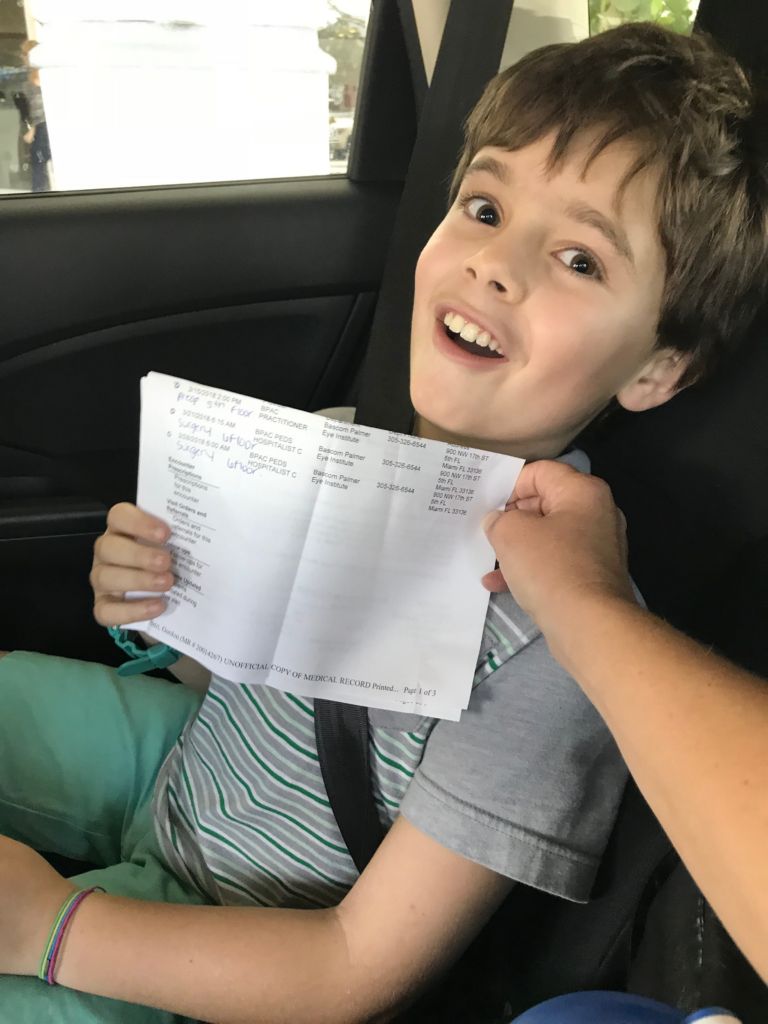
9-year-old Creed Pettit holding his “surgery scheduled” paperwork after he and his mom met with surgeons at Bascom Palmer Eye Institute in Miami to schedule his gene therapy treatment with LUXTURNA.
“This time was the first time I’ve ever come back home from Miami with a set date and hope.”
That date would be March 21st for genetic therapy surgery at Bascom Palmer Eye Institute using LUXTURNA™, a revolutionary treatment to correct the RPE65 gene mutation in one of Creed’s eyes.
The next important date will be March 28th for the same surgery in Creed’s other eye.
“I am on CLOUD 9!!!” Sarah emailed Monday, Feb. 19, hours after meeting with a team of doctors at Bascom Palmer.
The news comes after Sarah’s insurance provider, working with the developer of LUXTURNA™, Spark Therapeutics, gave the go-ahead to schedule surgery. The company established Spark Therapeutics Generation Patient Services™ to support commercially insured patients and their caregivers in the United States and help them navigate the insurance process, according to a Spark Therapeutics’ news release.
Soon after doctors diagnosed her son at the age of 3, Sarah began raising money, totaling about $100,000 that has gone toward research into finding a treatment for LCA-RPE65.
Creed, Sarah, Sarah’s friend, Chad, and Sarah’s mom, Mary, drove from Mount Dora to Miami on Sunday, Feb. 18; on Monday, a team of nurses and doctors met them and talked about what to expect for the surgery.
Meeting the gene therapy team
Dr. Audina M. Berracol will be doing Creed’s surgery. She is a Professor of Clinical Ophthalmology, specializing in areas including vitreoretinal diseases and surgery.
“She was amazing,” Sarah said. “We just had a chance to really meet her.”
Dr. Berracol answered Sarah’s questions and put her mind at ease. Creed has a sensory issue with anything that is “sticky” and had difficulty with patches on his eyes. To help overcome this, the doctor sent them home with a roll of tape used for patches.
“It’s to get him used to it because he’s not going to be able to pull it off,” Sarah said.
Creed later asked his mom how many minutes are in 24 hours. She Googled it and found 1,440 minutes.
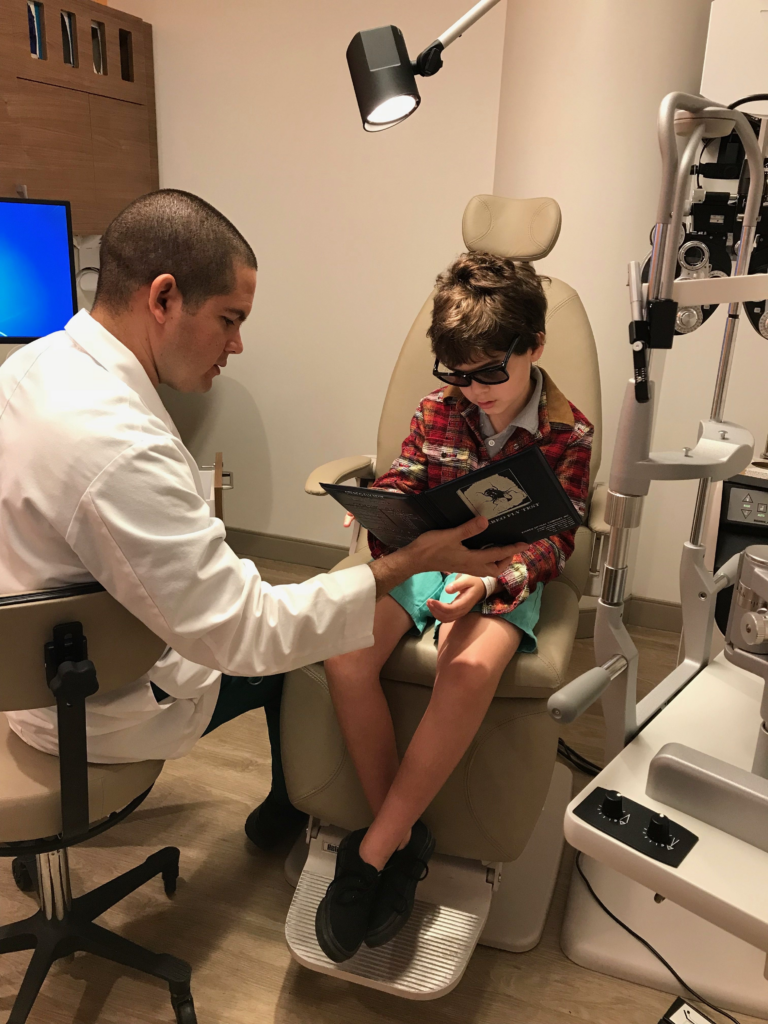
9-year-old Creed Pettit being tested at Bascom Palmer Eye Institute in Miami in advance of his gene therapy treatment with LUXTURNA.
He wanted to know because that’s how long he’s going to have to wear an eye patch after surgery.
“So that’s fine,” she said. “We’ll count down from there.”
Sarah also wondered what happens after surgery if Creed cries. It’s OK to cry, as long as he doesn’t rub his eyes. A small blister, called a bleb, forms after the surgery, creating vision as if looking through a fish-eye lens.
“Once it pops (naturally), you know you’re in the clear” the doctors said.
And Sarah asked about administering fluids intravenously, because Creed pulled out an IV after he woke up from having his tonsils out.
The doctor assured her that the IV will be placed so it can’t be pulled out.
She also learned the surgery usually lasts about an hour, much less time than she had imagined.
‘Excitement and worry’
Back home, Sarah reflected that everything was just so overwhelming.
“It was a long trip home but worth every second of it.”
Creed said the trip was “a one-night stay and we went to Bascom Palmer Eye Institute.”
As for the surgery, Creed said, “I’m feeling a little nervous.”
So is mom. Two days after returning from Miami, new fears crept in as she thought about all the “what ifs” that could happen during surgery.
“I can say other LCA moms are feeling this same emotion,” she said. “Waves of excitement and worry all flow through.”
Her feelings are smoothing out as she and Creed get back to their usual routine for the next several weeks before driving back to Miami for the surgery.
“We’re just going to plug along with school, and Creed’s school has offered to meet with me as to how we’re going to keep him on track while we’re there.”
Hannah Reif, 7, will be treated with LUXTURNA™ at Children’s Hospital of Philadelphia (CHOP) to cure her blindness caused by LCA-RPE65.
Amy Reif still can’t hold back tears when she recounts first hearing that a ground-breaking genetic-therapy treatment targeting her daughter’s LCA-RPE65 gene officially received approval.
Amy knew in October that the Food and Drug Administration was holding a meeting about LUXTURNA™, a gene therapy developed by Spark Therapeutics, and felt hopeful for a cure for her 7-year-old, Hannah’s vision loss.
“We didn’t actually realize there was a vote on it at the end, and it received unanimous support,” she recalled. She wondered, “Is this it?”
In October the FDA’s Cellular, Tissue and Gene Therapies Committee heard testimony, including that of Laura Manfre, co-founder and board chair of Sofia Sees Hope.
The committee voted unanimously to recommend approval of the breakthrough drug.
“Then we realized it was a good next step in the process,” Amy said. “Then when the FDA approval actually happened in December – I can’t even talk about it without crying – we just had so much hope for seven years and all of a sudden all of our dreams were realized,” she said through her tears. “And it was just incredible.”
Amy, a 41-year-old mother of three living in Maple Glen, PA, with her husband, Christopher, still marvels at the idea that the genetic research focused on the same gene mutation as her daughter’s.
“What were the chances that was going to be her gene? It was just amazing.”
The first-grader will be treated with LUXTURNA™ at Children’s Hospital of Philadelphia (CHOP), where Jean Bennett, M.D., Ph.D., and Albert M. Maguire, M.D., researched and conducted studies, working with mice and dogs, resulting in this extraordinary gene therapy. LUXTURNA™ is the first genetic therapy treatment for LCA-RPE65, and it is the first treatment in the United States for any inherited disease.
“We didn’t have to search far and wide,” Amy said.
Treatment likely this summer
The family met Feb. 12 with Bart P. Leroy, M.D., Ph.D., for their first appointment at CHOP to get ready for surgery, which probably will happen this summer. Dr. Leroy is director of Ophthalmic Genetics and Retinal Degenerations clinics in the Division of Ophthalmology and Center for Cellular and Molecular Therapeutics.
They discussed the surgery and took more photographs of Hannah’s eyes. They’re waiting to be scheduled for their next appointment.
Doctors told Amy that Hannah has one of the milder forms of LCA. She has night blindness that extends to any dimly-lit area any time of the day. She also has poor peripheral vision.
An ophthalmologist who saw Hannah at 2 months old suggested LCA as the possible cause of her visual impairment and sent her to CHOP for an electroretinogram (ERG).
At age 3 at CHOP, Hannah attempted to do simple tasks as part of getting into clinical trials, but she was too young, and the testing was difficult and upsetting. Two years later when they went back for their next ophthalmology appointment at CHOP, the trials were winding down.
“Had we had the opportunity to be in the trial, we would have, but it just didn’t work out.”
Over the last seven years, the family has raised more than $20,000 for Foundation Fighting Blindness through VisionWalk.
Spark’s patient assistance program
For help with the insurance process for Hannah’s surgery, Amy called Spark Therapeutics in January on the recommendation of other moms of children with LCA-RPE65. She said Spark is working with her insurance company on the $850,000 cost to treat both of Hannah’s eyes. The company has established Spark Therapeutics Generation Patient Services™ to support commercially insured patients and caregivers through the treatment experience and help them navigate insurance issues.
Amid all this preparation, Amy said she doesn’t know that Hannah has fully grasped what is going to happen.
“She knows that she’s going to see better, but I’m not sure at age 7 if she knows what that means. She knows that she can’t see stars and rainbows like other people can. At this point, we haven’t talked a lot about it because summer is several months away.
“She is very scared.”
Amy said her daughter had surgery for a lazy eye and still remembers having a hard time coming out of anesthesia and her eyes being crusty.
“She’s excited about the surgery, but she’s afraid she’s going to have crusty eyes. It doesn’t seem like a big deal to us, but for her it is.”
For now, though, Hannah’s enjoying life like any other kid. She attends regular first-grade classes and loves to play with her friends and with Barbies. She especially loves riding her scooter.
“The principal will be outside to meet the kids in the morning and he just sees her flying down the sidewalk on her scooter, and they know my child is visually impaired and they just can’t believe it.”
This is the first in a series following the progress of Creed Pettit, a 9-year-old Florida third-grader, who is a candidate for the breakthrough gene-therapy drug called LUXTURNA™, approved as the first gene therapy for Leber congenital amaurosis (LCA), and as the first-ever genetic therapy in the United States for an inherited disease.
A birthday wish for 9-year-old Creed Pettit, diagnosed with LCA-RPE65, comes closer than ever to coming true today when the Florida boy and his mom meet with a surgeon to schedule treatment with LUXTURNA™, the just-approved, revolutionary gene therapy that corrects his specific gene mutation.
Creed, LCA2 RPE65
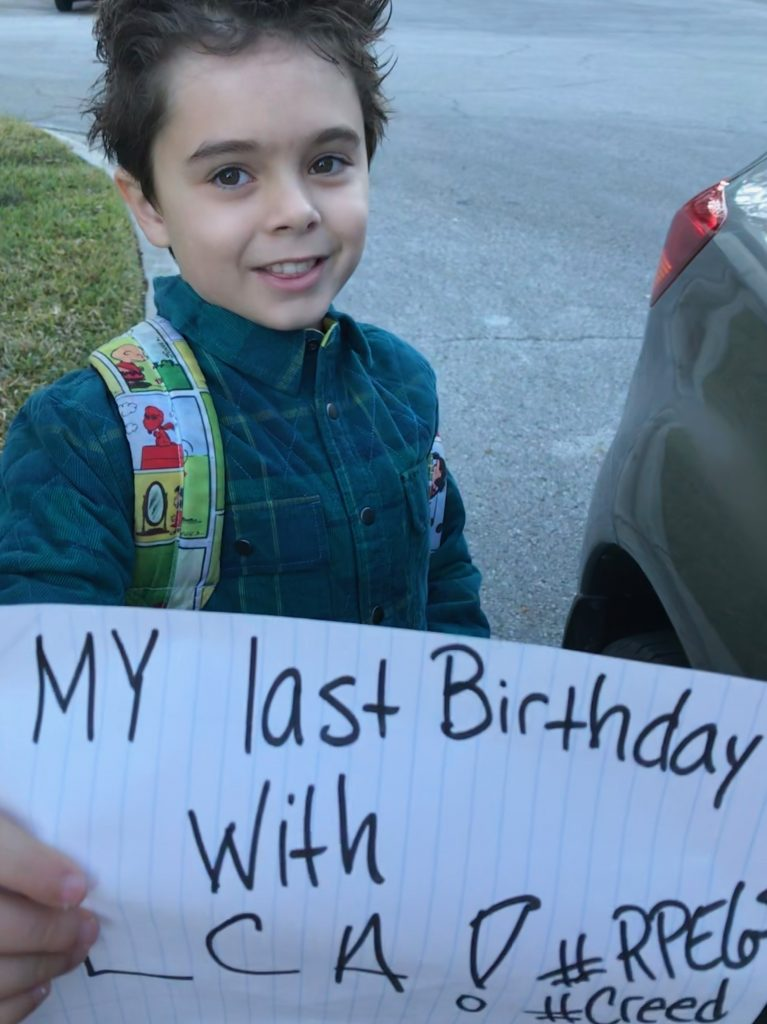
Creed had wished that his January 9th birthday would mark his very last with LCA-RPE65.
This third time might truly be the charm for Creed, as his mom, 41-year-old Sarah St. Pierre-Pettit of Mount Dora, Fla., twice tried to get her son, at ages 3 and 4, into clinical gene-therapy trials in Iowa. He was not approved for the trial because he could not perform steps required by the study, such as trying to navigate a maze.
Sarah learned a few days ago that her insurance company gave the go-ahead to schedule the surgery that costs $850,000.
“No more hurdles,” she wrote in an email. “I am a wreck of happy tears!!!”
It was last October when decades of research culminated in a Food and Drug Administration advisory committee hearing in which the group recommended approval of LUXTURNA™, Spark Therapeutics’ breakthrough gene-therapy treatment.
“One of the doctors spoke about my son in the FDA approval process, which was just amazing,” Sarah said. “That day I knew Creed could be treated.”
Creed and his mom, Sarah St. Pierre-Pettit of Mount Dora, Fla. Creed meets with his surgeon Feb. 19 to schedule his treatment with LUXTURNA to reverse his blindness caused by LCA-RPE65.
Hope in Focus (formally Sofia Sees Hope) founder and board chair Laura Manfre also counted among those speaking on behalf of this ground-breaking treatment, sharing with the committee a story of a woman whose vision greatly improved in the clinical trials and changed her life.
The FDA granted approval of the treatment in December, paving the way for patients like Creed with LCA-RPE65 to receive, LUXTURNA™, the first genetic therapy treatment for an inherited retinal disease (IRD), and the first genetic therapy in the United States created for any inherited disease.
RPE65 is a form of Leber congenital amaurosis in which the body can’t make a protein needed by the retina to convert light into vision-enabling signals, which are sent to the brain. This new therapy involves injecting under the retina a human-engineered virus containing copies of a normal gene, so cells can express the protein. LCA is a rare inherited retinal disease, and nearly 30 gene mutations are associated with it.
Creed said that after the surgery, he can’t wait to see a real rainbow and he can’t wait to throw his canes in the lake.
His mom, on speakerphone last week while driving to pick up a new batch of “Creed’s Cause” T-shirts that she designed, talked about her most recent effort to help pay for medical bills not covered by insurance, and for travel expenses.
At $20 apiece, Sarah sells them locally and through Facebook and Instagram. When she’s not making T-shirts, she’s an elementary school physical education assistant, and hosts trivia nights at a brewery owned by her sister and brother-in-law.
Creed is a third-grader at Mount Dora Christian Academy, a school that better serves his needs than the public system. MDCA is like family to Creed and his mom, hosting lots of fundraisers, including a January basketball event that raised $5,000. The Douglas G. Halliday Foundation of Orlando recently made a generous contribution, adding to the more than $100,000 raised from 5K races, a CrossFit event and contributions from many friends and people she doesn’t even know.
Missing milestones
In 2011, doctors diagnosed Creed with LCA; in the months following he received a genetic diagnosis of LCA-RPE65. Image: Toddler-aged Creed wearing patches over both eyes.
Sarah knew something was wrong with her baby shortly after he was born in January 2009.
“He missed all of the milestones. He would run into everything. He wasn’t walking. Instead, he did this weird Army crawl. He’d feel for his food and look up.
“Everything just said something’s not right.”
Then came the heartache of trying to figure out what was wrong. Doctors diagnosed Creed at 18 months old as autistic, and another said he had problems with his peripheral vision.
For the first year of Creed’s life, his mom thought he had colic because he would spend his days contentedly on a blanket outside, and at the end of the day when he went back into the house, he cried, all night.
An autism teacher advised Sarah to black out all the windows in the house, keep everything dark and not allow him to be in light, the exact opposite of what he needed.
She found the right advice from a woman specializing in depth perception and dyslexia. For the first time, and coming from a non-doctor, Sarah learned that her son probably was blind.
In 2011, doctors diagnosed Creed at 2 years and 8 months with LCA; in the months following he received a genetic diagnosis of LCA-RPE65. A week later, Sarah began her fundraising endeavors.
She also reached out for support that resulted in a team of therapists and specialists to address Creed’s movement, vision, speech, orientation, mobility and behavior.
Trying for a gene therapy trial
Sarah learned about RPE65 gene-therapy trials. She, her mother, Mary, and Creed traveled to Iowa twice for what turned out to be unsuccessful attempts to be part of the research.
Creed’s visual acuity is actually very good; when he has light, he can see. When he doesn’t have light, he can’t see anything. As Sarah says, “No light, no sight.”
He needed light and he got it, with his mom installing special bright lights all over the house.
“I’m positive they can see us in space,” she said of the lights in and around her home. Creed also has more light in school, including a light in his desk.
At school and in life, Creed has another light shining on him – his best buddy Michael, who bonded with him in first grade. He helps him be safe and gives Sarah updates about her son.
She said she can’t believe Michael’s maturity and sensitivity and believes he was put on this earth to help her son and others.
For Valentine’s Day, teachers filled bags with candy and sold them for $1 each, with proceeds going toward Creed’s expenses.
The words on the candy bag say, “Help Creed see how much we love him.”
Tami Morehouse made research history in the Leber congenital amaurosis world, and in the nation, when at age 44 she became the oldest person in a successful LCA-RPE65 genetic therapy trial, and the first patient to receive the retinal therapy in both eyes.
It’s been a long road for Tami, now 53 and living in the Cleveland area with her husband, Mike.
With no LCA diagnosis until her 30s, Tami made her way through life doing whatever she had to do. Sink or swim, she developed good coping and resource skills.
“I did what I had to do,” she said. “I had enough vision to make it work.”
No one noticed her vision problems until she was about a year old, when nighttime came, and she couldn’t see well at all. Attention focused on the idea she had night blindness.
It is difficult to detect vision clarity in small children, but her mom and dad knew something wasn’t quite right. Doctors picked up on it when she was 5, during an exam in which she recalled she was scared to death, screaming and crying, because they were poking around her eyes.
They determined she had issues with the clarity and clearness of vision, known as visual acuity.
She just adapted
From kindergarten into her 20s, she adapted to her surroundings and to her level of vision. She had difficulty seeing the chalkboard, reading a paper or deciphering bulletin-board postings.
“All of my teachers knew I had a hard time. I needed more light than the average kid. I remember the hallways of my elementary school were very, very dim and I had a hard time making my way around.”
Something her father said a long time ago helped her along the way. Her dad, who always called her Timmer, said, “‘Timmer, we all have our troubles, and if you want me to take you anywhere or do anything, just ask me.’ They just treated me like the typical kid I was not.”
Studying social work at Edinboro University in Pennsylvania, Tami scheduled classes in familiar and comfortable places. She avoided night classes, and when she couldn’t, she’d figure out how to get there, walking in better lit areas.
She realized that all her life she was a tweener – someone poised in-between.
“I was a tweener for forever because I did most things like everyone else did and there was that part that everyone else didn’t know.”
Since she was young, some sort of eye doctor tracked her through the years, but it wasn’t until she got her first social-work job and her then-boyfriend, now-husband, Mike, said they needed to explore potential options.
Finally, a diagnosis
Specialists diagnosed her under the retinitis-pigmentosa umbrella and told her she would lose her vision. They said it was good she already had her education and she should consider having her children now. “It was a heartbreaker day,” Tami recalled.
As she aged, so did her retina and its ability to function well. She went from reading storybooks to her three children to reading Dr. Seuss alphabet books. Some days she saw only hazy grays and browns and needed the brightest lights to see.
“It was really very scary. At that point, before the trial, I had more poor-vision days, than OK-vision days. Sometimes I was scared to death to set my alarm. What if tomorrow is the day I wake up and my vision doesn’t get better? What if I wake up and I can’t see?”
But one Sunday morning, Tami was in the house, and her husband was out in the garage. He suddenly barreled in. He had heard on the radio that a study was being done on children with LCA in Philadelphia by Dr. Jean Bennett and Dr. Albert McGuire. Mike called Bennett the next day, and the wheels turned fast. Bennett opened the study at Children’s Hospital of Philadelphia to older patients and invited Tami to take part in the Spark Therapeutics trial that would change her life.
RPE65 treatment, an improvement
In March 2009, doctors injected her left eye with healthy cells to help her retina perform more efficiently and regenerate healthy cells.
Several days later, she and her husband were having dinner in Philadelphia and Tami reached over and picked up her drink.
‘Do you know that you just reached over and picked that up, you didn’t feel for it?,’ Mike asked. ‘You just looked out and saw it and picked it up!’
The injection in her right eye in November 2010 brought more brightness and clarity, to the point where she could see some eye-chart letters.
In spring at a baseball practice for one of her sons, she noticed colors more than ever before.
“It was color and light and movement and the kind of stuff people take for granted every day, which may seem small if you have it. Once you lose those little things and then get them back, you realize how important they were. For me it was huge.”
Tami also got to see her daughter taunting the opposing pitcher on her softball team, as she frequently danced up and down the third-base line to almost always steal home.
‘Don’t give up’
Her only wish was that the therapy had been an option sooner, because as the years passed, her retinas kept deteriorating.
“If this was a life-threatening illness,” she quipped, “I would have died a long time ago.”
She advises anyone with LCA-RPE65 to investigate whether the therapy is an option, saying, “Time is of the essence. Don’t give up. There were a lot of us in that trial and we all seem to have different levels of benefits from procedures, whether you have a little vision or a lot of vision. I just value my vision so much, I just think everybody needs to act and respect whatever level you have and just be glad to have it. There’s so much to see. It’s an incredible gift.”