College Connection: Three Things Parents Can Do For Their Visually Impaired Child

Parents want nothing but the best for their children. This is why I am so often asked questions like, “I have a 6-year-old son who has a vision impairment. What can I do to help him become independent when he grows up?” I am lucky to have the parents I do because they have done many things that have helped me become the confident and independent person I am today. I am going to share a few examples of what they did for me in the hopes that you can help someone in your life, too.

Never Say “No”

“No” was never a word I heard growing up unless I was misbehaving (not that I ever did that). Once around the age of 8, I was talking about what I wanted to be when I grow up and my Dad, a financial planner, said “Jack, maybe you can take over my business.” My response was “I can’t do that, you drive lots for meetings and I am not allowed to drive.” Instead of agreeing with me, my parents simply replied,  “Jack, you could just have the clients come to you.”

I was never given an easy way out because I couldn’t see well. Instead I was intentionally challenged, which helped me develop many skills. In my preschool years, my parents would go for walks after dinner when it was dark. Most nights I would follow them on my tricycle. I have never been able to see in the dark. My parents didn’t always know this but when they found out, they didn’t stop me riding the tricycle in the dark. I believe that this helped me gain the excellent orientation and mobility skills that I have today.

Children who are different are often targeted by bullies. I was bullied frequently but I always knew that I could go to my parents for help. Being there also refers to being your child’s biggest advocate. Relentlessly advocate for an accessible education for your child because without that he or she will never be independent.

I hope that you can apply these examples to your own life and that you are inspired by my parent’s actions – I know that I am! As always, feel free to reach out online.

Jack McCormick is a 21-year-old honors business student at Canada’s Wilfrid Laurier University in Waterloo, Ontario, and he is a member of the National Young Leaders Program for the Foundation Fighting Blindness. Jack was diagnosed in high school with Leber congenital amaurosis due to mutations in the RPE65 gene. He is also a Hope in Focus (formally Sofia Sees Hope) Ambassador, helping people living with LCA and IRDs.
Continuing to See Hope for IRD Treatments

At three o’clock Thursday afternoon, Beth Chiarella and I had a very public moment of tears and hugs at Baltimore–Washington International Airport as we received news that after a day of hearing testimony, the Federal Drug Administration’s Advisory Committee unanimously recommended approval of a gene therapy that could reverse or reduce vision loss due to an inherited retinal disease (IRD).

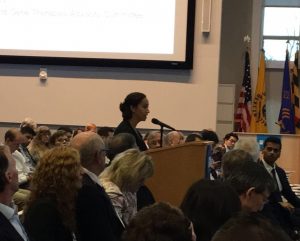
Sofia Sees Hope founder Laura Manfre testifying to Federal Drug Administration’s Advisory Committee about a gene therapy that would help those with RPE65 gene mutation form of LCA

The committee listened to Spark Therapeutics present their research and findings on LUXTURNA® (voretigene neparvovec), an investigational, potential one-time gene therapy, and heard testimonies from families whose lives have been changed dramatically by the therapy. Members then voted 16-0 without comment to endorse approval of the therapy for the treatment of patients with vision loss due to confirmed biallelic RPE65-mediated inherited retinal disease (IRD).

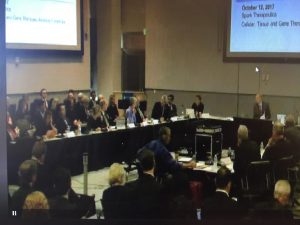
Federal Drug Administration’s Advisory Committee unanimously recommended approval of a gene therapy that could reverse or reduce vision loss due to an inherited retinal disease (IRD).

Alongside the brave individuals and their family members who were part of the clinical trials and traveled to Washington, D.C., to share their personal stories in support of this therapy, I played a small part in what is no doubt an historic moment for all LCA families. I’m grateful to Tami, the oldest participant in the RPE65 trial, who allowed me to share her experience with the panel, reinforcing that this treatment is life-changing at any age, and for any length of time. I’m also grateful to all of those who have made it possible for Sofia Sees Hope to play a role through their continued advice, support and enthusiastic cheerleading.

While this first treatment does not address the dozens of other genetic mutations that cause blindness for LCA and IRD individuals, we can hope that this endorsement will be followed by a potential FDA approval, in turn paving the way for continued research and treatment for my daughter and our entire LCA community. Thursday marked a positive step forward on the path to changing the lives for many people.

Read Laura’s full statement to the Advisory Committee here.

‘Walk Around With Your Blindness As a Badge of Triumph’

Doctors diagnosed Jack McCormick in high school with Leber congenital amaurosis due to mutations in the RPE65 gene. With a mix of feelings about his diagnosis, it was when he accepted his visual impairment that he began evolving into the young and innovative leader he is today.

Jack is smart, funny, creative, articulate, compassionate. The 20-year-old also has a passion for inclusion and he is an advocate for accessibility on all fronts.

He is an honors business student at Canada’s Wilfrid Laurier University in Waterloo, Ontario, and he is a member of the National Young Leaders Program for the Foundation Fighting Blindness.

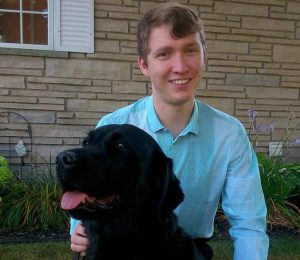
Jack McCormick in a blue shirt sitting next to his black lab, Jake
Jack McCormick and his guide dog Jake.

For a long time, Jack, like many blind or visually impaired people, worked hard at hiding his blindness; he didn’t want people to judge him because of it. But all of that changed in his senior year of high school when he got Jake, his beloved guide dog. Jake immediately made Jack feel like he was wearing a sticker that said, “Hey, I can’t see,” which meant no more hiding.

Acceptance leads to respect and opens pathways to social accessibility and, in turn, helps fuel research, Jack explained before an international audience in Toronto at the Foundation Fighting Blindness Vision Quest 2016 conference.

“I accepted it in myself and that is the most important thing you can do,” he said. “To accept it in yourself and be so confident about it that you walk around with your blindness as a badge of triumph rather than a badge of sorrow or something you’re trying to hide.

“And in doing that, people are going to be very committed to you, they’re going to respect you and respect is a very powerful thing.”

That respect continues in social situations, such as securing a job, and in fostering research, because people will know that blindness is an issue.

“It’s visible,” he said. “If the community sees it, they know it exists. If you’re hiding it, no one knows.”

Along with acceptance, Jack encourages people with blindness to tell their story. “The most powerful thing in your life is your story, so share it. Share it. Because when you do, other people will hear it and they will tell other people and then you’ll have the opportunity to share it with more people and it’s a spiral.”

You can hear more from Jack in his “College Connection” column that appears in our quarterly newsletter, “Seeing Hope,” and on his personal blog. Watch a video about Jack.

It’s April Fool’s Day, and we’ve got a great post to share with you!

“We can all make our lives much happier if we choose to laugh, live our lives more intentionally and find joy in the little things.”

Jack McCormick headshot
Jack McCormick

The quote above is from our friend, Jack McCormick’s blog. You may know seen the video, Jack’s Story, at Dinner in the Dark last year, or on Facebook or our website. Jack’s story is one of clinical misdiagnosis – something that happens all too frequently. It’s also about living with a visual impairment, the role his parents played in his life, and getting to a correct diagnosis. (Spoiler alert! Jack has LCA.) If you haven’t seen it yet, take a few minutes to watch!

If you’re raising a blind child, then we also recommend this post from Jack, Let’s Laugh: At Me! There are so many emotions and worries that keep parents up at night, and Jack’s post is a reminder that our kids are not just rare and beautiful, but sometimes just plain goofy, and a little humor and laughter can go a long way!