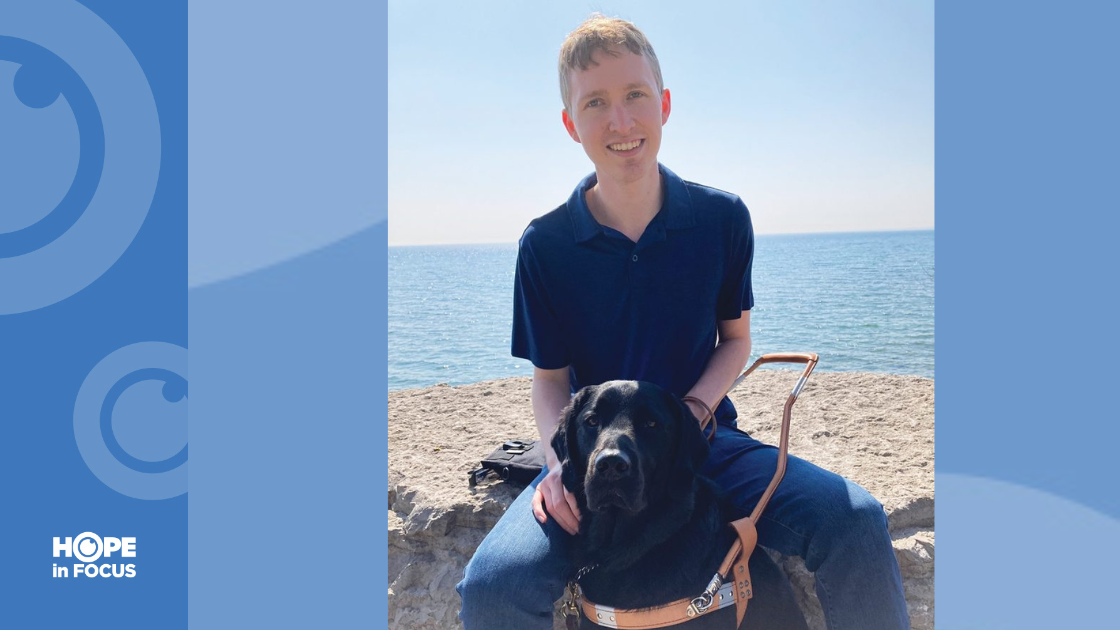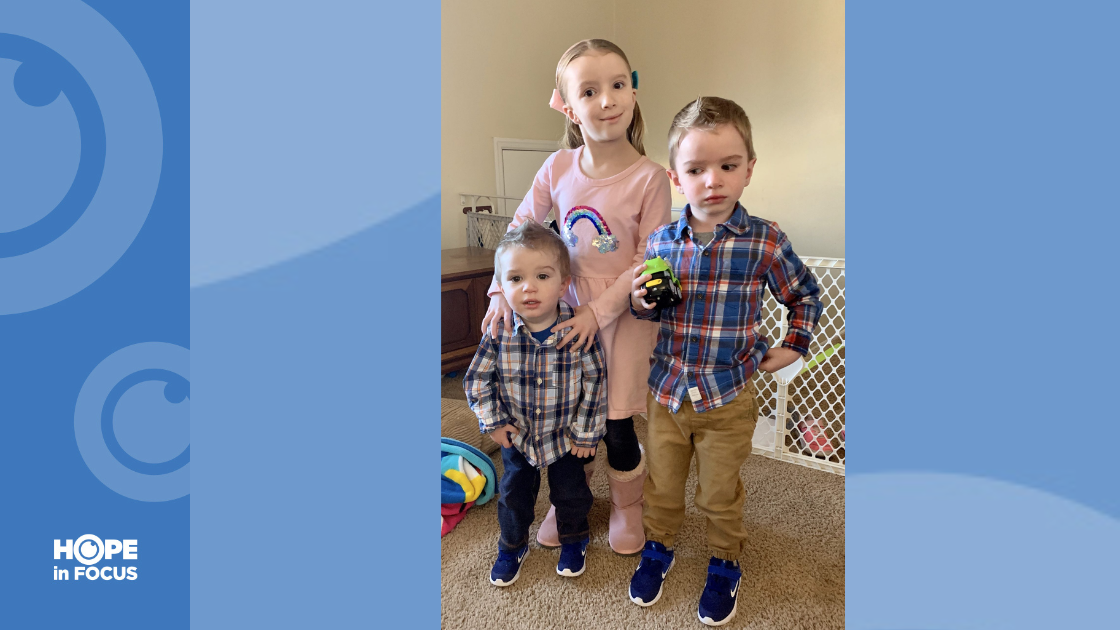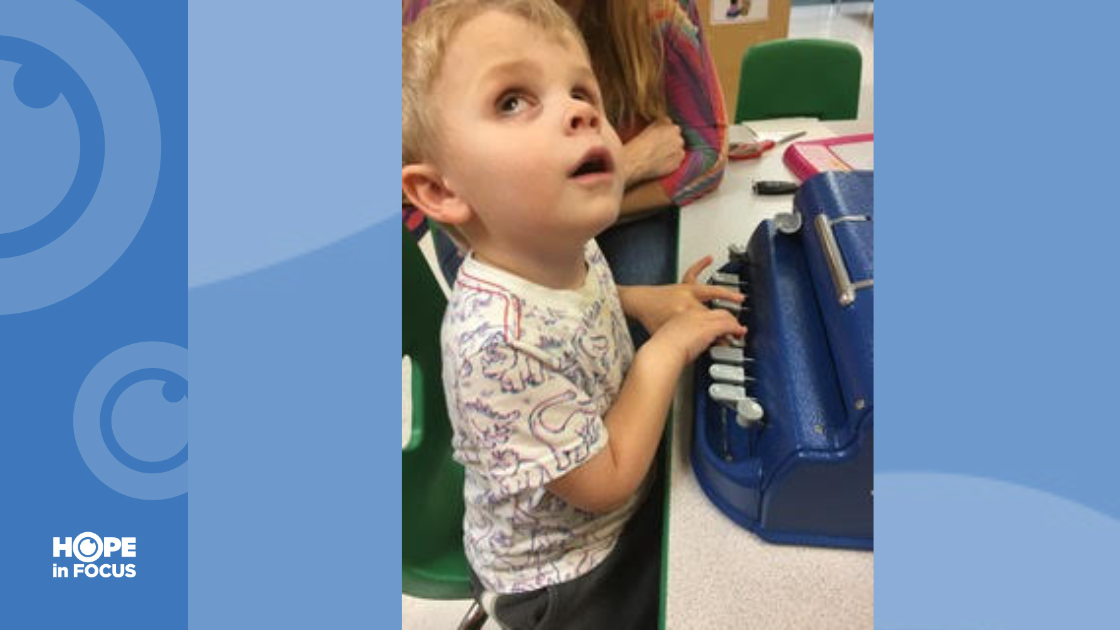
Even the Covid-19 cloud has a silver lining, and living proof is Andrew Picinich, a 4-year-old preschooler with LCA-CRX, an exceedingly rare form of Leber congenital amaurosis (LCA) caused by a mutation in his CRX gene.
Drew’ s sister Anna helping him with his computer
Other than saying a few words, Andrew, who goes by Drew, usually does not speak. Coaxing him to be more open and social poses one of the biggest challenges for his parents.
Turns out being stuck at home in northeast Philadelphia to temper the spread of the coronavirus, opened up Drew’s personality, thanks to being with his family – all day, every day. He is interacting and engaging with them more than ever.
Drew also receives vision teletherapy and virtual preschool assignments through Philadelphia’s Overbrook School for the Blind. Virtual learning, a challenge for many, has its built-in difficulties for a 4-year-old who, as his mother said, has the attention span of, a 4-year-old.
As with many families staying home during the pandemic, the Picinich household is extraordinarily busy. Drew’s mom, 39-year-old Monica, works full time now from home as a teacher of the visually impaired, and Drew’s dad, 41-year-old Cian, works full time downtown for the Philadelphia Corporation for the Aging, which helps with elder care.
Monica, a former middle school science teacher, decided rather than focus on Drew’s pre-Braille and computer skills for now, she would concentrate on teaching him – literally and figuratively – how to navigate everyday life, including helping him learn to play with the same games and toys as his 7-year-old sister, Anna, and 2-year-old brother, Sean. Anna also plays sort of a teaching-assistant role with her outgoing personality. But being so social while not being in a classroom also means she terribly misses her school, and her first-grade friends and her teacher.
CRX: Rare among the rare
At 4 months old, Drew moved his eyes from side to side as if reading a teleprompter, his mom said, and a pediatric
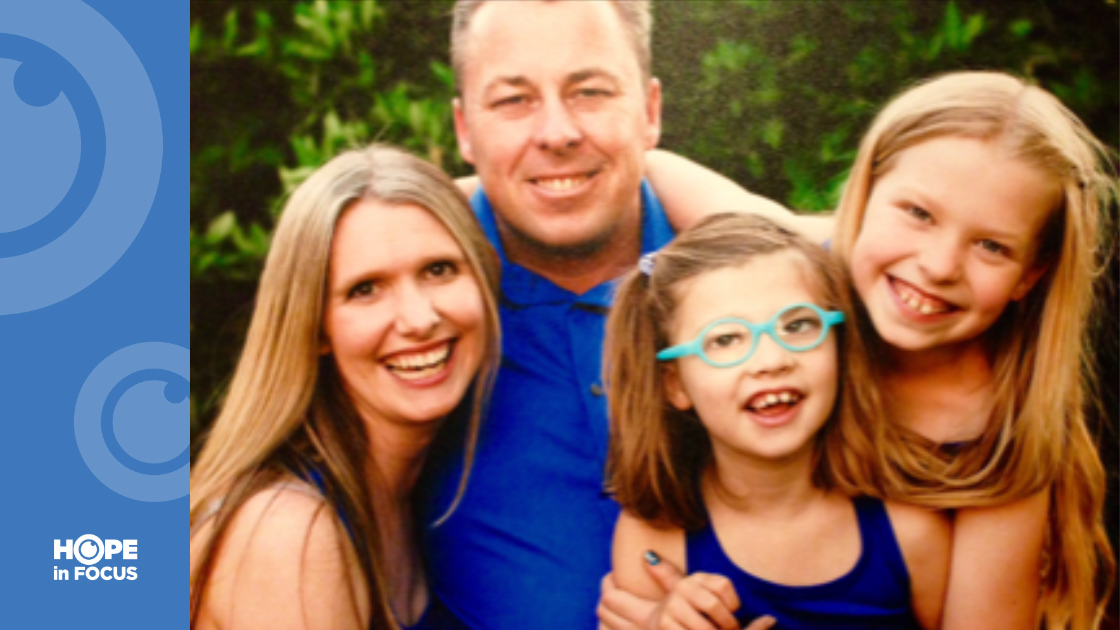
Drew’s Uncle Joe, Grandmom Barbara, cousin Sienna, sister Anna, brother Sean, Drew, Mom Monica, Dad Cian, Aunt Alysha and Uncle Greg, posing with the Easter bunny.
Drew’s confirmed genetic diagnosis later found he had a mutation in his CRX gene, resulting in LCA-CRX, also known as LCA7, a rarer version of the already rare forms of LCA.
The CRX mutation also distinguishes itself as an autosomal-dominant gene rather than LCA’s usual autosomal-recessive, meaning a gene mutation caused Drew’s condition, rather than him inheriting it from his parents. This also means Drew has a 50/50 chance of passing it on to his children.
Developing therapies for treating CRX also presents bigger challenges. The CRX dominant gene first needs to be turned off before inserting a good gene. A federally approved therapy for LCA2 (LCA-RPE65) works by inserting a new gene to overtake the bad, while a developing technology of gene editing works like molecular scissors to cut out the mutation.
As part of their search for more CRX information, the family attended the LCA Family Conference hosted by Hope in Focus (formally Sofia Sees Hope)last summer in Philadelphia. Patients, family members, advocates, doctors, researchers, and biotech industry leaders gathered at the two-day conference.
“I came away with knowledge and connections,” Monica said. “Being able to listen to and converse with doctors, FFB (Foundation Fighting Blindness) representatives, people from Sofia Sees Hope, and other families, was both informative and empowering. Even more impressive was the amount of dedication and love displayed by everyone that attended the conference.”
Drew’s Beacon for Blindness
Four year old Drew (right) with Anna, his 7-year-old-sister, and Sean, his 2-year-old-brother.
Soon after their son’s diagnosis, Monica and Cian (pronounced key-in) realized CRX families needed a patient organization to reach other families affected by LCA-CRX and to raise money for research.
Four summers ago, their extended family gathered around the dining room table at Monica’s parents’ beach house. They brainstormed and created Drew’s Beacon for Blindness. Monica and her brother, Joseph Cardullo, run the group.
The nonprofit supports the blind in Pennsylvania, New Jersey, and Delaware, and has two objectives: Finding a treatment/cure for CRX blindness and supporting schools and other organizations that provide educational technology for students living with blindness.
The group secured grant funding to give schools a 3-D printer and a K-NFB Reader (Kurzweil-National Federation of the Blind Reader), a mobile app that converts text to speech or text to Braille.
While researchers work toward developing a treatment for CRX blindness, Monica said, “Our main goal right now is to find other families with the same gene that want to unite to support CRX research.
“Aside from the research, it’s great getting to know people who have similar experiences as you. It helps make your rare experience feel more normal.”
Still in the early planning stages, Drew’s supporters in partnership with the Foundation Fighting Blindness are working on an educational webinar for CRX families. Sofia Sees Hope will help spread the word when the webinar plan comes to fruition.
With more input from researchers and families, Drew’s Beacon for Blindness hopes to discern promising avenues of CRX research and help fund studies to find a cure.
“Hopefully,” Monica said, “We can start to help move the research forward. It would be fantastic if everyone with LCA, no matter the gene, had an option for treatment.”
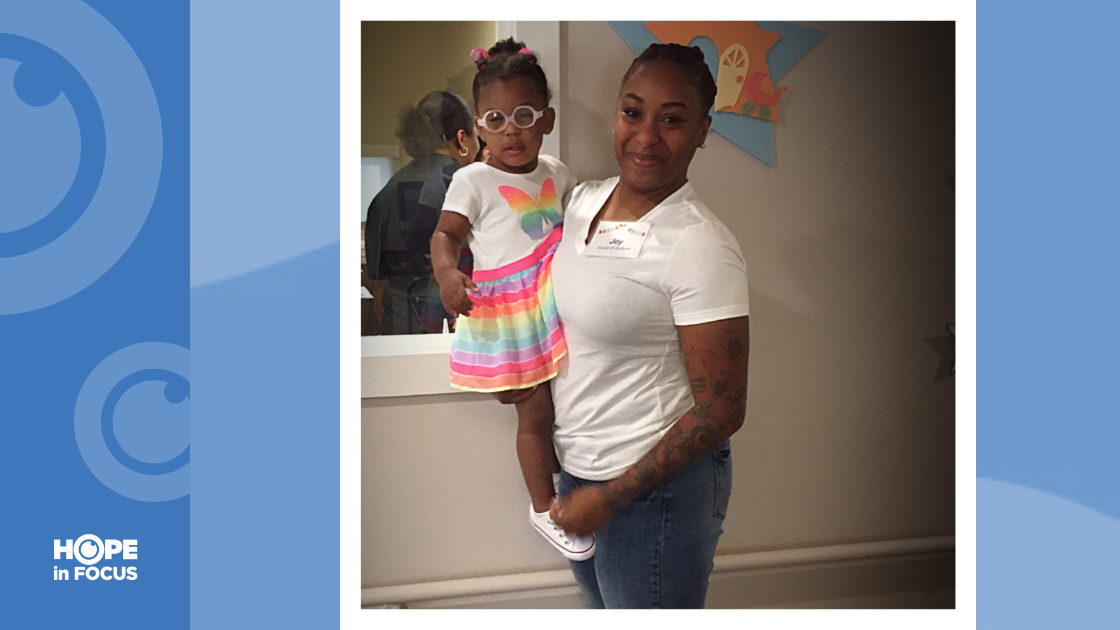
Blink and you just might miss toddler Jordynn rocket past you. A force to be reckoned with when it comes to music and movement, Jordynn is 4 years old and lives with Leber congenital amaurosis (LCA) caused by a mutation in her RPE65 gene.
Jordynn on her rocking unicorn.
“Jordynn is obsessed with movement,” said her mother, Joy. “So, before COVID happened, I would take her to Sky Zone (Trampoline Park),” now closed as part of a national shutdown to help contain the pandemic of coronavirus, known as COVID-19.
“Anything that moves, Jordynn is willing to try. We have a hard time getting her off the swings. At school, they use it as a reward for what she accomplished.”
Jordynn and her mother, who live in upstate New York near Rochester, received their genetic diagnoses in 2017, just several months before the U.S. Food and Drug Administration approved LUXTURNA™, a genetic therapy for patients with the RPE65 gene mutation, known as LCA2.
Jordynn was on a waiting list to take part in an RPE65 gene therapy study by Dr. Mina Chung of the University of Rochester Medical Center (URMC) Strong Flaum Eye Institute when Dr. Chung died in February after a fall while skiing in Italy.
Jordynn’s family is still reeling from Chung’s sudden death. She was a 51-year-old renowned researcher and retinal surgeon.
“She was the best,” Joy said. “We had just seen her a week before she went on her vacation and we’d see her when she came back.”
Joy is waiting to hear when Jordynn can join the study and was told by Dr. Benjamin Hammond, a colleague of Dr. Chung’s and an ophthalmologist working with Jordynn, that everything is on hold until another surgeon comes on board.
Turning 4 in the middle of a pandemic
Jordynn just celebrated her 4th birthday Wednesday, May 6, when her very arts-and-crafty mom gave her daughter a
Joy and her daughter Jordynn
quarantine birthday party, planned far in advance with a rainbows-and-cupcakes theme. Family members sang “Happy Birthday,” took photographs, and five minutes later left for their respective homes to help curb the spread of the virus.
With her prekindergarten class closed because of the pandemic, Jordynn gets her schoolwork sent home and through a YouTube channel. She has music therapy incorporated with orientation and mobility training because she is so drawn to playing the piano and the drums and loves to follow the beat and sing.
She also is learning Braille on a Brailler, and everything throughout her mom’s apartment and her grandmother’s nearby home is labeled in Braille for her to identify.
“Before it was all about Sesame Street,” Joy said of her daughter’s learning. “Right now, it’s ABCs and 123s and colors and all the things on YouTube that she can dance to and learn her numbers while she’s singing.”
Praise for New York’s VI Resources
Jordynn’s vision allows her to follow light and see three-dimensional shapes, but she cannot see them on paper.
Her mother first noticed something might be awry with her vision when she wouldn’t pay attention to people looking at her and smiling. Doctors diagnosed Jordynn with nystagmus, a vision condition wherein the eyes make repetitive, uncontrolled movements.
With a later diagnosis of LCA, Joy was stunned: “I just sat there, and then I said, is this my fault? Is there something I could have done when I carried her? OK, it’s something genetic.
Through it all, though, Joy is most grateful for an incredibly supportive family. Jordynn’s family support extends to her dad in North Carolina, aunts, uncles and four grandparents, including Grandma Gwen, Joy’s mom, who sees her almost every day.
“It’s just family support; that’s how we get through this,” Joy said. “Family support and lots of toys.”
On the move
Jordynn is among Gwen Goodwine’s dozen grandchildren and gets to see her grandma almost daily because they live near each other and because Gwen takes care of her while her mom, Joy, cares for the elderly and those with dementia.
Gwen Goodwine
There is no disguising the abundant love and hope that Gwen exudes for her youngest grandchild. For Jordynn, Gwen set up rugs like oversized dominoes throughout her house, blue and white rugs, from the family room, to the living room, to the kitchen, to the bedroom.
“That’s how she learned how to navigate,” Gwen said. “She runs through here like she’s got 20/20 vision.
“She likes to climb up on things. Anything she can reach. She takes the stool everywhere she wants to get. She loves to take the stool to my dresser. She plays with my perfume and plays with the jewelry. She’s fascinated. She looks in the mirror. She can’t see herself, but she’s seen me do it so many times that she does it.”
Jordynn moves a lot at grandma’s.
“She’d jump off this house if she could. I bought her a rocking horse. She’ll get on that horse and say, ‘I’m going to Tennessee, I’m going to Georgia, I’m going to California.’ She tore it up. Got another one. How she used it! They sent us another one free.
“She can be stubborn, too, oh my God. It’s her way or no way. She has a mind of her own. She knows what she wants, and she gets it.”
Gwen, now 80 with still a lot of energy, wants more than anything to see Jordynn see.
“I say, Lord, please. I don’t want to leave this earth ’til she look at me and see my white hair, take both of her hands on my jaws and kiss me.”
Conference connections
After Jordynn’s genetic diagnosis, Joy and Gwen found out about Spark Therapeutics, the research company that developed LUXTURNA™. The drug is an engineered virus that delivers the human RPE65 gene by subretinal injections.
Joy, her sister Jackie, Gwen, and Jordynn traveled last summer to the Philadelphia conference, a two-day event attended by more than 80 people – patients, family members, advocates, doctors, researchers, and biotech industry leaders – from across the country and Mexico.
Joy said it was great to meet families with kids who have gone through the same experiences.
“Learning about the treatment and getting the education about all of it really gave me something to think about as my daughter’s journey continues as she lives with this visual impairment,” she said. “Knowing that my daughter can thrive and live a happy life with some occasional bumps in the road was a wonderful feeling.”
She’s learned along the way the importance of perseverance and patience, offering this advice to parents beginning this journey:
“Don’t get discouraged. Take your time. Learn the process. Get to know your options. Find the resources available in your state. It’s a process but it takes time and sometimes it can be frustrating.”
Joy’s other message? “Please treat Jordynn like a normal toddler, because this is her normal and she is just like any other toddler.”
I was born in 1976 in Spokane, Washington. By the time I was born, my parents’ relationship was basically over, so I was raised by a single mom. It was clear from a very young age that I had significant vision loss. I started wearing glasses at 18 months. I went through lots of grueling tests as a toddler to figure out the cause of my vision loss with no real answers. Despite this, I lived a very full life. I was a Girl Scout. I did gymnastics. Basically, I did everything my friends did.
When I was 10, my mother took me to a research hospital in Portland, Oregon. After two days of testing, they told my mother I had Leber congenital amaurosis type 1. They told her I would likely be totally blind by the time I was 17.
So, I lived my days after that doing and seeing what I could because my vision had an expiration date. I didn’t just do the same stuff as my friends. I did more. I also got involved in the blindness community. I did public speaking in high school. I worked with blind kids, noticing that parents were not doing their children any favors by treating their children like fragile flowers. I worked with children with so few social skills because their parents didn’t expect them to act like the other kids. All that did was hurt them. But, I digress from my story.
So, I turned 17, and I could still see. Now, instead of vision having an expiration date, every day with vision was a gift. I went to college and met an amazing boy. We were married and pregnant with our first child within a year of meeting because I couldn’t stand the thought of not seeing my baby’s face.
I could go on forever about my life, but most of it is only interesting to me, so I’ll fast forward. I am 43, still married to that amazing boy, and we have two amazing boys of our own. I earned a Master’s degree in communications, and I work for a state agency that does vocational rehabilitation for people with visual impairments. I also still have a decent amount of vision, from my perspective.
A few weeks ago, I read a Facebook post about genetic testing. Nobody had ever talked to me about this before. I have regular eye appointments, but they really just check my vision and cataracts. I want to know more. I have started thinking I may have been misdiagnosed years ago, but I don’t even know where to begin. I’ve signed up for the genetic databases, but now what? It is such a strange feeling to doubt the one thing that had seemed certain my whole life.
So, that’s me. I’m not inspiring or pitiful. I’m just me, trying to figure out where I go from here and so glad to know I’m not alone.
Kristen Steele knows a thing or two about telling her story and getting what she needs to be her best.
The 22-year-old from Council Bluffs, Iowa, is a licensed massage therapist in Iowa and Nebraska. She travels throughout rural Nebraska, giving massages to the elderly and the ill as an independent contractor specializing in geriatric care.
But she had to fight to take her massage therapy exam in Braille. Never had anyone taken the Massage and Bodywork Licensing Examination, known as the MBLEx, in Braille.
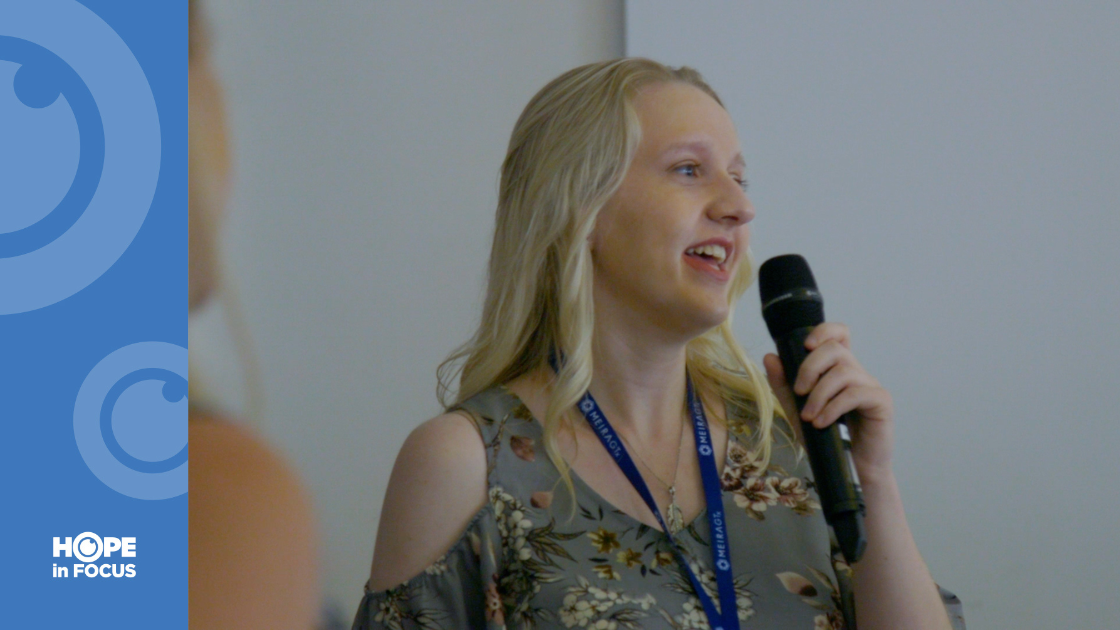
Kristen told her story to people living with Leber congenital amaurosis and other inherited retinal diseases (IRDs) at the Hope in Focus (formally Sofia Sees Hope) second LCA Family Conference in Philadelphia in July. The gathering brought together patients, advocates, doctors, researchers and biotechnology leaders – more than 80 people from across the nation and Mexico. She spoke from the audience following the conference’s session on patient advocacy called “Your Voice Matters!”
Doctors diagnosed Kristen with LCA as an infant, while her clinical diagnosis of LCA10 (CEP290) came years later in middle school. She learned Braille at age 3.
Kristen planned to be an English teacher but decided her passions aligned more with the medical field. She enrolled in Midwest School of Massage near Omaha after rejecting another school because of difficulty accessing its curricula. At Midwest, she found an instructor with a background in exercise physiology and physical therapy. She said the teacher cared and put in extra time to make sure she fully understood the techniques.
After completing the 1,000-hour massage therapy course on anatomy, physiology and pathology, plus 200 practice massages, with a 4.0 average, Kristen learned she couldn’t take the exam in Braille. Instead, volunteer readers administered the test to people with visual impairment. Readers could be unfamiliar with and prone to mispronouncing complex anatomical and medical terms, putting Kristen at risk of failing the exam. Plus, she didn’t want to pay the $195 exam fee twice.
She found a blind lawyer in Iowa and they sued the Federation of State Massage Therapy Boards. She reached a settlement agreement and took the exam, passing on her first try. Kristen also insisted on having a professional reader, an occupational therapist familiar with terminology used in the test questions – just in case she needed clarification.
Kristen polished her resumé with the help of visual interpreter services, highlighting her certificates in advanced dementia processes and other therapies.
“It placed my disability on the back burner, and it gave me the upper hand when you have sighted massage therapists and they’re interviewing without any of these advanced certificates,” she said.
A company interviewed Kristen by phone last year and hired her the day after her in-person interview. She continues to thrive there as a massage therapist specializing in geriatric care. She also devised her own transportation system to get to and from clients in the Nebraska countryside.
Kristen paved the way for others, including perhaps another conference attendee, Danielle Senick from Norwich, Conn. Danielle is studying to be a massage therapist, and Kristen said she will be there to help her succeed in changing the rules to take the exam in Braille in Connecticut.
The 21-year-old paved a smoother road for those without vision by changing massage-therapy exam protocol, writing policies and procedures, and proving herself as a competent, independent contractor who makes house calls to the elderly and the ill in rural Nebraska.
Kristen, who lives in Council Bluffs, Iowa, near the Nebraska line, forges through life with passionate determination. She finds the support she needs to be her best and passes her knowledge along so others can be their best.
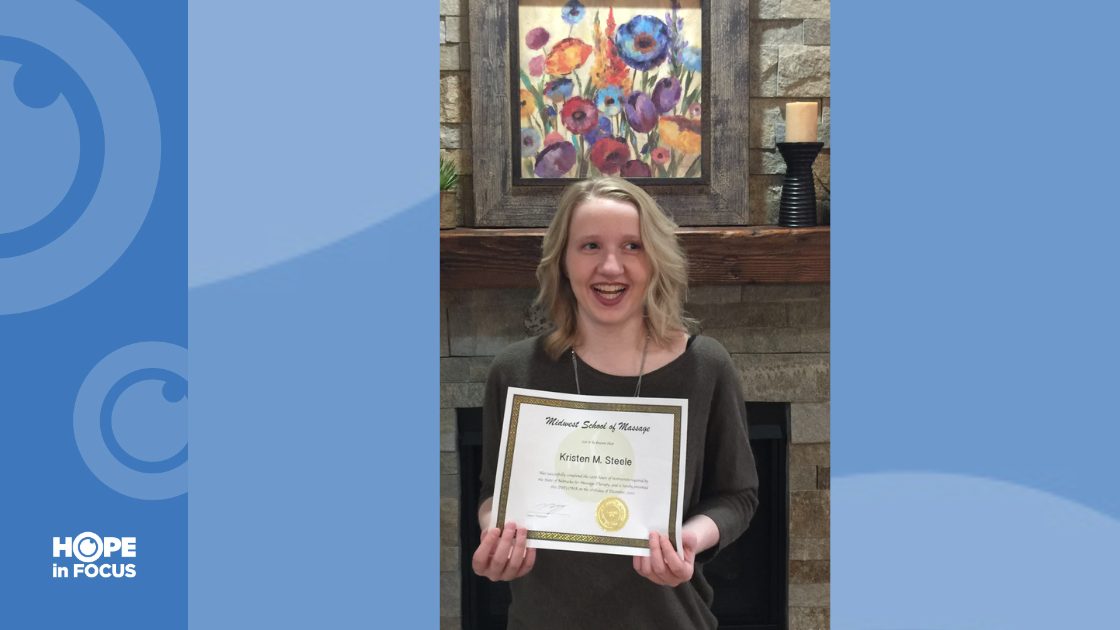
Kristen Steele proudly shows off her massage therapy certificate.
She has helped those without vision to pursue massage therapy careers, including Connecticut resident Danielle Senick. They connected through a Facebook page for people with Leber congenital amaurosis (LCA) and soon will connect in person at the second LCA Family Conference presented by Hope in Focus (formally Sofia Sees Hope) in Philadelphia this weekend, Friday, July 26, to Sunday, July 28.
Kristen, Danielle and those living with LCA or other rare inherited retinal diseases (IRDs) will gather at the conference, which offers myriad opportunities to engage in thoughtful and interactive exchanges of knowledge, ideas and viewpoints on research, future treatments, advocacy, and people sharing their stories.
Diagnosis: LCA10
Doctors diagnosed Kristen with LCA as an infant, although her clinical diagnosis of LCA-CEP290, also known as LCA10, came years later in middle school.
She began reading Braille at age 3, and since first grade, has used a BrailleNote, a mini tablet-sized personal digital assistant with input through a Braille keyboard.
Struggling in school and having trouble with teachers adapting to a blind student, Kristen’s mother quit her job in the accounts receivable department at a medical supply company.
Her mom would pull up her assignments on the computer and tell her what she was missing and what she needed to go forward with the work.
“I had straight As but it was hard to find someone competent enough and willing to adapt,” Kristen said. “My mom, still to this day, is in LCA groups with parents of blind children. She still tries to help out other families and reconnect and advocate.”
A friend of her pharmacist-dad helped her with geometry and algebra by making 3-D shapes with rubber bands, detail that enabled her to visualize and understand the problems.
“That worked. It was just the extra time and energy,” Kristen said. “I didn’t let anything stop me. Sometimes I’d be up ’til midnight doing papers. I spent countless hours. I had to do it because I couldn’t let myself fall behind because of someone’s ill-preparedness.”
Kristen graduated ahead of her class in December 2014, with plans to become a high school English teacher. That changed during a semester at the University of Nebraska at Omaha, where a public-speaking assignment to interview a person in her chosen field led to a blind English teacher in Indiana.
“She did a really great interview, but she told me to think twice about it.”
Working from 6 a.m. to midnight, it took double time to grade papers. The teacher, then 48 and named Teacher of the Year, said she’d never married or had children because her job took over her life.
“She also mentioned she has a lot of students texting in class, throwing spitballs. They threw a backpack at the window, broke the window, and they were laughing, thinking they played a cool prank on her.”
Choosing her path and fighting her fight
Kristen decided her passions aligned more with the medical field, given her parents’ work, and her interest in the healing arts. Also, her grandmother, who had dementia, had recently died, and she thought more about geriatrics and helping the elderly.
She reached out to a blind friend who is a licensed massage therapist and researched massage therapy schools, finding and rejecting one because of the difficulty in accessing its curricula. She ultimately enrolled at Midwest School of Massage near Omaha. The school turned out to be a perfect fit, pairing Kristen with an instructor named Les Lundberg, who had a background in exercise physiology and physical therapy.
“He cared. He wanted to put in the extra time to make sure I had a quality experience.”
Using a skeleton as tall as Kristen, her teacher went over each of the body systems and muscles, reviewing each individually on the skeleton, on herself and then on the instructor to make sure she understood the techniques.
“It was a really nice blend of anatomy and physiology.”
After completing the 1,000-hour course in February 2017 on anatomy, physiology and pathology, plus 200 practice massages, with a 4.0 grade point average, she studied for the Massage and Bodywork Licensing Examination, known as the MBLEx.
Before taking the exam, Kristen took on the Federation of State Massage Therapy Boards because it would not administer the test in Braille. She would have to take the four-hour test with a hundred multiple-choice questions using a human reader, a volunteer likely unfamiliar with medical terms.
“The exam cost $195 and I didn’t want to pay the price more than once and I didn’t want to fail.”
Through the National Federation for the Blind, Kristen found a blind lawyer in Iowa and they sued the Federation of State Massage Therapy Boards.
Eight months later, they reached a settlement agreement, making Kristen the first to advocate for and pass the MBLEx in Braille.
“I took the exam and passed on the first try, but I was debating over this whole time, was it worth it? I could have been licensed and working.”
In the end, she knew it was worth it.
“I wanted to create this advocacy for anyone else pursuing massage therapy and let the boards know it should be in Braille.”
Kristen now works with others, including Danielle, who was diagnosed with LCA-CRB1, also known as LCA8, and who is finishing massage therapy school and getting ready for the MBLEx.
First steps down a career path
Massage therapists often work as independent contractors and Kristen’s first contracted job led her to a brand-new company.
“They were accepting and very welcoming at first,” she said.
She honed her massage therapy technique on a hospice patient with dementia. The patient essentially was non-verbal, meaning Kristen learned the woman’s massage therapy needs from her client’s physical responses. The woman also could not hear well and indicated her soreness by holding out her arthritic hands and feet.
“If they can’t form words, I need to pay attention to what they are doing and how they’re reacting.”
Her next client did not have dementia and could tell Kristen where she had pain on her shoulders and back from bedrest.
“She helped me with the verbal side of crafting my technique.”
Kristen also wrote the company’s new policies and procedures for its massage therapy program.
Her employer, while pleased with her job performance, tried to have her sign a written contract that she couldn’t read because it wasn’t in Braille. Her mother came with her to read the new contract, but the company initially did not produce it.
“They finally spilled it. ‘We need to lower your rates.’ ”
She brought the case to the Nebraska Department of Labor and told officials she never looked over the contract because she can’t see.
“That went south quick. We won.”
She applied for a job at another company.
“The interview went OK. They just didn’t believe in me, that I would be able to find transportation, find the patients. They didn’t have the confidence that the blind could do it.”
She took a job at a physical therapy clinic in Council Bluffs but left because of few hours and low pay.
Kristen also began accumulating Continuing Education Unit (CEU) hours to help her stand out as a job candidate in a field of sighted massage therapists.
Comfort Touch™ instructor and licensed massage therapist Mary Kathleen Rose never had a Braille reader, so her course materials were not available to read by Braille.
Kristen ordered a print copy through Bookshare.org, an online library for people with visual disabilities. Bookshare scanned the book on a Monday and uploaded it by Friday, and she began the class.
“I was the first one to put these materials into Braille that are sold on Amazon and everywhere throughout the country. … That was the first ever CEU class that I took, and it was really cool because Mary Rose did a video of me reading in Braille the Comfort Touch™ textbook. I had adapted these course materials and paved the way, and for my turn (on the video) she wanted me to read ‘Adapting to Change,’” which deals with loss, aging and change.
In a 2017 North America/Caribbean Region Onkyo Braille Essay Contest, in which Kristen placed second, she detailed her advocacy for Braille in a piece called “Shining Through Darkness.” She recalled in the essay her Comfort Touch™ teacher saying after hearing her read: “Your reading . . . it’s just like everyone else.”
She also wrote in the essay: “Remaining literate despite being blind is not difficult; consistent practice can equal or surpass the fluency of print readers with eloquence and grace.”
Expanding her personal and professional horizons
Kristen also earned certificates in hot-and-cold stone therapy, aromatherapy, Reflexology, advanced dementia processes, and she is a licensed massage therapist in Iowa and Nebraska.
She familiarized herself with Aira and Seeing IA, visual interpreter services. She sent her resumé to Aira and worked with a trained professional who formatted and polished her draft into what Kristen called the perfect resumé.
“It placed my disability on the back burner, and it gave me the upper hand when you have sighted massage therapists and they’re interviewing without any of these advanced certificates.”
Between her resumé and an initial phone interview, Kristen felt she would be judged equally as a sighted person before showing up for an in-person interview.
After seeing a familiar job posting in May 2018, she sent her resumé to the company where representatives a year earlier did not believe she could do the job. She received a call back in an hour and did a phone interview.
During her in-person interview, Kristen demonstrated Aira – using a phone and wearing glasses connected via Bluetooth to a hotspot – and called an agent, displaying her ability to navigate a client in-take process and get around the office. Or, as she said, “I took Aira for a spin. I walked around the office, read people’s name tags, saw suite numbers.”
The company hired her the next day and she’s currently thriving there as a massage therapist specializing in geriatric care.
As an independent contractor, Kristen travels to clients and returns using a door-to-door shuttle service. Initially her mom helped, then she used Lyft and Uber, but that became expensive, prompting her to develop her own transportation service, which she jokingly calls Kristen’s Transportation Fleet. She contracts with drivers who get her to clients based on a negotiated fee.
So, what does this 22-year-old do when she’s not busy working and enhancing her skills?
She loves working and playing with her beautiful guide dog, a golden retriever named Corvette.
She loves to shop at a gigantic mall billed as the largest shopping area in Iowa.
“I like reading. I’d like to write a non-fiction book, kind of a memoir someday about my life and my work with comfort care.”
And she drives.
“I like to drive. My mom sits in the passenger’s seat. We go on the back roads. It’s so freeing.”
As Kristen said, quoting Helen Keller in her reading for the “Adapting to Change” video:
“What we have once enjoyed, we can never lose. All we love deeply becomes a part of us.”
Heather Le’s anxiety accompanying her daughter’s diagnosis of Leber congenital amaurosis melted into relief when she connected with a mom whose daughter was also born with LCA. And this mom – Christina Reichardt – came with the bonus of being Doctor Mom. Christina Reichardt, the mother of LCA patient Ashlyn, is a doctor of optometry in Tucson, Ariz.
The two connected when Heather, of San Diego, Calif., learned from Christina that her daughter underwent a procedure at Children’s Hospital of Los Angeles (CHLA) to correct an LCA gene mutation. Heather’s daughter, Monroe, and Christina’s daughter, Ashlyn, have LCA with a mutation in their RPE65 gene.
Dr. Aaron Nigel administered the ground-breaking genetic therapy called LUXTURNA™ to Ashlyn last May and June when she was 10 years old. Two months later, 6-year-old Monroe had the same surgery, in which a human-engineered virus containing a healthy version of the gene is injected under each retina, a week apart.
Dr. Nigel asked Christina if she would connect with other families living with LCA-RPE65, a request she considered an honor.
“It’s has been the biggest blessing to connect,” Christina said. “I truly consider these moms as friends and know we will always have the special LUXTURNA connection.”
She said she talks to at least one RPE65 mom a week: “It’s a highlight, sharing experiences and stories and life. Checking in the days of surgery and the days thereafter.
“It’s good for both of us,” she said. “We need to heal, too, as parents.”
Driving home from Ashlyn’s surgery, Christina talked with Heather, who was thrilled to get answers from the “mommy and doctor side.”
“She walked me through everything. I don’t know what I would do without that woman,” Heather said. “I mean she has been absolutely amazing. Since I had Christina to reach out to, I was more at ease because she was there for me to ask any mother questions I had.”
Christina enjoyed sharing her experiences.
“We still keep up with one another. We share videos and photos. I shared pre-op and post-op experiences, how Ashlyn felt, medicine talk of how she felt and the best way I found to get her drops and ointment in her eyes.”
Heather and Christina are among the many people who have connected and helped each other in their journeys with LCA or other inherited retinal diseases (IRDs). Sharing stories, LCA families shed feelings of isolation that often accompany diagnoses of rare diseases, and they become part of an understanding and resourceful community.
To get a clinical diagnosis, Christina and Heather knew they would have to have their daughters genetically tested.
Even though Heather felt scared, she knew she needed that diagnosis to get more answers. Shortly after Monroe turned 4, she received her RPE65 genetic diagnosis. (See Monroe’s Jan. 1, 2019, story on our website.)
Christina knew three hours after giving birth that something was not quite right with her daughter. Ashlyn was misdiagnosed with night blindness and, being a mom with a medical specialty in vision, she knew she had to start figuring out exactly what was affecting her daughter’s vision.
“I insisted on genetic testing.* She was tested genetically prior to this for other things. Since she was an infant, I said, ‘let’s just genetically test for everything.’ In my heart I felt there’s something more. If we don’t have a diagnosis that’s correct, we won’t have the information to help her.”
Christina, who practices optometry with her dad, said she had heard of LCA, but didn’t know much about it.
“This journey with Ashlyn has made me a better doctor.”
She felt happy to have a diagnosis, shocked because it’s not a common disease and upbeat, saying: “Hey, this is something we can do something about. This is it; this is what we’re going to do. We never looked back.”
The RPE65 diagnosis marked the first of many firsts.
“A feeling of peace and fear, but with that fear a calmness, once I was able to connect to others in the same situation,” Christina said. “Diagnosis was huge. Ashlyn was diagnosed much older than many.
“I believe many kids are still not diagnosed. Getting the word out is going to be very important. That (genetic) test is what we all should consider … It was incredible timing because it was like, boom, we got the diagnosis in May of 2017, LUXTURNA was approved in December and she had her surgery in May 2018. The whole thing went from not moving at all to warp speed.”
Moms helping moms
Along the road to surgery, Christina received answers to her many questions from Beth Guardino of Patchogue, New York, mother of Christian, who underwent the same surgery during LUXTURNA’s 2013 clinical trials. (See Christian’s March 25, 2018, story on our website.)*
“I reached out to her,” Christina said after finding Beth’s story on Facebook. “She was to me who I was to Heather. I had a bazillion questions, so we were on the phone all the time. It’s so awesome … I just feel that all parents need that connection. It’s a scary thing to go through. There’s a lot of unknowns, and getting it from another mom is invaluable, the mom questions.
“From Beth talking to us before Ashlyn received LUXTURNA, to my conversations with several moms as their kids embarked on the same journey – it has been comforting to talk to another mom who has ‘been there, done that,’ to hear her son’s perspective, how she as a mom dealt, how much time and medicine was needed and just to talk about fear and feelings. She was a true blessing and made me more confident walking into such a big unknown.”
Four days after surgery, Christina’s family took a paddle boat ride. Ashlyn looked up at the sky and said, “Mom, what’s that?”
“It’s the sky, honey. That’s a cloud.”
“That’s a cloud?”
“Before she had no visual acuity to see fish or color in the tank,” Christina said. “She ran over to the tank. ‘I see the fish; I see a yellow fish and a pink fish.’ Things like that, that you don’t think about are huge for her.
“She didn’t realize that the toilet (water) swirls when you flush it. ‘Whoa. I thought it just made noise. It’s a swirl,’ her daughter realized.
“Now she walks so easily and runs. Now everything’s novel and exciting.”
On a romantic getaway, as her boyfriend gazed at the starlit sky, she gazed at the vast darkness. Same with the twinkling lights at the tip of New York’s Staten Island.
“I was 19 years old when I discovered I couldn’t see stars.”
That’s when the actress and future author received her diagnosis of Retinitis Pigmentosa (RP), a rare, debilitating retinal disease. Her photo receptors were dying; no treatment, no cure.
Hearing she’d lose her vision by age 30 came as “absolute blindsiding news.”
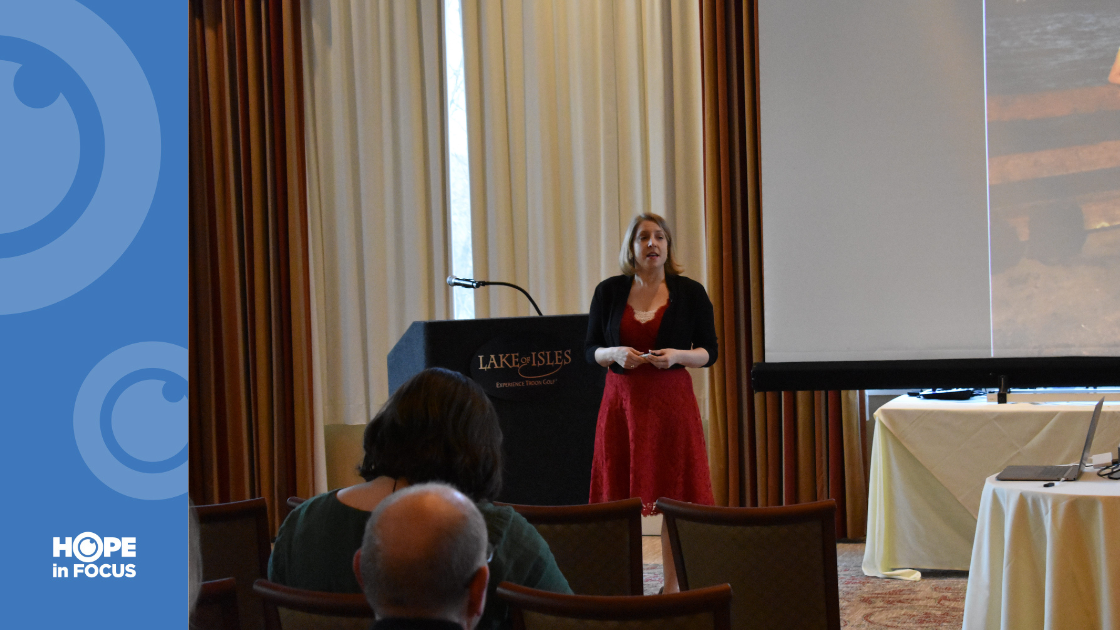
Kear shared her story with more than 100 people gathered at Lake of Isles in North Stonington, CT, on March 30. Sofia Sees Hope Co-Founder Laura Manfre characterized the event – which also included a panel discussion – as “a chance to hear from incredible people who have faced head-on an almost unimaginable challenge and chosen hope over defeat.”
Kear felt incredulous at her diagnosis.
She’d always chalked up any stumbles in life to being accident prone, or “I thought I was some airhead who didn’t pay attention.”
She had plans: She was going to be a star of the stage, fall in love, get married, have children.
“Nowhere in these plans was room for losing my vision by 30.”
A River Called Denial
Upon her diagnosis, Kear did what a lot of people might not have expected: “I decided not to think about it.”
Plus, she thought, by the time she turned 30, “I would be ancient by then.”
She learned to drive, kind of. Kear didn’t need a car in New York, but when she temporarily moved to Los Angeles for acting, only three days passed before she realized she’d made a colossal mistake. She drove anyway, with her idiosyncratic driving posture, prompting her sister to tell her maybe she should lean back a little, an exchange recounted in her book:
“What are you talking about?” I snapped, concentrating on my left turn.
“You don’t notice how close your face is to the windshield?”
It was true. My nose was almost touching the glass, my chest nearly pressing the wheel …
“There’s no law about sitting too close to the windshield,” I shot back. “Just sit back and enjoy the ride.”
I couldn’t see my sister’s face, but I bet she looked like she was enjoying the ride about as much as a turn on the Tilt-A-Whirl with a stomach full of corn dogs …
My uncool driving notwithstanding, I did a decent job of getting from point A to point B without dying or killing anyone. In general.
Kear fared better in restaurants than on the road. She learned to order the Caesar salad because it’s usually on the menu she couldn’t see, and she’d ditto her dining partner’s choice for the main course.
She traveled to Paris and London. She enrolled in the San Francisco School of Circus Arts where she learned to be a contortionist and earned a red nose.
“Following every rainbow, climbing every mountain,” Kear told her audience, until she finally gave up the ruse.
‘Anything Is Possible’
“I had realized that my vision had an expiration date … I could carpe diem as much as I wanted, but I had to reckon with my vision loss.”
At 33, after falling in love, marrying and having two of her three children, she faced her diagnosis and reached out to New York’s services for the blind.
The gravity of support and resources empowered her, connecting her to visually impaired people around the world.
“I know now that anything is possible.”
Kear ended her presentation by reading one of the tips that accompany each chapter of her book.
Tip #18: On glass doors. Walk into a glass door once, shame on the door. Walk into it twice, shame on you. Walk into it three times, get yourself a (*%&#*) game plan.
The best of both worlds – that’s how Ashlyn Lincoln describes life with her two sons: 4-year-old Gunner, who was born without vision, and 7-year-old Ace, who is sighted.
“Both Ace and Gunner teach us many life lessons, regardless of who is sighted and who is blind,” says their 29-year-old mom.
7-year-old Ace and his 4-year-old brother Gunner. Gunner was diagnosed at 6 months with LCA10, caused by a mutation in his CEP290 gene. Doctors determined Gunner came into this world with no usable vision cells and no light perception.
Living in eastern Iowa, Ashlyn and her husband, Axel, noticed problems with Gunner’s eyes in August 2014, when he was about 2 weeks old: he stayed awake during the day and his eyes would not focus. The pediatrician examining their infant at 6 weeks wasn’t concerned, but to put them at ease, he referred them to the first in what would become a series of specialists, leading to lots of tests on Gunner’s eyes and on his parents’ genetic backgrounds.
Gunner was diagnosed with Leber congenital amaurosis (LCA) at 4 months; at 6 months in February 2015, his parents learned through genetic testing that he had LCA10, caused by a mutation in his CEP290 gene. Doctors determined Gunner came into this world with no usable vision cells and no light perception.
Last May, the family moved to a suburb of Nashville, seeking a stronger support system and better resources for Gunner, who is now thriving at the Tennessee School for the Blind.
Mr. Independent
Gunner loves prekindergarten, especially gym time and swimming lessons. He listens to try to understand musical instruments, and he loves making art and writing on the Brailler. “He’s pretty independent,” Ashlyn says.
Ace and Gunner have a typical sibling relationship, blaming each other, kicking each other, playing in their own world, she says. “Ace pretty much treats him like he is sighted. He adjusts (when he remembers Gunner cannot see) and goes right back to thinking it. It’s the best of both worlds.
“Their positive outlook and attitudes on life really help us be better ourselves. I just feel so lucky to be able to always have different outlooks on everything that others may not realize,” she said.
Gunner ‘reads’ his Braille books. Gunner’s reading is feeling the Braille but making up his own stories as he goes along.
Their daily life is like other families — the boys get up and get ready for school, eat breakfast, brush their teeth. After school they have snack, play, watch cartoons, do homework.
“This might be the only thing ‘different,’” Ashlyn notes “Ace’s homework is reading, so Gunner will bring his Braille books to the couch and ‘read’ them, too. Gunner’s reading is feeling the Braille but making up his own stories as he goes, which are usually pretty creative and cute.”
Ashlyn’s best-of-both-worlds might as well extend to a third “world,” given the influence, support, and love she and her family have received from Axel’s “battle buddies” from his time in the Marines.
War Wounds Inside and Out
Axel served four years’ active duty (followed by four years’ inactive duty), being deployed twice to Afghanistan and once to Haiti on a relief mission.
He came home from Afghanistan suffering from severe injuries when his right shoulder took the brunt of his Humvee’s impact after it ran over an IED, an improvised explosive device.
Axel and Ashlyn married as soon as they could after his return home. He has a 90 percent disability rating for the injury and for Post-Traumatic Stress Disorder (PTSD). About two years ago, Alex’s service dog, Tucker, became part of the family, helping with his PTSD and bringing comfort when his anxiety is high. Tucker’s also great with the boys and may someday be joined by a service dog for Gunner.
Axel wasn’t the only one to come home to the Lincoln family. The Marines came, too, and they are still part of it.
When Ashlyn was about to deliver her firstborn, her husband and his Marine friends were there. If the baby was a girl, she’d get to name her. If not, Daddy and his buddies had the honors.
“They gave me options. I had Achilles, Leonidas, Thor, Zeus – I was excited about that one.”
Achilles it was, or Ace, as they call their now first-grader.
It was Ashlyn’s turn to name their second boy, but she still wanted to honor their military family.
She explained that a gunner, sitting on top of a Humvee and rotating 360 degrees to protect its occupants, would throw himself on a badly injured compatriot as “an unwritten act of brotherhood.” The gunner in Axel’s case did not have to, but if Axel’s injuries were worse, he would have.
“So, to go along with the history of Ace’s name, we picked Gunner to name him.”
When she picked the name, she didn’t think much about looking up its meaning.
“Later on, after we got the diagnosis, I randomly decided to look up the meaning to find it meant ‘Battle Strong,’ which seems very appropriate on our adventure.”
You’re Overwhelmed and It’s OK
Life wasn’t always easy though. Dealing with Gunner’s diagnosis and coping with new realities was difficult. Here is the message she would like to extend to other mothers: “I was overwhelmed, and I was tired. I want to acknowledge that I know you’re overwhelmed and it’s OK.
“Take baby steps, know your local resources, and know that it’s not just something you’re going to conquer in one day.”
For support and to learn more about the LCA community, Ashlyn and a friend she met through an LCA Facebook group, traveled to Connecticut last fall to attend Hope in Focus (formally Sofia Sees Hope) LCA Family Conference, where she found a sense of community.
“It was fantastic,” she says. “There are families in other states and I’m not alone and here we are together. It’s just a moment where you can find comfort and know you’re not alone.”
Ashlyn said she does have a personal goal – one that she’s fulfilled right here.
“It’s hard to admit when your child is born and not perfect, and your husband has PTSD,” she said. “I hope that just by telling my story about LCA and veterans, that other families also can not feel so alone.”
Dr. Maguire is part of the married research team that brought the genetic therapy treatment developed by Spark Therapeutics called LUXTURNA™ to fruition. Dr. Jean Bennett and Dr. Maguire researched and conducted studies working with mice and dogs, and then humans in clinical trials. They developed the first genetic therapy treatment for LCA2 (RPE65), and the first treatment in the United States for any inherited disease. The U.S. Food and Drug Administration approved it in December 2017.
Hannah had a milder form of LCA, with night blindness and poor peripheral vision. Her mother, Amy, still marvels at the idea of genetic research focusing on her daughter’s gene mutation.
Using a syringe, Dr. Maguire injected under Hannah’s left retina a human-engineered virus containing a healthy version of the gene, which supplants the mutated gene. Within 24 hours of the July 10 surgery, Hannah had increased sensitivity to light; six days later, she could see the water line in her glass, rather than sticking her finger in the glass to feel for the water. On Day 7, she saw a star for the first time; six days later she underwent surgery on her right eye.
‘She can see’
Hannah can now see everything in her environment more easily and her visual acuity has improved from 20/200 to 20/100.
Shortly after surgery, Hannah flipped on her desk lamp and was so startled by the brightness that she began to cry. Now, Hannah says, “I don’t even remember what it was like before my surgery.”
Amy and her husband, Chris, revel in their little girl playing with her horse figurines in a dark room on a cloudy day, and they say her night vision has improved a thousand-fold.
8-year-old Hannah Reif of Maple Glen, PA.
“It’s just wonderful to watch her do things and see things. She’s not saying, ‘Hey, look what I’m doing.’ She just does it. She can see.”
Her mom said most recently, she’s just discovered the blue veins under her skin and the “H” and “C” on the bathtub faucets.
Her parents and others have noticed she’s more confident in school, in church and socially with her friends. Although she still needs some supports in place at school, Hannah’s doing great in her second-grade class.
On past Christmas mornings, she’d open a gift and have to be told what it was. Not this year!
Amy also recalled Hannah walking into their church sanctuary, brightly decorated for Christmas with ribbons, greens and flowers.
“As she walked through the doors, she looked around in amazement and said in a soft, sweet voice, ‘Wow!’ ”
‘Like night and day’
Kindergartener Monroe Le underwent surgery Aug. 14 on her left eye and a week later on her right eye.
“She’s like night and day,” said her mom, Heather.
Before surgery, Monroe’s vision was 20/300 for both eyes and now it’s 20/150.
So much has changed since 2012; Heather knew something was wrong with baby Monroe at 2 weeks when she looked toward the light rather than her.
6-year-old Monroe Le of San Diego, CA.
“I remember crying and saying to my husband, ‘She’s blind. She’s blind,’ and he said, ‘She’s not’ … from 2 weeks until she was diagnosed, we were knocking on doctors’ doors.”
Heather was scared to have her daughter genetically tested, but she knew it would give her answers. Doctors diagnosed Monroe with LCA shortly after she turned 4; two months later she received her RPE65 genetic diagnosis.
“Oh, I’m so happy that I did it,” Heather said. “If I hadn’t gotten that test, Monroe wouldn’t have been a candidate for LUXTURNA.”
Her daughter received help to get up to speed with motor skills, and early on met a little girl named Penny, her forever friend, who has had difficulties with speech.
“They’re amazing, they love each other so much,” Heather said. “They complemented each other so well because Monroe would help her with the talking and Penny would help her with the seeing.”
Two days after her first surgery, Monroe insisted on being the one to retrieve a cap from an ointment tube dropped on the carpet. “She covered her non-surgerized eye and found it immediately.”
In school, Monroe no longer needs special lighting and doesn’t have to sit in the front of the room. “She even has been able to play four square.”
Monroe also sees her most favorite place in the world, Disneyland, and her most favorite attraction – Pirates of the Caribbean with Capt. Jack Sparrow – in a whole new light.
“There have been numerous times in a trip there where she asks me, ‘Mama is that new, or has it always been there and I’m just seeing it for the first time?’ ”
Heather and her husband, Bruce, see a much more confident little girl who no longer needs to hold hands in dim places.
“I can’t believe it’s the same girl who was so timid and afraid to let go of my hand,” she said.
“I feel that there are a lot of parents out there that are terrified for their kids to live this life,” she says from her southeastern Texas home. “And while it’s not ideal, it doesn’t mean that they aren’t capable of living a fulfilled life and love it like they should.”
Larson’s form of LCA, known as LCA6 caused by a mutation of the RPGRIP1 gene, is considered rare even within the realm of rare disease, accounting for only about 5 percent of the total LCA patient population. LCA in its more than two dozen genetic mutations affects fewer than 4,000 people in the United States; it accounts for 5 percent of all retinal dystrophies and 20 percent of blindness in school-age children.
Photoreceptors lacking RPGRIP1 are unable to maintain the retina’s light-sensing outer segments, resulting in patients losing retinal functions at an early age but retaining photoreceptors in the central retina well into adulthood, according to the National Institutes of Health.
Having grown up with vision loss, Larson says children born with LCA need the support of knowing that others have gone through life with the same inherited retinal disease and survived the bullying, mistreatment or embarrassment.
“I think I’d tell any parent that getting their child into therapy is a necessity,” she says. “Most of us need help navigating these very important emotional things in life. Like when you get made fun of, or when your sibling or friends get their driver’s license and you can’t. Just coping with what this will mean for their life and how to navigate it.”
Larson speaks from experience. More than anything, she wants to take the element of pity out of dealing with the disease.
“It does no good to have pity, or on the other side, to put people on a pedestal for doing things everyone can do,” she says. “It’s demeaning and degrading as a human to get praise for doing something everyone else can do, just because we can’t see well.”
She has some light perception and equates her field of vision to about the length of a drinking straw. With lenses, her visual acuity is 20/200 and 20/400.
Larson had vision loss early and began learning Braille at age 4. She was diagnosed at age 12, although incorrectly, with Retinitis Pigmentosa (RP). She worked with specialists to improve her independence but being around other kids never was easy. She was teased.
“You need extra help. You don’t want to stick out,” she recalls. “I made myself want to fly under the radar.”
By middle school, she didn’t want to deal with Braille or learn more about skills and concepts to help her get around and to be more independent.
“It was something that I just despised. I don’t want to be identified that way. I don’t want to be that kind of person.”
Larson did, however, go to Arizona State School for the Deaf and Blind in Tucson for her last two years of high school, graduating in 2007. She pursuing job training through the state’s Vocational Rehabilitation (VR) services, but the program lacked funding and was not accepting new clients.
While on the VR program waiting list in 2008, she met Andrew, who is now her husband, and in 2009 became pregnant with their first child.
Mikayla and Andrew Larson
They married in 2011, when their first-born, Conner, was 1. The day after the wedding, she was pregnant with her little girl, Aubrie. They lived outside of Phoenix and then moved even farther from family, southeast to a small Arizona town for Andrew’s first job as a chemical engineer.
The family moved in 2013 to another small town in southeastern Texas.
She is the mother of four children, “three here and one in heaven.” Their son Liam died from Sudden Infant Death Syndrome on April 3, 2015. He was 4 months old.
“My kids are very independent,” she says of 8-year-old Conner, 6-year-old Aubrie and Carter, 5. “They get up on their own with an alarm and get themselves dressed, and then Andrew and I make breakfast and make sure they have brushed teeth and are ready for school.”
Not being able to drive is a big deal, especially in rural Texas with no public transportation. Her children are picked up for school and driven home. Cooking has gotten easier and more comfortable with the advent of Air Fryers and Instant Pots.
Tripping over toys and three cats – Max, Teddy and Chester – is part of life. She shops with family and reads with the help of reading glasses and her phone’s camera, zooming in for small print.
“I would say I’m pretty self-reliant and just do what I need without any real thought.” She does suffer from anxiety.
“Once we lost Liam, the anxiety kind of crossed over into other parts of my life.” She is seeking help and open to resources.
Her biggest advocate, Andrew, contacted Spark Therapeutics, the developer of a new gene therapy called LUXTURNA™ for LCA2 (RPE65) because he thought she might have that form of LCA. The company suggested she receive genetic testing.
When Larson visited an ophthalmologist for a genetic testing referral, she was met with disbelief. The doctor said she couldn’t have LCA. “It’s too rare. That’s not possible,” he told her.
She finally got the doctor’s signature for testing, and, in January 2017 at age 28, her test revealed a mutation in her RPGRIP1 gene, also known as LCA6.
Larson says she was then in touch with Eric Pierce, MD and PhD, who is conducting lab-based research on RPGRIP1 at Massachusetts Eye and Ear. Dr. Pierce’s gene research involves evaluating the latest treatment version in a mouse model, with the plan to generate a gene-therapy vector for toxicology studies, ultimately leading to clinical trials.
While hopeful for a treatment, Larson prides herself on helping others and moving forward.
“We are still smart and capable. We have different challenges but that doesn’t mean we aren’t able.”