Over the years, I’ve learned that most people don’t understand that visual impairment is a spectrum. Most people think there are three options: 20/20 vision, vision that can be corrected by glasses, or total blindness.
As a child, I passed as fully sighted in most situations. When I told people that I was visually impaired, their first question often was, “Why don’t you wear glasses?” After getting a guide dog, I get fewer questions like that; however, people now assume that I am totally blind.
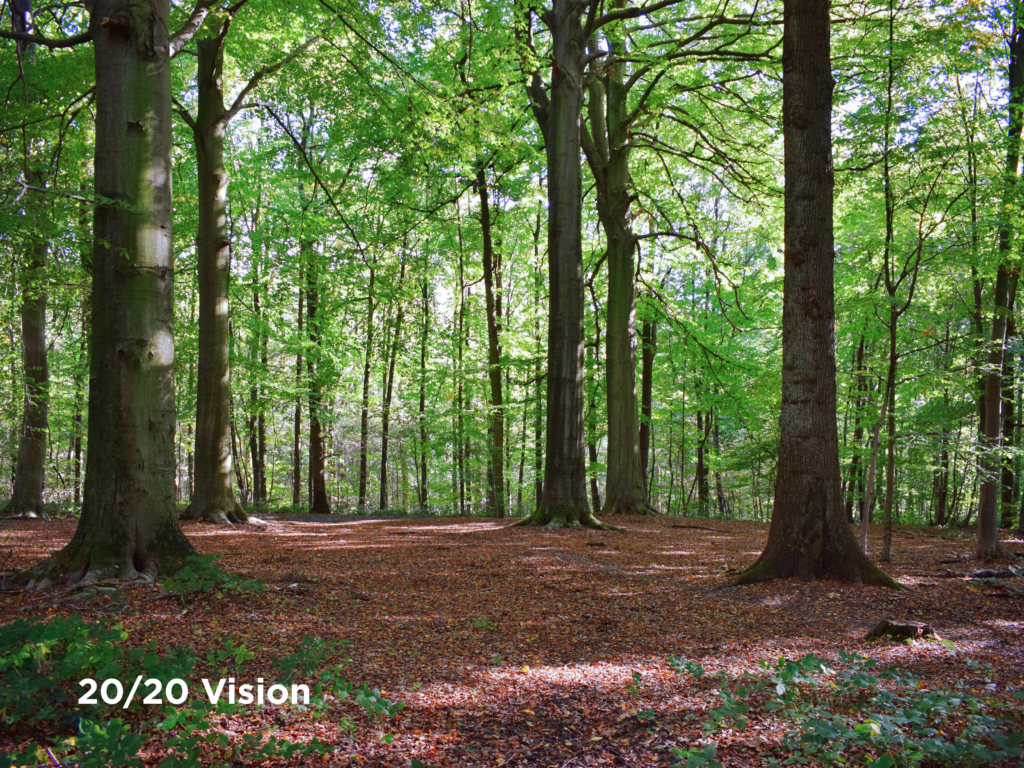
20/20 Vision
When people know what you can see, you are more likely to experience environments where you feel included. This is why it is so helpful to be able to explain what you can and can’t see in simple terms. It’s also important to take the initiative to share this information.
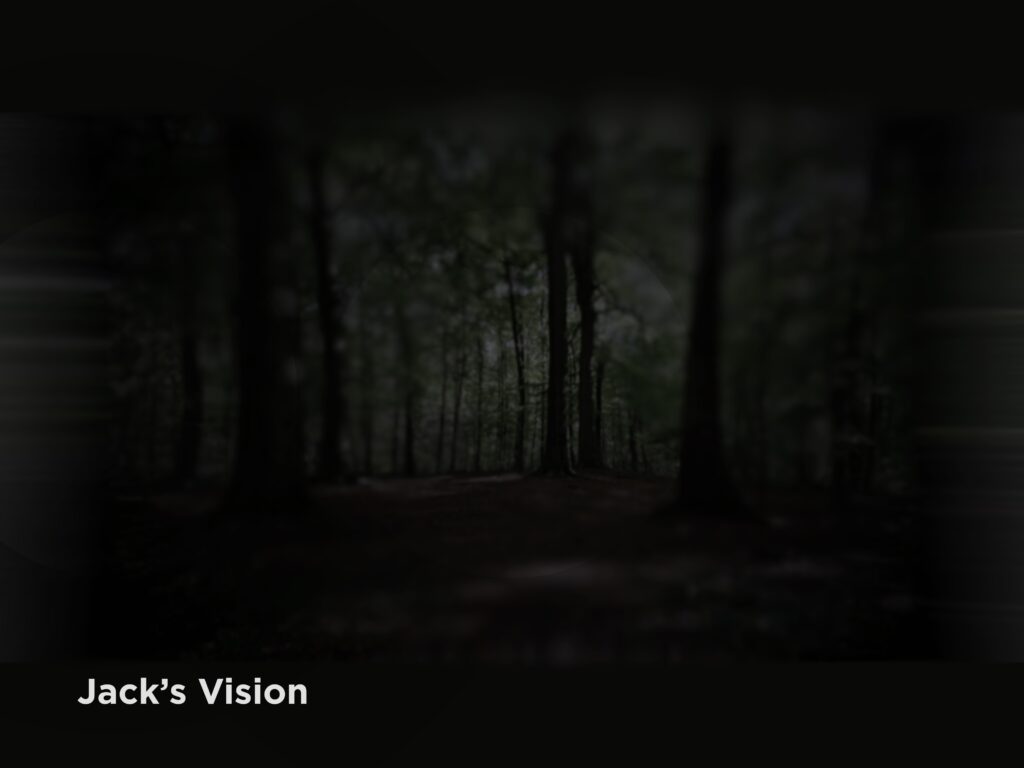
I describe my vision as looking backward through binoculars while wearing several pairs of sunglasses. This lets people know that things look much smaller to me, that I can’t read printed text, and that I can’t see in dark/dim lighting. It is much more effective to use this analogy than to list things I can’t see.
Sharing my analogy also helps someone to imagine what it would be like to look through binoculars backwards, wearing several pairs of sunglasses. But they often can’t imagine what it is like not to see in dim lighting. It is also hard for some people to ask what I can and cannot see since they don’t want to highlight my limited vision or are just uncomfortable asking.
Jack’s Vision
Providing information about your visual impairment or offering an analogy often puts people at ease. When people know you are comfortable talking about it, they feel freer to ask questions.
Imagine playing cards with a new group of friends. One person at the table asks, “Will you be able to play cards with us?” You know you won’t be able to see the cards in the center of the table, but you share your vision impairment analogy or description. By helping your friends understand that you can see the cards in your hand but will need them to announce the card that they lay down, allows them to make simple accommodations so you can participate. Because you were able to describe your vision loss simply, you and your friends had a great evening together.
I encourage you to come up with your own analogy to describe how you see. I know I am not alone in worrying about the accessibility of new environments. Most people are happy to do what they can to make things more accessible. Helping them understand what you can see will help them help you and lead to a more fulfilling, connected life.
Throughout her 29 years, Michelle Ward Caton has embraced life with unwavering curiosity and gusto. Determined to test her abilities and not be limited by vision loss from Leber congenital amaurosis (LCA), she is, among other things, a competitive adaptive rock climber and teacher of the visually impaired (TVI).
Growing up in North Haven, Connecticut, Michelle’s route to an LCA diagnosis took time. Initially, her parents noticed that she wasn’t focusing on faces. “Once I was walking, I bumped into a lot of things! But when this was discussed with my pediatrician, he said it was Michelle being Michelle,” she said. “When I was three, we moved into a new house, and while running around, I hit my head on the kitchen island overhang. My concerned parents took me to a pediatric ophthalmologist, where my poor eyesight was finally confirmed.”
Several years later, the eye doctor detected white blood cells in her eyes and sent her to a Boston eye specialist. By the time they got to Boston, the white cells were gone. However, it wasn’t until she did genetic testing during high school that Michelle was diagnosed with LCA8 from a mutation in the CRB1 gene.
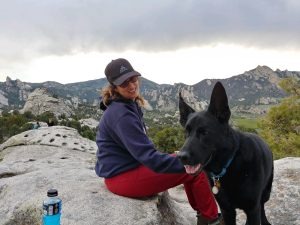
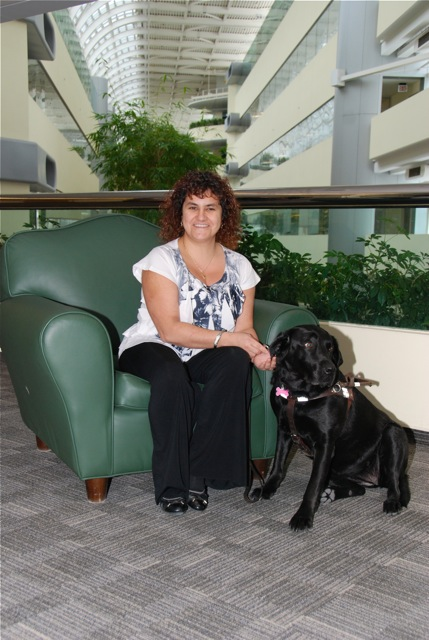
Michelle with her guide dog, Ryder
The Journey
Early intervention services started at age three, and by age five, Michelle had a TVI. Refusing to be sidelined, she did everything that her older sister did at the same time. “If she learned to bike ride or swim, I did too!” Michelle said. We were only a year apart, and it was almost like being twins. But determined to keep up, I did many daring things for a blind person.”
Her resolve to play softball in elementary school was dashed, she said, “When my dad took me outside and tossed a few softballs at me until I realized I couldn’t play. When you’re a kid, you think you can do anything. Sometimes, you have to realize you can’t.”
Michelle’s parents exposed her to various activities, including the piano, flute, and bass guitar. Later, she participated in gymnastics and was a ballroom dancer throughout high school. “I did Brazilian jiu jitsu and then Muay Thai, a form of kickboxing, which my dad practiced with me, allowing me to get the rhythm of the sport and have incredible workouts,” she said.
In college, Michelle tackled the gym and weightlifting, and when she was at UMass Boston working on her TVI degree, she met a friend who did rock climbing. “I began climbing with an adaptive climbing group that participated in competitions,” she said. “I went to nationals and placed second, got on the United States team, and went to the international competition in France,” she said.
Rock Climbing Lessons
Michelle and her husband, Jason, continue to climb and discuss competing again. “It’s important to go out of your comfort zone. I still have some vision, and being outside and up high with a view is incredible,” she said. “When I’m climbing in the gym and hit the spot where I’ve fallen many times and finally figure out the right move and body positioning, it’s a small victory. It’s great getting to the top of the wall, whether I can see it or not. The top of the wall isn’t necessarily the prize. It’s the fact that you did it that builds confidence.”
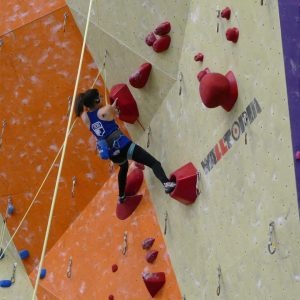
Michelle at the 2019 national adaptive climbing competition
Michelle Ward Caton competes on a climbing wall at the national adaptive climbing competition
Children with visual impairments often find body awareness and balance difficult, but these can also be tough for adults. Sometimes, when Jason tells Michelle how to move on the climbing wall, getting her correct body part to the right location is challenging. “Jason might say to move my right foot three feet, and I move my left foot one foot,” she said.
Helping children with body awareness is something Michelle focused on teaching in her preschool classes during TVI training. “I’d set up obstacle courses for the children to climb over, under, or step through or over,” she said. “I think climbing and jiu-jitsu are some of the best sports for kids with vision impairments because they help build body awareness.”
Vision Changes
When Michelle was about 26, her vision dramatically worsened. “I abruptly lost acuity, and my nystagmus got much worse. There was no time to adjust,” she said. “I’ve always had some nystagmus but could focus through it; now my vision always vibrates.”
As a TVI, Michelle teaches braille, but she also uses it to access all of the appliances in her home. She also does most of her visual work in the morning because the nystagmus exhausts her by evening. “You have to adapt your scenario to your specific needs. It feels like I’m constantly adjusting. I keep puzzling things together to see what works,” she said. “This is the reality for everyone with LCA; each situation is different, and you must finesse things until something works.”
The Right People
Dating during college helped Michelle discern that “it’s the people that don’t care about my vision that make the best friends. I’d meet someone, and when they found out about my vision impairment, they would shift from ‘You’re cute!’ to ‘You’re a science project.’ They’d ask me how many fingers they held up and what I could see. I got all of the stereotypical questions.”
Michelle loves that her husband doesn’t care that she is blind. “Jason does things for me that I don’t even notice. I’ll be looking for something, and he will grab it, hand it to me, and walk away without commenting. Or he will get out of the car and offer me his arm. We never talked about my limitations—he just got it!”
She said finding supportive people who don’t coddle is essential. “Jason encourages me to learn new things that a friend might say are dangerous. Instead, he teaches me how to do it. He doesn’t make assumptions about what’s possible for me.”
A sense of humor is vital for navigating a degenerative condition; Michelle explained, “I trip and fall and knock things over all the time! My visual decline in the last couple of years has been very tough, which makes it essential to find someone who laughs with you. Being morose doesn’t work!”
Family Interactions
Reflecting on growing up with LCA, she said, “My parents always treated me like my sister. Being blind was a characteristic that only meant I did things differently. My sister didn’t acknowledge my being blind for a long time. I don’t think she fully realized what it meant. Instead, she would stare at me and say, ‘Just do it,’ which is what a big sister does.”
“My parents never wallowed in my diagnosis, and we had many real-life conversations about my vision loss. But my dad struggled because he knew my vision would get worse, and I would face lifelong challenges.” Michelle said. “In high school, we met Robin Clark, a teacher passionate about ensuring kids had the independent living skills to live successfully. We implemented creative strategies, worked on things at home, and discussed what would help.”
TVI Responsibilities
As a TVI, Michelle travels between schools in New Hampshire, helping elementary through high school-aged students based on their individualized education plans (IEPs). “I love working with the teams that work daily with the kids to support their vision in class,” she said. “Life with LCA is like rock climbing. Starting out, you have no idea what you are doing, but you feel your way along, and eventually, you’re competing!”
With supercharged energy and positivity, Anthony, born with Leber congenital amaurosis (LCA), shares what it’s like to be blind through motivational speaking and his various social media platforms. His wife, Kelly Anne, helps him plan out what he wants to portray, and then she shoots and edits the videos about their life that later appear on TikTok, Instagram, Facebook, and YouTube. Anthony’s social platforms have become popular as he shares what managing the world without vision is like. As an advocate for increased accessibility, whether he’s changing diapers, making smoothies, or skateboarding, he shares how he tackles a variety of activities without sight.
Anthony Ferraro
Growing up in Spring Lake, New Jersey, the youngest of five children, Anthony was born with only 20/400 visual acuity (profound vision loss). He lost a chunk of vision in seventh grade and then again in his junior year of high school. Now in his late twenties, Anthony’s vision is decreasing daily, and he says, “The light is starting to go black.”
Against the odds, Anthony became a champion wrestler in high school and was the subject of an award-winning film, A Shot in the Dark, documenting his attempt to win a state wrestling championship in his senior year. In a previous interview with Hope in Focus, he said, “Wrestling has taught me a lot of things. It taught me hard work, that things don’t happen overnight, discipline, and how to deal with loss. It helped me prepare for life.”
Anthony aims to participate in the Los Angeles Paralympic Games in 2028 in Judo. The pivot from wrestling to Judo resulted from a concussion that ended his wrestling career in college. However, this event opened the door to pursuing Judo when the U.S. Paralympic team asked him to train for the team.
Open about his life, Anthony talks about struggling with depression. “When I was 19, I got so depressed that I checked myself into a mental health hospital. I learned a lot about mental health and not bottling things up. I got to work on myself and learn about what I was feeling and going through,” he said. “When I was 21 or 22, I started accepting the fact that I was blind and started using my cane and the resources that were around. That’s when my whole life changed. Soon after, I met Kelly Anne!”
An accomplished musician and skateboarder, Anthony is game to try almost anything. He and Kelly Anne have a baby girl, and some of his videos demonstrate how he cares for her. One example is his TikTok video “How I Find My Baby as a Blind Dad.” With unending zeal and courage, which Kelly Anne fully matches, Anthony propels himself into life.
Come meet Anthony and his family at Dinner in the Dark 2024 and hear him speak about his personal experiences and hopes for a possible treatment for LCA, tickets are available at hopeinfocus.org/dinner. Learn more about Anthony and connect with him on social media at asfvision.com.
Joseph F. Smith has been legally blind since birth. He lost what little sight he had in his mid-30s, when he learned he had Leber congenital amaurosis (LCA). Thirty years later, genetic testing revealed a mutation in his CRB1 gene, a diagnosis known as LCA8.
More than 40 leading experts in ophthalmology and gene research gathered virtually for more than five hours in February to share research and patient perspectives on CRB1 and identify the next steps to advance treatment for the patient community.
The CRB1 gene provides the body with instructions for making a protein that plays an essential role in normal vision. This protein is found in the brain and the retina, which is the specialized tissue at the back of the eye that detects light and color.
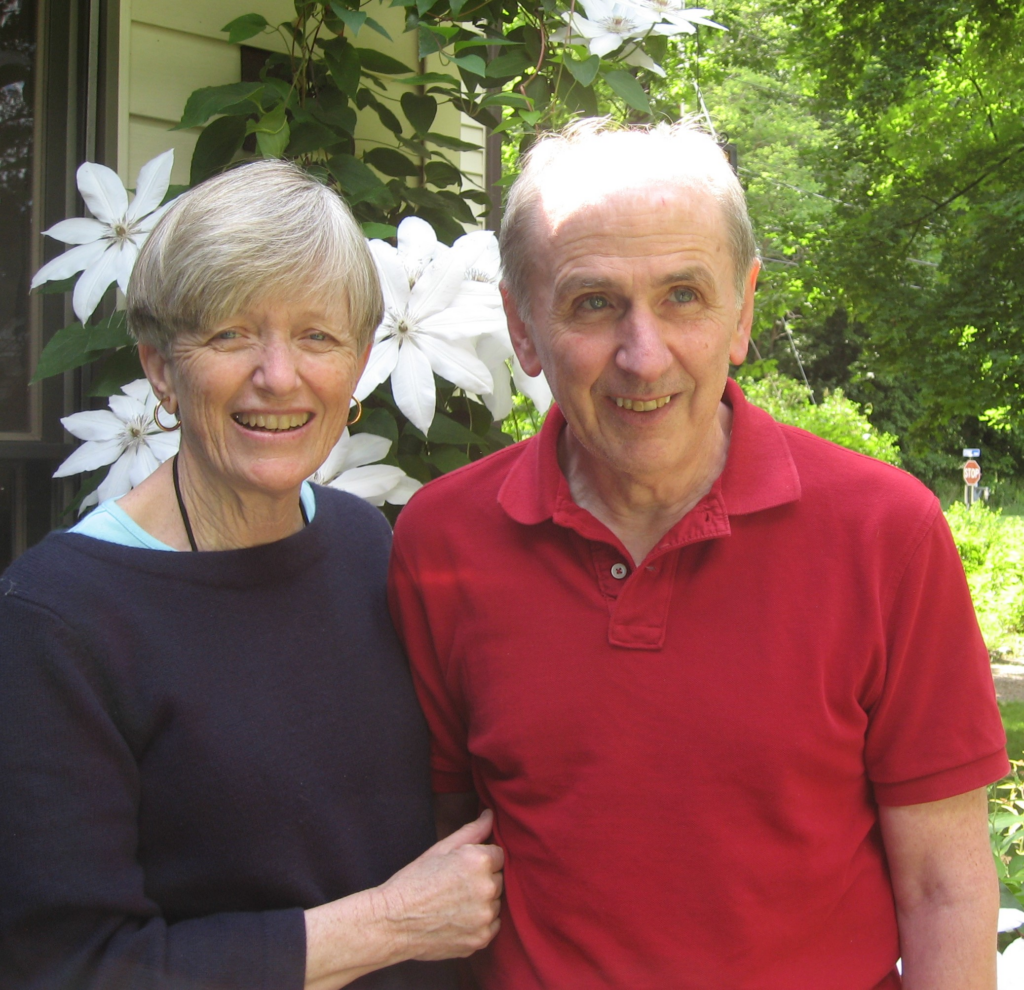
Alice and Joe
While the biology for CRB1 is particularly complex, early research produced the discovery of a new version, or isoform, called CRB1b. Preclinical studies give rise to new questions as to whether CRB1a or CRB1b expression, or both, should be the target of a gene therapy. Click here to view the webinar.
In his letter, Joe wrote: “I won the CRB1 lottery 76 years ago and spoke briefly during the webinar.”
When we spoke to Joe by phone, he wanted to know what he could do to reassure parents of children who are blind or visually impaired that they can thrive.
Joe earned a law degree from Cornell Law School after graduating as a math major at Alfred University in upstate New York. He worked at the New York City Corporation Counsel’s Office in the Real Estate Tax Division for three years.
While working, Joe began his teaching career at New York’s Dominican College where he taught a business law course. He taught law at the University of Baltimore Law School in 1973, and three years later accepted a job at Fort Lauderdale’s Nova Southeastern University School of Law, where he became a tenured professor and taught for more than 30 years.
He is retired, living in Florida with his wife of 51 years, Alice.
The Importance of Learning Braille
Joe’s 76-year journey began long before the enactment of the Individuals with Disabilities Education Act and the Americans with Disabilities Act, Congressional civil rights legislation prohibiting discrimination and guaranteeing that people with disabilities would have the same opportunities as everyone else. He said he was fortunate to receive scholarships from an earlier version of the Rehabilitation Act of 1973 to fund his higher education.
People with vision difficulty or other challenges must still vigorously advocate for accessibility and equality, but those roads were even bumpier in the past.
Before retiring, Joe developed a course on the rights of people with disabilities. He also created a program in which he supervised students working for organizations providing services for people with disabilities.
He understands that ever-evolving technology greatly helps people with vision loss, but he is a proponent of learning braille.
“One thing I do think is very important is that a child who is losing sight or is blind needs to learn braille. I know many educators will say with accessible computers, cell phones, and recorded materials, braille is unnecessary. My simple response is, ‘All that technology is available to sighted people, but they still use pens and pencils.’
“If you learn braille, you have something to keep in your mind. You have a physical image of the written word.”
With CRB1, Supportive Parents and Friends
Joe believes much of the credit for his success goes to his blue-collar parents who did not graduate from high school.
“I can’t imagine what it must have been like for them to find out I was blind and with no explanation as to why.”
Early on he could distinguish basic colors and he can still see red and orange in his mind’s eye.
Growing up in the 1950s, “back in the dark ages,” Joe said his parents knew that the local Catholic school was not going to work for him because it offered no resources. His mother wanted to wait a year for him to go to first grade, but his father said no. A learning disability kept Joe’s dad back a year because he could not read, prompting him to quit school in eighth grade to play baseball.
“He knew that education was important.”
Joe attended Lavelle School for the Blind run by Dominican nuns in the Bronx, leaving home Sunday nights and returning Friday afternoons, through eighth grade.
Lavelle served Joe well, but he wanted to attend a regular high school – any school that would take him, as mainstreaming was not a big goal back then and schools were not obligated to accept students who were blind.
He went to Archbishop Stepinac High School in White Plains run by the Archdiocese of New York. His senior year, another blind student was accepted to the school.
Math books in braille were in short supply and books in general were hard to get, so his mom read to him – a lot.
His dad also rarely said no to him trying new things. He rode around the neighborhood on his bike, enjoyed daredevil sledding, and loved cars in high school. His dad took him to an empty parking lot and taught him how to drive a stick-shift.
But the pièce de resistance for this self-described car nut came when he slid behind the wheel of an automatic BMW for the ride of his life on the skidpad at a defensive driving school.
“Truth be told, my wife was taking the course, but the instructors snuck me out for an unforgettable hour of bliss.”
I guess what I’m trying to say is a child who is blind should be encouraged to develop interests in and to try activities, which, at first blush, might not seem suitable for a child with limited or no sight.
His best friend in grammar school read him comic books, and as they got older, car magazines. They didn’t go to the same school, but they managed to get into trouble together and often double dated.
He excelled in math and thought he might be an engineer, toyed with psychology, and after Alfred University, decided to go to law school.
Practicing and Teaching Law
Joe met Alice on a blind date in his second year of law school when she was a sophomore at New York’s Wells College. She earned a Bachelor of Arts and worked in the Criminal Division of the Legal Aid Society of Westchester County while pursuing her master’s degree in early childhood education at Manhattanville College. They married in 1970.
Joe did well in law school and said he knew if he were not blind, he would have received more than one job offer after graduation. He received many rejection letters, heard many excuses, and sometimes heard nothing at all after interviews.
Still, he almost did not interview for that one job offer; only after repeated urgings from different people, he did so and got the job at New York City’s Corporation Counsel’s Office, which already employed a blind lawyer in the Real Estate Tax Division.
Recounting his getting the job despite almost not interviewing, Joe invoked an ancient adage: “Luck is what happens when preparation meets opportunity,” words from Roman philosopher Seneca, reminding us that we make our own luck.
After three years of practicing tax law, Joe wanted to try something else, perhaps be a trial lawyer or a teacher. He and Alice drove out to Colorado where he planned to take the Colorado bar exam, but the day after they arrived, he was offered a teaching job at the University of Baltimore.
Before returning East, he and Alice goofed off and he learned how to ski, loving the feeling of freedom, and losing his fear of speeding down a mountain.
When they moved to Baltimore, Alice, who worked at the Baltimore Museum of Art, read for Joe from textbooks.
“Most importantly, from that time until I retired from teaching in 2007, she read all of my exams and papers to me.”
Getting a Confirmed CRB1 Genetic Diagnosis
Joe was diagnosed in his late 20s with retinitis pigmentosa (RP), but he thought it wasn’t correct for several reasons, including that people with RP lose peripheral vision and, in his case, he lost central vision.
Joe and Alice met Gordon and Lulie Gund while learning to ski at Snowmass in Colorado. The Gunds co-founded Foundation Fighting Blindness in 1971 to fund research for treatments and cures for blinding retinal diseases after Gordon was diagnosed with RP and ultimately lost his vision in 1970. He is a Foundation director and chairman emeritus.
Gordon came back into Joe’s life in the 1990s when he invited him to a Foundation dinner. There he met Iowa State University’s Edwin Stone, MD, PhD, who spoke of emerging research into gene therapy targeting a form of LCA and suggested Joe get genetically tested.
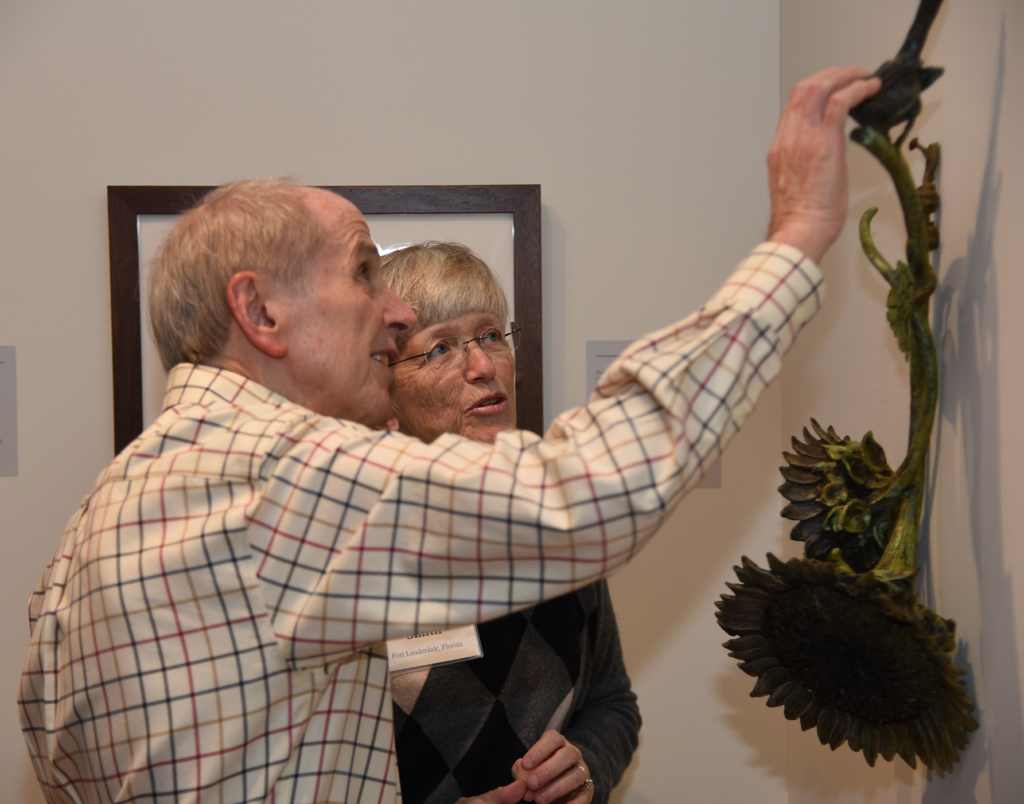
Joe and Alice
Joe’s genetic test showed his LCA was due do a mutation in his CRB1 gene, not the RPE65 gene, the focus of the research that led to the 2017 federal approval of LUXTURNA®, the first gene therapy for the eye or an inherited condition. People with LCA2 (RPE65) cannot make a protein needed by the retina to convert light into vision-enabling signals, which are sent to the brain. The breakthrough therapy involves injecting under the retina a human-engineered virus containing copies of a normal gene, so cells can express the protein.
In the CRB1 Research Update webinar, Joe said he was fortunate to have lived near a teaching hospital where he could learn about the cause of his blindness. In the Q&A, he asked where people with visual impairment should turn for help when living in rural areas with less accessibility to universities or large hospitals.
In answer, Ben Shaberman, Senior Director of Scientific Outreach and Community Engagement for the Foundation, said a team is working nationwide to educate eye-care professionals about LCA and other rare inherited retinal diseases (IRDs), so they can refer patients to specialists. He also encouraged people to email the Foundation at info@fightingblindness.org for contacts in the academic and medical worlds of retinal specialists and researchers.
Laura Manfre, Sofia Sees Hope Co-Founder and President, said people can follow the Foundation and Sofia Sees Hope websites for information and research news. They also can email their questions and concerns to info@sofiaseeshope.org.
As a lawyer, a law professor and a man diagnosed only a decade ago with CRB1, Joe said, “I’m not trying to paint an overly rosy picture of the challenges we face. I realize I am a minority, as I’ve been employed continuously from law school graduation to retirement. I also know with my class rank, I should have had more than just one job offer coming out of law school. At the same time, I realize that technology that was not available to me then has opened up many more opportunities for us …
“I guess what I’m trying to say is a child who is blind should be encouraged to develop interests in and to try activities, which, at first blush, might not seem suitable for a child with limited or no sight.”
I must admit, when I learned that my vision was slowly deteriorating, I lost hope. I didn’t know what the future would bring. I knew that with worse vision came more accessibility barriers and was worried that these barriers would prevent me from achieving my dreams.
But my hope soon returned. I knew that I needed to make a choice. I could either feel bad about myself or do something to make a difference. I chose the second and began to plan. For me, hope is about believing the future can be better.
I wasn’t sure if there was anything I could do about my vision. Genetics had made up its mind. The science was close to a treatment, but I couldn’t count on it. That being said, many treatments were near enough to becoming reality that they would definitely affect many. This was my opportunity. I began raising money for sight-saving research, speaking at events and advocating for treatments. I’ve learned that snails move faster than medical research. It is frustrating and easy to lose hope. But, a snail’s pace is still progress!
For example, LUXTURNA®. The first FDA-approved gene therapy for an inherited retinal disease was approved in the US long before it was approved here in Canada. I’m pleased to say that it was finally approved by Health Canada in October 2020. I have the type of LCA that LUXTURNA treats, and if the provincial government agrees to fund it, I could receive this treatment soon.
The disease that causes my vision loss is advanced. LUXTURNA® will come nowhere close to giving me perfect vision. I’ve learned that having hope for restored vision and hope for life after vision loss are equally important. The best parts of life are not lost with vision loss. I have an amazing life. I have a lot to be thankful for – a good job, an incredible family, fantastic friends and opportunities to participate in accessible activities like sailing and skiing. I hope that you continue to have hope for life after vision loss too.
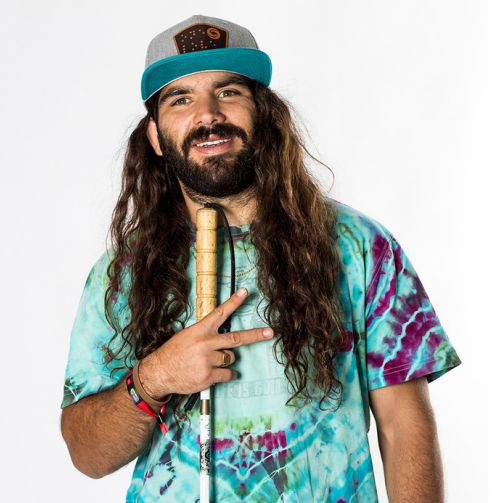
Jack McCormick was diagnosed in high school with LCA2. He graduated in 2018 from Canada’s Wilfrid Laurier University in Waterloo, Ontario. He is a Hope in Focus (formally Sofia Sees Hope) ambassador, helping people living with LCAs and IRDs. You can read his blog at jackdamccormick.wordpress.com
I first heard about coronavirus on my way back from a weekend of skiing in mid-January. It seemed to be the only thing the radio station we were listening to was talking about. At the time, COVID-19 was only reported in China and I didn’t think it would ever impact my life. I’ve never been so wrong.
On March 13 I was scheduled to fly to Australia for a dream vacation with my childhood friend. I was subscribed to travel advisories issued by both the Canadian and Australian governments. I woke to an email from the Australian government advising against all travel. I phoned my friend. We needed to cancel the trip. I don’t think he appreciated the 5 AM call. We made the right decision. By noon Canada had issued its own travel advisory. I have never spent so much time on hold and hope to never again. Eventually I received refunds for the flight and hotels. This was only the beginning.
I work in the human resources department of a hospital. I spent the time I had planned to be on vacation working non-stop. We had to keep our patients and staff safe. Government guidelines seemed to change every day. We didn’t have enough staff. Everyone in our department was working three jobs.
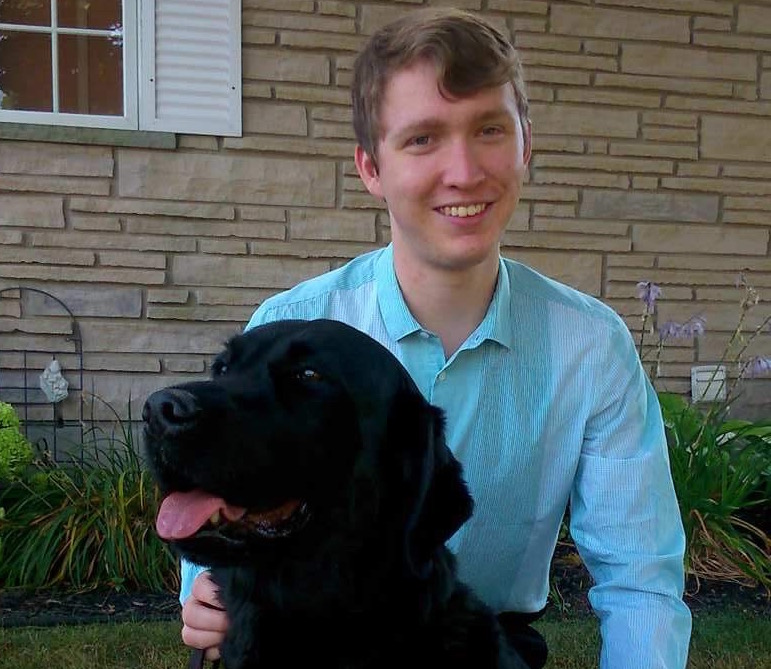
Jack and his guide dog Jake
I had no food. I had eaten everything – not wanting to return from Australia to rotten food. As someone with a visual impairment I get assistance from a store employee when I do my groceries. Getting this assistance meant being physically close to someone who wasn’t part of my regular interactions – something I didn’t feel comfortable doing given the pandemic. The alternative was delivery and it was near impossible to book a time. When I finally did, the shopper couldn’t find most of the things I had requested because people were buying up everything. I soon ran out of food again. Someone from work offered to help me do my groceries. The shelves were empty. It felt like something out of a movie.
We fell into a new rhythm at work. I lost count of the number of people I hired. To limit the number of people in the hospital, those who could work from home did. This included me most days. I hardly left my apartment.
Even now, there isn’t much to do outside work. We are all struggling. We don’t know when it will be over.
Throughout this experience my vision loss has created a host of challenges. It has also helped me live in the pandemic. With decreasing vision, I have learned to adapt to change – something we have all had to do in 2020. My vision loss has made me stronger. Living through the pandemic will do the same for you.
For me, I’ve learned more about pain, struggles and the power of connection. I’ve learned to acknowledge the challenges I experience and connect with the people who are important to me (even if it is virtually) to support each other because we are better together even when we are far away.
Jack McCormick was diagnosed in high school with LCA2. He graduated in 2018 from Canada’s Wilfrid Laurier Universty in Waterloo, Ontario. He is a Hope in Focus (formally Sofia Sees Hope) ambassador, helping people living with LCAs and IRDs. You can read his blog at jackdamccormick.wordpress.com
The 52-year-old Canadian, newly transplanted to southeastern Florida, takes her Hebrew name literally.
“I am light, and I am vision,” she said. “I want to offer everything I have for others to realize their perfect light and vision is possible.”
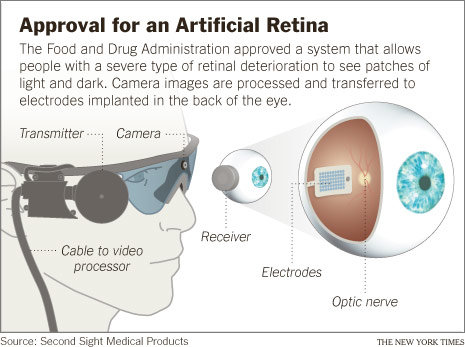
As a child she had enough vision to read large print, but in her 20s, Orly’s sight deteriorated to minimal light perception and shadows. In 2014, she was part of a clinical trial in Canada for the Argus Retinal Prosthesis System (Argus II). The Argus II, known as the bionic eye, stimulates the eye with electrodes to transmit visual information captured by a video camera to the patient’s brain. You can read about her experience in the trial here.
“Still, I have true 20/20 vision,” she said. “My blindness forces a mindful clarity through all my other senses and that enriches everything from my cooking and healing, to my service to others.”
Along her journey through the darkness of an opiate addiction, she rediscovered her mother’s traditional Moroccan fish dish, served as part of each Friday’s sabbath dinner.
Little did she know the importance this recipe would have to her survival.
From 1999, after having her third child, until 2012, she said, “My opiate addiction took a huge chunk of my life away because it
Orly Shamir and her husband Amit (and guide dog Regan at the 2019 Dinner in the Dark to benefit Hope in Focus (formally Sofia Sees Hope).
was a fight. That’s why I want to give back and give light to the darkness.”
It began with chronic pain and prescriptions for Percocet and Oxycontin that offered relief and a false sense of well-being. Domestic abuse led to living in a shelter with her children. Orly finally realized she needed to get off the pills, but she could not.
“It was the beginning of torture for several years. That’s why we have an epidemic with opiates. It takes a lot of strength and support, and I tried three times over a four-year period. It takes everything out of you to get to the other end and never look back.”
Childhood memories of simmering aromas of lemons, parsley, cilantro, peppers, tomatoes and all the spices helped get her to the other side.
She tweaked her mother’s recipe during one of her mom’s visits from Montreal to Orly’s home in Toronto. When her don’t-you-dare-mess-with-ingredients mom left the kitchen, she took the opportunity, with guilt-laced excitement, to add a few more to the pot.
“Voila, my specialty Moroccan Salmon, the champion of my life was born! At dinner my mom raved about her wonderful fish, and all I did was smile while my soul did a happy dance.”
Years later her addiction took its toll with memory loss and less ability to perform skills. She realized that improving her cognition could be accomplished several ways, including by eating healthy food, especially fish like salmon with lots of omega-3s.
It’s fatty, versatile and widely available, which is why Orly says her dish is champion food for anyone on any recovery journey, whether from illness, addiction or the blues.
“Without knowing it, this spiritually comforting food became physical healing food.”
Blind Ambition
Orly is a gifted chef, a title-holding athlete (Italian and Canadian dragon-boat racing!), a financial analyst fluent in French and a motivational speaker. She has two sons and a transgender daughter, all in their 20s living in Canada. Orly, her husband of 12 years, Amit, and her guide dog, a 6-year-old Black Lab named Regan, live in Hollywood, Fla.
She just graduated from a Florida culinary school with her sights set on developing a YouTube cooking series and a recipe app.
To help finance her project, she applied in January for the Holman Prize for Blind Ambition by making a 90-second video about her project of combining culinary and cooking expertise with her inspirational recovery story.
“Do you know blind people are 40 percent more likely to develop addictions?” she tells viewers in her video. “And did you know proper nutrition is key to recovery? … Although I’ve been legally blind my whole life, I lost my soul’s true vision through opioid addiction and poor health.”
Orly Shamir with her guide dog Regan.
Orly is turning her recovery story into a series of videos demonstrating healthy, delicious culinary delights, an accessible-to-all recipe app, and input from guest experts to help heal through the art of cooking.
She fashioned her simple and nutritious recovery recipes by using pronounceable ingredients, healthy fats, nuts and seeds and the like.
“It gives us more mental and physical strength because we start to feel better. We’re not as sluggish.”
Orly learned in March that she is one of 39 semi-finalists for the Holman Prize, selected from 109 applicants worldwide. Three winners will be selected in May.
The Holman Prize for Blind Ambition is annually awarded to three blind individuals to carry out a dream project to push limits and change perceptions about blindness around the world. The prize honors James Holman, a Victorian-era adventurer and author who became the first blind person to circumnavigate the globe; he also holds the distinction of being the most prolific traveler in history, sighted or not, prior to the invention of modern transportation.
Each Holman Prize winner receives up to $25,000 to fund a project or an adventure that will make an impact. The contest is sponsored by LightHouse for the Blind and Visually Impaired in San Francisco. The organization launched the prize concept to support the emerging adventurousness and can-do spirit of blind and low-vision people worldwide.
LightHouse CEO Bryan Bashin said the Holman Prize is not meant to save the world nor to congratulate someone for leaving the house. It is meant to change perceptions about what blind people can do.
“This prize will spark unanticipated accomplishments in the blindness community. You will see blind people doing things that surprise and perhaps even confuse you.”
Previous winning projects include teaching blind people to become beekeepers in Uganda, hosting the first conference in Mexico for blind children and their families led by blind professionals, and recording a documentary series called “Planes, Trains & Canes” about navigating and accessing transportation systems in five cities around the world.
For the next step in the contest, Orly is creating an in-depth proposal due by the end of April.
“My talent for cooking, my experiences all over the world tasting a plethora of inspiring favors, and my own story of failure, addiction and abuse woven in with courage, resilience and recovery – it was all for this.”
Health Canada approved the system in 2015. It was approved in the United States in 2014 and in Europe in 2011.
Orly has a form of Leber congenital amaurosis called LCA4 caused by a mutation in her AIPL1 gene. She could read large print as a child, but her vision deteriorated to minimal light perception and shadows in her 20s. Now 52, Orly took part in the 2014 trial when she was 46.
Photoreceptors in a healthy retina convert light into electrochemical pulses sent through the optic nerve and into the brain where they are decoded into images. When photoreceptors don’t function properly, as in the case of people with LCA, the first step in the vision process is disrupted and cannot transform light into images.
The Argus II bypasses damaged photoreceptors through electrodes implanted on the retina. Following the delicate three-hour surgery, Orly wore glasses containing a tiny camera that converted video images into a series of small electrical impulses transmitted wirelessly to the electrodes. Visual information transmits to the brain’s optic nerve when the pulses stimulate the retina’s remaining cells.
The visual improvement does not equal regular sight, but it allows patients to perceive light patterns, observe whether doors and windows are open, or pick up a glass.
Orly worked with rehabilitation experts, low-vision therapists and consultants from Second Sight. Three months following the surgery, she could detect contrast and recognize the difference between white and black. Because patients receive a form of artificial vision through this bionic eye, they need to re-train their brains through rehabilitation to learn and understand messages sent by the device. It’s kind of like learning a new language.
Orly volunteered to take part in the clinical trial for a year but presently does not use the technology.
“I worked hard for two years, then decided to not use the system for personal use, as it didn’t provide any benefits as of yet.”
Orly’s participation is exactly what a clinical trial is all about. She committed to making frequent visits and underwent testing over the course of a year. She knew that the goal of a clinical trial is to see whether a potential treatment is safe and effective, and that, while a trial participant might benefit, the trial’s purpose is to determine if the therapy works.
“I was prepared in being part of advancing technology for blind/visually impaired people in the future. That’s always who I am,” she said. “I’m 100 percent ready and available to get updates and keep trying.”
I was born in 1976 in Spokane, Washington. By the time I was born, my parents’ relationship was basically over, so I was raised by a single mom. It was clear from a very young age that I had significant vision loss. I started wearing glasses at 18 months. I went through lots of grueling tests as a toddler to figure out the cause of my vision loss with no real answers. Despite this, I lived a very full life. I was a Girl Scout. I did gymnastics. Basically, I did everything my friends did.
When I was 10, my mother took me to a research hospital in Portland, Oregon. After two days of testing, they told my mother I had Leber congenital amaurosis type 1. They told her I would likely be totally blind by the time I was 17.
So, I lived my days after that doing and seeing what I could because my vision had an expiration date. I didn’t just do the same stuff as my friends. I did more. I also got involved in the blindness community. I did public speaking in high school. I worked with blind kids, noticing that parents were not doing their children any favors by treating their children like fragile flowers. I worked with children with so few social skills because their parents didn’t expect them to act like the other kids. All that did was hurt them. But, I digress from my story.
So, I turned 17, and I could still see. Now, instead of vision having an expiration date, every day with vision was a gift. I went to college and met an amazing boy. We were married and pregnant with our first child within a year of meeting because I couldn’t stand the thought of not seeing my baby’s face.
I could go on forever about my life, but most of it is only interesting to me, so I’ll fast forward. I am 43, still married to that amazing boy, and we have two amazing boys of our own. I earned a Master’s degree in communications, and I work for a state agency that does vocational rehabilitation for people with visual impairments. I also still have a decent amount of vision, from my perspective.
A few weeks ago, I read a Facebook post about genetic testing. Nobody had ever talked to me about this before. I have regular eye appointments, but they really just check my vision and cataracts. I want to know more. I have started thinking I may have been misdiagnosed years ago, but I don’t even know where to begin. I’ve signed up for the genetic databases, but now what? It is such a strange feeling to doubt the one thing that had seemed certain my whole life.
So, that’s me. I’m not inspiring or pitiful. I’m just me, trying to figure out where I go from here and so glad to know I’m not alone.
Kristen Steele knows a thing or two about telling her story and getting what she needs to be her best.
The 22-year-old from Council Bluffs, Iowa, is a licensed massage therapist in Iowa and Nebraska. She travels throughout rural Nebraska, giving massages to the elderly and the ill as an independent contractor specializing in geriatric care.
But she had to fight to take her massage therapy exam in Braille. Never had anyone taken the Massage and Bodywork Licensing Examination, known as the MBLEx, in Braille.
Kristen told her story to people living with Leber congenital amaurosis and other inherited retinal diseases (IRDs) at the Hope in Focus (formally Sofia Sees Hope) second LCA Family Conference in Philadelphia in July. The gathering brought together patients, advocates, doctors, researchers and biotechnology leaders – more than 80 people from across the nation and Mexico. She spoke from the audience following the conference’s session on patient advocacy called “Your Voice Matters!”
Doctors diagnosed Kristen with LCA as an infant, while her clinical diagnosis of LCA10 (CEP290) came years later in middle school. She learned Braille at age 3.
Kristen planned to be an English teacher but decided her passions aligned more with the medical field. She enrolled in Midwest School of Massage near Omaha after rejecting another school because of difficulty accessing its curricula. At Midwest, she found an instructor with a background in exercise physiology and physical therapy. She said the teacher cared and put in extra time to make sure she fully understood the techniques.
After completing the 1,000-hour massage therapy course on anatomy, physiology and pathology, plus 200 practice massages, with a 4.0 average, Kristen learned she couldn’t take the exam in Braille. Instead, volunteer readers administered the test to people with visual impairment. Readers could be unfamiliar with and prone to mispronouncing complex anatomical and medical terms, putting Kristen at risk of failing the exam. Plus, she didn’t want to pay the $195 exam fee twice.
She found a blind lawyer in Iowa and they sued the Federation of State Massage Therapy Boards. She reached a settlement agreement and took the exam, passing on her first try. Kristen also insisted on having a professional reader, an occupational therapist familiar with terminology used in the test questions – just in case she needed clarification.
Kristen polished her resumé with the help of visual interpreter services, highlighting her certificates in advanced dementia processes and other therapies.
“It placed my disability on the back burner, and it gave me the upper hand when you have sighted massage therapists and they’re interviewing without any of these advanced certificates,” she said.
A company interviewed Kristen by phone last year and hired her the day after her in-person interview. She continues to thrive there as a massage therapist specializing in geriatric care. She also devised her own transportation system to get to and from clients in the Nebraska countryside.
Kristen paved the way for others, including perhaps another conference attendee, Danielle Senick from Norwich, Conn. Danielle is studying to be a massage therapist, and Kristen said she will be there to help her succeed in changing the rules to take the exam in Braille in Connecticut.